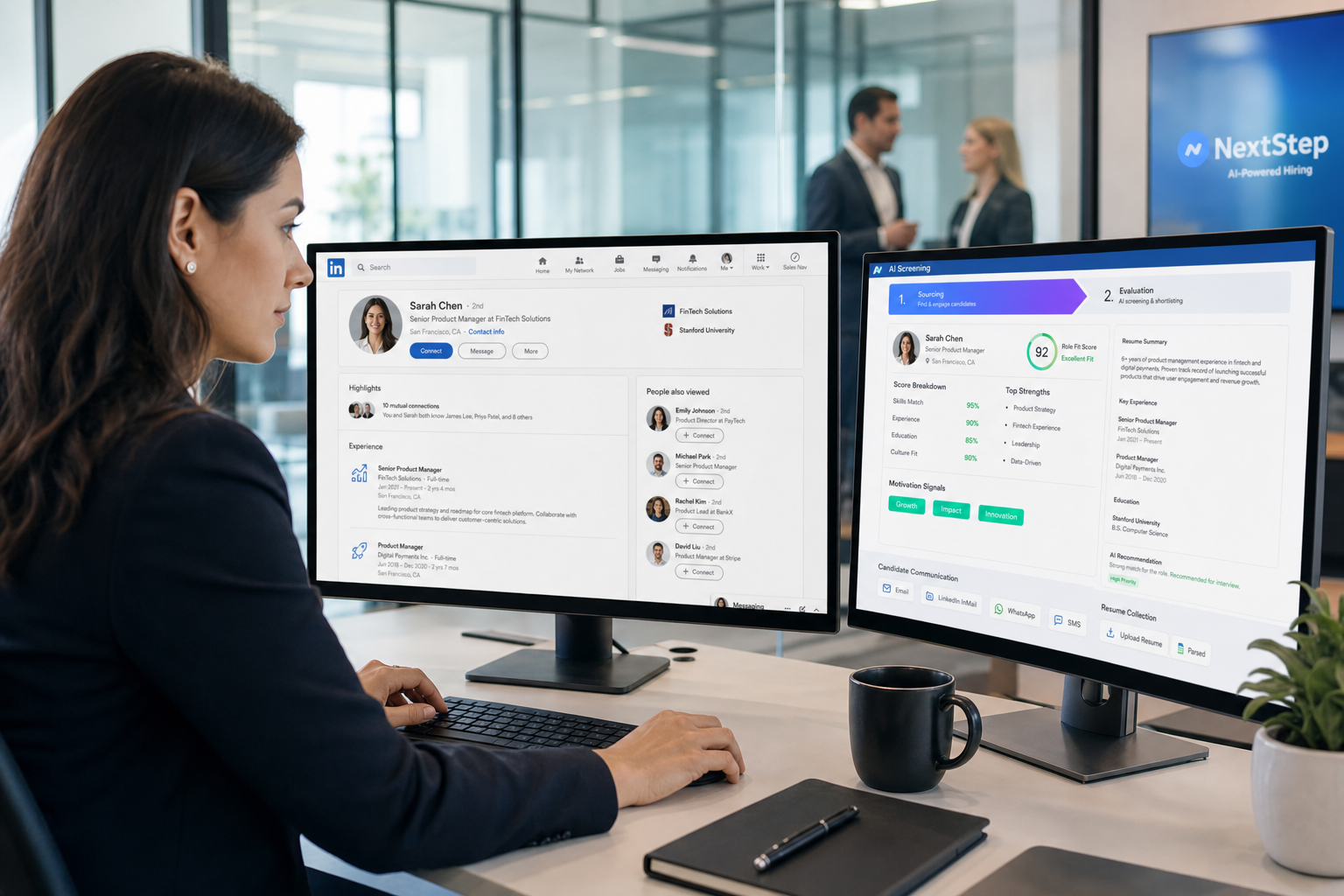
Use this guide to judge candidate ai by whether it catches motivation and role-fit tradeoffs before noisy shortlists waste recruiter time.
Without that discipline, fast screening creates a different kind of drag. Agency recruiters lose time chasing half-qualified applicants, in-house teams advance people who fit the resume but not the role, and hiring managers get frustrated when the shortlist does not match the real business need. The damage is not only operational. Candidate trust drops, internal alignment gets harder, and every disputed rejection becomes more difficult to explain.
In my own workflow, tools that reduce repetitive outreach and intake can help before formal evaluation begins, especially when the problem is inconsistent early conversations rather than final assessment. I have used StrategyBrain AI Recruiter to keep LinkedIn replies moving after hours, collect resumes from interested candidates, and handle multilingual first-touch communication more consistently. That kind of support matters when recruiters are sorting opportunity-fit signals at scale, but the recruiter still has to review the resume, judge relevance, and decide whether the candidate should enter an ai screening stage.
The same tension shows up in a familiar career-move scenario. A finance professional has spent a few years in public accounting, survived enough busy seasons, and starts asking what comes next. Stay at the firm and keep climbing. Move to a large company for structure, mentorship, and steadier progression. Join a startup for faster growth, broader ownership, and direct exposure to leadership. Before any interview happens, that person is already weighing stability against upside, support against autonomy, and a defined path against a role that may change every quarter.
For recruiters, that moment is not just career storytelling. It is a screening problem. If your process cannot tell the difference between a candidate who wants enterprise stability and one who wants startup velocity, your shortlist gets noisy fast. The same applies when an interview with artificial intelligence is introduced too early or without context. Good ai screening should help surface motivation, role fit, and job-related evidence in a structured way, not flatten very different career choices into one generic score.
- Why context matters in AI candidate screening
- What candidate ai means in practice
- What the public-accounting-to-industry decision teaches recruiters
- Sourcing AI vs screening AI
- How ai screening works in a real hiring process
- Where an interview with artificial intelligence fits
- Benefits for recruiters and hiring teams
- Bias, access, and compliance risks
- How to set up responsible screening
- FAQ
Why Context Matters in AI Candidate Screening
One of the biggest mistakes I see is using AI-assisted hiring as if every applicant is solving the same problem. They are not. Some are trying to leave a narrow specialist track for a broader role. Some want stable processes, defined promotion paths, and established benefits. Others are willing to accept more volatility because they want direct ownership and faster advancement. If screening does not capture that decision context, recruiters end up reviewing people against a role they would never actually accept.
That is why AI candidate screening should start with the question behind the application, not only the data inside it. A resume can show technical fit, but it rarely explains whether the candidate wants a large team with mentorship, a smaller company with less structure, or a client-facing path with commercial upside. In practice, candidate ai is most useful when it helps recruiters organize those signals before they become wasted interviews.
This is also where I see the value of support tools on LinkedIn. In high-volume searches, candidates often reply outside business hours, ask basic role questions in different languages, or delay sending resumes until someone follows up. In those situations, I have found that AI Recruiter can keep the conversation alive long enough to gather resumes and contact details while I reserve my time for actual screening judgment. It does not replace evaluation. It protects the top of funnel from going stale.
What Candidate AI Means in Practice
AI candidate screening refers to software models, automation rules, or structured analysis that help a recruiting team review applicants against job-related criteria. Depending on the workflow, the system may summarize resumes, map evidence to required skills, rank applicants for review, flag missing qualifications, or support an early structured assessment step.
In legal and policy discussions, some of these tools fall under the broader category of automated employment decision tools, often shortened to AEDT. Recruiters do not need to turn every conversation into a compliance seminar, but they do need to understand a basic distinction: if a tool influences who advances, who is deprioritized, or who is rejected, then governance matters.
From an operating standpoint, the best candidate ai setups do three things well:
- They tie outputs to job-related criteria, not vague ideas of fit.
- They keep a human reviewer in the loop, especially before consequential decisions.
- They preserve documentation, so the team can explain what happened later.
That last point becomes much easier when screening is connected to an ATS. Recruiters need one record of the requisition, knockout logic, scorecards, notes, and disposition path. Otherwise, AI outputs sit in one tool, candidate communication sits somewhere else, and nobody can reconstruct why a decision was made.
What the Public-Accounting-to-Industry Decision Teaches Recruiters
The reference scenario behind this article is not about recruitment software at all. It is about a professional asking a familiar question: after earning credentials and spending a few demanding years in public accounting, what does life after the firm look like? The options are clear enough on paper. A large enterprise offers mentorship, stability, and a defined path, but growth can be slower and access to senior leadership more limited. A startup offers room to learn, broader ownership, and potentially much faster advancement, but role volatility is real and support structures may be thinner.
That is exactly the kind of tradeoff recruiters should be screening for. If the role sits inside a mature enterprise, candidates drawn to ambiguity and rapid reinvention may lose interest once they understand the pace. If the role sits inside a startup or scale-up, candidates who want a carefully managed development ladder may struggle once they realize there is no blueprint and no large finance department to lean on.
The useful lesson is that screening quality improves when recruiters identify the candidate's decision criteria early. In other words, the strongest process does not only ask, "Can this person do the job?" It also asks, "Why would this person choose this environment over another?" That is where AI-assisted pre-screening can help organize patterns, but only if the workflow is designed around real career choices rather than generic matching.
Practical takeaway: The better your screening process understands why a candidate would choose enterprise, startup, or partner-track style work, the fewer wasted interviews you create downstream.
Sourcing AI vs Screening AI
Another common source of confusion is treating sourcing AI and screening AI as the same category. They are not. Sourcing tools help recruiters discover people, send outreach, manage first contact, and gather expressions of interest. Screening tools help evaluate whether the person should move forward.
This distinction matters because the risk profile changes. A sourcing workflow may help surface people who match a search, but a screening workflow can shape who gets advanced or rejected. That is why I separate the two operationally. If I am using automation in LinkedIn messaging, I want it to help with response speed, basic qualification, and resume collection. If I am using AI in screening, I want tighter controls, stronger documentation, and clearer reviewer accountability.
That separation is one reason I do not treat early outreach automation as a hidden evaluation layer. When I used StrategyBrain AI Recruiter on LinkedIn-heavy searches, the value was in handling repetitive first-contact tasks, confirming candidate interest, and collecting resumes while I stayed focused on the actual assessment. That is sourcing support. The final qualification still happens when the recruiter reviews the profile against the role.
How AI Screening Works in a Real Hiring Process
Most good AI screening workflows are less dramatic than the marketing suggests. They are really about imposing order on high-volume review. A sensible process usually looks like this:
- Define the role in business terms. Is this job best for someone who wants enterprise stability, startup breadth, or a client-facing growth path? Clarify the operating environment, not just the task list.
- Set must-have and preferred criteria. Separate essential qualifications from nice-to-have background markers.
- Collect structured inputs. Use applications, screening questions, resumes, and any role-relevant candidate assessment prompts.
- Run AI-assisted review. Let the system summarize fit, map evidence, or place applicants into review queues.
- Apply human judgment. A recruiter checks for motivation, environment match, edge cases, and false negatives.
- Advance with purpose. Move selected applicants to recruiter screen, live interview, or another structured stage.
- Retain records. Keep notes, scorecards, and decisions in a central system.
Notice what is missing from that list: blind trust in automation. In the real world, the recruiter still needs to interpret career signals. A public-accounting candidate considering industry roles is not only choosing a title. They are choosing how fast they want to grow, how much structure they need, and whether direct exposure to senior leadership matters to them. Good screening captures that.
Where an Interview With Artificial Intelligence Fits
The phrase interview with artificial intelligence can mean several different things, and candidates often assume it means a machine is deciding their future. Usually, it refers to an early-stage asynchronous interview, a structured AI-led prompt sequence, or an AI-assisted review layer before a human conversation.
Used carefully, this stage can help when volume is high, schedules are difficult, or the hiring team wants consistency in the first round. But it should only be used when the team can answer basic questions clearly:
- What is being evaluated?
- Is the tool scoring, summarizing, or only organizing responses?
- What data is being analyzed?
- When does human review happen?
- What accommodation path exists if the format creates a barrier?
My rule is simple: if the team cannot explain the stage in plain English, it is not ready to use. For roles where candidate motivation matters as much as technical fit, an AI interview step should never become a black box. It should support structured evidence gathering, not hide judgment behind automation language.
Benefits for Recruiters and Hiring Teams
When screening is designed well, AI can improve both speed and quality. The value is not removing recruiters. The value is giving recruiters better control over repetitive review while preserving the nuance of human hiring decisions.
- Faster triage: Large applicant pools can be sorted more quickly.
- Better consistency: Candidates are reviewed against the same criteria instead of each recruiter improvising.
- Cleaner prioritization: Recruiters can focus on applicants who need human attention first.
- More relevant interviews: Screening can identify environment fit before the hiring manager spends time on a call.
- Stronger documentation: Notes and reasons for progression can be retained more clearly.
In practical recruiting terms, that means fewer wasted interviews with candidates who want the opposite of what the role offers. The public-accounting-to-industry example illustrates this well. A person looking for mentorship, slower change, and a defined ladder is screening a company just as the company is screening them. Good candidate ai helps recruiters respect that two-way evaluation instead of treating every application like a one-directional funnel.
Bias, Access, and Compliance Risks
Every serious discussion of ai screening needs to address risk. Faster review is useful only if the process remains fair, explainable, and accessible.
Bias and adverse impact
If the workflow disadvantages certain groups, the fact that a model or automation rule produced the output does not make the result defensible. Recruiters should ask what evidence is being used, whether it is job-related, and how impact is monitored.
Accessibility and accommodation
An AI screening interview or video-based step can create barriers for some candidates. Teams need an accommodation process, an alternative path, and someone accountable for handling it.
Transparency
Candidates increasingly expect to know whether AI is involved, what data is being analyzed, and whether a human reviews the outcome. Internal users need the same clarity. Hiring managers should not treat a system score as self-explanatory.
Compliance and AEDT governance
Public discussions around AEDT rules, including bias audits and candidate notice requirements, have made one point very clear: if automation affects hiring decisions, documentation matters. Even outside jurisdictions with specific local requirements, many teams now use the same standards as a practical baseline.
This is another reason to keep sourcing automation and screening judgment separate. Communication support on LinkedIn can be helpful, but once the workflow starts influencing selection decisions, the governance standard needs to rise quickly.
How to Set Up Responsible Screening
If you want AI candidate screening to work in practice, start with process design rather than software enthusiasm. Here is the setup I recommend:
- Define the business context of the role. Clarify whether the environment is enterprise, scale-up, client-service heavy, or something else. This comes directly from the lesson in the opening case.
- Build role-specific criteria. Use skills, competencies, and essential requirements rather than vague culture language.
- Separate sourcing support from evaluation. Keep outreach automation from quietly becoming rejection logic.
- Keep recruiters in the loop. Human reviewers should confirm matches and review exceptions before next-step decisions.
- Prepare candidate explanations. Be able to describe the process, including any AI-assisted stage, in plain language.
- Plan accommodations. Offer alternatives where needed.
- Review outcomes over time. Look for false negatives, inconsistent progression, and patterns that suggest unfair impact.
That operating model works best when the recruiting team is disciplined about systems. The ATS should hold the requisition logic, scorecards, notices, disposition reasons, and reviewer notes. If your records are spread across inboxes, spreadsheets, and disconnected tools, even a good screening model becomes difficult to govern.
How I Use AI Support Without Handing Over Judgment
My own view is shaped by day-to-day recruiting work, especially on searches where LinkedIn is the highest-friction part of the funnel. Candidates respond late, switch languages, ask basic role questions before sending a resume, and disappear unless someone follows up quickly. In those cases, I have used AI Recruiter as a practical sourcing assistant rather than a decision-maker. It keeps conversations moving, gathers resumes from interested candidates, and captures contact details so I do not lose momentum between outreach and real screening.
What I like most in that setup is the boundary. The tool can handle repetitive first-touch communication and help me maintain coverage across time zones, but it does not remove my responsibility to assess whether a former public accounting candidate is truly suited to a startup finance role, a large-company controllership track, or a more client-facing path. That distinction sounds small, but in recruiting operations it is everything.
For headhunters and lean in-house teams, that kind of support is especially useful when workload spikes but standards cannot drop. If you want to see how that sourcing layer is framed, the public product material around AI Recruiter is useful mainly because it keeps the recruiter responsible for the final resume review and next-step decision. That is the right division of labor.
FAQ
What is AI candidate screening?
It is the use of software models, rules, or automated analysis to help review applicants against job-related hiring criteria. Depending on the system, it may summarize resumes, rank candidates for review, or support a structured early assessment stage.
How is candidate ai different from sourcing automation?
Candidate ai in screening influences evaluation and progression decisions. Sourcing automation helps with discovery, outreach, first contact, and resume collection. The governance requirements for screening are much higher.
Is an interview with artificial intelligence always fully automated?
No. It usually means an asynchronous or AI-assisted early interview step. The important questions are what is being analyzed, whether candidates are scored, and when a human reviewer becomes involved.
Can ai screening replace recruiters?
No responsible team should position it that way. Recruiters still define the criteria, interpret context, review edge cases, communicate with candidates, and make or support the final decision.
What should recruiters screen for beyond resume fit?
They should screen for environment fit, career motivations, willingness to accept the actual operating model of the company, and whether the candidate's goals match the role's reality. That is the main lesson from the public-accounting-to-industry decision framework used in this article.
What data might AI candidate screening analyze?
Depending on the workflow, it may analyze resumes, application forms, screening questions, candidate assessment responses, and in some cases audio or video from an AI-assisted interview stage.
Conclusion
The best AI candidate screening processes do not start with automation. They start with a more disciplined question: what is this candidate actually choosing, and what is this role really offering? The public-accounting-to-industry example makes that clear. Candidates are evaluating stability, growth speed, mentorship, leadership access, and role volatility long before a recruiter logs a disposition code.
That is why strong candidate ai workflows keep humans responsible for judgment while using technology to support consistency, documentation, and scale. Done well, ai screening helps recruiters organize evidence and reduce noise. Done poorly, it hides weak process design behind software language. And whenever an interview with artificial intelligence enters the process, the same rule applies: the technology may assist, but the hiring team still owns the decision.