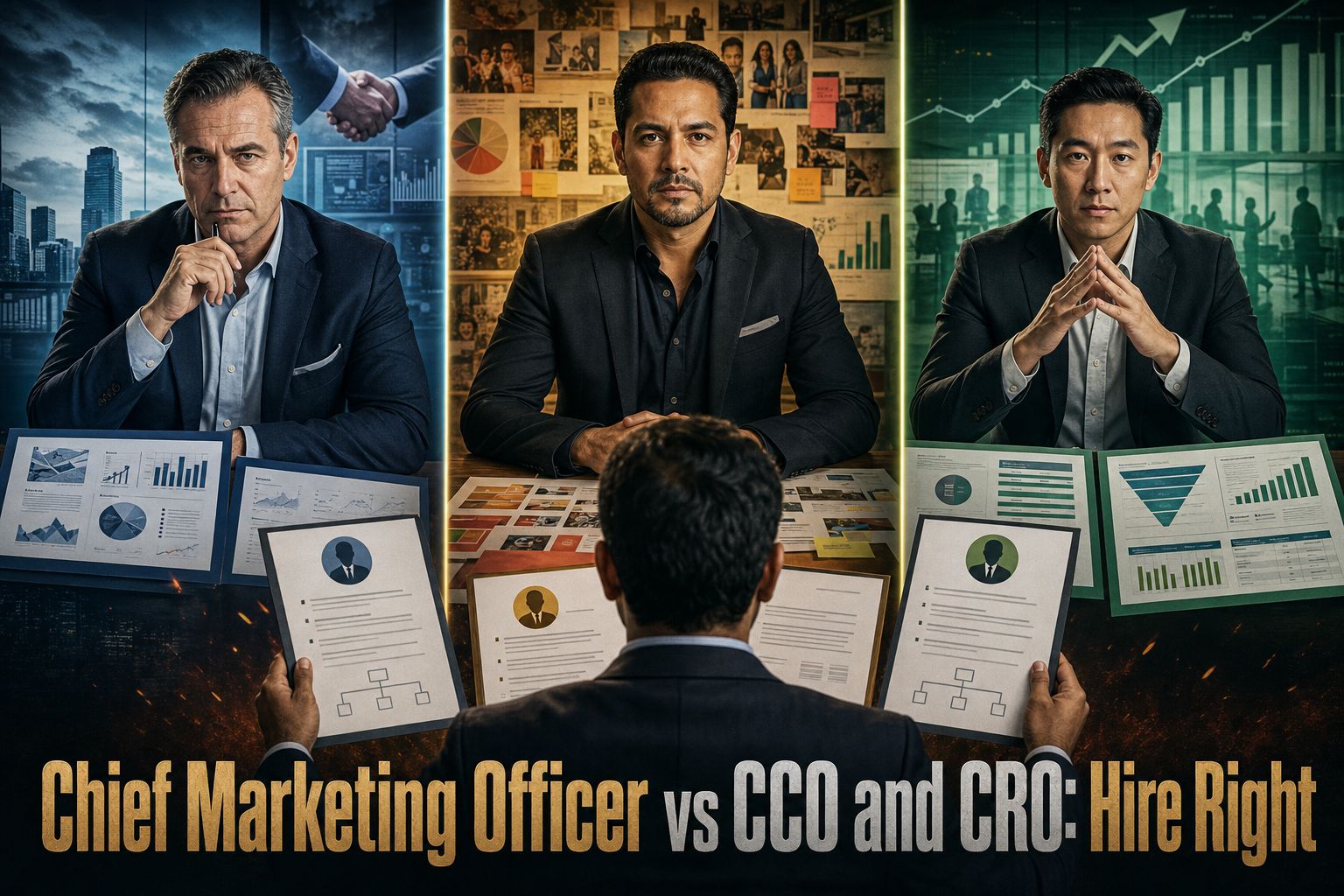
Recruiters can assess a chief marketing officer mandate before outreach and avoid candidates mismatched on scope and authority.
When those details are missing, an executive search can attract candidates whose experience matches the title but not the actual mandate. Independent headhunters lose outreach time, smaller search firms risk damaging client confidence, and corporate recruiters may advance finalists who expect control over functions that the employer never intended to assign.
A recruitment automation system can help by delivering consistent role information, responding to initial candidate questions, and collecting contact details or résumés from interested prospects. It is most useful when the underlying brief is already accurate; the recruiter must still assess each résumé, test leadership evidence, manage sensitive conversations, and decide who should progress.
Consider the moment a recruiter prepares a social hiring post for a chief marketing officer opening. The recruiter reviews the requisition, places the executive title prominently, confirms whether the position is office-based or remote, summarizes the relevant benefits, and adds a direct application route. Before publishing, however, the recruiter notices that the brief never says whether the CMO controls demand generation, reports to a chief commercial officer, or shares revenue accountability with a CRO.
That discovery exposes a larger executive-search problem: a clear job advertisement cannot compensate for an unclear operating model. To define chief marketing officer requirements—and distinguish a genuine CMO appointment from a CCO, CRO, or senior marketing role—the hiring team must establish functional scope, decision rights, reporting lines, business context, and measurable outcomes before promoting the opportunity.
Table of Contents
- CMO vs CCO vs CRO at a Glance
- How to Define Chief Marketing Officer
- What an Executive Job Message Must Include
- What a Chief Commercial Officer Owns
- How a Chief Revenue Officer Differs
- CMO vs VP of Marketing vs Marketing Director
- Which Executive Should You Hire?
- Executive Recruiting Scorecard and Process
- Common Hiring Mistakes
- Frequently Asked Questions
CMO vs CCO vs CRO at a Glance
The most reliable distinction is the business system each executive owns. A chief marketing officer leads market understanding, positioning, brand, and demand capability. A chief commercial officer integrates a broader set of commercial functions, while a chief revenue officer governs the connected process that turns demand into new, retained, and expanded revenue.
| Comparison Area | Chief Marketing Officer | Chief Commercial Officer | Chief Revenue Officer |
|---|---|---|---|
| Primary mandate | Translate customer and market insight into positioning, brand strength, demand, and growth priorities | Coordinate sales and wider commercial performance, often with responsibility for pricing and profitability | Manage the revenue lifecycle from acquisition and conversion through retention and expansion |
| Typical scope | Marketing, brand, communications, demand generation, customer insight, channels, and marketing operations | Sales, business development, pricing, partnerships, key accounts, and sometimes marketing | Sales, revenue operations, forecasting, customer success or retention, and sometimes demand generation |
| Key decisions | Positioning, segmentation, marketing investment, channels, brand standards, and customer-data use | Commercial priorities, pricing direction, account strategy, partnerships, and resource allocation | Pipeline governance, revenue process, forecasting, conversion, retention, and expansion |
| Typical reporting line | Usually the CEO, although the role may report to a CCO | Usually the CEO | Usually the CEO |
| Common measures | Brand health, qualified demand, acquisition contribution, channel performance, and marketing return | Sales growth, margin, pricing performance, account growth, and commercial profitability | Revenue growth, pipeline coverage, conversion, forecast accuracy, retention, and expansion |
| Best fit | A business needing stronger positioning, insight, brand leadership, or demand capability | A business needing integrated leadership across sales and other commercial functions | A business needing one owner for its complete revenue engine |
Recruiting principle: Start the search with the mandate, not the title. Document the decisions the executive can make, the teams under the role, and the outcomes for which the person will be accountable.
How to Define Chief Marketing Officer Responsibilities
To define chief marketing officer accurately, look beyond advertising, campaigns, and communications. The CMO is the senior executive who turns market knowledge and customer evidence into enterprise positioning, demand strategy, brand value, and informed growth choices.
CMO stands for chief marketing officer. The search variation CMO officer is commonly used but technically redundant because the final letter already means officer. Employers can include the abbreviation naturally in a description, but the formal title should remain chief marketing officer or CMO.
Core responsibilities of a modern CMO
- Market strategy: Identify priority markets, segments, customer needs, and competitive positions.
- Brand leadership: Establish how the organization is understood and differentiated.
- Demand generation: Develop qualified demand and coordinate the handoff between marketing and sales.
- Customer insight: Convert research, customer feedback, and behavioral evidence into business decisions.
- Marketing analytics: Evaluate investment, channel performance, attribution limits, and contribution to growth.
- Customer-data governance: Help define responsible collection, management, and use of customer information.
- Marketing technology: Guide the systems used for analysis, execution, measurement, and customer engagement.
- Channel strategy: Determine how direct, digital, partner, and other channels support market access.
- Cross-functional leadership: Align marketing decisions with sales, product, finance, operations, and technology.
A credible CMO candidate should be able to show how customer or market evidence changed an enterprise decision. Managing a large campaign is useful experience, but it is not by itself proof that the person can set company-level priorities, allocate major resources, or influence executive peers.
What an Executive Job Message Must Include
The opening scenario illustrates why job promotion should be treated as a final validation step rather than the beginning of role design. Whether the opportunity appears on a careers page, a professional network, or another social channel, four basic elements determine whether the right people understand it quickly.
1. A precise and visible title
Place the role name where candidates can identify it immediately, but do not expect the title to carry the full meaning. If the position is called CMO while sales, pricing, partnerships, and account management all report to it, the description must explain that unusually broad commercial mandate.
2. Location and working arrangement
State the office location, required travel, remote-work conditions, and geographic scope. For an executive appointment, location can also affect access to the CEO, leadership team, customers, and board. A vague remote label may conceal expectations that materially change the opportunity.
3. Relevant benefits and opportunity value
Describe the aspects of the role that matter to an executive candidate: strategic authority, team scope, transformation mandate, resources, reporting access, and development opportunity. Standard benefits remain relevant, but they should not replace an explanation of why the role exists and what the executive can genuinely influence.
4. A direct next step
Give candidates an unambiguous application or contact route. For confidential searches, this may be a conversation with the recruiter rather than a public application form. The recruiter should also be prepared to explain the mandate consistently before requesting sensitive career information.
Executive hiring post framework
Headline: Lead our market strategy as Chief Marketing Officer
Message: We are seeking a CMO to own market positioning, customer insight, brand strategy, and demand generation. The role reports to the CEO, leads the marketing organization, and works closely with sales and product leadership. Include the location or remote arrangement, the relevant benefits, and the strategic reason for the appointment.
Next step: Apply or contact the named recruiter through the stated route.
This framework is intentionally simple. It will not solve an unresolved reporting structure, ambiguous authority, or disagreement about whether the business actually needs a CMO, CCO, or CRO.
What a Chief Commercial Officer Owns
A chief commercial officer usually coordinates a wider range of revenue-producing and profit-influencing functions than a typical CMO. The remit commonly includes sales, pricing, key accounts, partnerships, and business development. Marketing may report to the CCO, but that arrangement is not universal.
The central distinction is breadth. A chief marketing officer leads marketing capability and market-facing strategy. A CCO balances growth with sales execution, pricing discipline, strategic-account performance, partnerships, and commercial profitability.
A CCO may be appropriate when:
- Sales, partnerships, pricing, and business development operate as disconnected functions.
- Major accounts require coordinated executive ownership.
- Commercial priorities conflict across regions, channels, or customer groups.
- The CEO needs one leader to resolve trade-offs between growth, margin, and pricing.
- Marketing and sales need closer alignment under a broader commercial structure.
Before approaching candidates, recruiters should confirm whether marketing reports directly to the CCO. A sales-led CCO with indirect influence over marketing requires a different background from an executive expected to lead the entire commercial organization.
How a Chief Revenue Officer Differs
A chief revenue officer owns the operating system that produces revenue across the customer lifecycle. The role generally connects acquisition, pipeline development, conversion, forecasting, retention, and account expansion. It is consequently more focused on revenue-process integration than the typical chief marketing officer position.
The distinction between CCO and CRO is sometimes narrow. A CCO often has a wider commercial and profitability mandate that includes pricing, partnerships, and strategic accounts. A CRO is more likely to concentrate on making every stage of the revenue engine measurable, connected, and accountable.
Questions that indicate a true CRO mandate
- Will the executive own revenue from both new and existing customers?
- Who controls pipeline definitions, forecasting, and revenue operations?
- Does the role have authority over retention and expansion?
- Do sales, customer success, and parts of marketing report to this executive?
- Is the primary problem fragmented revenue execution rather than weak market positioning?
If the executive is accountable only for closing new business, the opening may be a senior sales position rather than a genuine CRO appointment. The hiring message should not inflate the title to compensate for limited authority.
CMO vs VP of Marketing vs Marketing Director
The chief marketing officer differs from a vice president of marketing or marketing director primarily through enterprise influence and strategic accountability. A CMO participates in company-level decisions; vice presidents and directors more often execute an established strategy within a defined function, region, or business unit.
| Role | Typical Focus | Organizational Influence | Evidence to Seek |
|---|---|---|---|
| Chief marketing officer | Enterprise market strategy, insight, brand, demand, and growth contribution | C-suite participation and cross-functional decision authority | Examples of shaping strategy, allocating major resources, and influencing executive peers |
| VP of marketing | Leadership and execution across several marketing disciplines | Senior functional influence, often under a CMO or commercial executive | Examples of scaling teams, channels, operating plans, and performance systems |
| Marketing director | Execution within a market, region, channel, or discipline | Departmental or business-unit influence | Examples of program delivery, team management, and specialist expertise |
Company size does not settle the question. A smaller organization may need a genuine CMO when marketing must influence enterprise strategy. A large company may appropriately use a VP title when another executive retains the final strategic authority.
Which Executive Should You Hire?
Choose a CMO when marketing needs enterprise leadership
Hire a chief marketing officer when the business needs stronger positioning, customer insight, segmentation, brand leadership, channel development, or demand capability. The role is particularly relevant when marketing must become a strategic contributor rather than a campaign service for other departments.
Choose a CCO when commercial functions need integration
Hire a chief commercial officer when sales, pricing, partnerships, business development, and key accounts require coordinated leadership. A CCO is also appropriate when one executive must balance growth with margin and commercial profitability.
Choose a CRO when the revenue lifecycle needs one owner
Hire a chief revenue officer when acquisition, conversion, retention, and expansion are fragmented. The CRO needs enough authority to align measurement, forecasting, revenue operations, and functional handoffs across the customer lifecycle.
Consider more than one executive role
A company can appoint both a CMO and CCO, or both a CMO and CRO, when the mandates are genuinely distinct. For example, the CMO might own insight, positioning, brand, and demand strategy while the CCO owns sales, pricing, partnerships, and key-account performance.
Before opening either search, the CEO and HR leader should agree on which executive makes the final decision in each area. Shared growth goals can encourage collaboration, but shared goals do not eliminate the need for clear authority.
Executive Recruiting Scorecard and Process
An accurate role brief makes both personal outreach and public job promotion more effective. It also gives recruiters a defensible basis for comparing candidates whose previous titles may conceal very different levels of authority.
- Define the business problem. State what must change and why the problem requires C-suite leadership.
- Map the functions. Identify every team reporting directly or indirectly to the executive.
- Document decision rights. Clarify who approves positioning, pricing, budgets, channels, technology, hiring, and account strategy.
- Confirm the reporting structure. Record the direct manager, executive peers, board exposure, and matrix relationships.
- Establish the business context. Explain the long-term growth strategy, customer model, competitive position, commercial constraints, and leadership culture.
- Select mandate-specific outcomes. Choose measures that reflect the real job instead of copying another employer's description.
- Build evidence-based interviews. Ask candidates to describe decisions, authority, stakeholder resistance, trade-offs, and lessons learned.
- Validate the candidate message. Ensure the title, location, opportunity value, benefits, and next step accurately reflect the approved mandate.
Questions for CMO candidates
- When has customer evidence changed an enterprise-level decision you influenced?
- How do you balance long-term brand development with near-term demand requirements?
- Which decisions should belong to the CMO, and which should be shared with sales or product?
- How have you governed analytics, customer data, marketing technology, or automated tools?
- How do you assess marketing's contribution when several functions influence the outcome?
Questions for CCO or CRO candidates
- Which commercial or revenue functions have you directly controlled?
- How have you resolved competing priorities across sales, marketing, pricing, and customer teams?
- What authority is essential if you are accountable for commercial or revenue performance?
- How do you distinguish pipeline activity from reliable revenue visibility?
- How have you managed acquisition, retention, and expansion as a connected system?
Score the evidence rather than the candidate's fluency with executive terminology. Strong answers explain the operating context, the person's actual authority, the decision made, the cross-functional trade-offs, the outcome, and what the candidate would do differently.
Common Hiring Mistakes
Choosing the title before defining the problem
A title-first search produces an unfocused candidate pool and makes the eventual job message harder to write. Decide whether the company needs marketing leadership, commercial integration, or revenue-system ownership first.
Assuming titles are standardized
CMO, CCO, and CRO titles do not reliably indicate scope. Compare team ownership, reporting lines, budgets, decision authority, and performance measures across each candidate's previous roles.
Advertising before resolving internal disagreements
A polished social post can generate attention, but it cannot answer questions the leadership team has avoided. Resolve who owns marketing, sales, pricing, retention, and customer data before outreach begins.
Giving accountability without authority
A CMO cannot reasonably own demand performance without influence over budget, channels, data, and sales alignment. The same principle applies to a CCO or CRO held responsible for outcomes controlled by other executives.
Confusing shared KPIs with shared decisions
Several executives can contribute to growth, retention, or acquisition. The organization must still identify who has final authority over each stage and how disagreements will be resolved.
Automating an inaccurate message
Automation can extend outreach and improve response handling, but it also distributes unclear information more efficiently if the brief is wrong. Recruiters must approve the source material, monitor candidate questions, and retain responsibility for assessment and progression decisions.
Frequently Asked Questions
What does CMO stand for?
CMO stands for chief marketing officer. The role normally owns marketing strategy, positioning, brand leadership, customer insight, demand capability, and marketing's contribution to growth. The phrase CMO officer is redundant, although people sometimes use it when searching.
What does a chief marketing officer do?
A chief marketing officer leads enterprise marketing strategy. Responsibilities commonly include market analysis, positioning, brand management, demand generation, customer insight, analytics, channel strategy, marketing technology, and cross-functional alignment.
Is a CCO higher than a CMO?
Not automatically. A CCO may oversee the CMO in a unified commercial structure, but the two can also be peer executives reporting to the CEO. Seniority depends on authority, reporting relationships, functional scope, and budget ownership.
Does a CMO report to a CCO?
A CMO can report to a CCO when marketing sits inside a broader commercial organization. Elsewhere, the CMO and CCO report separately to the CEO. The appropriate structure depends on whether marketing needs independent enterprise representation or tighter integration with sales and commercial operations.
What is the difference between a CMO and CRO?
The CMO owns market strategy, positioning, customer insight, brand, and demand capability. The CRO owns the connected revenue system, usually spanning acquisition, conversion, retention, and expansion. Any overlap should be resolved through documented decision rights.
Can a company have both a CMO and CCO?
Yes. The arrangement can work when the CMO owns insight, brand, positioning, and demand strategy while the CCO owns sales, pricing, partnerships, business development, and strategic accounts. Clear reporting lines and decision boundaries are essential.
What should a CMO job post include?
Include the title, location or working arrangement, reporting line, strategic mandate, functional scope, decision authority, relevant benefits, expected outcomes, and a clear application route. Avoid publishing until leadership agrees on how the CMO will work with the CCO, CRO, sales leader, and product organization.
Final Hiring Guidance
The right executive title follows the work. Choose a chief marketing officer when positioning, customer insight, brand, and demand capability need C-suite leadership. Choose a CCO when broader commercial functions require integration, and choose a CRO when one executive must own the complete revenue lifecycle.
Before launching the search or publishing a social hiring message, create a one-page mandate covering the business problem, functional scope, reporting line, location, budget ownership, decision rights, success measures, benefits, and candidate next step. That document gives recruiters a more accurate search profile and gives executive candidates a credible basis for evaluating the opportunity.