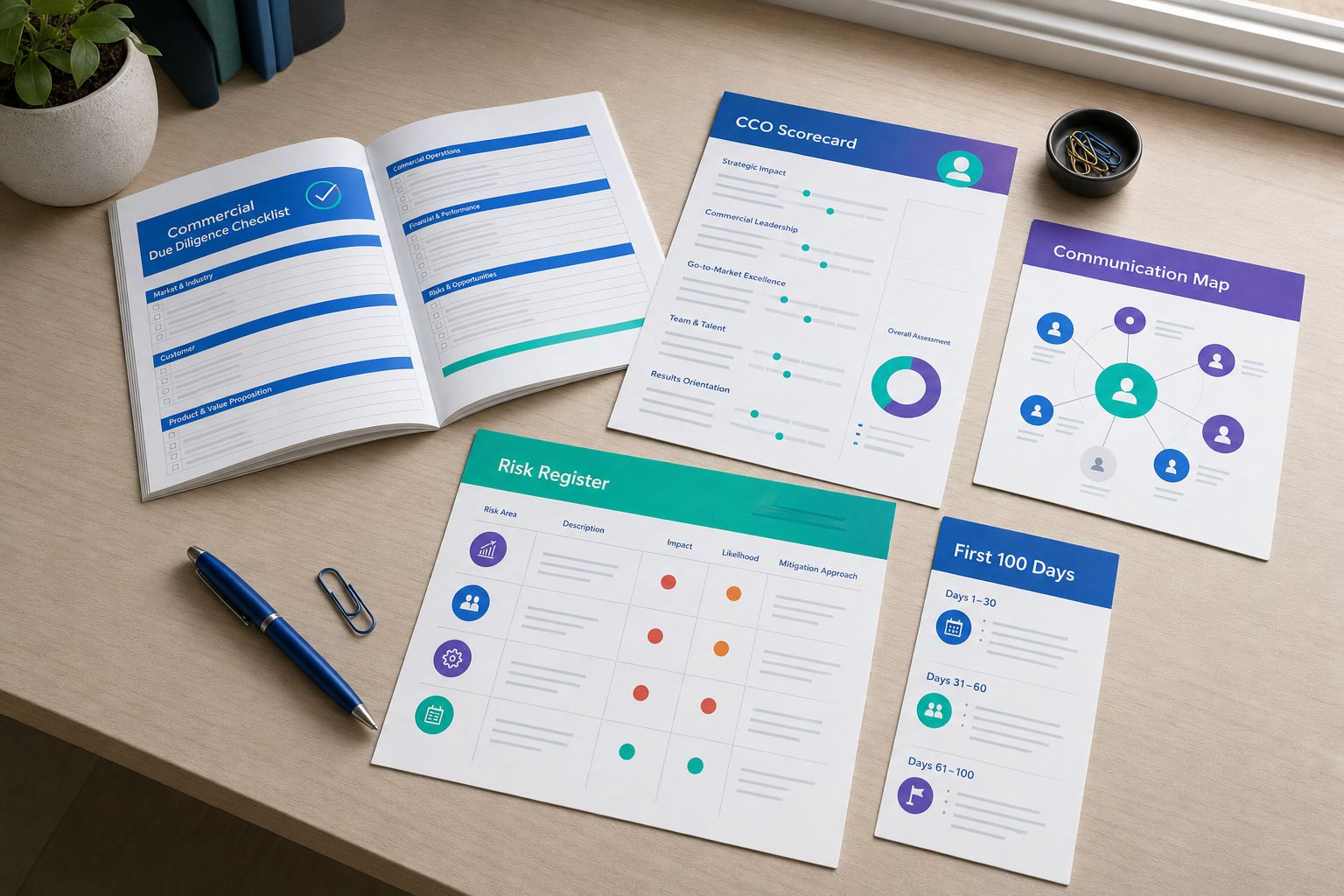
This framework helps headhunters translate commercial due diligence into precise CCO scorecards and avoid leadership mismatches.
Without that discipline, a boutique search firm may spend weeks approaching commercially impressive candidates who cannot operate in the target company’s environment. Internal recruiters face similar losses: unclear scorecards slow shortlisting, repeated clarification frustrates candidates, and misalignment between the board, deal team, and hiring manager can damage confidence in both the search and the transaction.
An AI-supported recruiting workflow can reduce part of that coordination burden by handling initial candidate outreach, maintaining follow-ups across languages and time zones, and collecting résumés and contact details from interested executives. It should support rather than replace professional judgment: the recruiter must still evaluate each résumé, investigate the candidate’s record, test leadership fit, and decide who advances.
Consider a Head of Talent who has spent two months in a remote-first company with colleagues distributed across Europe. While supporting a CCO search, she reviews the requisition list, follows up on unanswered candidate messages, and updates candidate stages before trying to train the team on a new assessment process. With only a few overlapping working hours, frequent check-ins begin to feel intrusive, yet written instructions leave important questions unresolved. Technical interruptions and missing non-verbal cues make it harder to tell whether colleagues understand the new process or are simply presenting confidence during video meetings.
This scene exposes more than a remote-work inconvenience. It shows why chief commercial officer consulting must connect commercial due diligence with communication design, decision rights, workforce capacity, and leadership readiness. A practical commercial due diligence framework—and, for sellers, credible commercial vendor due diligence—must test not only whether the growth thesis is attractive, but whether the organization can coordinate the work required to deliver it.
Table of Contents
- What commercial due diligence means for CCO advisory
- Why communication belongs in the diligence scope
- A commercial due diligence framework
- Buy-side and commercial vendor due diligence
- A decision-led diligence process
- Evidence and triangulation
- Decision-ready deliverables
- Turning findings into a CCO search
- The first 100 days
- Sector-specific considerations
- Deal and talent checklist
- Frequently asked questions
What Commercial Due Diligence Means for CCO Advisory
Commercial due diligence is a forward-looking assessment of whether market demand, customer behavior, competitive positioning, pricing, and commercial capabilities support a company’s plan and valuation. It asks which assumptions are credible, which remain unproven, and which could materially weaken future revenue or margin.
Chief commercial officer consulting and advisory take the analysis into execution. The findings should shape market priorities, customer segmentation, pricing governance, channel strategy, sales management, retention programs, revenue synergies, and the organization required to deliver them.
Practical principle: Diligence tests the growth thesis; CCO advisory converts the evidence into accountable commercial action.
For recruiters and HR leaders, this distinction changes the search brief. A mandate to “drive growth” says little about the actual work. The company may need a pricing-led operator, a market-entry strategist, a sales transformation leader, a retention specialist, or an integrator who can coordinate commercial teams across functions, countries, and time zones.
Why Communication Belongs in the Diligence Scope
A commercially sound plan can still fail when information moves slowly or ambiguously. This is especially relevant when the CCO will inherit distributed sales, marketing, customer success, pricing, and regional teams.
Missing non-verbal and informal signals
Colocated teams often resolve uncertainty through brief conversations and observable reactions. Distributed leaders receive fewer of those signals. A polished video meeting may hide disagreement, limited understanding, or an operational blocker that emerges only after the call.
Technology and process constraints
Collaboration tools enable remote work, but adding software does not create a communication model. New systems require training, clear ownership, compatible data definitions, and agreed rules about where decisions are recorded. Connection failures and fragmented platforms can also interrupt customer meetings, forecasting, and time-sensitive deal work.
Limited overlap across time zones
When colleagues share only a few working hours, an unresolved pricing exception or customer escalation can remain blocked for a full day. Diligence should therefore establish which decisions can be asynchronous, which require real-time discussion, and how urgent matters are escalated.
The commercial consequences
- Reduced clarity: conflicting instructions weaken accountability and forecast reliability.
- Lower trust: excessive check-ins may be perceived as micromanagement, while insufficient contact can leave employees unsupported.
- Slower execution: delayed decisions affect proposals, customer responses, hiring, and pipeline progression.
- Inconsistent market behavior: regional teams may apply different pricing, positioning, qualification, or account-management practices.
These are not merely cultural concerns. They influence revenue quality, sales productivity, customer retention, and the CCO’s ability to implement the value-creation plan.
A Practical Commercial Due Diligence Framework
An effective commercial due diligence framework connects market evidence with execution capacity. Each workstream should produce a transaction conclusion and a corresponding implication for leadership and talent.
| Framework area | Core diligence question | CCO and talent implication |
|---|---|---|
| Investment thesis | Which assumptions must hold for the plan and valuation to remain credible? | Define the outcomes and trade-offs the CCO must own. |
| Market size and growth | Where is addressable demand concentrated, and what could change it? | Determine whether market-entry, segmentation, or portfolio experience is essential. |
| Customer quality | How concentrated, loyal, profitable, and expandable is the customer base? | Prioritize key-account, customer-success, or retention leadership where exposure is high. |
| Competitive advantage | Why do customers choose the company, and how durable is that preference? | Assess whether candidates can turn differentiation into consistent market behavior. |
| Pricing | Does the business capture appropriate value, and where does discount leakage occur? | Test for pricing governance, value communication, and margin discipline. |
| Go-to-market performance | How productive are the channels, pipeline, conversion process, and account coverage? | Clarify whether the mandate is optimization, redesign, or a commercial build. |
| Communication model | How are decisions, feedback, forecasts, and escalations handled across the organization? | Evaluate distributed leadership, operating cadence, and cross-functional influence. |
| Expansion opportunities | Which segments, products, channels, or regions offer evidence-supported upside? | Match the executive’s experience to the specific expansion route. |
| Downside scenarios | What happens if growth, retention, pricing, or productivity falls below plan? | Look for evidence of leadership under constraints, not only during expansion. |
Executive search teams should translate these areas into a scorecard before approaching candidates. Evidence from each executive’s career should be matched to the risks, dependencies, and operating conditions identified in diligence rather than to title prestige alone.
Buy-Side vs Commercial Vendor Due Diligence
Buy-side and vendor reviews often examine similar evidence, but they serve different sponsors and decisions.
| Factor | Buy-side commercial due diligence | Commercial vendor due diligence |
|---|---|---|
| Sponsor | Prospective buyer or investor | Seller, management team, or selling shareholder |
| Primary objective | Test the target’s plan, valuation assumptions, risks, and upside | Prepare an independent buyer-lens assessment before or early in a sale |
| Perspective | Shaped by the buyer’s thesis and risk appetite | Designed to anticipate questions from multiple potential buyers |
| Typical output | Investment conclusions, risks, sensitivities, and post-deal priorities | Evidence-based equity story, prepared analyses, and transparent treatment of risks |
| Leadership relevance | Tests whether the current team can deliver the buyer’s plan | Identifies management dependencies that buyers are likely to challenge |
Commercial vendor due diligence should not be treated as promotional material. Its credibility depends on independent challenge, consistent definitions, transparent evidence, and a balanced explanation of strengths and weaknesses.
For talent teams, vendor work can reveal whether growth depends excessively on a founder, one senior salesperson, or a few account owners. It can also expose whether distributed teams operate through shared processes or rely on informal knowledge. Succession, management depth, and communication discipline may therefore become transaction issues rather than post-deal HR tasks.
A Decision-Led Commercial Due Diligence Process
The strongest process begins with the decisions that investors and leaders must make, not with indiscriminate data collection.
- Translate the thesis into testable questions. Identify the assumptions behind market growth, customer demand, pricing, retention, sales productivity, and expansion.
- Establish the full business context. Clarify the investment horizon, strategic priorities, target operating model, geographic scope, and long-term commercial goals. Without that context, teams may optimize local metrics while undermining the wider plan.
- Build an evidence map. Match each question to management information, market research, customer evidence, competitor insight, and commercial operating data.
- Test market and customer quality. Segment addressable demand, examine concentration and retention, and distinguish durable growth from temporary conditions.
- Assess competition, pricing, and go-to-market execution. Review alternatives, differentiation, price realization, discounts, pipeline quality, conversion, sales cycles, and channel productivity.
- Review communication channels and protocols. Determine where forecasts, customer decisions, project feedback, and pricing approvals are recorded and who can act on them.
- Separate asynchronous and synchronous work. Routine updates should be documented for flexible review; complex decisions and unresolved disagreements should move into focused meetings with a clear agenda.
- Assess managers and commercial capacity. Examine leadership depth, workforce capability, systems, incentives, decision rights, and the management routines required to execute the plan.
- Model upside and downside. Distinguish evidence-supported initiatives from hypotheses that require further validation.
- Convert findings into decisions. Produce investment conclusions, a risk register, a leadership scorecard, and priorities for the first 100 days.
HR and executive search leaders should participate before the final step. Early involvement helps them test whether the proposed CCO role has sufficient authority, peer support, data access, and organizational capacity.
Evidence Triangulation and Defensible Conclusions
No single source is sufficient. Management information may be detailed but shaped by internal definitions. Interviews provide depth but may not represent the wider customer base. Surveys provide breadth but depend on sound sampling and interpretation.
- Management data: revenue, margin, account, product, region, and channel performance.
- Customer interviews: buying criteria, satisfaction, alternatives, switching barriers, and emerging concerns.
- Competitor and expert perspectives: market structure, regulation, technology, and category change.
- CRM and pipeline records: stage conversion, velocity, forecast quality, opportunity source, and rep productivity.
- Cohort analysis: retention, churn, expansion, and behavior by acquisition period or segment.
- Pricing evidence: list prices, realized prices, discounts, renewals, packaging, and exceptions.
- Win-loss analysis: why opportunities convert, stall, or move to competitors.
- Operating evidence: meeting cadence, decision logs, escalation routes, handoffs, and response times.
Leadership assessment requires the same triangulation. A candidate’s account of growth should be tested against market conditions, team maturity, inherited pipeline, pricing authority, channel mix, customer concentration, and actual decision rights. Structured interviews and references should examine the same execution hypotheses rather than invite general endorsements.
Decision-Ready Diligence Deliverables
A useful report enables action. Dense analysis without clear implications makes it difficult for investors, boards, CCOs, and hiring teams to align.
- Addressable-market model: realistic demand segmented by customer, use case, geography, or channel.
- Voice-of-customer findings: buying criteria, satisfaction, unmet needs, and risks.
- Retention analysis: churn, repeat purchase, renewal, and expansion patterns.
- Pricing assessment: realization, discounting, packaging, willingness to pay, and governance gaps.
- Sales-funnel review: pipeline quality, conversion, velocity, forecast reliability, and channel contribution.
- Communication map: decision owners, information flows, meeting cadence, asynchronous records, and escalation paths.
- Growth roadmap: prioritized initiatives with owners, dependencies, and measurable outcomes.
- Risk register: evidence, potential impact, warning indicators, and mitigation options.
- Leadership implications: retention, succession, development, role redesign, and external hiring priorities.
Recruiters do not necessarily need access to every confidential transaction detail. They do need a sufficiently specific mandate—for example, strengthening price discipline, rebuilding forecast management, reducing account concentration, or integrating regional channels.
Turning Diligence Findings into a CCO Search
The diligence report should become a role-design document. A strong scorecard defines expected business outcomes, required capabilities, inherited conditions, decision rights, and the trade-offs the executive must manage.
Test execution evidence, not labels
“Led international growth” is a label. Useful evidence explains how the executive selected markets, allocated resources, adapted pricing, built channels, changed the team, established communication protocols, and responded when assumptions proved wrong.
Assess distributed leadership explicitly
If teams operate across locations or time zones, interviews should examine how the candidate balances written direction with live discussion. Relevant questions include:
- Which decisions should be documented and handled asynchronously?
- When does an issue require a synchronous meeting?
- How does the executive monitor performance without encouraging micromanagement?
- How are regional disagreements surfaced and resolved?
- How does the leader create psychological safety for employees to challenge assumptions?
Protect human judgment in technology-supported recruiting
Automation can assist with outreach, candidate responses, scheduling information, and record collection. Recruiters should retain responsibility for contextual résumé review, structured assessment, references, confidentiality, candidate experience, and the final recommendation. A faster workflow is useful only when the underlying scorecard is precise.
From Diligence to the First 100 Days
The first 100 days should protect the investment thesis, establish reliable commercial information, and create momentum without overwhelming the organization.
Days 1–30: Establish context and decision rules
- Confirm priority segments, customers, channels, and value-creation assumptions.
- Reconcile commercial definitions across finance, sales, marketing, and customer success.
- Publish decision rights for pricing, forecasting, account ownership, and escalation.
- Agree which communication channels hold formal decisions and project records.
Days 31–60: Diagnose and stabilize
- Protect at-risk customers and assign retention ownership.
- Review pipeline quality, forecast routines, and stalled opportunities.
- Examine price exceptions and discount approval practices.
- Use structured one-to-one and cross-functional meetings to surface blockers that written updates may conceal.
Days 61–100: Launch priority changes
- Sequence growth initiatives and revenue synergies.
- Clarify the commercial organization and workforce plan.
- Train managers on feedback, check-ins, and distributed decision-making.
- Link each initiative to revenue, margin, retention, or productivity outcomes.
The CCO should not be expected to solve every structural gap personally. If the plan requires improved data, new delivery capacity, or redesigned incentives, the board must provide authority and cross-functional support.
How the Framework Changes by Sector
Business-to-business software
Priorities may include recurring revenue quality, retention cohorts, product usage, pipeline conversion, pricing and packaging, channel contribution, and customer-success capacity. The CCO may need to integrate acquisition, expansion, retention, and forecasting across distributed teams.
Industrials and manufacturing
Key questions include cyclicality, customer concentration, specification advantage, distributor economics, price realization, service revenue, and production capacity. Commercial leadership must respect supply and service constraints while coordinating regional channels.
Consumer and retail
Diligence may emphasize segmentation, brand differentiation, channel economics, purchasing frequency, promotion dependency, retention, and margin management. The mandate may span brand, trade, digital, customer insight, and pricing.
Professional services and recruitment
Analysis often covers client concentration, repeat business, consultant productivity, pipeline quality, fee discipline, sector specialization, and key-person dependency. For recruitment businesses, the central question is whether growth is supported by a repeatable commercial system or concentrated among a few individual billers.
Commercial Due Diligence Checklist
- Is the investment thesis expressed as testable commercial assumptions?
- Is the addressable market segmented rather than presented as one headline figure?
- Are customer concentration, retention, churn, and expansion visible by cohort?
- Is differentiation supported by customer and win-loss evidence?
- Are price realization, discounting, packaging, and governance assessed?
- Are pipeline quality, conversion, sales cycles, and forecast reliability understood?
- Are communication channels, decision rights, and escalation routes explicit?
- Is asynchronous work documented precisely enough to prevent repeated clarification?
- Are live meetings reserved for complex decisions, alignment, and sensitive feedback?
- Are technology limitations and data fragmentation reflected in the execution plan?
- Are growth opportunities separated into supported, testable, and speculative categories?
- Are downside scenarios explicit?
- Does the CCO scorecard reflect the actual growth thesis and operating conditions?
- Are leadership gaps addressed through retention, development, succession, redesign, or hiring?
- Does the first 100-day plan assign owners and measurable outcomes?
Common Mistakes to Avoid
Treating the management plan as evidence
A plan is a set of claims to test. Market, customer, pricing, retention, and pipeline evidence should support each material assumption. Recruiters should apply the same discipline to candidate claims.
Assuming tools will resolve unclear communication
Technology can move information, but it cannot decide which channel to use, who owns a decision, or when a written exchange should become a live discussion. Protocols, training, and management behavior remain essential.
Using a standard CCO job description
Generic descriptions miss the transaction’s specific value-creation requirements. Build the role around diligence findings, decision rights, team maturity, geographic complexity, and execution dependencies.
Separating diligence from post-deal planning
Waiting until completion can cause context to disappear and hiring to begin too late. The growth roadmap, communication model, organization design, and talent implications should develop alongside the commercial conclusions.
Overlooking management capacity
An attractive market cannot compensate for insufficient leadership bandwidth, weak systems, ambiguous authority, or poor coordination. One senior hire is not a substitute for resolving structural capability gaps.
Frequently Asked Questions
What is the scope of commercial due diligence?
Commercial due diligence typically covers the investment thesis, market size and growth, customer behavior, concentration and retention, competition, pricing, go-to-market performance, expansion opportunities, commercial capabilities, and downside scenarios. Where distributed execution is material, it should also examine decision rights, communication routines, systems, and management capacity.
How does commercial due diligence affect a CCO search?
It converts broad growth expectations into specific outcomes and capabilities. The findings help recruiters define the mandate, build an evidence-based scorecard, test candidates against likely execution conditions, and identify whether additional hires or organizational changes are required.
What is commercial vendor due diligence?
Commercial vendor due diligence is an independent buyer-lens assessment commissioned for a seller. It evaluates the market, customers, competition, pricing, growth plan, and commercial risks while preparing management for likely buyer questions.
How does commercial due diligence differ from financial due diligence?
Financial due diligence examines historical financial quality and related risks. Commercial due diligence is primarily forward-looking: it tests whether market demand, customers, competition, pricing, and go-to-market capabilities support the plan. The two should connect because commercial assumptions influence revenue, margin, cash flow, and valuation.
What data is needed?
Useful inputs include management accounts, customer and product revenue, CRM records, pipeline metrics, retention cohorts, pricing and discount data, win-loss information, market research, interviews, surveys, and expert perspectives. Definitions must be reconciled before sources are compared.
When should HR or executive search become involved?
HR and executive search should participate once the principal commercial hypotheses and capability questions are clear, rather than waiting for the final report. Early involvement improves role scope, succession decisions, organization design, and hiring sequence.
How should confidentiality be managed?
Access should be limited to people with a legitimate need to know. Search briefs can describe the mandate, risks, operating conditions, and required capabilities without disclosing restricted transaction details or confidential counterparties.
Conclusion
Commercial due diligence should not end with a conclusion about market attractiveness or valuation. In chief commercial officer consulting and advisory, it should connect customer, competitive, pricing, and go-to-market evidence with the organization’s practical ability to communicate, decide, and execute.
For boards, investors, HR leaders, and headhunters, the central lesson is to define the CCO mandate from the commercial thesis. Test not only what candidates have achieved, but how they established context, coordinated distributed teams, chose between asynchronous and synchronous work, and delivered change under the conditions the target business actually faces.