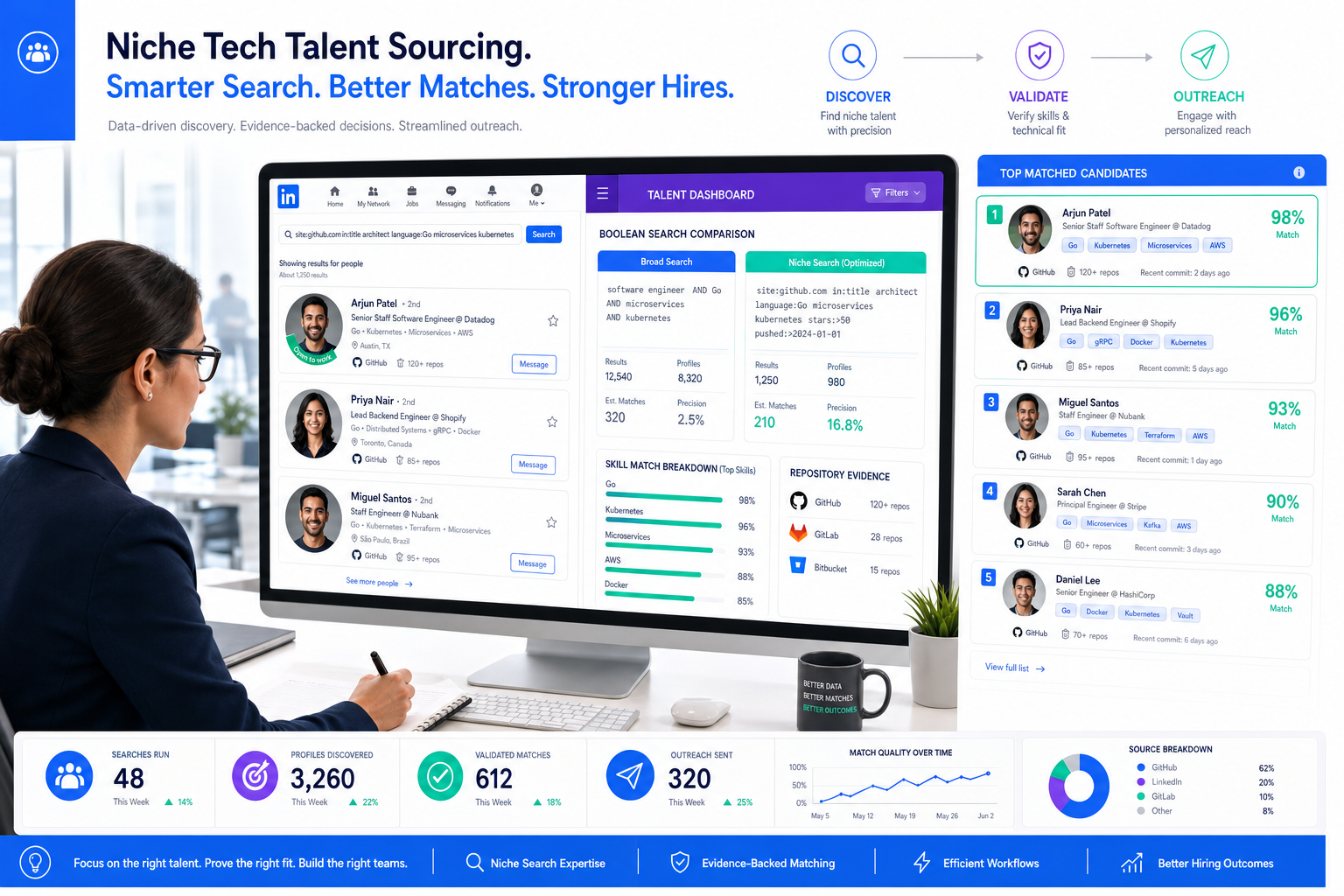
When weak shortlists come from patched searches, this article helps headhunters judge how sourcing tools identify candidates for niche tech stacks and avoid scaling broken search logic.
The recruiting damage usually starts when a hard search gets patched with shortcuts instead of rebuilt properly. A recruiter copies an old Boolean string, a founder asks for “more profiles by tomorrow,” someone exports another spreadsheet, and the team keeps layering manual fixes on top of a broken sourcing process. The result is familiar: weak shortlists, duplicated outreach, hiring-manager frustration, slower response times, and a search function that looks busy without getting more precise.
In that gap between quick fix and real process, I have found that StrategyBrain AI Recruiter can help on the outreach and qualification side when a search depends heavily on LinkedIn activity. What helped in practice was not handing over final judgment, but using its automated candidate messaging, after-hours follow-up, and multilingual communication to keep conversations moving while I stayed responsible for résumé review, niche-stack fit, and next-step decisions. For teams that want to see how it works in more detail, the product walkthrough and usage notes are useful starting points: setup overview and recruiter workflow notes.
The clearest way to understand the problem is to look at recruiting like an operations team looks at a workaround gap. A difficult search opens, the recruiter pulls names from one source, messages from another, and tracks progress in a spreadsheet because the system view is incomplete. Then the hiring manager asks why no strong profile seems to match the stack. Instead of tracing the real issue, the team reaches for another quick fix: add more keywords, broaden titles, message faster, and hope volume covers the weakness in the search logic.
What happens next is the same pattern process leaders see in broken internal workflows. The team never steps back to ask why the process failed, where the signal was lost, or which part of the search should be redesigned end to end. In talent acquisition, that is exactly the point where this topic matters: if you want to understand how sourcing tools identify candidates for niche tech stacks, compare social media sourcing tools, or assess the best startup sourcing platforms, you need to evaluate whether a tool closes that workaround gap or simply makes the workaround faster.
Table of Contents
- Why niche sourcing breaks in the first place
- How sourcing tools identify candidates for niche tech stacks
- Which signals actually matter
- Where social media sourcing tools fit
- How to judge the best startup sourcing platforms
- A five-step review process for sourcing tech
- How to build a sourcing stack without more workarounds
- AI sourcing vs Boolean search
- Common buying mistakes
- FAQ
Why niche sourcing breaks in the first place
Most hard searches do not fail because recruiters lack effort. They fail because the process becomes a pile of small workarounds. One search string is used as a substitute for market mapping. One title filter stands in for technical understanding. One spreadsheet becomes the unofficial system of record. One outreach channel gets overused because it is familiar.
That pattern creates what operations people would call a workaround gap: the team keeps solving for urgency instead of solving for the real need. In recruiting, common symptoms look like this:
- Rework: recruiters repeatedly rebuild lists because the first search was too narrow or too noisy
- Delay: hiring managers wait for a shortlist while the recruiter manually validates stack evidence
- Error: good candidates are missed because they do not use standard titles
- Stress: agency recruiters and lean in-house teams burn time across spreadsheets, tabs, and partial profiles
- Bad decisions: teams confuse discoverability with relevance and outreach activity with real pipeline quality
That is why software selection for sourcing should begin with process diagnosis, not feature envy. Before asking which database is biggest, ask where your current search breaks: source coverage, evidence quality, contactability, internal rediscovery, or recruiter workflow.
Key insight: A sourcing platform is valuable when it removes manual patchwork from the search, not when it helps your team produce the same weak list more quickly.
How sourcing tools identify candidates for niche tech stacks
The practical answer is that strong non-LinkedIn tools use multi-source discovery and evidence-based matching. They pull together public signals from places where technical work is visible, then rank candidates by patterns that suggest genuine relevance.
That matters because niche technical candidates often describe themselves indirectly. A distributed systems engineer may present as a platform generalist. A machine learning engineer may emphasize research, data infrastructure, or experimentation instead of the exact title in your brief. A strong developer may barely maintain a formal profile at all, while their real work shows up in repositories, issue discussions, conference talks, publications, portfolio projects, or technical communities.
In practice, useful tools tend to identify fit through combinations like these:
- Repository activity: languages, contribution patterns, project themes, and collaborator networks
- Community participation: technical Q&A, challenge sites, niche forums, open-source discussion, and specialist groups
- Adjacent skill signals: related frameworks, infrastructure patterns, and domain overlap that suggest trainable fit
- Project evidence: shipped products, demos, technical writing, academic work, and talks
- Profile enrichment: merging fragmented public data into a more complete, searchable talent profile
For recruiters, the important question is not just whether a tool returns names. It is whether it can show why those names surfaced. Transparent evidence is what separates a useful ranked list from a black box.
What experienced recruiters should test
If you are evaluating how sourcing tools identify candidates for niche tech stacks, use live searches and pressure-test four things:
- Source breadth: Does the search go beyond résumé-style profiles?
- Context quality: Can the tool infer relevance from adjacent experience rather than exact keywords only?
- Evidence visibility: Can a recruiter quickly verify the ranking logic?
- Workflow continuity: Can the team move from discovery to outreach without rebuilding the list manually?
Those checks are especially useful for recruiters who are tired of fixing the same search problem with new tabs, new exports, and new shortcuts.
Which signals actually matter
Once you stop treating sourcing like a title search, the next step is to decide which signals deserve trust. In niche hiring, some signals matter far more than a polished headline.
| Signal Type | What It Suggests | Why It Matters |
|---|---|---|
| Code and repositories | Hands-on technical depth | Useful when titles are vague, inflated, or outdated |
| Public contributions | Consistency and domain interest | Helps identify passive candidates with real engagement |
| Talks and publications | Specialization and visible expertise | Helpful for senior, research-heavy, or niche roles |
| Adjacent skills | Transferable capability | Expands the pool without relying on exact matches |
| Community activity | Practical involvement in a field | Often stronger than headline keywords in emerging stacks |
| Intent and environment fit | Readiness for certain employers | Important when startup hiring is the real objective |
A good sourcing review asks not “Can we pull enough records?” but “Can we detect credible evidence of fit before the recruiter wastes another hour on manual validation?” That shift alone tends to improve hiring-manager trust.
Where social media sourcing tools fit
Many buyers misunderstand social media sourcing tools because they hear “social” and think only of mainstream social networks. In real recruiting practice, social sourcing is broader than that. It is community-based discovery: finding people where they discuss, build, share, answer, teach, or demonstrate the work.
Outside LinkedIn, that can include code communities, portfolio sites, technical forums, challenge platforms, design communities, research networks, and niche interest channels. The value is not that these spaces replace structured recruiting systems. The value is that they surface practical signals that résumé databases often flatten or miss.
Social sourcing is especially useful when you need to:
- Find passive candidates who rarely update formal profiles
- Spot specialists before they adopt a standard market title
- Map talent pockets around an emerging language, framework, or infrastructure problem
- Understand community reputation and actual subject-matter engagement
But social discovery also creates its own workaround risk. If the recruiter has to jump source by source, manually copy context, and reconstruct identity from partial traces, the process becomes slow again. The best use of social media sourcing tools is to support longlist building and market mapping, then connect that discovery to enrichment, prioritization, and structured outreach.
How to judge the best startup sourcing platforms
When teams compare the best startup sourcing platforms, they often make the same mistake they make in niche search generally: they optimize for access to profiles instead of evidence of realistic fit.
Startup hiring introduces a second layer of matching. It is not just “Can this person do the work?” but also “Would this person join this environment?” Search tools that look strong on paper may still underperform if they cannot distinguish public visibility from genuine openness to startup conditions.
For startup teams, useful evaluation criteria usually include:
- Candidate intent: Is the person actually open to startup conversations?
- Environment fit: Can you identify people who have worked well in lean or ambiguous settings?
- Direct-access speed: Can a recruiter or founder reach people quickly without heavy admin?
- Expectation clarity: Are compensation and role-scope discussions easier to start early?
- System fit: Can sourcing outputs move into your ATS or CRM without more duplicate work?
That is why a broad sourcing database and a startup-focused platform should not be treated as interchangeable. One may be better for volume and passive discovery; the other may be better for startup intent and speed. Most growing teams need a mix of both.
A five-step review process for sourcing tech
The most useful lesson from workaround-heavy operations is that teams improve faster when they stop reacting and start diagnosing. If you are reviewing sourcing tools, use this five-step process instead of a feature checklist alone.
1. Admit the current process is patched, not designed
If your recruiters are switching between browser tabs, spreadsheets, saved searches, and separate outreach notes, you do not just have a sourcing problem. You have a process problem. Naming that early changes the buying conversation.
2. Ask why the shortlist is weak
Do not jump straight to new tooling. Ask why previous searches failed. Was the issue poor source coverage? Overreliance on titles? No way to see adjacent skills? Weak collaboration with the hiring manager on acceptable tradeoffs?
3. Map the search from requisition to outreach
One of the best exercises I have used with recruiting teams is to map the current search end to end on a whiteboard. Not just sourcing in isolation, but the full path: intake, calibration, search, list review, outreach, response handling, and feedback. The goal is to compare what the team thinks happens with what actually happens when a niche role opens.
This is also where tools such as AI Recruiter can play a supporting role if LinkedIn outreach is a bottleneck inside that flow. In my own use, it was most helpful once the shortlist logic was already defined. The system handled initial LinkedIn messaging, follow-up across time zones, and candidate response capture, while I still made the call on résumé relevance and who moved to interview. That division of labor matters: automation can reduce repetitive communication work, but it should not replace recruiter judgment on niche-stack fit.
4. Sort pain points into source, process, and people issues
This is where many sourcing evaluations finally become clear.
- Source issues: the tool cannot see enough relevant signals
- Process issues: the workflow from search to outreach creates rework and delay
- People issues: recruiters and hiring managers are not aligned on acceptable adjacent skills or role tradeoffs
Without this separation, teams often buy software to solve a calibration problem or blame recruiters for what is really a source-quality problem.
5. Start with the highest-friction fix
Do not rebuild everything at once. Fix the most expensive bottleneck first. For one team, that may be longlist quality. For another, it may be passive outreach response handling. For a startup, it may be candidate intent rather than source volume. Small improvements build momentum, and they also reveal whether the tool truly closes the gap or simply hides it better.
How to build a sourcing stack without more workarounds
The strongest teams rarely rely on one platform to do everything. They design a stack that removes patchwork rather than adding a bigger patch.
A practical non-LinkedIn sourcing stack often looks like this:
- External discovery: multi-source search across public technical signals
- Internal rediscovery: re-ranking past applicants, silver medalists, and dormant CRM leads
- Profile enrichment: merging evidence, contact details, and visible work history
- Prioritization: ranking by likely fit with transparent evidence
- Outreach execution: contacting candidates through email and appropriate channels
- Feedback loop: refining the search with recruiter and hiring-manager input
Where LinkedIn remains central to communication, outreach automation can sit inside that stack instead of replacing it. That is the best way I have seen teams use StrategyBrain AI Recruiter: not as a magic sourcing engine for every hard role, but as a way to keep candidate communication active around the clock, collect résumés and contact details from interested people, and reduce after-hours message lag while the recruiter remains accountable for fit, judgment, and relationship quality.
AI sourcing vs Boolean search
This is not an either-or decision. It is a sequencing decision.
AI sourcing is usually better for contextual discovery. It can infer relevance from project evidence, adjacent skills, contribution patterns, and fragmented signals that do not fit cleanly into a title field. That makes it useful when you need to understand how sourcing tools identify candidates for niche tech stacks.
Boolean search is still valuable for control and validation. It helps recruiters test assumptions, tighten must-have criteria, and check whether the AI-ranked pool makes sense.
| Approach | Main Strength | Main Limitation | Best Use |
|---|---|---|---|
| AI sourcing | Contextual matching at speed | Can feel opaque if evidence is hidden | Discovering non-obvious candidates |
| Boolean search | Precision and recruiter control | Misses people with non-standard profiles | Refining and validating candidate pools |
The better workflow is usually to widen intelligently with AI, then narrow deliberately with recruiter judgment and structured filters.
Common buying mistakes
Most sourcing tools disappoint for the same reasons most workaround-heavy processes disappoint: the team buys for surface efficiency instead of root-cause improvement.
- Overvaluing profile count: more records do not mean better niche fit
- Ignoring evidence quality: if a tool cannot explain why a candidate appears, recruiter trust drops quickly
- Skipping process mapping: you cannot fix a broken search flow if nobody has mapped it end to end
- Confusing social visibility with readiness: public activity does not equal hiring intent
- Forgetting internal talent: rediscovery is often cheaper and faster than new top-of-funnel activity
- Automating too early: outreach automation helps only after the search logic is strong enough
That last point matters. If the list is weak, automating messages only scales the weakness. If the shortlist is strong, automation can protect recruiter time and improve responsiveness.
FAQ
How do sourcing tools find passive candidates outside LinkedIn?
They usually aggregate public signals from technical communities, repositories, portfolio sites, publications, forums, and other professional profiles. The better tools enrich those records and rank likely relevance based on evidence instead of titles alone.
Do social media sourcing tools only mean mainstream social networks?
No. In recruiting, social media sourcing tools often refer to community-based discovery across places where people share work, discuss technical problems, or build reputation in a field.
What makes the best startup sourcing platforms different?
The best startup sourcing platforms usually help with more than skill discovery. They are stronger when they also surface intent, startup environment fit, and faster paths to direct contact.
Can AI identify niche candidates better than title search?
Often yes. AI-style matching can detect relevant project history, adjacent skills, and public evidence that title-based searches miss. Recruiters still need to validate the match and assess the résumé.
Where does LinkedIn automation fit if the topic is non-LinkedIn sourcing?
It fits best after discovery. Many teams source from broader web signals and communities, then use LinkedIn as one outreach channel. In that stage, tools like StrategyBrain AI Recruiter can help maintain response speed and candidate communication without removing the recruiter from final decision-making.
Conclusion
If you want a practical answer to how sourcing tools identify candidates for niche tech stacks, start with the process problem before the product problem. The best tools do not just search bigger databases. They reduce workaround-heavy recruiting by combining multi-source discovery, visible evidence, adjacent-skill matching, and cleaner handoffs from search to outreach.
That is also the right way to evaluate social media sourcing tools and the best startup sourcing platforms. Ask whether each tool improves the real workflow, whether it helps recruiters verify why a candidate belongs on the list, and whether it removes manual patchwork instead of adding more. For niche tech hiring, that is what turns sourcing from frantic activity into a repeatable recruiting advantage.