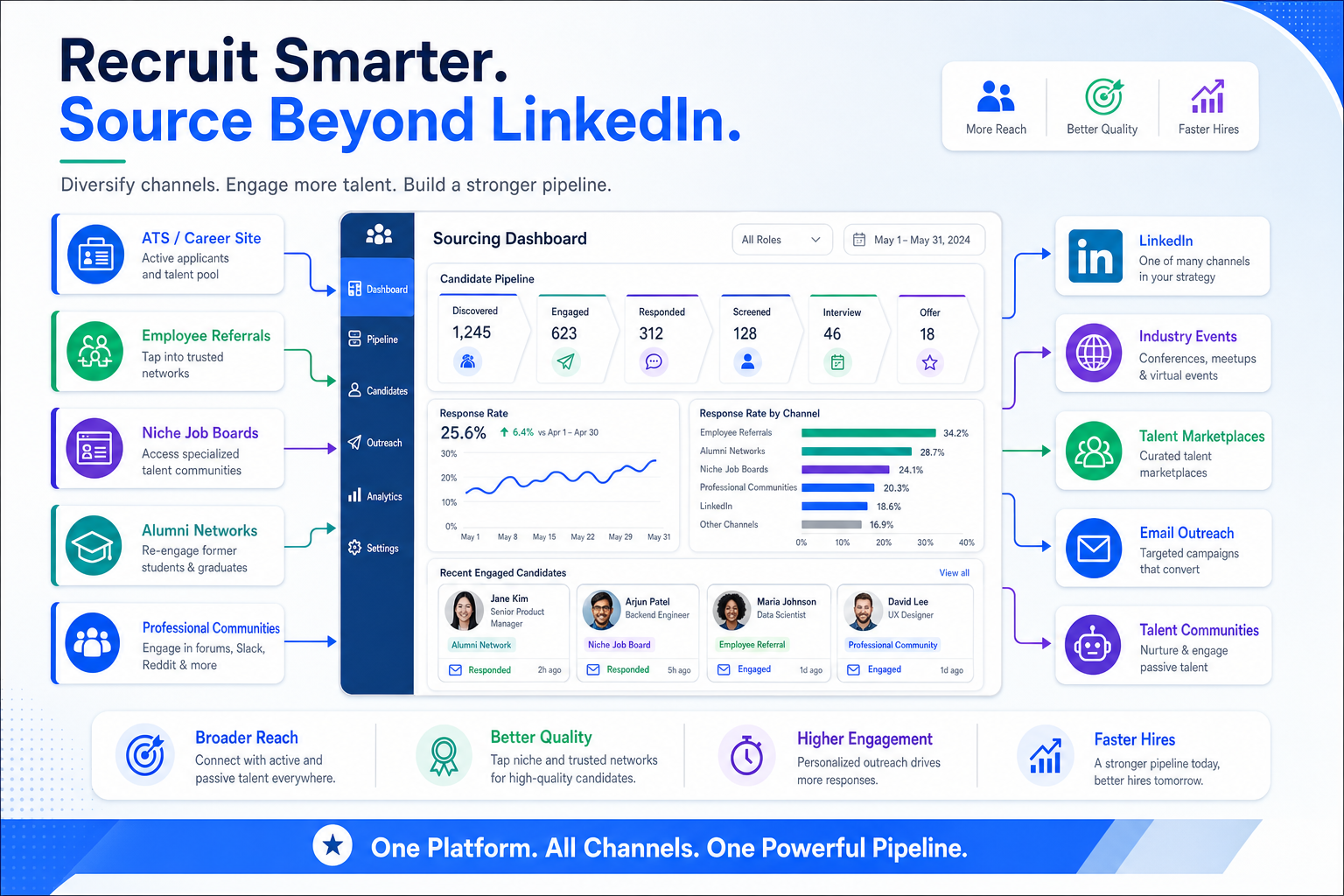
This article helps headhunters judge hr sourcing channels and workflows to avoid weak-fit pipelines, poor response rates, and damaged client trust.
When teams ignore that discipline, the damage shows up fast: recruiters spend hours chasing visible profiles everyone else already contacted, hiring managers lose confidence in shortlist quality, and smaller search firms absorb the hidden cost of weak response rates, messy follow-up, and candidate relationships that cool off before a real conversation starts.
I have found that support tools help most when they remove repetitive LinkedIn work without pretending to replace recruiter judgment. In practice, that is where StrategyBrain AI Recruiter is relevant: it can automate initial LinkedIn outreach, keep candidate communication moving after hours, and collect resumes or contact details from interested people, while the recruiter still owns final qualification, resume review, and next-step decisions.
You can see why this matters in a familiar recruiter-candidate dynamic. A candidate wants a recruiter to open the door to the right opportunity, but the relationship starts to break down when the candidate oversells skills, applies too broadly, or treats every recruiter as interchangeable. The recruiter, in turn, is trying to judge fit, protect credibility with clients, and decide who is worth advocating for.
That tension gets sharper when follow-up timing, feedback, and professionalism are mishandled. If a candidate keeps checking in without a real update, ignores recruiter feedback, or misunderstands that the recruiter is filling a client role rather than acting as a personal job finder, the relationship weakens. For sourcing teams, that same pattern exposes a bigger workflow issue: good candidate sourcing channels and good job sourcing are not just about finding more names. They depend on fit judgment, channel context, and a process that helps recruiters build qualified, well-managed conversations.
That is why modern talent sourcing tools beyond LinkedIn should be evaluated less as giant databases and more as workflow support for better recruiter-candidate matching. The best systems help you search wider, message with context, and manage timing well enough that you do not create the same avoidable missteps at scale.
In this article, you will learn:
- Why non-LinkedIn sourcing matters when recruiter credibility and candidate fit are both on the line
- Which candidate sourcing channels deserve priority for different role types
- What capabilities matter most when evaluating sourcing tools
- How to build a practical job sourcing workflow that supports better outreach and follow-up
- Which sourcing mistakes damage conversion even when your database looks large
Table of Contents
- What HR Sourcing Really Means
- Why Fit Matters More Than Volume
- Candidate Sourcing Channels Beyond LinkedIn
- What to Look for in Sourcing Tools
- Building a Job Sourcing Workflow
- Using LinkedIn Support Without Overrelying on It
- How to Match Channels to Roles
- Metrics That Actually Matter
- Common Mistakes in HR Sourcing
- FAQ
What HR Sourcing Really Means
HR sourcing is the front-end discipline of identifying, qualifying, and engaging likely-fit candidates before they enter the broader recruiting funnel. It is not just search. It includes role calibration, channel selection, outreach quality, follow-up timing, and judgment about who is actually worth moving forward.
That matters because sourcing is where many recruiting problems are either prevented or multiplied. If the sourcing stage produces poorly matched profiles, generic outreach, and weak communication discipline, the rest of the hiring process inherits that chaos.
Experienced recruiters usually learn this the hard way: a large list of names can still produce a weak pipeline if the people on that list were found in the wrong place, contacted without context, or advanced before real fit was established.
Key insight: Strong hr sourcing is not name collection. It is the structured creation of credible, contactable, and conversion-ready talent pools.
Why Fit Matters More Than Volume
The reference case behind this article is useful because it reminds us that recruiter-candidate relationships break down around the same issues that weaken sourcing: overselling, poor feedback handling, over-applying, mistimed follow-up, and misunderstanding the recruiter's role.
Those are not only candidate mistakes. They are also sourcing design problems.
If your process encourages broad, low-context outreach, you will attract people who are curious but not truly aligned. If your recruiters do not document feedback and timing well, follow-up becomes either too frequent or too slow. If your team treats every channel the same way, candidates start to feel like they are being processed rather than approached with intent.
From a practical job sourcing perspective, going beyond LinkedIn helps because it reduces channel crowding and improves context. Different professionals show fit in different places: internal systems, referral networks, portfolios, associations, alumni communities, or specialist boards. Better sourcing starts when recruiters accept that fit signal changes by channel.
Candidate Sourcing Channels Beyond LinkedIn
The best candidate sourcing channels are role-dependent, but the following sources consistently help recruiting teams improve coverage and relevance beyond one platform.
1. Internal ATS and CRM Databases
Your own database is often the most overlooked sourcing asset. Past applicants, prior finalists, archived prospects, and silver-medalist candidates already have some relationship to the company or search firm.
Why it works: known history, existing interest signal, faster qualification path.
Practical takeaway: search title variants, adjacent backgrounds, location flexibility, and prior feedback notes. Rediscovery should come before broad cold outreach for many roles.
2. Employee and Network Referrals
Referrals still matter because they add context that databases cannot. They often help recruiters judge fit earlier, especially when hiring managers care about operating style, stakeholder presence, or industry credibility.
Why it works: warmer entry, better trust signal, stronger alignment clues.
Practical takeaway: ask for targeted referrals, not generic job sharing. Good prompts include title alternatives, target companies, and the real capabilities needed to succeed.
3. Niche Job Boards
Specialized boards can outperform broad channels when hiring into concentrated functions or trades. They are also useful for understanding how talent in a market describes itself.
Why it works: narrower audience, stronger self-selection, clearer market language.
Practical takeaway: use niche boards for both posting and search intelligence. The way candidates label skills and titles can improve your sourcing logic everywhere else.
4. Professional Communities
Forums, membership groups, trade communities, and discipline-specific online spaces often reveal more than a headline profile does. You can see how people contribute, communicate, and build credibility among peers.
Why it works: stronger expertise signals and more authentic engagement context.
Practical takeaway: community sourcing only works when recruiters approach with respect. Generic copy-and-paste outreach is usually obvious and poorly received.
5. Portfolio and Work-Sample Platforms
For technical, product, design, and creative hiring, work samples often tell you more than a self-written summary. They also support better personalization because the outreach can reference actual output.
Why it works: clearer evidence of depth, style, specialization, and consistency.
Practical takeaway: review the work before messaging. The outreach should reflect what the person actually built, wrote, shipped, or designed.
6. Alumni Networks
Alumni groups can be useful for both early-career and mid-career hiring, especially when a shared institutional background creates an easier introduction.
Why it works: trust anchor, concentrated pools, warmer conversation starter.
Practical takeaway: build outreach around program relevance, not just school brand. The connection should make sense for the role.
7. Professional Associations
Associations are especially helpful in regulated, standards-driven, or highly specialized hiring. They can also improve recruiter understanding of how professionals in that field define advancement and credibility.
Why it works: concentrated expertise and better qualification signals.
Practical takeaway: use directories, event participation, and content contribution as context clues, not just name lists.
What to Look for in Sourcing Tools
When evaluating talent sourcing tools, the best question is not which vendor has the biggest brand presence. The better question is which capabilities reduce the exact mistakes that weaken sourcing quality.
| Capability | What It Supports | Why It Matters |
|---|---|---|
| Multi-source search | Searching across different datasets and channel types | Reduces overdependence on one platform |
| Candidate rediscovery | Finding past applicants and archived prospects | Improves speed and makes better use of existing talent relationships |
| Contact enrichment | Completing contact information where appropriate | Helps recruiters move from discovery to outreach more efficiently |
| Structured outreach | Managing sequences, reminders, and follow-up timing | Prevents missed responses and over-follow-up |
| Talent intelligence | Adding market and relevance signals | Improves targeting decisions and shortlist quality |
| AI-assisted support | Helping with repetitive search or communication tasks | Frees recruiters to focus on judgment, messaging quality, and conversion |
The key is to map the tool to the workflow gap. If your recruiters already find enough names but get poor replies, the issue is probably outreach quality or timing. If your team starts every search from zero, rediscovery may create more value than yet another external source.
Building a Job Sourcing Workflow
A good job sourcing workflow should protect recruiter credibility the same way a good recruiter protects a client relationship. The following sequence works because it mirrors how fit should be judged, not just how fast names can be gathered.
1. Calibrate the Role Before You Search
Clarify success outcomes, acceptable title variants, transferable backgrounds, and true deal-breakers. This is the sourcing equivalent of asking whether a candidate is applying selectively or just broadly.
Practical advice: ask hiring managers for feeder teams, adjacent industries, and examples of backgrounds they would genuinely consider.
2. Search Internal History First
Before launching broad outreach, check your ATS and CRM. Past candidates may already have the fit and interest level you need.
Practical advice: review old notes, interview outcomes, and prior timing issues. A candidate who was unavailable six months ago may be viable now.
3. Expand Into the Right External Channels
Choose channels based on role family and candidate behavior, not habit. This is where candidate sourcing channels strategy usually improves fastest.
Practical advice: separate warm channels from cold channels and prioritize by likely fit, not just volume.
4. Qualify Before Personalizing
Do not send tailored outreach to weak matches. Review evidence first: scope, achievements, environment, and likely motivation.
Practical advice: a smaller qualified list usually creates better response rates than a large low-fit campaign.
5. Manage Follow-Up Like a Professional Relationship
One of the strongest lessons from recruiter-candidate relationship failures is that timing matters. Follow up for a reason: a relevant role, a changed circumstance, or a reasonable interval. The same standard should apply to outbound sourcing.
Practical advice: document why each follow-up is being sent. If there is no new value, the message is probably premature.
6. Capture Feedback and Use It
Feedback only helps if the team accepts it and works it back into search logic. Recruiters should record why a candidate was advanced, declined, or nonresponsive, then use that information to refine future sourcing.
Key insight: Sourcing workflows improve when follow-up and feedback are treated as decision signals, not administrative leftovers.
Using LinkedIn Support Without Overrelying on It
Although this article focuses on talent sourcing tools beyond LinkedIn, most recruiting teams still use LinkedIn as one part of the workflow. The issue is not whether to use it. The issue is whether your team depends on it so heavily that every search, every message, and every follow-up starts to look the same.
In my own workflow, I have used AI Recruiter as a support layer when the bottleneck was repetitive first-touch communication on LinkedIn. What stood out was not that it replaced recruiting judgment; it did not. What helped was that it kept initial introductions moving, handled replies outside normal work hours, and collected resumes and contact details from interested candidates so I could spend more time reviewing actual fit.
That distinction matters. Recruiters still need to decide whether the resume supports the brief, whether the candidate's experience is being oversold, and whether the opportunity is a credible match. Used that way, a tool like StrategyBrain AI Recruiter can support the LinkedIn portion of the process while your broader hr sourcing strategy continues across referrals, internal rediscovery, niche boards, communities, and associations.
For teams that struggle with after-hours replies, multilingual outreach, or slow handoffs between initial interest and recruiter review, that kind of support can reduce lag without encouraging lazy sourcing. It works best when LinkedIn automation remains one controlled component inside a multi-channel sourcing system.
How to Match Channels to Roles
A sourcing plan becomes more credible when channels are chosen by role family rather than recruiter habit.
| Role Type | Best-Fit Channels | Why They Work |
|---|---|---|
| Technical roles | Internal ATS, portfolio platforms, technical communities, referrals | Work evidence and specialization matter more than headline profiles |
| Creative and design roles | Portfolio sources, niche communities, alumni groups, referrals | Output quality is easier to judge directly |
| Finance and accounting roles | Internal databases, associations, specialist boards, referrals | Credential clarity and recruiter trust are especially important |
| Sales roles | Referrals, niche boards, ATS rediscovery, selected outbound | Performance signal and timing often drive conversion |
| Operations and corporate roles | ATS, alumni networks, job boards, professional communities | Title variation and transferable experience widen the pool |
| Specialist or regulated roles | Associations, niche boards, internal database, referrals | Qualification signals are stronger in concentrated channels |
Notice that finance and accounting roles deserve special attention here. The reference material centered on finance recruiter relationships for a reason: in more structured functions, credibility, specialization, and fit discipline are even more important. Broad, noisy sourcing can do more harm than good.
Metrics That Actually Matter
Many teams still celebrate activity metrics that do not predict hiring success. Better sourcing measurement should reflect actual movement and quality.
- Qualified candidate rate: how many sourced profiles meet core role requirements
- Response rate: how many contacted candidates reply
- Positive response rate: how many replies indicate real interest
- Submit-to-interview conversion: how many sourced candidates move forward
- Channel conversion: which candidate sourcing channels lead to meaningful progress
- Rediscovery yield: how often your internal database produces viable candidates
- Follow-up efficiency: whether later touches add value or just create noise
These metrics align with the relationship lessons from the opening case. A recruiter who follows up too often, ignores feedback, or pushes weak-fit candidates may stay busy, but the pipeline quality will show the truth.
Common Mistakes in HR Sourcing
Treating Every Recruiter or Channel the Same
Just as candidates should not assume all recruiters operate identically, recruiting teams should not assume every channel produces the same type of talent signal.
Starting with Cold Outreach Before Checking Internal Talent
This wastes both time and goodwill. Rediscovery is often the fastest route to relevant conversations.
Rewarding Over-Application Behavior
If your sourcing process tolerates weak-fit outreach at scale, you will attract low-intent activity and create extra screening work.
Ignoring Feedback From the Market
When candidates decline, ghost, or object to the same parts of a role repeatedly, that is actionable sourcing feedback, not background noise.
Following Up Without a Reason
The opening reference made this point clearly: timing matters. Recruiters should follow up when there is a relevant role, changed circumstances, or a reasonable interval.
Forgetting the Recruiter's Actual Role
Recruiters are there to fill roles for clients or employers, not to manufacture fit where it does not exist. Your sourcing process should reinforce that reality, not blur it.
FAQ
How can recruiters source candidates without LinkedIn?
Recruiters can source without LinkedIn by combining ATS rediscovery, referrals, niche job boards, professional communities, portfolio platforms, alumni networks, and professional associations. The best approach is a multi-channel system where each source is chosen for role fit and outreach context.
What are the most effective candidate sourcing channels for passive talent?
For passive candidates, referrals, internal rediscovery, professional communities, work-sample platforms, and alumni networks often perform better than broad public job channels because they support more relevant and personalized outreach.
Why is internal ATS search so important in hr sourcing?
Your ATS often contains candidates who already know your company, were previously assessed, or nearly matched another opening. That makes rediscovery one of the most efficient and underused sourcing steps.
How should teams measure job sourcing success?
Measure job sourcing through qualified candidate rate, response rate, positive response rate, submit-to-interview conversion, rediscovery yield, and channel conversion. These metrics reflect real hiring progress better than list size alone.
Can LinkedIn automation help if the goal is sourcing beyond LinkedIn?
Yes, if it is used as one controlled support layer rather than the entire strategy. For example, AI-supported LinkedIn outreach can reduce repetitive first-touch work while recruiters continue broader sourcing across non-LinkedIn channels and keep final qualification in human hands.
Conclusion
Effective hr sourcing beyond LinkedIn is not about replacing one platform with another. It is about building a sourcing discipline that respects fit, feedback, timing, and channel context.
The opening recruiter-candidate case makes that clear. Relationships break down when people oversell, over-apply, follow up badly, or misunderstand the recruiter's role. Sourcing pipelines break down for the same reasons.
If you want stronger results from your candidate sourcing channels and a more reliable job sourcing workflow, start by rediscovering internal talent, matching channels to role type, tightening follow-up standards, and using support tools only where they reduce repetitive work without replacing recruiter judgment.
That is usually where a healthier pipeline begins.