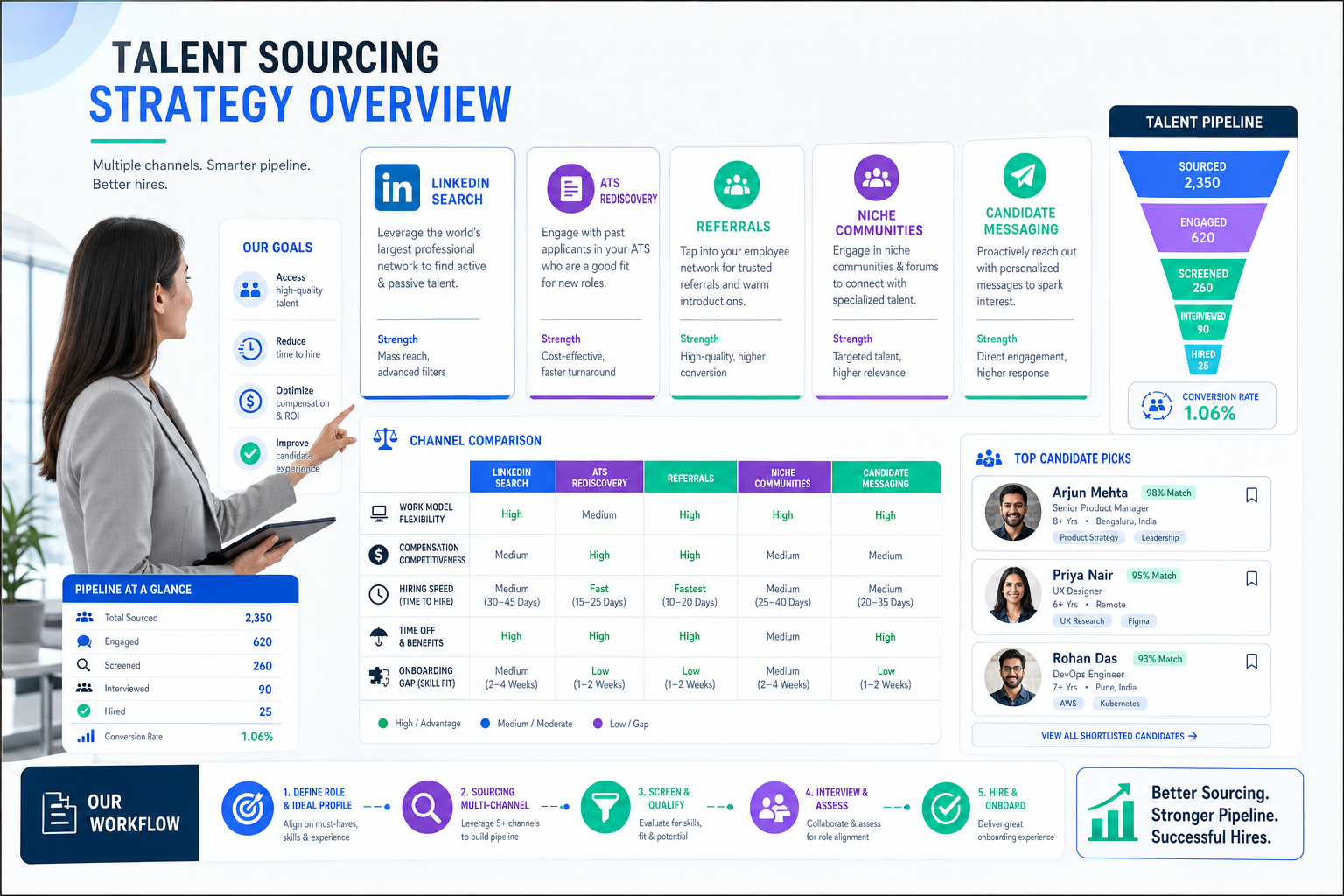
When hr sourcing stalls, this article helps recruiters diagnose expectation gaps and choose better-fit channels before drop-off costs time twice.
That sounds simple, but in practice most sourcing problems begin with a mismatch between what employers want to hire for and what candidates are prepared to accept. When remote flexibility, compensation range, time off, hiring speed, or onboarding support are misread at the top of the funnel, recruiters lose time twice: once finding people who look right on paper, and again trying to recover after late-stage drop-off. For agency recruiters, that hurts credibility with clients. For in-house teams, it slows headcount plans and weakens source quality. For solo headhunters, it turns every search into more chasing, more follow-up, and less trust.
In my own workflow, that is where StrategyBrain AI Recruiter can help without replacing recruiter judgment. I have found it most useful for keeping candidate communication moving after hours, handling multilingual replies when a search crosses markets, and collecting resumes or contact details from people who are genuinely interested so I can focus on final resume review and next-step decisions. Used that way, it supports the messy front end of sourcing rather than pretending to make the hiring call for you.
The real friction becomes visible the moment a candidate starts weighing an opportunity instead of just appearing in a search result. A recruiter may have a shortlist ready, but the candidate is comparing on-site expectations against work-from-home needs, testing whether compensation is realistic, wondering how much vacation is actually usable, and reading long hiring timelines as a signal that the role may lack urgency. Those are not abstract market trends. They are live decision points that shape whether outreach becomes a conversation or gets ignored.
That is why non-LinkedIn talent sourcing cannot be treated as a list-building exercise alone. The same five expectation gaps that show up in hiring conversations, work model, compensation, time off, speed, and onboarding, should also shape your channel mix, messaging, and tool choices. Once you see sourcing through that lens, recruitment sourcing techniques and personnel sourcing become less about blasting more contacts and more about building a workflow that matches the way candidates actually evaluate opportunities.
- What sourcing means in HR and why expectation alignment belongs upstream
- Why non-LinkedIn channels matter when candidate and employer priorities diverge
- How to evaluate talent sourcing tools by workflow, not vendor hype
- Which recruitment sourcing techniques work better outside one dominant platform
- What to measure if you want stronger personnel sourcing over time
Table of Contents
- What Is HR Sourcing?
- The Five Expectation Gaps That Shape Sourcing
- Why Non-LinkedIn Sourcing Matters
- Plan Before You Pick Tools
- Talent Sourcing Tools by Workflow
- Channels and Recruitment Sourcing Techniques
- A Practical HR Sourcing Process
- Metrics That Matter in Personnel Sourcing
- Common Mistakes to Avoid
- FAQ
What Is HR Sourcing?
HR sourcing is the proactive work of identifying, researching, qualifying, and engaging potential candidates before they formally enter the recruiting process. It includes active and passive candidate outreach, talent pool building, rediscovery of prior applicants, and early-fit evaluation.
That is different from recruiting as a whole. Recruiting includes intake alignment, interview coordination, stakeholder management, offer handling, and close. In other words, sourcing feeds the funnel; recruiting manages more of the full journey.
Experienced recruiters know this distinction matters because many downstream hiring problems start with upstream sourcing assumptions. If a role is calibrated too loosely, or if candidate expectations are ignored until the interview stage, even a large talent pool can convert badly.
Key Insight: Good sourcing is not just finding people who can do the work. It is finding people whose likely expectations are close enough to the job reality to justify outreach.
The Five Expectation Gaps That Shape Sourcing
One of the most useful ways to improve sourcing quality is to look at where employer and candidate expectations drift apart. In day-to-day practice, five gaps come up repeatedly: work location, compensation, vacation and time off, hiring timeline, and onboarding or training support.
1. On-site vs. work from home
If the market expects flexibility and the role is more rigid than competitors, your channels and outreach need to reflect that early. A recruiter who hides location constraints until late stages wastes sourcing effort and damages response quality.
2. Compensation
Compensation reality shapes the size and quality of your reachable pool. This is especially important in personnel sourcing because unrealistically narrow budgets often get mistaken for a sourcing problem when the issue is actually market mismatch.
3. Vacation and time off
For some talent segments, time-off expectations are part of job quality, not a side detail. Messaging that sounds strong on title but vague on work-life boundaries can underperform even when the search itself is well targeted.
4. Hiring timelines
Slow process speed kills more sourcing momentum than many teams admit. Candidates often read long delays as confusion, low priority, or internal misalignment.
5. Onboarding and training
Top-of-funnel conversations increasingly include questions about what support exists after hire. That matters when targeting adjacent talent, career changers, or candidates moving between sectors.
These gaps are why solid sourcing starts with mutual-fit logic instead of pure profile matching. The more clearly you understand where expectations may break, the better your search filters, outreach copy, and source mix become.
Why Non-LinkedIn Sourcing Matters
A non-LinkedIn strategy matters because expectation alignment rarely comes from one platform alone. The best candidates for a role may already exist in your ATS, in referral networks, in alumni circles, in niche communities, or among prior finalists who were unavailable last time but are more open now.
When recruiters depend too heavily on a single channel, they also inherit that channel's limitations. Everyone sees the same talent, everyone sends similar messages, and the market becomes noisier. A broader sourcing model gives you more ways to match role realities with the right audience.
| Channel Type | Strength | Best Use |
|---|---|---|
| Internal talent pool | Known context and faster re-engagement | Repeat hiring, evergreen roles, boomerang talent |
| Past applicants | Existing intent and historical data | Rediscovery for similar openings |
| Employee referrals | Higher trust and clearer context | Specialist and hard-to-reach profiles |
| Niche communities | Better skill relevance | Technical, creative, or regulated roles |
| Industry associations and alumni networks | Shared professional identity | Experienced and passive candidates |
| Events and meetups | Warmer relationship entry points | Longer-horizon pipeline building |
In my own searches, some of the strongest non-LinkedIn results have come from database rediscovery plus disciplined follow-up. For searches that still require heavy outbound messaging, I have used AI Recruiter to keep replies moving overnight and across time zones, especially when candidates respond outside normal working hours. That helps maintain momentum, but I still decide who belongs in the shortlist and whether a resume actually matches the role.
Plan Before You Pick Tools
Before comparing software, start with role calibration. Most sourcing failures are not caused by the absence of one magical tool. They come from weak intake discipline around required skills, acceptable adjacent backgrounds, location flexibility, timeline urgency, and compensation reality.
Experienced recruiters usually pressure-test these points early:
- Must-have capabilities: What must a candidate do from day one?
- Trainable gaps: What can be taught during onboarding?
- Work model expectations: On-site, hybrid, remote, travel, relocation, or regional scope.
- Compensation realism: Is the package aligned with the target market?
- Timeline pressure: How quickly must the team move once prospects engage?
- Post-hire support: What onboarding or training story can be told credibly?
This is where better recruitment sourcing techniques begin. The intake is not just an admin step. It is the foundation for better search strings, better channel selection, and better outreach relevance.
Talent Sourcing Tools by Workflow
When evaluating talent sourcing tools, think in workflow layers rather than product categories alone. Most sourcing teams need support across discovery, enrichment, contact handling, outreach, rediscovery, analytics, and AI-assisted communication.
1. Search and discovery tools
These help you find profiles, resumes, talent signals, and communities across multiple sources. Their value depends less on database size and more on how well they support flexible search and adjacent-talent discovery.
What to look for:
- Boolean or semantic search support
- Useful filters for skills, location, seniority, and industry
- Support for passive candidate sourcing
- Ways to organize talent pools for later reuse
2. Profile enrichment and contact finding tools
Once a prospect is identified, recruiters often need more detail to judge relevance and write more specific outreach. Enrichment can improve prioritization, but it should sharpen judgment rather than automate assumptions.
3. Outreach sequencing tools
These tools help structure multi-step messaging and track responses. The real question is whether they support respectful follow-up rather than spammy volume.
What good looks like:
- Simple sequences with manual editing
- Clear response tracking
- Support for channel-appropriate timing
- Controls that reduce duplicate or excessive contact
For LinkedIn-heavy searches, teams sometimes need extra support precisely because candidate replies arrive outside office hours or across different languages. In those cases, StrategyBrain AI Recruiter is best understood as a communication support layer. It can introduce opportunities, answer basic role questions, continue conversations around the clock, and collect resumes or contact information from interested candidates, while the recruiter remains responsible for fit assessment and interview decisions.
4. CRM and ATS rediscovery tools
Rediscovery is one of the most undervalued non-LinkedIn sourcing assets. Previous applicants, silver medalists, former referrals, and past campaign responders often convert better than cold prospects because some context already exists.
5. Analytics and source measurement tools
If you cannot compare channels, you cannot improve them. Good measurement helps you understand not only where hires come from, but also which sources produce candidates whose expectations align with the role reality.
6. AI-assisted matching and communication tools
AI can help widen the first-pass net, support semantic search, organize responses, and keep communication moving. It is most helpful when it speeds repetitive work without claiming authority over final candidate quality.
Practical Takeaway: The best sourcing stack is the one that helps your team discover, engage, and re-engage talent while preserving human judgment at every real decision point.
Channels and Recruitment Sourcing Techniques
Strong non-LinkedIn sourcing comes from matching the channel to both the role and the candidate's likely decision criteria. That is the difference between activity and traction.
Internal talent pools and past applicants
Start with people who already know your brand. Organize them by skill family, geography, prior stage, and known constraints. Re-engage candidates whose earlier process ended because of timing, not capability.
Employee referrals
Referrals improve when the ask is specific. Share likely backgrounds, role priorities, work model realities, and why the opening matters now. A vague request gets vague referrals.
Niche job boards and specialist communities
These often outperform broader channels when the role requires specific domain knowledge or when candidates care about professional credibility as much as title.
Online communities and forums
Use these carefully. Contribute before you recruit. Community trust is easy to damage and hard to rebuild.
Industry associations and alumni networks
These are especially useful when candidates value identity, reputation, or field-specific context. Shared affiliation can make outreach feel warmer and more relevant.
Events and meetups
Events are best for relationship-led sourcing. The key is fast, specific follow-up while the conversation is still fresh.
Across all of these channels, one rule holds: the best recruitment sourcing techniques do not start with message volume. They start with better fit hypotheses about what the candidate will care about most.
A Practical HR Sourcing Process
If you want a repeatable process, use a workflow that connects planning, discovery, engagement, and measurement.
- Calibrate the role and the likely expectation gaps
Clarify must-haves, compensation, work model, process speed, and onboarding support before search begins.
- Choose target channels based on candidate behavior
Use ATS rediscovery and referrals for known pools, and niche communities or associations for specialist outreach.
- Build and test the search
Review sample profiles manually to catch title inflation, misleading keywords, or overly narrow assumptions.
- Enrich and prioritize
Add enough context to separate likely fits from weak matches and to tailor your first message.
- Run respectful outreach and follow-up
Explain why the person was selected, what the role solves, and why the timing may be worth a conversation.
- Track outcomes by source and by expectation gap
Measure not just replies, but where mismatches happen. That is how personnel sourcing becomes a process instead of a guess.
One lesson I have learned is that candidates often reply when recruiters are offline, especially in cross-border searches. In those moments, using AI Recruiter as a front-end communication assistant can prevent drop-off between first interest and resume collection. It keeps the thread alive, but it does not replace the sourcer's responsibility to review the resume, judge fit, and decide whether to advance the person.
Metrics That Matter in Personnel Sourcing
Many teams measure activity because it is easy. Better teams measure whether sourcing inputs produce candidates who are both qualified and realistically aligned with the role.
- Reply rate: Is the outreach relevant enough to earn attention?
- Qualified screen rate: Are the responses actually viable?
- Interview pass-through: Was the sourcing shortlist calibrated well?
- Source of hire: Which channels produce actual hires?
- Reactivation rate: How often do ATS or CRM rediscovery efforts create live opportunities?
- Mismatch reason tracking: Are drop-offs happening on compensation, work model, speed, or onboarding confidence?
| Metric | What It Tells You | Why It Matters |
|---|---|---|
| Reply rate | Early relevance of outreach | Useful, but not enough alone |
| Qualified screen rate | How many replies are real fits | Better measure of source quality |
| Interview pass-through | Whether shortlisted profiles match hiring criteria | Exposes calibration issues |
| Source of hire | Which channels actually convert | Guides future effort and budget |
| Reactivation rate | Value of internal database sourcing | Shows whether rediscovery is working |
| Mismatch reasons | Where expectation gaps appear | Improves future targeting and messaging |
Review metrics by role family, not only at company level. A source that works for one function may fail for another because candidate priorities differ.
Common Mistakes to Avoid
Treating sourcing like list production
Bigger lists do not solve expectation mismatch. If the role is miscalibrated, more names just create more noise.
Ignoring candidate decision criteria until late stage
When location, compensation, timeline, or onboarding questions appear only after interviews begin, the sourcing team has already paid the cost.
Underusing your ATS or CRM
Many teams search outside first and only later rediscover candidates who were already warm.
Using too many disconnected tools
Tool sprawl creates duplicate records, inconsistent outreach, and weak reporting.
Automating communication without recruiter oversight
AI support can help with scale and responsiveness, but a recruiter still needs to own relevance, judgment, and next-step decisions.
Writing channel-blind outreach
Community members, alumni contacts, referrals, and past applicants should not all receive the same message logic.
FAQ
What does sourcing mean in HR?
Sourcing in HR means proactively finding and engaging potential candidates before they apply. It includes search, qualification, talent pool building, and outreach to both active and passive candidates.
How is sourcing different from recruiting?
Sourcing is the front-end discipline of identifying and attracting talent. Recruiting is broader and includes interviews, assessment, process management, offers, and closing.
Why does non-LinkedIn sourcing matter?
It reduces channel dependence, improves access to overlooked talent pools, and often creates better alignment between role realities and candidate expectations.
What are the best non-LinkedIn channels for hr sourcing?
Useful channels include ATS and CRM rediscovery, past applicants, employee referrals, alumni networks, industry associations, niche communities, specialist job boards, and events.
Which recruitment sourcing techniques improve response quality?
Start with clearer intake, target fewer but better-matched channels, personalize outreach around real role context, and track where expectation mismatches happen.
What does personnel sourcing involve in practice?
Personnel sourcing involves identifying likely-fit talent, organizing talent pools, re-engaging known candidates, running outreach, and measuring which sources produce viable hires.
Can AI help with sourcing without replacing recruiters?
Yes. AI can support semantic search, communication continuity, multilingual replies, and resume collection. Recruiters still need to validate fit, review resumes, and make advancement decisions.
Conclusion
The best non-LinkedIn sourcing strategy is not about replacing one platform with another. It is about building a sourcing system that reflects how candidates actually evaluate opportunities. When work model, compensation, time off, hiring speed, and onboarding support are considered early, hr sourcing becomes more precise and more credible.
That is also what makes talent sourcing tools worth evaluating by workflow instead of hype. The right stack helps you discover talent, keep conversations moving, rediscover warm candidates, and measure where real alignment happens. Over time, that is what makes recruitment sourcing techniques and personnel sourcing stronger, more repeatable, and far less dependent on any single channel.