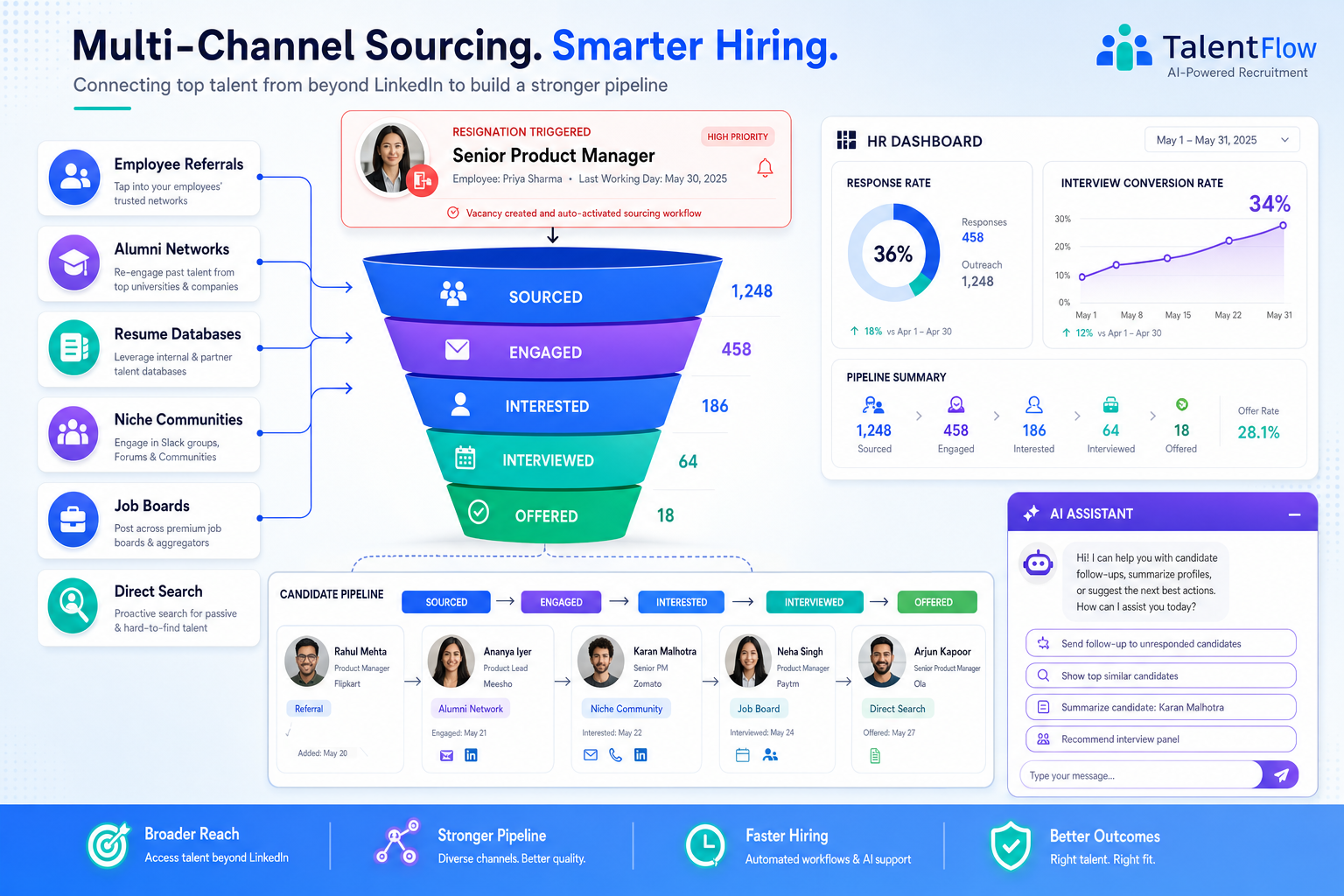
When a resignation hits, HR leaders can use this HR sourcing guide to judge channels faster, avoid one-platform blind spots, and rebuild pipeline with context.
That matters most when hiring starts under pressure rather than on a tidy timeline. A resignation, an unexpected vacancy, or a critical project handoff can leave agency recruiters, solo search consultants, and in-house talent teams scrambling to rebuild pipeline while protecting delivery speed, client confidence, and team morale. When sourcing lives in one channel or one recruiter inbox, the real cost shows up as missed follow-up, duplicate outreach, weak market coverage, and burned-out teams carrying the gap.
In that kind of workflow, I have found that StrategyBrain AI Recruiter can ease some of the top-of-funnel pressure when recruiters are trying to maintain outreach momentum, keep responses moving after hours, and collect candidate interest details without losing time on repetitive messaging. The useful part is not that it replaces recruiter judgment; it does not. Recruiters still decide who is worth pursuing, review resumes, and make the next-step call. What it can do is support initial communication, multilingual follow-up, and candidate response handling while the recruiter stays focused on qualification and stakeholder alignment.
The pressure becomes very concrete the moment someone resigns. A manager asks for the formal resignation letter and confirms the employee’s final date. Then the transition work begins immediately: which projects must be wrapped up, which clients or internal stakeholders need proactive communication, and which duties will be picked up by the rest of the team until a replacement arrives. At the same time, somebody has to define what the replacement role now really requires, not just repost an old job description.
That is exactly where weak sourcing habits get exposed. If knowledge transfer is incomplete, if the team has not documented priorities, and if recruiters do not know whether to search alumni, past applicants, niche communities, or resume databases first, the vacancy stays open longer than it should. The lesson is bigger than one resignation workflow: the best recruitment sourcing methods and practical ways of sourcing candidates are the ones that help teams respond quickly when a role changes hands and the hiring brief needs both speed and context.
When hiring teams rely too heavily on one platform, pipelines narrow fast. Strong HR sourcing today depends on a broader mix of tools, repeatable search logic, and outreach habits that help recruiters find both active and passive candidates beyond LinkedIn.
In practice, sourcing sits at the very top of the hiring funnel. It is the proactive work of identifying, researching, engaging, and nurturing potential candidates before they ever become applicants. Recruiting is the full journey; sourcing is the part that creates qualified conversations in the first place.
This article focuses on how to evaluate non-LinkedIn talent sourcing tools, how to choose the right recruitment sourcing methods, and which ways of sourcing candidates make the most sense when a team needs to replace talent quickly, protect continuity, and avoid rebuilding every search from zero.
- What HR sourcing includes in day-to-day recruiting
- How resignation-driven hiring changes sourcing priorities
- Which internal and external channels deserve attention first
- What non-LinkedIn sourcing tool categories are actually useful
- How experienced recruiters build repeatable sourcing workflows
- What to measure if you want better speed, quality, and candidate experience
Table of Contents
- What HR Sourcing Means in Practice
- What a Resignation Teaches You About Sourcing
- Internal vs External Recruitment Sourcing Methods
- Non-LinkedIn Talent Sourcing Tool Types
- Best Ways of Sourcing Candidates Beyond LinkedIn
- A Practical HR Sourcing Workflow
- How to Approach Passive Candidates
- How to Measure Sourcing Performance
- Common Sourcing Mistakes to Avoid
- FAQ
What HR Sourcing Means in Practice
HR sourcing is the proactive process of finding and engaging potential candidates before they enter the formal application stage. In simple terms, it is how recruiters build pipeline instead of waiting for inbound applicants to appear.
This distinction matters because sourcing is not the same as recruiting as a whole. Recruiting includes intake meetings, screening, interviews, offers, and close. Sourcing happens earlier. It focuses on talent discovery, market mapping, outreach, and relationship-building.
A useful way to explain sourcing to hiring managers is this: applicants are people who raise their hands; sourced candidates are people your team deliberately identifies because they look relevant to the work ahead. That matters even more for confidential searches, specialist positions, backfills after resignations, and markets where strong candidates are rarely applying at the exact moment you need them.
Active vs passive candidates
Most sourcing conversations become clearer once you separate active candidates from passive candidates.
- Active candidates are already looking, applying, or signaling openness.
- Passive candidates are not in active job-search mode but may respond to a relevant opportunity.
Many ways of sourcing candidates work across both groups, but the message and timing should differ. Active candidates usually respond to clarity and speed. Passive candidates usually respond better to relevance, credibility, and a low-pressure first conversation.
Key insight: The strongest sourcing teams do not chase one perfect channel. They build a system that can absorb hiring shocks, including sudden resignations, business changes, and role reprioritization.
What a Resignation Teaches You About Sourcing
One of the most useful management lessons in hiring comes from what happens right after someone resigns. First, the departure has to be formalized. Then priorities need to be identified. The team has to decide what work must be finished, what knowledge needs to be transferred, who temporarily covers the gap, and how colleagues or clients will be informed. Only after that does the replacement process truly begin.
For recruiters, this sequence is a reminder that sourcing quality depends on business context. If you start searching before you understand what the departing employee actually handled, you risk filling the wrong version of the role. If you ignore knowledge transfer and stakeholder communication, you may overemphasize title matching and miss the real capabilities the next hire needs.
In other words, a resignation is not just a trigger to open a requisition. It is a forced audit of your sourcing process. It tells you whether your team can quickly rebuild a candidate pool, search historical talent, and adjust outreach based on what the business now needs.
In my own workflow, that is where a support layer like AI Recruiter has been most helpful. I have used it less as a magic search engine and more as a way to keep early outreach moving when a backfill search creates a rush of candidate responses across time zones. It is especially useful when you need multilingual communication and consistent follow-up while still reserving human time for market calibration, resume review, and final qualification.
Internal vs External Recruitment Sourcing Methods
One of the clearest ways to organize recruitment sourcing methods is to split them into internal and external approaches. That mirrors how good teams react after a resignation or any urgent backfill: first check talent close to the business, then widen the search deliberately.
Internal sourcing methods
Internal sourcing focuses on talent that already has some relationship to the organization. It is often faster and easier to assess because there is already context.
- Internal mobility: employees who can grow into the role
- Employee referrals: candidates introduced by current team members
- Talent rediscovery: previous applicants and silver-medalist candidates
- Alumni networks: former employees who left in good standing
- Talent communities: people who opted into future hiring updates
These channels become especially valuable when the departing employee leaves behind specialized knowledge or strong stakeholder relationships. In those cases, context matters almost as much as technical fit.
External sourcing methods
External sourcing widens the aperture. It helps when internal pipelines are thin, skill requirements are specialized, or the team wants to expand reach and diversify inputs.
- Job boards and resume databases
- Direct search across the open web
- Professional communities and forums
- Industry events and meetups
- University and alumni channels
- Niche communities by function, trade, or geography
- Social platforms outside LinkedIn
External methods usually require more research discipline and more personalized outreach, but they are often where recruiters uncover people competitors are not speaking to yet.
| Method Type | Best Use Case | Typical Strength | Practical Watchout |
|---|---|---|---|
| Internal sourcing | Backfills, trusted talent pools, repeat hiring patterns | Speed and context | Can become too narrow if overused |
| External sourcing | Niche roles, growth hiring, fresh market reach | Broader access and new pipelines | Requires better research and outreach discipline |
Non-LinkedIn Talent Sourcing Tool Types
When recruiters ask about talent sourcing tools beyond LinkedIn, the best answer is usually not a list of logos. It is a breakdown of tool categories and what each category is actually good at.
1. Resume databases
Resume databases are useful when you need searchable candidate profiles at scale. They can help surface active talent, identify adjacent experience, and build outreach lists quickly.
Best for: volume hiring, common roles, and first-pass market scans.
Watchout: database search should start the map, not become the full strategy.
2. Candidate rediscovery and CRM layers
If resignations or business changes repeatedly trigger similar hiring needs, talent rediscovery matters. A good CRM-style layer helps recruiters revisit previous finalists, warm prospects, and earlier conversations instead of reopening every search from scratch.
Best for: backfills, repeat role families, and long-cycle relationship building.
3. Outreach automation support
Some tools are designed to help recruiters keep first-touch communication, follow-up, and response handling consistent. Used carefully, they can save time on repetitive messaging while still leaving candidate judgment to the recruiter.
Best for: maintaining top-of-funnel momentum when reply volume spikes.
Practical note: I would only use this kind of support when the recruiter remains responsible for shortlist quality. In my experience with StrategyBrain AI Recruiter, the value is strongest when it helps with initial conversations, after-hours responses, and collecting resumes or contact details from interested candidates, not when teams expect automation to replace hiring judgment.
4. Niche community search tools
Niche communities often contain stronger-fit candidates than broad channels because members gather around a specific discipline, trade, stack, or interest area.
Best for: hard-to-fill roles and specialized skill sets.
5. Social and public profile search tools
These tools support candidate discovery across broader public profiles, portfolios, project footprints, and online communities.
Best for: candidates who are visible through work, projects, or community participation rather than resumes alone.
Best Ways of Sourcing Candidates Beyond LinkedIn
If your goal is to improve ways of sourcing candidates without depending on LinkedIn, start with channels that are proven, practical, and scalable. The strongest approach usually combines several of the options below.
Job boards and resume search
Job boards are still useful, especially when recruiters use them for both posting and proactive search. They are effective for reaching active candidates and building near-term pipeline.
Practical advice: search for adjacent titles, not just exact matches from the job description.
Employee referrals
Referrals remain one of the most practical recruitment sourcing methods because they introduce trust early and often surface candidates who would never apply through a posting.
Practical advice: ask employees for profile traits and likely backgrounds, not just names.
Talent rediscovery
When replacing someone who resigns, one of the first searches should often be your own history. Previous finalists, strong runners-up, and paused candidates can be faster to re-engage than a cold external search.
Practical advice: revisit old notes before reopening the market.
Alumni networks
Former employees, interns, and contractors are often overlooked sourcing assets. They already understand the environment and may now bring broader experience back with them.
Practical advice: treat alumni as a long-term network, not only as boomerang hires.
Industry events and meetups
Events help recruiters find talent in context. You see who is active in the field, who communicates well, and who stays current.
Practical advice: focus on networking first and recruiting second.
Niche communities and forums
Specialized communities can outperform broad channels for technical, creative, operational, and trade-based roles.
Practical advice: read before you message so your outreach matches the tone of the community.
Direct search and market mapping
Direct search means researching target companies, adjacent titles, public portfolios, conference speakers, certification holders, or role-specific footprints across the web.
Practical advice: this works best when the hiring brief reflects the real work left behind by the departing employee, not a recycled requisition.
A Practical HR Sourcing Workflow
The most effective HR sourcing is not just about where you search. It is about using a workflow that turns a hiring need into qualified conversations without losing context.
- Confirm the real vacancy, not just the open title.
If the role opened because of a resignation, first understand the departing employee’s projects, stakeholder relationships, and unfinished responsibilities.
- Capture knowledge before search begins.
Look for notes, workflow documentation, hiring manager input, and any available handover detail. This helps sharpen the candidate profile.
- Choose channels based on role risk.
A repeatable support role may start with rediscovery and resume databases. A specialist backfill may require alumni outreach, referrals, niche communities, and direct search.
- Build search logic around skill adjacency.
Strong recruitment sourcing methods include alternate titles, feeder companies, transferable experience, and likely neighboring functions.
- Research prospects before outreach.
Read enough to personalize the first touch and show why the person stood out.
- Use communication support carefully.
When response volume is high, automation support can help maintain momentum. In my own use of AI Recruiter conversation workflows, the biggest gain was consistency in early-stage follow-up while I kept ownership of screening decisions and shortlist quality.
- Track and refine.
Measure response rates, qualified conversations, interview conversion, and source mix. Then adjust channels and messaging.
How to Approach Passive Candidates
Passive candidates usually do not respond because a recruiter found a perfect template. They respond because the message feels specific, credible, and worth a few minutes of attention.
What strong outreach usually includes
- A clear reason for contact: why this person, not a mass list
- Relevant role context: what the team is trying to solve
- A realistic value proposition: what may be interesting about the scope, challenge, or environment
- A low-friction ask: a brief conversation, not an immediate application
What to avoid
- Generic praise without specifics
- Copy-pasted messaging across channels
- Urgency that only matters to the employer
- Long first messages that hide the real reason for contact
When a role opens suddenly, recruiters often rush this step. That is usually where response quality drops. Better outreach protects candidate experience and improves the odds that sourced prospects enter the process with the right expectations.
How to Measure Sourcing Performance
Sourcing performance should not be judged by volume alone. More profiles or more outreach does not automatically mean better hiring.
Instead, track business-relevant measures such as:
- Speed: how quickly qualified prospects enter the funnel
- Quality: how many sourced candidates move to meaningful interview stages
- Candidate experience: responsiveness, clarity, and professionalism
- Cost: time and tool effort required to build viable pipeline
- Retention signals: whether sourced hires align with actual role needs over time
- Diversity of pipeline: whether your methods broaden representation
| Metric | What It Tells You | Why It Matters |
|---|---|---|
| Response rate | Whether outreach resonates | Improves targeting and message quality |
| Qualified conversation rate | Whether search logic is sound | Reduces wasted recruiter effort |
| Interview conversion | Whether sourced prospects fit the role | Supports quality of hire |
| Time to pipeline | How fast channels produce leads | Helps manage backfill urgency |
| Source mix | Which channels contribute most | Prevents overreliance on one platform |
Common Sourcing Mistakes to Avoid
Relying on one channel
If every search depends on one platform, your team will keep seeing the same talent pool. Broader ways of sourcing candidates reduce channel risk.
Skipping role recalibration after a resignation
The old job description may not reflect the real work now left behind. Rebuilding the same role blindly is a common sourcing error.
Writing generic outreach
Strong candidates ignore vague messages. A little role-specific research usually outperforms mass personalization tokens.
Confusing activity with progress
Large outreach counts can hide poor targeting. Focus on qualified conversations, not just message volume.
Ignoring knowledge transfer
When specialized know-how walks out with the departing employee, recruiters lose context that should shape the search.
Failing to nurture near-fit prospects
Not every candidate is ready today. Relationship-based follow-up is one of the most underused recruitment sourcing methods for future hiring success.
FAQ
What are talent sourcing tools used for?
Talent sourcing tools help recruiters identify, research, organize, and engage potential candidates before they apply. Depending on the category, they may support resume search, outreach workflows, public profile discovery, or candidate rediscovery.
What is the difference between sourcing and recruiting?
Sourcing is the proactive top-of-funnel work of finding and engaging potential candidates. Recruiting is the broader hiring process that also includes screening, interviews, offers, and close.
What are the best non-LinkedIn ways of sourcing candidates?
Some of the most practical ways of sourcing candidates beyond LinkedIn include job boards, resume databases, employee referrals, talent rediscovery, alumni networks, events, niche communities, and direct search.
When should recruiters rely more heavily on sourcing?
Recruiters should increase sourcing effort when roles are hard to fill, candidate supply is limited, competition is high, or a resignation creates an urgent need for a replacement pipeline.
How should recruiters approach passive candidates?
Approach passive candidates with concise, personalized outreach tied to their background and the actual scope of the role. Lead with relevance, not pressure.
Can outreach automation help with sourcing?
It can help with repetitive communication, follow-up cadence, and candidate response handling, but recruiters should still own final judgment, resume review, and selection decisions.
Conclusion
Effective HR sourcing is not about swapping one platform for another. It is about building a repeatable, multi-channel system that still works when hiring gets messy, urgent, or politically sensitive.
The resignation scenario is a useful reminder of what good sourcing really requires: clarity on the work that must continue, a fast but thoughtful search strategy, and enough process discipline to turn candidate interest into managed conversations. The strongest recruitment sourcing methods combine internal talent pools, external research, personalized outreach, and practical follow-up.
If your team wants better ways of sourcing candidates beyond LinkedIn, start by clarifying the real vacancy, widening the channel mix, and measuring what actually leads to qualified conversations. That is how sourcing becomes more than activity. It becomes a dependable hiring capability.