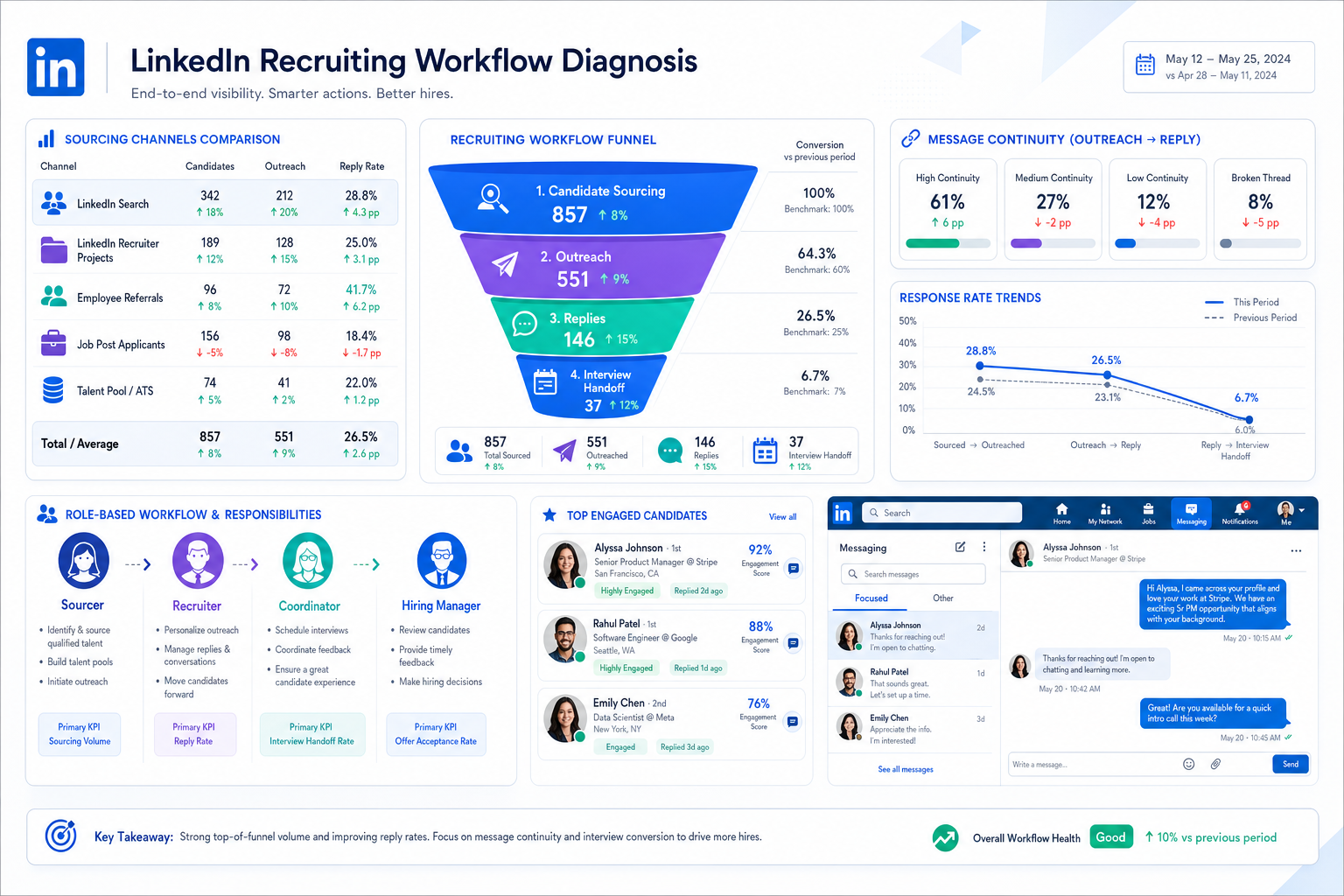
When hr sourcing stalls, this article helps recruiting leaders diagnose workflow gaps, compare channel choices, and avoid costly follow-up failures.
When that system breaks, the damage is rarely limited to a slower search. Agency recruiters lose momentum on retained work, in-house teams burn time on weak lists, hiring managers stop trusting pipeline updates, and smaller firms feel the cost most because every missed reply, duplicated search, or poorly chosen channel directly affects revenue, credibility, and team energy.
In my own workflow, I have found that AI Recruiter is most useful when the real problem is not candidate volume but message continuity and response handling. If recruiters are juggling too many live searches, its always-on outreach, multilingual messaging, and automated résumé collection can reduce the manual back-and-forth that causes promising conversations to stall. The recruiter still has to review the résumé, judge fit, and decide whether to move someone forward.
That matters because sourcing is not a solo sport. The better lesson comes from workplace teamwork itself: when a group is expected to deliver under pressure, one person cannot carry every specialty, every message, and every deadline alone. In recruiting, the same failure pattern shows up when sourcers, recruiters, coordinators, and hiring managers operate without clear roles, feedback loops, or a shared view of what a qualified candidate actually looks like.
Think about a live search where the recruiter has already opened web searches, checked old applicants, and drafted outreach, but the hiring manager keeps refining the brief, the team has no reliable handoff point, and candidate replies arrive after hours from different regions. The problem is bigger than finding names. It is a teamwork and operating-model issue, which is why the best sourcing strategies and sourcing strategies in recruitment depend on tools that support coordination, accountability, and consistent candidate follow-up rather than another isolated database.
Table of Contents
- What HR Sourcing Really Requires
- Why Teamwork Matters in Sourcing
- Why Teams Look Beyond LinkedIn
- 8 Best Sourcing Strategies for Modern Recruiting Teams
- Non-LinkedIn Talent Sourcing Tools by Category
- Quick Comparison Table
- How to Choose the Right Sourcing Tools
- How to Build a Repeatable HR Sourcing Workflow
- How to Measure Sourcing Effectiveness
- Common Mistakes in Sourcing Strategies in Recruitment
- FAQ
What HR Sourcing Really Requires
Talent sourcing is the proactive work of identifying, qualifying, engaging, and tracking people before they formally apply. In practice, hr sourcing is not just search. It is a coordinated workflow that combines target definition, channel selection, outreach, response handling, and feedback from the hiring side.
That is also why sourcing should be separated from full-cycle recruiting. Sourcing is the front end of market discovery and early engagement. Recruiting continues into screening, interview management, offers, and close. The distinction matters because many sourcing problems are actually collaboration problems: unclear intake, weak accountability, poor follow-up ownership, or limited visibility into which channels are working.
A practical sourcing system usually has five parts:
- Target definition: clear scope, skill priorities, realistic geography, compensation logic, and adjacent backgrounds.
- Channel selection: choosing where the right talent is discoverable, active, or reachable.
- Candidate identification: finding people through public profiles, communities, referrals, portfolios, and internal records.
- Outreach and follow-up: messaging with relevance, tracking replies, and maintaining cadence discipline.
- Measurement and optimization: reviewing qualified candidate rate, response quality, and interview conversion.
If one of those breaks, the whole process becomes fragile. That is why experienced recruiters often describe the best sourcing strategies as operating habits rather than hacks.
Why Teamwork Matters in Sourcing
One of the most useful ideas borrowed from broader workplace practice is that high-performance work depends on the collaboration of strengths. In recruiting, expecting one person to own intake quality, market research, outreach, candidate nurturing, hiring-manager education, and reporting all at once is usually unrealistic. Even strong recruiters eventually hit throughput limits.
When a sourcing team functions well, communication improves, better ideas surface from different perspectives, and people are more willing to test broader search angles because responsibility is shared rather than isolated. A sourcer may spot adjacent talent pools, a recruiter may rewrite outreach based on candidate objections, and a hiring manager may relax title requirements after seeing real market evidence. That collective adjustment often creates better outcomes than any single tool.
There is also a retention angle inside the recruiting team itself. Clear roles, visible contribution, and recognition matter. When recruiters can see how their work contributes to interviews and hires, morale holds up better during difficult searches. When they constantly work in a reactive environment with weak handoffs, sourcing quality drops and burnout rises.
So before comparing software, it helps to ask a more basic question: does your sourcing environment actually support teamwork? If not, tool adoption usually disappoints.
Why Teams Look Beyond LinkedIn
Many teams are looking for non-LinkedIn sourcing options because candidate signal is spread across far more places than one professional network. Strong prospects often show up more clearly in work samples, technical repositories, alumni communities, industry associations, referral networks, event participation, and your own ATS or CRM than in a single polished profile.
This matters because different roles reveal fit in different ways. Technical candidates may be easier to assess through public work and specialist communities. Operations or frontline hiring may depend more on geography, prior applicant pools, and referral loops. Senior operators may respond more through trusted networks than broad outbound search.
For recruiting teams, going beyond LinkedIn helps in practical ways:
- It widens access to niche or lower-visibility talent pools.
- It improves context through portfolios, certifications, community participation, or project evidence.
- It reduces channel dependency so pipeline health is not tied to one ecosystem.
- It supports inclusion efforts by broadening where talent is discovered.
- It strengthens passive outreach because recruiters can meet candidates where they already contribute.
The key point is simple: non-LinkedIn sourcing is not about replacing one site with one other site. It is about building a stronger team-based search model.
8 Best Sourcing Strategies for Modern Recruiting Teams
The best sourcing strategies work because they connect discovery, coordination, and follow-up. Below are eight tactics that fit modern hr sourcing and reflect how strong teams actually operate.
1. Start with a skills-based search brief
Overly narrow job titles make teams miss adjacent talent. Build the brief around outcomes, capabilities, and likely transition backgrounds. This creates a shared search language across sourcers and hiring managers.
Practical takeaway: ask for three must-have skills, three flexible skills, two adjacent backgrounds, and one likely path into the role.
2. Rediscover past applicants and CRM talent pools
Most teams underuse their own data. Previous finalists, silver medalists, and past outreach contacts can be quicker to re-engage than starting from zero.
Practical takeaway: review candidates from the last 12 to 24 months who matched similar roles or received strong recruiter notes.
3. Use Boolean and X-ray search across the public web
Boolean and X-ray methods still matter when talent is easier to find through indexed public pages, portfolios, talks, repositories, and bios than through standard profile databases.
Practical takeaway: search by skill clusters, certifications, project types, tools, and geography instead of titles alone.
4. Source from niche communities
Specialist communities often produce higher signal than broad channels because they show participation, credibility, and actual work.
Practical takeaway: prioritize places where target talent shares work, solves problems, or participates in standards and events.
5. Turn referrals into a sourcing engine
Employee referrals work best when they are structured. A vague internal request usually produces vague results.
Practical takeaway: give employees target-company examples, a short role summary, and simple outreach wording.
6. Use alumni and former employee networks
Former employees, alumni groups, and training cohorts can provide warmer access to experienced talent than cold outreach.
Practical takeaway: segment alumni by role family, region, and prior relationship strength.
7. Match the channel to the hiring scenario
Different roles need different sourcing strategies in recruitment. Technical hiring, volume hiring, and leadership hiring should not be forced into one search pattern.
Practical takeaway: judge each tactic by role type, urgency, geography, and how candidates in that market actually behave.
8. Build follow-up into the process, not as an afterthought
Search quality means little if the team cannot handle replies consistently. This is where workflow support matters.
Practical takeaway: run a two- to four-touch sequence over one to two weeks, and assign clear ownership for reply review and next steps.
Key insight: sourcing performance improves when the team treats search, communication, and accountability as one connected system.
Non-LinkedIn Talent Sourcing Tools by Category
When recruiters talk about sourcing tools, they often mix up strategy and software. Strategy decides where to look and how to judge fit. Tools help execute that plan more consistently. For non-LinkedIn hr sourcing, the main categories are usually the following.
1. AI sourcing and skills-matching tools
These tools help surface candidates based on skills, likely fit, and adjacent experience instead of exact-title matching.
Best for: lean teams, broad searches, and roles where title logic is too limiting.
What to look for: editable filters, visible ranking logic, deduplication, and easy recruiter review.
2. Boolean and web search tools
These tools support advanced search across public sources, making external research faster and easier to organize.
Best for: technical, creative, and research-heavy searches.
What to look for: flexible query building, filtering, and export organization.
3. Talent rediscovery tools for ATS and CRM databases
Rediscovery tools make old candidate records easier to search, segment, and reactivate.
Best for: teams with meaningful applicant history and repeated hiring patterns.
What to look for: parsing quality, tags, search relevance, and campaign support.
4. Outreach automation tools
These tools matter when reply handling, reminders, and sequence consistency are your real bottleneck.
Best for: teams running high outbound volume or working across time zones.
What to look for: personalization controls, cadence visibility, reply tracking, and collaboration features.
In my own testing of outreach-heavy workflows, StrategyBrain AI Recruiter was most helpful when candidate replies came in after hours or across languages. It did not replace recruiter judgment, but it reduced the lag between first contact, candidate questions, and résumé collection. That is especially useful when a small team needs to protect continuity without adding more coordinators.
5. Diversity sourcing tools
These tools are designed to broaden discovery across underrepresented communities and alternative search inputs.
Best for: teams reviewing representation, reach, and channel mix.
What to look for: transparent sourcing logic and support for inclusive criteria.
6. Niche community and portfolio discovery tools
These tools are useful when proof of work matters more than profile polish.
Best for: engineering, product, design, research, and specialist hiring.
What to look for: signal quality, discoverability, and candidate organization.
Quick Comparison Table
| Tool Category | Primary Use | Best Hiring Scenario | Main Strength | Main Caution |
|---|---|---|---|---|
| AI sourcing and skills matching | Surface likely-fit candidates faster | Lean teams, broad search needs | Speed and pattern recognition | Can over-rank incomplete data |
| Boolean and web search tools | Search public web signals | Technical and niche roles | Flexibility and reach | Requires recruiter skill |
| Talent rediscovery tools | Search ATS or CRM candidates | Repeat hiring, larger databases | Warm talent access | Weak data hygiene reduces value |
| Outreach automation tools | Manage sequences and follow-up | High outbound volume | Consistency and reply tracking | Generic messaging scales poorly |
| Diversity sourcing tools | Expand representation and reach | Teams improving channel mix | Broader discovery options | Must still align to role fit |
| Niche community tools | Find specialists through ecosystems | Skill-based and portfolio-led hiring | Higher relevance signals | Coverage may be narrower |
How to Choose the Right Sourcing Tools
The right tool depends less on category labels and more on where your current process is failing. If your team already finds people but loses them in follow-up, you need communication support. If your ATS is full of forgotten candidates, rediscovery may matter more than another external database.
Use these questions when evaluating tools:
- What hiring scenario are we solving for? Technical, frontline, executive, or repeat-volume hiring require different search logic.
- Do we need net-new discovery or better use of current data? Many teams need the second more than the first.
- Where does the workflow break today? Search, outreach, handoff, response handling, or reporting.
- Who will use the tool every day? If adoption is hard, workflow value usually collapses.
- Does it support teamwork? Shared visibility, ownership, and accountability matter more than feature count.
- Can recruiters still control the final judgment? They should.
That last point matters. Even when I use AI Recruiter for first-touch communication support, I still treat the tool as workflow infrastructure, not as a substitute for qualification judgment. It helps maintain response coverage, answer routine questions, and collect candidate information, but the recruiter remains responsible for evaluating the résumé and deciding whether the candidate belongs in the process.
How to Build a Repeatable HR Sourcing Workflow
The strongest hr sourcing model is a repeatable workflow, not a stack of browser tabs. The teamwork lesson from the opening still applies here: define roles, create accountability, and build communication channels that people actually use.
- Align on the role before search begins
Confirm outcomes, must-have capabilities, nice-to-have flex points, and business context with the hiring manager.
- Map the channel mix
Choose three to five sources based on role type, including at least one internal source, one relationship channel, and one external research channel.
- Set ownership and handoff rules
Decide who searches, who reviews replies, who updates records, and who feeds market feedback back to the hiring manager.
- Source and tag consistently
Use common tags for skill fit, geography, seniority, source, and status so the team can compare quality later.
- Run personalized outreach
Use relevant messaging tied to the role, the candidate’s background, and a realistic reason for contact.
- Track response and qualification rates
Measure who replies, who qualifies, and who moves to interview-ready stages.
- Review every two to four weeks
Look at channel quality, recruiter conversion, hiring-manager feedback, and where coordination is failing.
That review cadence is often where teams improve fastest. Just as strong workplace teams need feedback mechanisms and role clarity, sourcing teams need regular adjustment points rather than one-off search bursts.
How to Measure Sourcing Effectiveness
Many teams still evaluate sourcing by activity alone. That usually inflates vanity metrics and hides process problems. Better measurement should show whether sourcing is helping the team create qualified conversations and interviews faster.
Useful metrics include:
- Source-of-hire: which channels contribute to actual hires over time.
- Qualified candidate rate: what percentage of sourced talent meets core requirements.
- Response rate: who replies to outreach.
- Sourced-to-screen conversion: who progresses into recruiter review.
- Sourced-to-interview conversion: who reaches manager or panel interview.
- Time-to-fill support: whether sourcing reduces delays in key hiring stages.
For recruiting leaders, one simple monthly view works well: sourced candidates created, qualified candidates created, and interviews generated. That makes it easier to separate list volume from hiring value.
Common Mistakes in Sourcing Strategies in Recruitment
Even experienced teams weaken results by repeating a few avoidable mistakes. Most of them trace back to poor coordination rather than lack of effort.
Relying on one channel
If your pipeline depends on one source, performance becomes fragile.
Using titles instead of skills
Title-only search misses adjacent backgrounds and narrows the market too early.
Ignoring internal talent pools
Overlooking prior applicants wastes existing relationship equity and slows hiring.
Sending generic outreach
Passive talent responds to relevance, not volume.
Failing to define ownership
When nobody clearly owns reply review, candidate updates, or hiring-manager feedback, good leads stall.
Confusing software with strategy
No tool can fix unclear intake, weak communication, or a team that has not agreed on what good looks like.
FAQ
What is talent sourcing in recruiting?
Talent sourcing is the proactive process of finding, qualifying, and engaging potential candidates before they apply. It is a core part of hr sourcing.
How is sourcing different from recruiting?
Sourcing focuses on candidate discovery and early engagement. Recruiting covers the broader hiring journey, including screening, interviews, offers, and close.
Which non-LinkedIn talent sourcing tools are best?
The best option depends on your hiring scenario. Common categories include AI sourcing, Boolean and web search tools, ATS rediscovery tools, outreach automation tools, diversity sourcing tools, and niche community discovery tools.
Why does teamwork matter in sourcing?
Because successful sourcing depends on shared role clarity, accountability, communication, and consistent feedback between recruiters, sourcers, and hiring managers.
How do you measure sourcing effectiveness?
Track source-of-hire, qualified candidate rate, response rate, sourced-to-interview conversion, and whether sourcing helps reduce time-to-fill friction.
Conclusion
Non-LinkedIn talent sourcing works best when it is built like a functioning team: clear roles, focused communication, shared accountability, and reliable follow-up. That is the foundation of effective hr sourcing. The most useful tools are the ones that strengthen this operating model, whether by improving search reach, rediscovering forgotten candidates, or helping recruiters maintain timely communication while keeping final judgment where it belongs. In practice, the strongest best sourcing strategies and the most durable sourcing strategies in recruitment are the ones that turn fragmented effort into a repeatable system.