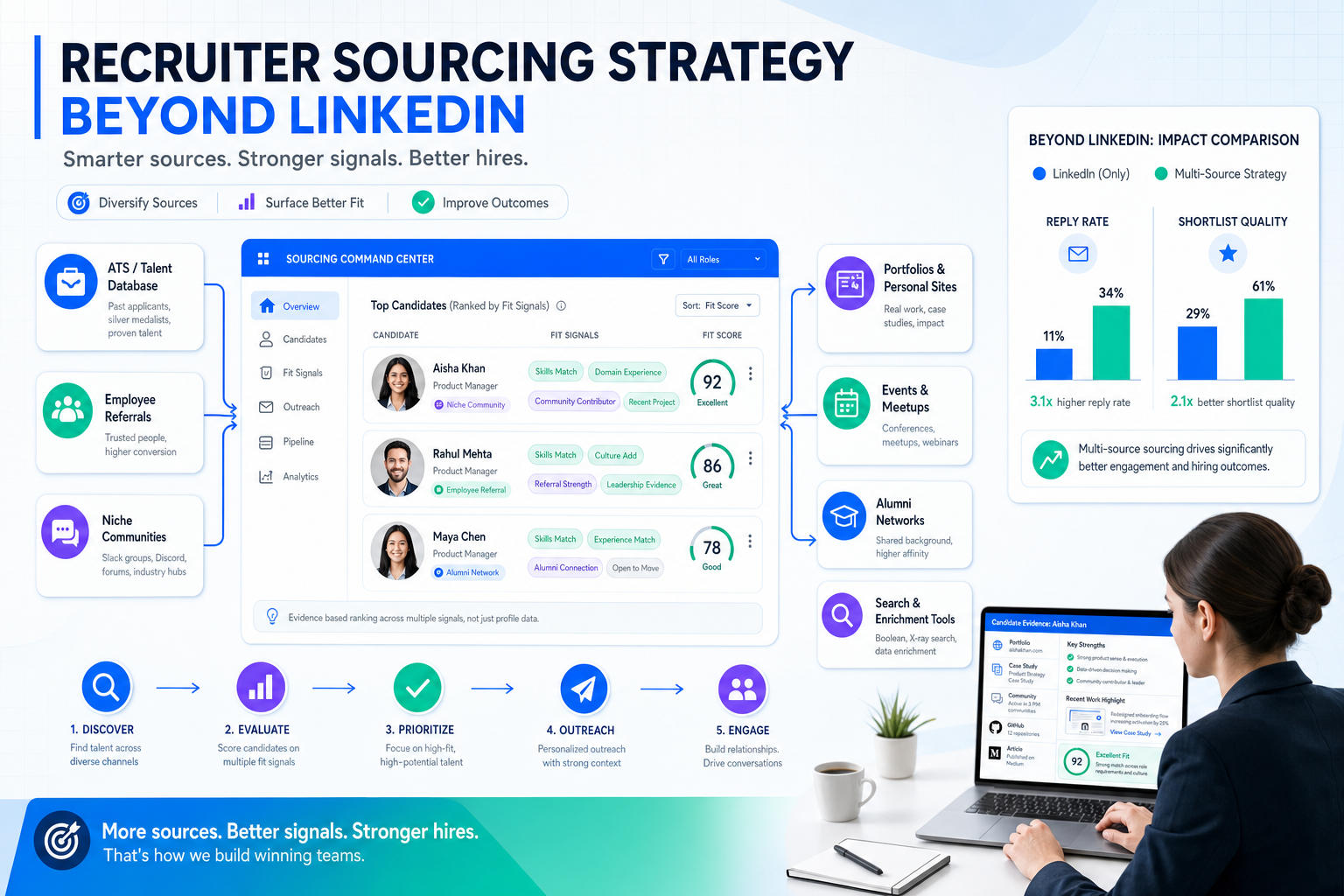
Judge hr sourcing by fit signals before outreach to avoid saturated channels, weak replies, and shortlist quality problems.
That distinction matters more than many teams admit. When recruiters keep pulling from the same platform, they do not just see the same talent repeatedly; they also create avoidable costs: weaker reply rates, thinner shortlists, more follow-up work, and hiring-manager frustration when sourced candidates look active on paper but stall in process. For smaller search firms, that means time burned on saturated outreach. For in-house teams, it can mean missed deadlines on priority roles and a damaged employer impression among passive talent who receive generic messages.
In my own workflow, the most useful support has come from pairing channel diversification with selective automation. Tools like StrategyBrain AI Recruiter can help with repetitive outreach, after-hours candidate replies, and multilingual communication when conversations span time zones, while the recruiter still owns the final judgment on fit, resume review, and next-step decisions. Used that way, it reduces manual drag without turning sourcing into blind automation.
A good way to see the issue is to step away from recruiting software for a moment and look at how managers assess a new finance manager after the hire. The real question is not whether the person looked strong in search results. It is whether they can handle deadline pressure, think independently when old processes are not good enough, and improve outcomes for the team around them. In practice, that assessment happens through visible work: meeting reporting timelines, managing competing priorities, coaching others, and showing whether they add business value rather than just maintain activity.
That same logic should shape non-LinkedIn sourcing. If recruiters can only find candidates in places where titles are easy to search but actual performance signals are thin, they struggle to judge who is likely to hit deadlines, solve problems creatively, or mentor a team after joining. That is why this guide focuses on talent sourcing tools beyond LinkedIn, plus creative ways to source candidates and practical candidate sourcing techniques that surface stronger evidence before outreach begins.
Table of Contents
- Why assessment logic should shape hr sourcing
- Why hr sourcing needs more than LinkedIn
- 12 talent sourcing tool categories beyond LinkedIn
- What signals to look for before outreach
- How to choose sourcing channels by role type
- Candidate sourcing techniques that improve results
- How to measure sourcing success
- Common mistakes in non-LinkedIn sourcing
- FAQ
Why assessment logic should shape hr sourcing
One of the most useful lessons from post-hire evaluation is simple: strong hiring decisions are easier when the team knows what real success looks like. In the finance-manager example, evaluation is not based on vague impressions. It comes back to a few grounded questions: do they deliver on time, do they improve how work gets done, and do they raise the performance of others?
That mindset is highly relevant to hr sourcing. Before a recruiter decides where to search, they need to define what signals matter for the role. If the job requires deadline ownership, process discipline, cross-functional communication, or mentoring strength, then the sourcing plan should prioritize channels where those traits are visible. This is what separates intentional sourcing from random profile collection.
It also helps recruiters avoid a common trap: overvaluing availability signals while undervaluing evidence of execution. A candidate can look easy to contact and still be a weak match. Another candidate may be harder to find, but their public work, referrals, project history, or community reputation reveals much more about likely performance after hire.
Key insight: The best sourcing channel is not the one with the most profiles. It is the one that lets you judge fit using evidence that matters after the person joins.
Why hr sourcing needs more than LinkedIn
LinkedIn remains useful, but overreliance creates a narrow and noisy market view. Everyone searches similar titles, uses overlapping filters, and sends familiar messages. The result is predictable: candidates get saturated, response quality falls, and recruiters begin competing in the most crowded possible lane.
Non-LinkedIn sourcing improves coverage in two ways. First, it gives access to talent pools where professional credibility is shown through work, contribution, or peer reputation rather than profile optimization. Second, it increases channel resilience. If one source underperforms, recruiters can still build pipeline through internal rediscovery, referrals, niche communities, events, portfolios, and re-engagement workflows.
That is one of the most practical creative ways to source candidates: stop treating sourcing as a title-search exercise and start treating it as a fit-evidence exercise. The market is broader than one network, and the best candidates often leave the strongest signals elsewhere.
I learned this especially clearly when running searches that required evening follow-up across regions. Broad-network outreach produced volume but also a lot of repetitive back-and-forth. Using StrategyBrain AI Recruiter for initial candidate communication and follow-up helped keep conversations moving overnight, while I used non-LinkedIn sources to improve who entered the pipeline in the first place. That combination worked better than trying to force every search through one channel.
12 talent sourcing tool categories beyond LinkedIn
The goal is not to stack endless tools. It is to build a focused sourcing mix that reveals different kinds of evidence and supports better recruiter judgment.
1. Internal ATS and CRM rediscovery tools
Your own database is often the fastest hidden talent pool. Past finalists, strong applicants from paused searches, and candidates who were simply mistimed can become high-value leads when a similar role opens again.
This is especially useful when a role, like a finance manager hire, needs proven deadline ownership and business partnership. Old interview notes, hiring-manager comments, and previous process outcomes often contain richer performance clues than a fresh profile search. Good hr sourcing treats the ATS as a live market asset, not just a filing cabinet.
2. Employee referral systems
Referrals add context that direct sourcing often lacks. Colleagues can identify people who are respected under pressure, who improve team performance, or who solve operational problems well. Those are the exact signals a manager usually tries to verify only after hire.
Instead of asking for broad recommendations, give employees targeted prompts tied to real outcomes. Ask who consistently handled month-end chaos, who built a cleaner process, or who was known for mentoring junior staff. These are better prompts than “send us good people.”
3. Niche communities and professional forums
Focused communities often reveal how people think, not just how they label themselves. In many specialist functions, that is more valuable than title matching alone.
Good candidate sourcing techniques in communities start with observation. See who answers difficult questions clearly, who shares useful frameworks, and who is trusted by peers. That behavior can be more predictive than a polished profile summary.
4. Code repositories and technical contribution platforms
For engineering and technical hiring, contribution history can show problem-solving style, collaboration habits, and practical depth. It is one of the clearest ways to move from surface matching to evidence-based sourcing.
Recruiters should still avoid shallow metrics. Activity counts alone rarely explain whether someone can manage complexity, document well, or improve team execution. As with the finance-manager assessment logic, the useful question is what signs indicate they can do the work in the real environment.
5. Portfolio and creator platforms
For design, content, marketing, and product roles, portfolios often outperform resumes as a sourcing signal. They show how a person frames problems, what quality standards they apply, and how consistently they execute.
That makes them one of the strongest non-LinkedIn sources for hr sourcing. If the role depends on judgment and craft, source where judgment and craft are visible.
6. Event and conference sourcing tools
Events are useful because they capture active practitioners around a shared topic, challenge, or discipline. Speaker lists, attendee groups, and workshop communities can uncover candidates who care enough about the field to invest time in it.
Use this source before and after the event. Pre-event sourcing helps build a target map. Post-event follow-up gives you a timely reason for outreach that feels less generic and more relevant.
7. Alumni and education networks
Alumni communities can support both warm outreach and targeted searches, especially for functions where peer trust and domain familiarity matter. They can also help with career-transition talent that broad databases often miss.
The best use is not prestige filtering. It is identifying people shaped by similar training environments, problem sets, or professional communities.
8. Social channels outside professional networks
Public social channels can show interests, side projects, communication style, and domain engagement. They are particularly relevant for creator, community, product, developer-relations, and market-facing roles.
Used responsibly, this becomes one of the more creative ways to source candidates. The goal is not to invade personal space; it is to identify public professional signals and use them to write more relevant outreach.
9. Talent pooling and re-engagement platforms
Some tools are built to help recruiters revisit and reactivate people over time. That matters because timing changes. A candidate who was unavailable six months ago may be open now because the manager changed, the work model shifted, or their priorities evolved.
I have found that this is where disciplined documentation matters most. If previous conversations captured why the person paused, what they cared about, and what role conditions mattered, follow-up feels informed instead of transactional.
10. Search-and-enrichment systems
These tools combine discovery with added context such as contact details, public signals, and profile synthesis across sources. Their real value is not just speed. It is helping the recruiter make a better first decision about who deserves tailored outreach.
When I used AI Recruiter support in an outreach workflow, the operational gain was not magical matching. It was freeing time from repetitive candidate messaging so I could spend more energy reviewing evidence, comparing backgrounds, and deciding which profiles actually justified a personalized approach.
11. Manager and team network mapping tools
Hiring managers often know which companies train the right people, which adjacent titles transfer well, and which former peers consistently perform. Bringing that market knowledge into sourcing expands quality far more than another broad keyword search.
This is one of the most underrated candidate sourcing techniques. Managers are often better at recognizing role adjacency than databases are.
12. Community-based employer channels
Some teams build long-term sourcing leverage through newsletters, office hours, webinars, technical writeups, or local communities. It is slower than direct search, but it creates credibility and inbound trust over time.
This is especially useful when your brand is not yet well known or when your ideal candidates care more about craft and substance than polished employer messaging.
What signals to look for before outreach
If the opening case teaches anything, it is that the right sourcing question is not “Can I find this profile?” but “Can I see enough evidence to believe this person can succeed after joining?” For many roles, especially manager-level roles, outreach quality improves when recruiters screen for a few practical indicators first.
Can they deliver against time pressure?
Look for signs of ownership in deadline-driven work: launches, reporting cycles, operational cadence, cross-functional programs, or customer commitments. Someone who has consistently worked in those environments is often easier to assess than someone whose profile is all labels and no evidence.
Do they improve the work, not just maintain it?
The finance-manager assessment framework emphasized independent thinking and process improvement. In sourcing, translate that into visible signals such as system changes, process redesigns, measurable scope growth, content that explains a better way to solve a problem, or public examples of operational thinking.
Do they raise team performance?
Mentoring, coaching, documentation, onboarding support, community leadership, and collaborative project work can all indicate someone who helps others succeed. For people-management roles, this matters as much as individual output.
These signals make hr sourcing more precise because they mirror what hiring managers will eventually care about after the offer is accepted.
How to choose sourcing channels by role type
Different roles expose different evidence in different places. Start with what success looks like, then choose channels where those signals are easiest to observe.
| Role Type | Best Non-LinkedIn Sources | What to Look For |
|---|---|---|
| Technical roles | Code platforms, niche communities, events, ATS rediscovery | Contribution depth, specialization, collaboration, documentation |
| Finance and operations roles | Referrals, alumni groups, ATS, niche associations, events | Deadline ownership, process improvement, stakeholder management |
| Design and creative roles | Portfolio sites, communities, referrals, creator platforms | Problem framing, craft quality, consistency, communication |
| Sales and customer roles | Referrals, CRM re-engagement, events, public social channels | Market familiarity, communication style, customer context |
| People managers and team leads | Referrals, network mapping, ATS, niche communities | Mentoring signals, cross-functional influence, execution under pressure |
For recruiters, the practical move is to choose three to five channels per role, not twelve. That keeps the search disciplined and gives you enough variation to compare source quality without creating operational chaos.
Candidate sourcing techniques that improve results
Tools help, but consistent sourcing quality comes from repeatable habits.
Start with role calibration
Before sourcing begins, align on outcomes, not just requirements. What must this person deliver? Where does the role sit in the workflow? What kind of pressure will they operate under? This step is what turns a search plan into real candidate sourcing techniques rather than keyword fishing.
Map target companies and adjacent backgrounds
Build a practical market map. Include direct target companies, adjacent sectors, and role families with transferable experience. This is one of the most effective creative ways to source candidates because it surfaces people your competitors may not be chasing.
Use evidence-led search strings
Search for projects, tools, communities, deliverables, certifications, public work, or function-specific language that indicates lived experience. Job titles alone miss too much.
Enrich before messaging
Gather enough context to write a message that explains why the person is relevant now. One specific reference to a project, contribution, or operating environment is worth more than generic praise.
Automate the repetitive layer, not the decision layer
This is where I found StrategyBrain AI Recruiter most useful. It can keep candidate communication moving, answer routine role questions, and collect resume or contact details from interested people, especially when replies arrive after hours. But the recruiter still needs to decide whether the background truly matches the role, whether the resume supports the conversation, and whether it is worth advancing.
Capture feedback loops
Note why profiles were accepted, declined, or paused. Over time, these notes sharpen channel selection, sourcing filters, and outreach quality.
How to measure sourcing success
Volume is an incomplete metric. If you care about role outcomes, you need measures that reflect whether the source creates real hiring progress.
- Reply rate: Are candidates responding?
- Positive response rate: Are they open to a discussion?
- Qualified conversation rate: Do replies turn into meaningful screens?
- Submission-to-interview conversion: Are sourced candidates moving forward?
- Source efficiency: Which channels produce the best outcome per hour invested?
- Pipeline resilience: Are strong candidates coming from multiple channels or only one?
A useful review question is borrowed from performance assessment logic: which sources consistently surface people who are most likely to perform well after they join? That question keeps teams from confusing activity with quality.
Common mistakes in non-LinkedIn sourcing
- Treating every role the same: sourcing for a hands-on specialist is different from sourcing for a people manager.
- Relying on titles too heavily: exact-title searches miss adjacent and high-transfer talent.
- Ignoring post-hire success signals: if you do not source for likely performance, you create avoidable assessment risk later.
- Forgetting your ATS: previous candidates often carry stronger evidence than cold external leads.
- Over-automating judgment: automation can support workflow, but it should not replace recruiter evaluation.
- Sending generic outreach: weak relevance lowers response rates and brand credibility.
- Failing to track channel quality: without conversion data, sourcing becomes guesswork.
The fix is disciplined execution: calibrate, select channels intentionally, enrich profiles, personalize messages, track outcomes, and refine based on evidence.
FAQ
What are the best talent sourcing tools beyond LinkedIn?
The best options usually include ATS rediscovery tools, referral systems, niche communities, portfolio platforms, event lists, alumni networks, re-engagement systems, and search-enrichment tools. The right mix depends on the role and on what evidence of fit you need before outreach.
Why is non-LinkedIn sourcing important in hr sourcing?
It reduces dependence on crowded channels, improves access to hidden talent pools, and helps recruiters find stronger fit signals than title-based profile searches alone. It also creates more resilient pipeline coverage when one source becomes saturated.
What are creative ways to source candidates without LinkedIn?
Practical options include re-engaging silver-medalist candidates from your ATS, prompting referrals around specific project environments, sourcing through portfolio evidence, using event communities before and after conferences, and mapping manager networks for adjacent talent.
Which candidate sourcing techniques improve outreach quality?
Start with role calibration, search for evidence instead of titles, enrich profiles before messaging, and personalize based on a visible reason for contact. Recruiters who source around proof of work usually get better conversations than recruiters who source around labels alone.
Can automation help with non-LinkedIn sourcing workflows?
Yes, especially for repetitive communication and follow-up. In my experience, tools such as StrategyBrain AI Recruiter are most useful when they handle repetitive messaging and candidate replies while the recruiter keeps control of fit assessment, resume review, and advancement decisions.
Conclusion
Strong hr sourcing beyond LinkedIn is not about collecting more tools for the sake of it. It is about using the same judgment you would apply after the hire and moving that judgment earlier into the sourcing process. If a hiring manager will eventually care about deadlines, initiative, and team impact, then your sourcing channels should help you see those signals before the first outreach.
That is the real advantage of a diversified sourcing approach. It gives recruiters better evidence, less channel saturation, and more control over pipeline quality. Start with a few focused sources, apply disciplined candidate sourcing techniques, and use automation only where it removes repetitive friction. That is how creative ways to source candidates become a repeatable system rather than a one-off tactic.