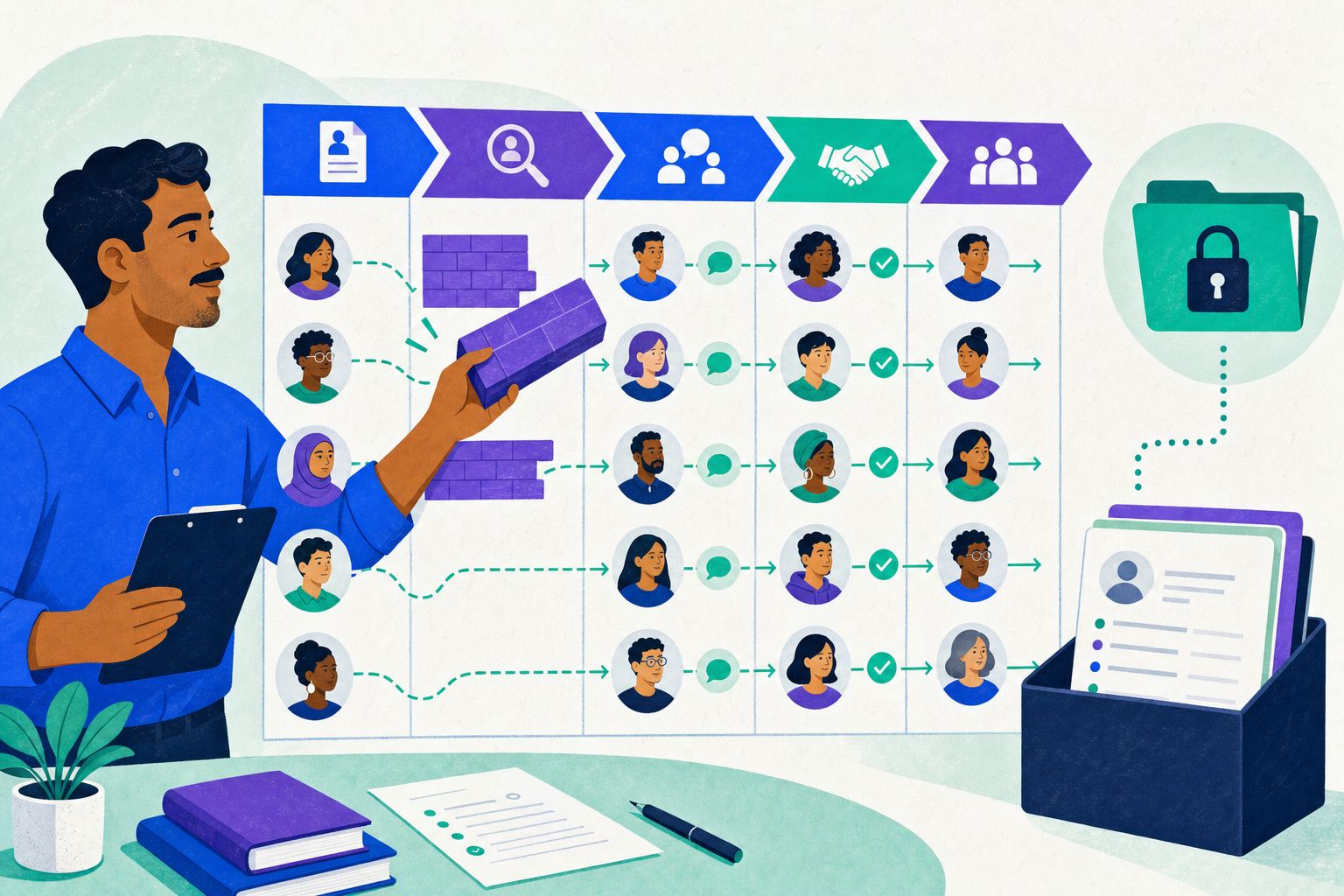
Recruitment leaders can use this guide to audit inclusive hiring baselines, locate pipeline barriers, and test initiatives with data.
Without that discipline, small recruitment firms spend time on outreach that does not broaden the qualified pipeline, individual headhunters struggle to explain inconsistent shortlists, and corporate recruiters lose credible candidates at preventable screening or assessment hurdles. The damage extends beyond efficiency: unclear standards strain hiring-manager relationships, inaccessible processes weaken employer reputation, and poorly governed data creates legal, privacy, and candidate-trust risks.
Recruiting technology can relieve part of this pressure by recording source activity, standardizing candidate stages, supporting multilingual communication, and keeping follow-up from disappearing across inboxes. It should not determine who deserves a job. Recruiters must remain responsible for reviewing résumés, interpreting job-related evidence, granting appropriate exceptions, and deciding what happens next.
Consider the review point faced by an inclusion and diversity lead at a career-focused apprenticeship provider. After several diversity initiatives had launched, the team opened its applicant records, compared representation across recruitment stages, and checked whether apprentices later completed their qualifications and remained satisfied with the program. The exercise exposed a basic difficulty: an initiative could sound promising while the organization still lacked a reliable baseline for determining whom it reached or where people encountered barriers.
That apprenticeship example captures the operating challenge behind inclusive hiring. Recruiters need voluntary, appropriately governed demographic data to examine representation; structured evidence to assess individual candidates; and feedback covering application, selection, progression, retention, and experience. The most useful inclusive hiring practices—and the most defensible diversity hiring best practices—connect those elements without turning personal characteristics into selection criteria.
Working principle: Maintain legitimate performance standards, remove methods that do not measure those standards, and use data to test whether the redesigned process works.
Table of Contents
- What inclusive hiring means
- Build a responsible data foundation
- Interpret achievement in context
- Design roles around real work
- Improve advertising and sourcing
- Screen for evidence
- Use structured, accessible interviews
- Make evidence-based decisions
- Handle offers and onboarding
- Measure results and improve
- Govern recruiting technology
- Apply U.S. legal guardrails
- Implementation checklist
- Frequently asked questions
What Inclusive Hiring Means in Practice
Inclusive hiring is the deliberate removal of unnecessary barriers throughout recruitment so qualified people can access the process and demonstrate job-relevant capability. It covers role design, advertising, sourcing, screening, interviews, selection, offers, onboarding, and measurement.
Diversity hiring is closely related but has a different emphasis. It typically examines representation in a workforce or candidate pipeline. Inclusive recruitment asks whether the process gives qualified people an equitable opportunity to participate and provide evidence. Equitable hiring considers whether candidates receive fair access and appropriate support while the organization maintains consistent, job-related standards.
| Approach | Primary focus | Question for recruiters |
|---|---|---|
| Inclusive hiring | Removing unnecessary barriers | Can qualified candidates access the process and demonstrate capability? |
| Diversity hiring | Representation in pipelines and workforces | Are different groups reaching and progressing through the process? |
| Equitable hiring | Fair access, treatment, and support | Are barriers addressed without changing legitimate job standards? |
The distinction matters operationally. A sourcing campaign may create a broader applicant pool, but its value is limited if vague screening rules, inaccessible assessments, or improvised interviews repeatedly exclude qualified people. Strong diversity hiring best practices therefore combine wider access with clear competence definitions, consistent evaluation, and stage-level analysis.
Build a Responsible Inclusive Hiring Data Foundation
Data should begin with a decision, not a dashboard. Before collecting another field, identify the business question: Is the organization trying to broaden access to entry-level careers, find a screening barrier, improve accommodation delivery, or understand why candidates withdraw? A precise question makes it easier to choose a baseline, define a target, and evaluate the intervention.
The apprenticeship provider in the opening example used an intersectional view rather than treating identity as a set of isolated categories. Its analysis considered information such as gender, ethnicity, disability, neurodiversity, education, socioeconomic background, sexual orientation, and caring responsibilities. It then examined outcomes across application, recruitment, qualification completion, satisfaction, progression, and retention.
That model offers a useful lesson, but it should not become a universal data-collection template. The appropriate fields depend on jurisdiction, purpose, workforce size, privacy obligations, and the organization’s ability to protect the information. Collecting sensitive data without a defined use, access policy, or reporting method creates risk without improving decisions.
Rules for Responsible Demographic Data Collection
- Define the purpose: State which recruitment or workforce question each field will help answer.
- Make disclosure voluntary: Give people a genuine option not to provide the information.
- Separate monitoring from selection: Individual interviewers and decision-makers generally should not use demographic monitoring data to score candidates.
- Limit access: Restrict sensitive information to authorized people with a legitimate need.
- Protect small groups: Suppress or combine reporting where small sample sizes could identify individuals.
- Explain retention: Tell candidates what is collected, why it is used, how long it is kept, and whom they can contact.
- Review local law: Data-protection and employment requirements differ across countries, states, and localities.
Look Beyond the Final Hire
Hiring totals cannot show where a barrier occurred. Recruiters should inspect application rates, screening decisions, assessment completion, interview progression, offers, acceptances, withdrawals, and early onboarding. Where appropriate, the organization can also review later outcomes such as progression and retention to determine whether the promise made during recruitment matches the employment experience.
Employee and candidate surveys add information that administrative records cannot capture. Questions about feeling respected, understanding the process, obtaining necessary resources, or accessing an appropriate working environment can reveal friction that conversion figures miss. Pulse surveys can be useful after a process change, while less frequent surveys can track longer-term sentiment. Participation should remain voluntary, and reporting should protect confidentiality.
Assess Potential Without Ignoring Context
One of the most useful ideas from the apprenticeship setting is contextual interpretation. Prior attainment can reflect access to opportunity as well as ability. A candidate who achieved a strong result while managing limited resources, caring responsibilities, or educational disruption may have demonstrated relevant capability that a raw credential does not reveal.
Contextual assessment is not permission to invent assumptions about a person. Recruiters need defined evidence and a controlled process. For example, a team might recognize verified alternative credentials, compare achievement with the opportunities available, or use a work sample to assess current capability directly. Candidates should be told what evidence is relevant and given a fair way to provide it.
The apprenticeship provider assessed future potential through five broad competency areas that included persistence, conscientious behavior, motivation, interpersonal ability, and communication. That can widen the evidence considered, but terms such as persistence or motivation become subjective unless they are translated into observable behavior.
| Broad concept | More defensible evidence | Weak shortcut |
|---|---|---|
| Persistence | Adapting an approach after a documented setback | Assuming career gaps indicate low commitment |
| Motivation | Explaining the role-specific work the candidate wants to perform | Rewarding enthusiasm style or constant availability |
| Communication | Organizing relevant information for the role’s actual audience | Preferring a familiar accent or conversational style |
| Interpersonal effectiveness | Resolving a stakeholder disagreement with a reasoned approach | Using an undefined feeling of cultural fit |
In practice, I treat contextual information as a prompt to seek better evidence, not as an automatic positive or negative score. The recruiter still has to connect the evidence to the work, document the interpretation, and apply the same rule to comparable candidates.
Stage 1: Design the Role Around Real Work
Many barriers originate before sourcing begins. Hiring managers inherit degree requirements, inflated experience thresholds, prestigious-employer preferences, or long software lists that no longer reflect the position. The recruiter’s first task is to distinguish what a person must be able to do from the conventional profile of someone who previously held the job.
Run a Skills-Based Requirements Review
- Define business outcomes: Describe what the person must deliver and why it matters to the wider team or customer.
- Identify essential competencies: Connect every minimum requirement to a real task, regulatory obligation, or material risk.
- Separate trainable skills: Move capabilities that can reasonably be learned after joining out of the minimum threshold.
- Accept equivalent evidence: Consider relevant experience, portfolios, apprenticeships, work samples, and alternative credentials.
- Remove unsupported proxies: Challenge degrees, uninterrupted employment, employer prestige, location, and arbitrary years of experience.
- Record the reasoning: Preserve why each criterion is essential before applications arrive.
Understanding the larger business goal is critical. An interviewer cannot fairly evaluate project leadership, for example, if the team has not explained whether the role is expected to stabilize an existing operation, launch a new service, or influence resistant stakeholders. The same résumé evidence may have different relevance in each context.
Stages 2 and 3: Improve Advertising and Sourcing
A job advertisement should help candidates make an informed decision. Use a recognizable title, plain language, clearly separated essential and preferred qualifications, a realistic description of working conditions, and an outline of the selection process. State how candidates can request reasonable accommodation without requiring them to disclose sensitive details to the hiring manager.
| Before | After | Recruitment benefit |
|---|---|---|
| “Marketing rock star with a degree and seven years of agency experience.” | “Plan and improve paid and organic campaigns. Essential evidence includes budget management, performance analysis, and recommendations to stakeholders. Equivalent experience and relevant portfolio work are welcome.” | Replaces prestige and tenure proxies with observable skills. |
| “Must thrive under pressure and work long hours.” | “Manage competing deadlines, communicate delivery risks, and provide occasional pre-planned support outside standard hours.” | Describes the actual condition instead of applying a vague endurance test. |
Broaden Access Without Tokenism
Inclusive sourcing starts with capabilities and then asks where people with those capabilities may be found. It does not assume that one school, association, community, or platform represents an entire demographic group.
- Use multiple search terms for equivalent skills, qualifications, and career routes.
- Review whether employee referrals are concentrated in the same professional networks.
- Build relationships with relevant educational, apprenticeship, and professional communities.
- Write outreach around the work and candidate value rather than demographic assumptions.
- Track which sources produce qualified applicants and which candidates progress.
- Give new channels enough time and recruiter attention to generate meaningful evidence.
Source data requires careful interpretation. A channel that generates many applications but few interviews may be attracting unsuitable profiles, or the screening rule may be too narrow. Recruiters need to inspect both possibilities before closing the channel or claiming that broader outreach failed.
Stage 4: Screen for Evidence, Not Familiarity
Unstructured résumé review encourages decisions based on prestigious employers, familiar career paths, polished formatting, or personal similarity. A short screening rubric should be approved before applications arrive. It should state what evidence is sufficient, what is missing, and when clarification is more appropriate than rejection.
| Competency | Acceptable evidence | Do not use as a shortcut |
|---|---|---|
| Project delivery | Completed work, documented responsibilities, portfolio evidence, or a relevant work sample | Employer reputation alone |
| Technical capability | Applied experience, assessment evidence, or an equivalent credential | Degree title alone |
| Stakeholder communication | Examples of advising, presenting, coordinating decisions, or resolving issues | Writing style unrelated to the job |
| Learning ability | A specific example of acquiring and applying a needed skill | Assumptions based on age or career length |
Skills-based hiring does not require a team to accept every substitute as equally persuasive. It requires the team to determine whether the evidence credibly demonstrates the necessary capability. Rejection reasons should map to predefined criteria, and recruiters should periodically review whether those reasons are being used consistently.
Stage 5: Use Structured and Accessible Interviews
Structured interviews are among the strongest inclusive hiring practices because they improve candidate comparability. Every candidate should receive the same core job-related questions. Follow-up questions may differ when clarification is necessary, but they should probe the same competency rather than create easier or harder interviews for different people.
Build the Interview Before Meeting Candidates
- Select a limited set of competencies tied to successful performance.
- Write behavioral or situational questions for each competency.
- Define weak, acceptable, and strong scoring anchors.
- Tell candidates what the process will involve.
- Have interviewers rate evidence independently before group discussion.
- Require notes that explain the rating rather than impressions such as “great fit.”
Make the Candidate Journey Accessible
- Explain the format, duration, technology, and preparation expectations in advance.
- Provide a clear, confidential route for requesting reasonable accommodation.
- Use captioning and accessible documents where appropriate.
- Test interview platforms for keyboard and assistive-technology use.
- Provide an alternative assessment when the standard format creates a barrier unrelated to the job.
- Train the person handling requests so candidates are not repeatedly asked to disclose the same information.
Consistency and accessibility are compatible. An accommodation may change how a candidate participates without changing the competency being assessed. The team should document that distinction so interviewers do not mistakenly interpret support as an advantage or evidence of reduced capability.
Stage 6: Make Selection Decisions From Recorded Evidence
A decision meeting should compare evidence, not reward the most persuasive interviewer. Begin with the agreed criteria and review independent scores before open discussion. When ratings differ substantially, ask which answer, work sample, or observed behavior supports each score.
- Do not introduce new selection criteria after candidates have completed the process.
- Do not use undefined cultural fit as a veto.
- Separate observed evidence from inference in interview notes.
- Apply any competency weighting consistently.
- Record the final decision and its job-related reasons.
- Review whether exceptions were available and handled consistently.
Inclusive hiring does not always mean mechanically selecting the candidate with the highest total. A role may contain critical competencies that carry greater weight. The weighting must, however, be defined before the team knows which candidate benefits from it.
Stages 7 and 8: Keep Offers and Onboarding Inclusive
The offer stage can reintroduce inequity when salary, flexibility, start dates, or employment conditions are handled inconsistently. Establish the approved range and decision factors before negotiation. Explain the offer in plain language, provide accessible documents, and give candidates reasonable time to review the terms.
Accommodation discussions should remain separate from unsupported assumptions about capability. A request for an accessible document, modified communication method, or workplace adjustment should start the appropriate review process—not a new debate about whether the candidate belongs in the role.
After acceptance, confirm practical requirements, share a clear first-week schedule, explain how systems and workspaces are accessed, and identify a reliable contact. Transfer only the accommodation information required for a confidential and effective handoff. The opening apprenticeship example examined completion and satisfaction as well as recruitment because access to a role has limited value if the new hire lacks the resources needed to succeed.
Measure Inclusive Hiring Across the Lifecycle
A useful measurement cycle has four parts: establish a baseline, set a specific objective, introduce a defined change, and review the data after enough time has passed. If results do not improve, examine implementation quality and alternative explanations before adding more initiatives.
| Measure | What it may reveal | Recommended response |
|---|---|---|
| Applicant representation | Whether outreach reaches a broader pool | Review channel mix, message clarity, and advertisement accessibility |
| Stage conversion | Where groups progress, withdraw, or are screened out at different rates | Audit criteria, communications, assessments, and access |
| Interview-to-offer rate | Whether interview decisions show unexplained patterns | Review questions, scoring anchors, notes, and calibration |
| Accommodation delivery | Whether candidates can request and receive support | Check instructions, ownership, response time, confidentiality, and alternatives |
| Candidate experience | Whether the process feels clear, respectful, and usable | Prioritize recurring friction and close the feedback loop |
| Offer acceptance and withdrawal | Whether expectations, terms, or delays cause candidate loss | Review communications, timelines, flexibility, and offer consistency |
| Progression and retention | Whether access is followed by opportunity and support | Connect recruitment findings with onboarding and workforce practices |
A difference in conversion is a signal for investigation, not proof of a single cause. Small sample sizes, role mix, location, incomplete disclosure, and process changes can affect the result. Where adverse-impact concerns arise, involve qualified legal and analytical specialists rather than relying on a dashboard alone.
Use Surveys as Diagnostic Evidence
The apprenticeship provider supplemented lifecycle data with recurring inclusion and wellbeing surveys. Its questions examined whether people felt included and respected and whether they had the resources and working environment needed to perform. Recruitment teams can apply the same logic to candidate and new-hire feedback without copying the exact survey design.
Ask focused questions at moments when people can respond meaningfully: after an assessment, after process completion, and during early onboarding. Keep the survey short, allow optional comments, protect anonymity where promised, and publish what the team changed. Collecting feedback without acting on repeated issues undermines trust.
Govern Recruiting Technology and Automation
Recruiting systems can improve consistency by storing approved requirements, scorecards, stage changes, source information, and disposition reasons. They can also scale a flawed rule. Technology governance should therefore examine the complete candidate journey rather than the recruiter interface alone.
- Accessibility: Test applications, assessments, messages, and documents with relevant assistive technologies.
- Job relevance: Require a documented link between every automated signal and the work.
- Human review: Assign someone who can examine, override, and explain an automated outcome.
- Data separation: Keep voluntary demographic monitoring information out of individual scoring workflows.
- Alternatives: Offer another application or assessment method when the standard route is inaccessible.
- Change control: Recheck outcomes after configuration, model, assessment, or workflow updates.
- Auditability: Preserve stage history and job-related decision reasons without retaining unnecessary data.
In my workflow reviews, I look first at whether technology preserves the approved criteria and makes missing evidence visible. I then test whether a recruiter can correct a stage, review an exception, and recover the reasoning behind a decision. A system that produces more activity but obscures these controls is not supporting inclusive hiring.
Automated outreach and multilingual messaging may help candidates receive timely information across locations and time zones. Those functions are most useful when messages accurately describe the role, candidates can reach a person when necessary, and automation does not infer qualification from willingness to respond. Recruiters must still review the résumé and make the next decision.
Apply U.S. Legal and Ethical Guardrails
For U.S.-focused recruitment, broader outreach, accessible processes, and consistent job-related assessment can support inclusive hiring. These efforts should not become protected-characteristic preferences, quotas, candidate exclusions, or individual scoring criteria unless a specific lawful framework has been reviewed by qualified counsel.
Legal obligations vary by employer, role, contract, location, data type, and technology. Recruiters should document why selection criteria matter, keep sensitive monitoring information appropriately separated, follow applicable accommodation procedures, and obtain legal advice for specific policies and decisions.
Headhunters need the same discipline when acting for clients. A client’s informal request does not make an unlawful or unsupported criterion acceptable. Translate the request into job-related competencies, challenge vague profile preferences, and preserve a clear record of the agreed requirements.
Inclusive Hiring Practices: Implementation Checklist
- Set the objective: Identify the business problem, baseline, target, and review period.
- Design the role: Separate essential outcomes from trainable or preferred qualifications.
- Define evidence: Decide what can credibly demonstrate every required competency.
- Advertise clearly: Use plain language, realistic conditions, process details, and an accommodation route.
- Broaden sourcing: Expand channels and search terms without using demographic assumptions.
- Structure screening: Apply a predefined rubric and record job-related disposition reasons.
- Assess accessibly: Use consistent questions, scoring anchors, independent ratings, and reasonable accommodations.
- Select transparently: Compare evidence, challenge unsupported impressions, and document the rationale.
- Protect data: Make sensitive disclosure voluntary, limit access, and explain use and retention.
- Extend support: Carry necessary accessibility arrangements into offers and onboarding confidentially.
- Review the lifecycle: Examine conversion, experience, progression, retention, and recurring barriers.
- Adjust deliberately: Change one defined part of the process, monitor it, and retain or revise it based on evidence.
Common Mistakes in Diversity Hiring
- Measuring representation without measuring process: Final workforce figures do not show where candidates were lost.
- Collecting data without a decision plan: Sensitive information creates risk when nobody knows how it will be used.
- Treating disclosure as mandatory: Candidates need a genuine option not to answer demographic questions.
- Confusing context with assumption: Contextual assessment needs verified evidence and consistent rules.
- Using potential as an undefined score: Terms such as motivation and resilience require behavioral anchors.
- Training without redesigning the process: Awareness does not replace rubrics, accessible assessments, or accountability.
- Optimizing only for speed: A faster process is not better if it creates inaccessible or unexplained exclusions.
- Expecting immediate transformation: Inclusion is a systems problem that requires repeated measurement and adjustment.
Frequently Asked Questions
Is inclusive hiring the same as diversity hiring?
No. Diversity hiring generally focuses on representation in candidate pools or workforces. Inclusive hiring focuses on removing unnecessary barriers so qualified people can access recruitment and demonstrate job-relevant capability. The approaches reinforce each other, but neither substitutes for the other.
What data should an inclusive recruitment team collect?
Collect only information tied to a defined and lawful purpose. Operational data may include sources, stages, disposition reasons, withdrawals, accommodations, offers, and candidate feedback. Voluntary demographic data may support aggregate analysis where collection is lawful, transparent, secure, and separated from individual selection decisions.
Why is intersectional analysis useful?
Single categories can hide different experiences within a group. Intersectional analysis may reveal that barriers affect combinations of background or circumstance differently. It also increases privacy and sample-size concerns, so organizations should use careful aggregation, suppression rules, and expert review.
How can recruiters assess potential fairly?
Translate potential into observable, job-related behavior. Use structured questions, relevant work samples, scoring anchors, and credible evidence of learning or adaptation. Context may help explain an achievement, but recruiters should not infer personal circumstances or award points based on assumptions.
How do structured interviews support inclusive hiring?
They give candidates the same core questions and evaluate answers against predefined criteria. Independent ratings and evidence-based notes reduce the influence of familiarity, personal similarity, and undefined cultural fit. Structured interviews must still be accessible and open to reasonable accommodation.
Can recruitment automation make hiring more inclusive?
Automation can improve consistency, stage tracking, communication, and follow-up. It can also scale inaccessible design or weak criteria. Teams should test accessibility, validate job relevance, protect sensitive data, preserve human review, and monitor outcomes after changes.
How quickly should inclusive hiring results appear?
Timing depends on hiring volume, the intervention, and the outcome being measured. Application or stage-conversion changes may appear sooner than progression or retention results. Set a baseline and review period in advance, but avoid drawing strong conclusions from very small samples.
Conclusion: Treat Inclusion as a Measured System
Effective inclusive hiring is not a campaign attached to recruitment. It is a disciplined system that defines real work, broadens legitimate access, evaluates comparable evidence, protects sensitive information, supports accessibility, and checks outcomes across the candidate and employee lifecycle.
Start with one vacancy and one measurable question. Review the requirements, build a competency-based rubric, test the candidate journey, record stage outcomes, and ask participants what impeded their progress. Then compare the results with the baseline and improve the process one controlled step at a time.