When response speed and candidate fit keep breaking searches, this article helps recruiters judge whether is linkedin or indeed better for jobs.
The problem is that many teams still compare these platforms by raw posting volume or personal preference, then wonder why they get either plenty of applicants with weak fit or polished profiles with little interview movement. Solo recruiters lose time chasing replies across platforms. Small agency owners lose margin when follow-up stalls after hours. In-house hiring teams lose stakeholder trust when they cannot explain why a search is active but not converting.
That is one reason I have used StrategyBrain AI Recruiter in LinkedIn-heavy workflows: not to replace recruiter judgment, but to keep outreach moving, answer candidates in real time, and capture resumes or contact details while interest is still warm. In practice, its always-on messaging and multilingual communication are most useful when candidate conversations would otherwise sit overnight, while the recruiter still handles final resume review, fit assessment, and interview decisions. If you want to understand the setup and use cases, the product page and tutorial examples at this overview and this field note are a fair place to start.
The comparison becomes sharper when the role itself is not just transactional. Think of a finance leadership search where the employer is not hiring a spreadsheet operator but a change catalyst, a steward of risk, and a trusted advisor who has to align multiple decision-makers. In that kind of search, the recruiter is not simply posting a vacancy and hoping volume does the job. They are checking the requisition, mapping likely stakeholders, reviewing profile depth, and watching for signs that the candidate can influence a business, not just report on it.
Now the friction shows up fast. A broad board may generate more applications, but many will not prove strategic range. A network-led platform may surface stronger profiles, but only if outreach is timely and the recruiter can maintain conversation quality across time zones and work hours. That is the real bridge into indeed vs linkedin: this is not only a candidate question. It is a sourcing, workflow, and judgment question about whether you need breadth, credibility, or both.
Table of Contents
Is LinkedIn or Indeed Better for Jobs? Quick Verdict
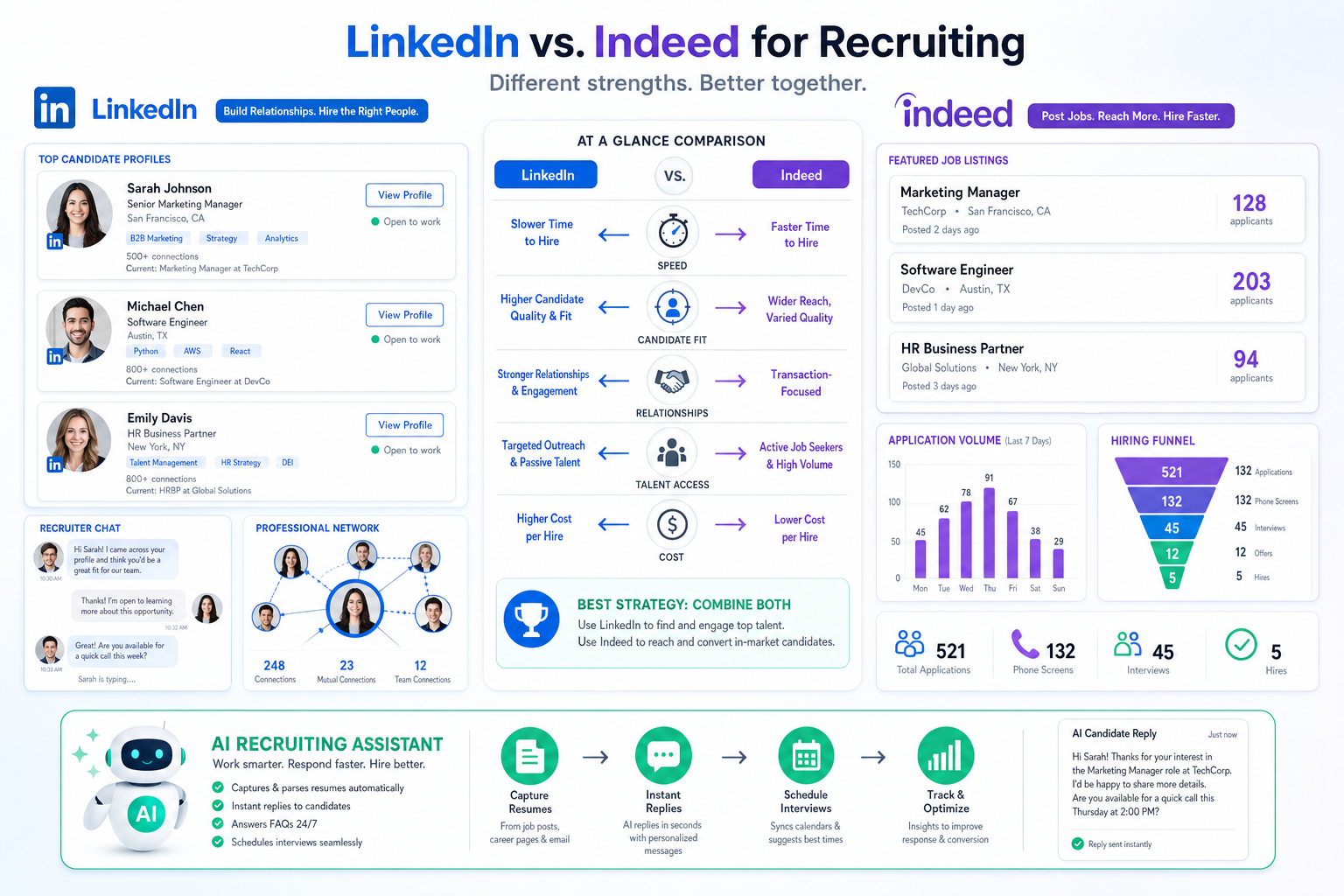
If you want the shortest usable answer, Indeed is usually better for broad, active job search and faster application volume, while LinkedIn is better for recruiter visibility, relationship-led hiring, and targeted professional moves.
But that answer only becomes useful when you tie it to search type:
- Choose Indeed first when speed, local coverage, and high application throughput matter most.
- Choose LinkedIn first when profile credibility, passive talent access, and networking shape outcomes.
- Use both when you need search breadth and market positioning at the same time.
As a recruiter, I rarely treat this as a winner-takes-all decision. The better frame is job board versus professional network. One is built to help people cover more openings quickly. The other is built to make professional identity visible enough for recruiters, hiring managers, and search consultants to act on it.
Why the Comparison Gets Misread
People often search is indeed or linkedin better as if both platforms are trying to do the same job. They are not.
Indeed is strongest when the market is active, the role is clear, and the candidate is willing to apply now. LinkedIn is strongest when the opportunity requires trust, narrative, and signal quality beyond a resume upload. That difference matters even more in hiring markets where seniority, specialization, or business influence shape the shortlist.
The leadership-search example above is useful because it forces the real issue into view. A CFO-level hire is no longer evaluated as a number processor sitting alone with reports. The role is expected to drive change, protect assets, manage risk, and create alignment across executives. When the job requires that kind of stewardship and influence, the platform that gives a recruiter richer profile context often becomes more valuable than the platform that simply produces more applications.
Practical takeaway: The more a role depends on trust, strategic judgment, and stakeholder buy-in, the more LinkedIn tends to outperform a pure volume channel. The more a role depends on active search breadth and immediate application flow, the more Indeed tends to lead.
Indeed vs LinkedIn: Side-by-Side Comparison
| Factor | Indeed | |
|---|---|---|
| Primary role | Job board and job search engine | Professional network with job discovery |
| Best for | High-volume applications and broad market coverage | Networking, sourcing, and targeted career moves |
| Candidate behavior | Mainly active job seekers | Active and passive candidates |
| Recruiter visibility | Moderate | High when profiles are complete |
| Application speed | Usually faster | Good, but profile quality matters more |
| Relationship value | Lower | Higher |
| Best-fit roles | Entry-level, hourly, local, operational | Professional, managerial, specialist, executive |
| Main weakness | More noise and duplicate-looking listings | Better outcomes often require profile effort and outreach discipline |
If your only question is indeed vs linkedin, this table is enough to set direction. If your real question is how recruiters actually get hires from both, the workflow matters more than the platform label.
When Indeed Works Better
Indeed usually wins in situations where speed and coverage matter more than professional narrative.
1. Broad search coverage
Indeed is typically the better starting point for candidates who want to see a lot of openings quickly. That includes local jobs, operations roles, support positions, and early-career searches where applying broadly is rational.
2. Faster application rhythm
Many candidates can apply faster on Indeed, which matters when urgency is high. Recruiters also benefit from faster applicant flow when hiring at volume.
3. Better for active candidate markets
When the role depends on people who are ready to move now rather than passive talent who may need cultivation, Indeed usually gives more top-of-funnel momentum.
The tradeoff is quality control. More listings do not always mean more unique opportunities, and more applications do not always mean better fit. A recruiter still has to sort noise from signal.
When LinkedIn Works Better
LinkedIn tends to win when the hire depends on credibility, relationships, and context.
1. Better recruiter discovery
A strong LinkedIn profile gives recruiters more than a title history. It shows trajectory, role scope, network signals, recommendations, activity, and often enough context to judge whether outreach is worth the effort.
2. Better for targeted career moves
If the next role is a step up, a pivot, or a reputation-sensitive move, LinkedIn is usually more effective than a pure job board. That is especially true for managers, specialists, consultants, and executives.
3. Better for passive candidate outreach
Many of the best conversations in recruiting start before someone applies. LinkedIn is built for that dynamic in a way that traditional job boards usually are not.
So when people ask is linkedin or indeed better for jobs in the professional end of the market, my answer is often LinkedIn first, especially if discovery by recruiters is a meaningful part of the strategy.
What Leadership and Specialist Searches Reveal
The finance leadership example from earlier is worth expanding because it shows why platform choice is really about role design. In modern hiring, senior finance leaders are expected to be catalysts for change and stewards of the business, not isolated technical operators. Recruiters filling those roles have to evaluate whether a candidate can handle risk, influence stakeholders, and support growth decisions with data.
That is why the search process itself looks different. The recruiter reviews the role brief, checks who the decision-makers are, compares profiles for signs of commercial judgment, and then reaches out in a way that can sustain a serious conversation. In a market like that, a static posting alone rarely does enough.
I have found this is exactly where AI Recruiter can help on the LinkedIn side without pretending to replace the recruiter. In my own use, the biggest gain was continuity: candidates replied after hours, the system kept the conversation moving, introduced the role, answered common questions, and collected resumes from interested people before the thread went cold. I still made the actual call on fit, shortlist quality, and next steps. For cross-border searches, the multilingual support matters more than most teams expect because a delayed reply can quietly kill momentum.
That experience does not make LinkedIn universally better. It makes LinkedIn better for certain kinds of searches, especially those where the quality of interaction shapes who stays in the funnel.
General LinkedIn Alternatives Beyond Indeed
If your broader topic is general linkedin alternatives, it helps to widen the lens beyond these two giants.
Niche job boards
Niche boards can outperform both LinkedIn and Indeed when the role belongs to a specialized community. Technical, nonprofit, academic, healthcare, design, and industry-specific markets often respond better to focused channels.
Company career pages
Direct employer sites remain underrated. They often carry the cleanest version of the job, reduce confusion from syndicated duplicates, and can help candidates avoid applying through stale listings.
Search aggregators
Aggregators are useful for market scanning. They are less useful as a trust signal. Candidates should still verify openings at the employer source.
Communities, referrals, and alumni networks
For relationship-led hiring, these can beat public platforms entirely. This is especially true for hard-to-fill, confidential, and leadership-oriented roles.
That is why the best answer to is indeed or linkedin better is often incomplete on its own. The better strategy is channel mix.
A Practical Recruiter Workflow
Here is the workflow I usually recommend when recruiters or serious job seekers are trying to decide how to split effort:
- Start with Indeed for market coverage. Use it to map job volume, titles, locations, and broad demand.
- Use LinkedIn for credibility and outreach. Optimize profile quality or sourcing quality, depending on which side of the market you are on.
- Move important applications to company sites. That reduces ambiguity and confirms the role is current.
- Add niche channels where the role justifies it. Specialist markets almost always need this.
- Keep response time tight. This is where an automation layer can help on LinkedIn, especially when candidate engagement depends on immediate follow-up.
When I have used StrategyBrain AI Recruiter, it fit best into step five. It handled repetitive first-touch messaging, maintained conversation flow, and helped collect resume details while I focused on evaluation. For recruiters doing international searches or juggling several LinkedIn pipelines, that is a real operational advantage. If you want to review more implementation detail, the vendor’s conversation examples are available here.
Software and Platform Mix: 3 Common Options
Because this topic touches platform use and workflow, it helps to compare three common options recruiters actually encounter.
1. LinkedIn
- Use experience: Strong for sourcing, profile review, networking, and recruiter-led outreach.
- Effect: Best when trust, seniority, and passive talent access matter.
- Cost reality: Often worth the spend for specialist and white-collar searches, but not always ideal as the only channel for volume hiring.
- Best for: Agencies, in-house recruiters, specialist hiring, leadership searches.
- Works with AI Recruiter: Very well, because the workflow benefit is in message handling, follow-up continuity, and resume capture on LinkedIn conversations.
2. Indeed
- Use experience: Fast, broad, practical, and easy to use for active job markets.
- Effect: Strong for application flow and local or high-volume hiring.
- Cost reality: Can be efficient for broad reach, though conversion quality varies heavily by role.
- Best for: Entry-level, hourly, local, operations-heavy hiring.
- Works with AI Recruiter: Indirectly. Indeed can feed awareness and applicant flow, while LinkedIn plus AI support handles outreach-driven parts of the funnel.
3. ZipRecruiter
- Use experience: Simple posting and distribution model, convenient for employers who want reach without complex sourcing behavior.
- Effect: Useful for broad exposure, though less relationship-driven than LinkedIn.
- Cost reality: Better suited to employers wanting straightforward job advertising rather than deep passive-candidate engagement.
- Best for: Small and midsize employers, generalist hiring needs.
- Works with AI Recruiter: As a complementary channel rather than a direct workflow pair, since the strongest automation use case here remains LinkedIn-based outreach and response handling.
The point is not that one tool replaces the others. It is that each one serves a different part of the funnel. For recruiters, the best stack usually combines a board for reach, a network for quality, and a workflow layer to prevent slow follow-up from wasting hard-won interest.
FAQ
Is Indeed better than LinkedIn for jobs?
Indeed is usually better for broad search coverage and fast applications. LinkedIn is usually better for networking, recruiter visibility, and targeted professional moves. The better platform depends on the role and how the hiring market behaves.
Should I apply on Indeed or LinkedIn?
If speed matters, Indeed is often easier. If your profile and professional context are part of your value, LinkedIn can be stronger. For important opportunities, verify the job on the employer site either way.
Do recruiters use LinkedIn more than Indeed?
For sourcing and passive talent outreach, many do. For incoming applicant volume, Indeed still matters a great deal. Most experienced recruiters use both because they solve different problems.
Why do the same jobs appear on multiple platforms?
Because employers often distribute jobs through several channels at once, including direct postings, job feeds, and recruiting systems. Duplicate visibility does not always mean more unique jobs.
Is LinkedIn only useful for white-collar jobs?
No, but it is strongest where professional identity and network context influence hiring decisions. That is why it tends to outperform for specialist, managerial, and leadership roles.
What is the best general LinkedIn alternative?
Indeed is the most practical broad alternative for many job seekers. Beyond that, niche boards, employer career pages, and referral communities can all be strong alternatives depending on the role.
Conclusion
So, is linkedin or indeed better for jobs? The practical answer is still the same, but now with better context: Indeed is better for volume and speed, while LinkedIn is better for visibility, credibility, and relationship-led hiring.
The more a role looks like a transaction, the more Indeed tends to help. The more a role looks like leadership, stewardship, influence, or specialist judgment, the more LinkedIn tends to matter. That is the lesson recruiters learn quickly on searches where candidates are expected to do more than execute tasks.
And if LinkedIn is a meaningful part of your workflow, tools like StrategyBrain AI Recruiter can make the channel more usable by keeping conversations live, handling repetitive outreach steps, and collecting candidate information while the recruiter stays responsible for final selection. In real recruiting, that combination of platform fit and process discipline is usually what produces better hires.