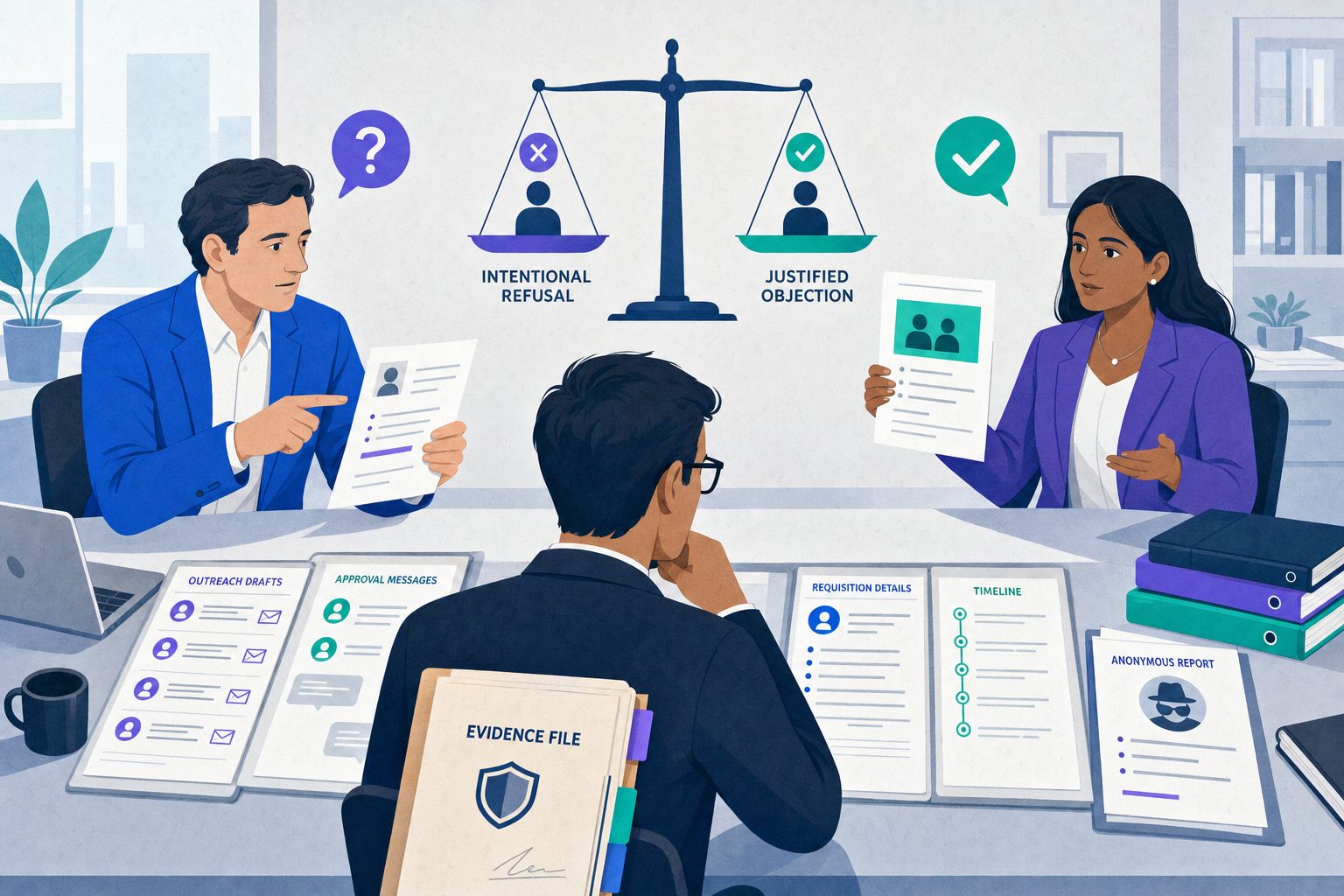
Recruiting leaders can use this framework to assess employee misconduct without mistaking a justified objection for insubordination.
Without that discipline, a small recruitment agency may lose productive consultants, an individual headhunter may damage relationships with candidates and clients, and an internal recruiting team may discipline someone for a communication failure rather than deliberate defiance. The costs extend beyond investigation time: inconsistent decisions can weaken trust, disrupt delivery, expose confidential information, and damage the employer brand among candidates who already receive crowded, impersonal outreach.
An AI-supported recruiting workflow can reduce some of that pressure by maintaining timely candidate communication, recording responses consistently, and collecting résumés and contact details from interested people. These capabilities can preserve useful context when a complaint concerns outreach instructions or follow-up activity, but the recruiter must still evaluate the résumé, investigate disputed conduct, and make every employment decision.
Consider a sourcing consultant who is preparing outreach for a product manager search. She reviews the requisition, researches each candidate’s background, drafts a short subject line, personalizes the opening, and ends with one clear request for a conversation. Before she sends the messages, her manager directs her to replace them with a generic bulk email containing a compensation statement she cannot verify.
The consultant asks for confirmation, explains the accuracy concern, and pauses the send. The manager repeats the instruction, the campaign remains unsent, and the missed launch is reported as insubordination. During the same period, an unidentified colleague uses the employee anonymous reporting channel to allege that recruiters are regularly being told to make unsupported claims. The investigation must now distinguish intentional refusal from a justified objection while preserving the outreach drafts, approval messages, requisition details, and follow-up history.
This scenario connects communication quality with employee misconduct. A concise message, reliable research, personalization, a clear next action, an identifiable sender, and a documented follow-up plan are not only outreach practices; they also create evidence of what was requested and why. When anonymous complaints in the workplace raise related concerns, investigators need a process that tests the directive, the employee’s understanding, the reason for noncompliance, and the surrounding records without assuming either side is correct.
Key takeaway: Do not begin with the proposed penalty. First determine whether an authorized manager issued a clear, lawful, and reasonable directive, whether the employee understood it, and whether the employee intentionally refused without a valid justification.
Table of Contents
- Why communication context matters
- What qualifies as insubordination
- How to structure the complaint
- The three-part investigation test
- Step-by-step investigation workflow
- Anonymous complaints and reporting
- Interview questions
- Credibility and findings
- Corrective action and documentation
- Retaliation prevention and follow-up
- Common mistakes
- Investigation checklist
- Frequently asked questions
Why Recruitment Communication Context Matters
Recruiting communication takes place in an unusually crowded environment. Historical industry estimates have placed global email traffic at roughly 320 billion messages per day, while cited recruitment benchmarks have suggested that many candidates are passive prospects and that subject lines materially influence whether messages are opened. These figures should not be treated as permanent performance benchmarks, but their operational lesson remains relevant: recruiting instructions must be precise, credible, and easy to execute.
A direction to “send more messages” leaves important questions unanswered. Which candidates should receive them? What role and compensation information has been approved? Should recipients reply, schedule a call, or complete an application? Who owns follow-up? A vague instruction may produce poor results, but it also makes a later employee misconduct allegation difficult to assess.
Recruiting teams can adapt several established outreach principles to create better investigation records:
- Define the audience and purpose. Identify the candidate group, requisition, communication objective, and approved claims.
- Research before acting. Confirm that candidate information, role details, compensation, location, and requirements are current.
- Keep the direction focused. State the required action, deadline, channel, and expected outcome without burying them in unrelated information.
- Specify one next step. Conflicting instructions make compliance harder to demonstrate and evaluate.
- Identify the accountable sender. Approved signatures and ownership records clarify who authorized and delivered a communication.
- Document follow-up. Record reminders, questions, revisions, objections, and the final decision.
These controls do not eliminate disputes. They make it easier to determine whether a recruiter ignored a valid instruction, misunderstood an incomplete request, lacked the required information, or raised a legitimate concern about candidate communications.
What Qualifies as Insubordination?
Insubordination is generally an employee’s intentional refusal to follow a lawful and reasonable directive from an authorized manager. It is narrower than employee misconduct as a whole. Harassment, dishonesty, confidentiality breaches, policy violations, and unprofessional behavior may constitute misconduct without involving a refusal to follow an instruction.
A defensible insubordination finding normally requires evidence that:
- A person with appropriate authority issued a sufficiently clear directive.
- The directive was lawful, reasonable, and consistent with applicable policy.
- The employee received and understood the directive.
- The employee intentionally refused or unreasonably delayed compliance.
- No safety, legal, ethical, accommodation, authority, or practical issue justified the response.
| Issue | Typical factual pattern | Appropriate focus |
|---|---|---|
| Possible insubordination | The employee understood a valid directive and deliberately declined to follow it. | Authority, intent, justification, impact, and consistency. |
| Poor performance | The employee attempted the work but delivered an inadequate or late result. | Standards, workload, skill, training, and resources. |
| Misunderstanding | The employee interpreted an ambiguous instruction differently. | Wording, communication channel, clarification, and context. |
| Practical inability | The employee lacked access, time, data, equipment, or required approval. | Whether compliance was reasonably possible. |
| Constructive disagreement | The employee questioned the decision but ultimately complied. | Whether a separate conduct policy was implicated. |
| Potentially justified refusal | The employee identified a safety, legal, ethical, discriminatory, or policy concern. | The validity of the concern and how it was communicated. |
Record observable behavior rather than a manager’s conclusion. “The consultant did not send the approved campaign by 4 p.m.” is more useful than “The consultant was defiant.” Neutral wording gives the investigator a testable allegation.
Structure the Complaint Before Investigating It
A well-structured complaint serves the same purpose as a strong communication outline: it identifies the audience, objective, essential facts, supporting material, and required next step. An investigator should be able to answer the following intake questions:
- Who issued the directive, and what authority did that person have?
- What exactly was the employee required to do?
- When and through which channel was the instruction communicated?
- What deadline, quality standard, or outcome applied?
- What did the employee say or do in response?
- Was clarification requested or provided?
- What documents, systems, witnesses, or records can test the allegation?
- Did the employee raise a legal, safety, ethical, accommodation, or practical concern?
For recruiting-related disputes, preserve the full business context. That may include the requisition, approved compensation range, candidate criteria, outreach drafts, authorization history, candidate replies, workflow stages, message timestamps, and instructions from the hiring manager. A single screenshot rarely tells the whole story.
The Three-Part Test for Investigating Insubordination
1. Was the directive authorized, clear, lawful, and reasonable?
Identify the person who issued the instruction and confirm that the person had authority over the work. Record the exact task, deadline, expected output, communication channel, and business purpose. Instructions affecting candidates should also be compared with approved role information, privacy rules, communication policies, and client commitments.
A directive can be operationally important and still be too vague to support an insubordination finding. “Improve response rates” is a goal. “Send the approved revised message to the 20 listed candidates by 3 p.m. and record each response” is an instruction that can be tested.
2. Did the employee receive and understand it?
Message delivery is not the same as understanding. Ask the employee to describe the instruction in their own words. Compare that account with meeting notes, acknowledgments, follow-up questions, drafts, task updates, and later conduct.
Understanding may be supported when the employee accurately restated the assignment, produced part of the requested work, or identified the specific requirement they opposed. It may be weakened by conflicting directions, missing attachments, inaccessible systems, changed deadlines, or different versions of the same brief.
3. Was there an intentional refusal without a valid reason?
Intent is usually inferred from the surrounding evidence. Relevant facts include explicit statements, repeated reminders, selective compliance, conduct after clarification, availability of required resources, and whether the employee proposed a workable alternative.
Investigators must also test justification. A recruiter who refuses to make a knowingly false representation presents a different issue from a recruiter who simply dislikes an approved message. Likewise, delayed work caused by missing access or conflicting priorities should not be treated as deliberate defiance without additional evidence.
Step-by-Step Employee Misconduct Investigation
- Define the allegation neutrally. Describe the directive, expected action, employee response, date, and alleged impact without making a finding.
- Assess immediate risks. Consider safety, retaliation, evidence loss, candidate harm, client obligations, confidentiality, and operational disruption.
- Choose proportionate interim measures. Preserve records, pause disputed communications, adjust access, or separate decision-making responsibilities when necessary. Avoid measures that appear punitive before findings are reached.
- Select an impartial investigator. The investigator should have no stake in the outcome and sufficient authority and competence to gather evidence.
- Preserve complete records. Collect original messages, email threads, task histories, policies, meeting notes, system logs, approved outreach, and relevant files.
- Create an investigation plan. List each allegation, the applicable policies, witnesses, evidence sources, interview sequence, and unresolved questions.
- Interview the reporting person and key witnesses. Begin with open questions, then establish exact words, dates, actions, and sources of knowledge.
- Interview the employee. Provide enough detail for a meaningful response and explore understanding, intent, obstacles, and possible justification.
- Conduct focused follow-up. Test new evidence, resolve material inconsistencies, and give the employee an opportunity to address important adverse information.
- Assess credibility and make allegation-specific findings. Apply the organization’s stated standard consistently.
- Choose a proportionate response. Consider seriousness, intent, impact, comparable cases, relevant history, and mitigating circumstances.
- Document and monitor. Record the rationale, communicate appropriate closure, preserve confidentiality, and monitor retaliation risks.
Investigator’s discipline: Gather evidence to answer the defined questions, not to support the outcome preferred by the most senior participant.
Handling Anonymous Complaints in the Workplace
Anonymous complaints in the workplace can support a legitimate inquiry even when the reporter’s identity is unknown. Anonymity may restrict follow-up, but it does not make an allegation inherently false or unreliable. The initial decision should depend on specificity, seriousness, corroboration, policy relevance, and whether there is a reasonable path to investigate.
| Concept | Meaning | Practical implication |
|---|---|---|
| Anonymity | The organization does not know the reporter’s identity. | The inquiry depends on report details, independent evidence, witnesses, and secure follow-up. |
| Confidentiality | Identity and case information are restricted to people with a legitimate need to know. | Absolute secrecy should not be promised because limited disclosure may be required for fairness. |
Evaluate an anonymous report using five factors
- Specificity: Does it identify dates, instructions, words, participants, systems, or records?
- Corroboration: Can independent messages, documents, schedules, logs, or witnesses test it?
- Severity: Could the reported conduct create legal, safety, ethical, financial, or significant operational risk?
- Policy relevance: Does the alleged conduct fall within a workplace rule or reporting obligation?
- Investigability: Can facts be gathered without speculating about or trying to expose the reporter?
Effective employee anonymous reporting should allow secure two-way communication. A one-way form may capture an accusation but prevent the investigator from clarifying the date, disputed directive, potential witnesses, or location of records. A protected follow-up channel improves investigability while allowing the reporter to remain unidentified.
Do not turn the investigation into a search for the reporter. Focus on the alleged employee misconduct unless identifying the source is necessary, lawful, and supported by a compelling reason. Attempts to expose a good-faith reporter can deter future reporting and create a separate retaliation concern.
Interview Questions for an Insubordination Investigation
Questions for the manager
- What exactly did you instruct the employee to do?
- Why was the instruction necessary, and what business outcome did it support?
- What authority did you have to issue it?
- When, where, and through which channel was it communicated?
- What deadline, standard, or approved material did you provide?
- What showed that the employee received and understood it?
- What words or actions indicated refusal?
- Did the employee raise concerns or propose an alternative?
- What clarification or additional opportunity to comply did you provide?
- Which witnesses and records can confirm or challenge your account?
Questions for the employee
- What instruction did you understand you had received?
- Who issued it, and what did you understand their authority to be?
- What did you do after receiving the instruction?
- What prevented or delayed compliance?
- Did you believe the direction was unsafe, unlawful, misleading, discriminatory, impractical, or inconsistent with policy?
- Did conflicting instructions or missing information affect your response?
- Did you raise an accommodation or another work-related limitation?
- What alternative did you propose, if any?
- What evidence or witnesses support your account?
- After clarification, were you able and willing to comply?
Questions for witnesses
- What did you personally see or hear?
- Where were you, and who else was present?
- What words were used, as accurately as you can recall?
- Did you observe clarification, objection, refusal, delay, or later compliance?
- Have you discussed the event with anyone else?
- Which records could confirm your account?
Do not coach witnesses or circulate a shared version of events before interviews. Separate firsthand observations from assumptions, conclusions, and information received from other people.
Assessing Credibility and Reaching Findings
Credibility is not determined by seniority, confidence, likability, or polished presentation. A persuasive account generally aligns with reliable records, remains consistent on material facts, explains contrary evidence, and is supported by independent information.
| Factor | What to examine | Important caution |
|---|---|---|
| Firsthand knowledge | Whether the person directly saw, heard, sent, received, or performed the relevant act. | A sincere secondhand statement remains secondhand. |
| Contemporaneous evidence | Messages, drafts, notes, task records, and files created near the event. | Records may be incomplete or stripped of context. |
| Material consistency | Whether the central account remains stable over time. | Minor memory differences do not necessarily indicate dishonesty. |
| Independent corroboration | Evidence from sources that did not originate with the same person. | Repeated retelling of one account is not independent support. |
| Plausibility | Whether the account fits the sequence, systems, and known working conditions. | Personal assumptions should not replace evidence. |
| Motive or bias | Conflicts, interests, retaliation concerns, and reasons to misstate facts. | Possible bias is a factor, not proof of dishonesty. |
Make a separate finding for each allegation. Depending on organizational policy, findings may be described as substantiated, unsubstantiated, or inconclusive. Each conclusion should identify the applicable standard, decisive facts, important contrary evidence, and reasoning.
Before finalizing the report, ask whether the same evidence and reasoning would be accepted if the manager and employee occupied different levels of seniority. That consistency check can expose assumptions that have not been supported by facts.
Corrective Action and Documentation
A substantiated finding does not automatically require the most severe penalty. Corrective action should be proportionate to the employee misconduct, consistent with policy and comparable cases, and informed by aggravating and mitigating circumstances.
Factors to consider
- The clarity, lawfulness, reasonableness, and importance of the directive.
- Whether the refusal was explicit, repeated, disruptive, or temporary.
- Whether the employee acted in good faith or raised a valid concern.
- The operational, candidate, client, safety, or financial impact.
- Whether the manager provided adequate information and clarification.
- Relevant prior conduct, where policy permits it to be considered.
- Consistency with responses to comparable cases.
- Whether coaching, training, mediation, a warning, or reassignment can address the issue.
What the investigation record should contain
- A neutral allegation statement and defined scope.
- The applicable policies and decision standard.
- An evidence log identifying collected and reviewed material.
- Interview dates, participants, notes, and follow-up questions.
- Credibility assessments and allegation-specific findings.
- The rationale for corrective action or no action.
- Communications made to relevant participants.
- Retention, confidentiality, and post-investigation monitoring steps.
Participants should receive the information they need without receiving the entire investigation file. The employee should understand future expectations. Reporters and witnesses should receive an appropriate closure message and a clear route for reporting retaliation or recurring conduct.
Preventing Retaliation After the Investigation
Anti-retaliation should operate as a separate control rather than a sentence added to a closure email. Protection should cover known complainants, anonymous reporters whose identities become known, witnesses, the accused employee, and other good-faith participants.
- Explain prohibited retaliation to every participant.
- Provide a reporting route outside the immediate management chain where possible.
- Assign a contact for post-investigation concerns.
- Review significant employment actions affecting participants for a reasonable period.
- Investigate alleged retaliation separately and promptly.
- Protect employee anonymous reporting channels from attempts to identify or punish users.
In recruiting functions, post-case monitoring should include internal applications, transfers, account assignments, candidate ownership, access to requisitions, performance evaluations, and references. Participation in an investigation must not quietly become a negative selection or allocation factor.
Common Investigation Mistakes
- Accepting the label instead of defining the conduct. Replace “insubordination” with a factual statement describing the instruction, response, and timing.
- Investigating without the business context. Review the requisition, approved claims, communication objective, policies, and decision background.
- Assuming message delivery proves understanding. Test what the employee actually received and believed was required.
- Confusing disagreement with refusal. An employee may question a direction and still comply.
- Ignoring justification. Examine safety, legality, ethics, discrimination, accommodation, protected activity, authority, and practical impossibility.
- Using incomplete communication records. Preserve full threads, drafts, attachments, timestamps, and system history rather than isolated excerpts.
- Promising absolute confidentiality. Explain need-to-know handling and the limits of confidentiality.
- Dismissing anonymous complaints in the workplace. Evaluate specificity and corroboration before deciding that a report cannot be investigated.
- Using one-way reporting. Employee anonymous reporting is more useful when investigators can ask protected follow-up questions.
- Choosing discipline before making findings. Separate the fact-finding role from the action decision where practical.
- Ending oversight when the case closes. Monitor retaliation and recurring conduct after the formal investigation.
Insubordination Investigation Checklist
- Describe the alleged behavior without character judgments.
- Identify the manager, exact directive, deadline, and delivery method.
- Confirm that the manager had authority to issue the instruction.
- Check whether the directive was lawful, reasonable, and policy-compliant.
- Preserve the full business and communication context.
- Determine whether the employee received and understood the instruction.
- Identify evidence of intentional refusal or unreasonable delay.
- Test safety, legal, ethical, discrimination, accommodation, protected-activity, authority, and feasibility concerns.
- Assess immediate operational and retaliation risks.
- Select an impartial investigator and define the scope.
- Maintain an evidence log and preserve original records.
- Interview the manager, employee, reporter, and relevant witnesses.
- Use secure follow-up for employee anonymous reporting where available.
- Assess credibility using firsthand knowledge, consistency, corroboration, and context.
- Make a separate finding for every allegation.
- Select a proportionate and consistent response.
- Document the rationale, communications, confidentiality controls, and follow-up plan.
- Monitor retaliation and repeated conduct after closure.
Legal and Policy Cautions
Insubordination investigations can intersect with workplace safety, discrimination rules, accommodation duties, privacy requirements, collective rights, employment contracts, representation rights, protected reporting, and rules governing investigatory interviews. The correct approach depends on the jurisdiction, worker status, applicable agreements, and specific facts.
Obtain qualified legal guidance when a case involves possible illegality, safety refusals, discrimination, accommodation, protected collective activity, union rights, senior executives, threatened litigation, regulatory reporting, or potential termination. This article provides a practical process framework and is not legal advice.
Frequently Asked Questions
What qualifies as insubordination?
Insubordination generally requires an intentional refusal to follow a clear, lawful, and reasonable directive from an authorized manager. The employee must have received and understood the instruction, and the evidence must not establish a valid justification for noncompliance.
Is poor performance the same as insubordination?
No. Poor performance generally involves an unsuccessful attempt to complete work, while insubordination involves deliberate refusal or unreasonable delay. Investigators should examine skill, workload, resources, access, expectations, and intent before classifying the conduct.
Can anonymous complaints be investigated?
Yes. Anonymous complaints in the workplace should be assessed for specificity, severity, policy relevance, available witnesses, and corroborating records. An unknown identity can limit follow-up but does not automatically make a report unreliable.
What makes employee anonymous reporting effective?
Effective employee anonymous reporting provides a protected two-way channel, clear anti-retaliation rules, restricted access, reliable case records, and an explanation of how reports are assessed. It should allow follow-up without requiring the reporter to reveal their identity.
Can an employee refuse an investigatory interview?
The answer depends on local law, organizational rules, contracts, representation rights, and the circumstances. Do not assume that hesitation is insubordination. Explain the interview’s purpose and obtain qualified guidance if protected rights may apply.
How should credibility be assessed?
Compare firsthand knowledge, contemporaneous records, material consistency, independent corroboration, plausibility, and possible bias. Job title, confidence, and demeanor should not decide the case.
When can insubordination lead to termination?
Termination may be considered when a substantiated refusal is sufficiently serious under applicable law, policy, contract, and past practice. Decision-makers should consider intent, impact, justification, comparable cases, prior history, and less severe alternatives.
Is disrespectful behavior always insubordination?
No. Disrespect may violate a conduct policy, but insubordination concerns refusal to follow an authorized directive. A rude employee who complies may present a conduct issue, while a polite employee who deliberately refuses may present an insubordination issue.
Conclusion: Investigate the Refusal, Not the Label
A reliable investigation determines whether an authorized manager issued a clear, lawful, and reasonable directive, whether the employee received and understood it, and whether the employee intentionally refused without a valid justification. Complete communication records are especially important when the dispute arises from candidate outreach, approved claims, deadlines, or follow-up responsibilities.
For headhunters, agency owners, and internal recruiting teams, the practical response is to define instructions precisely, preserve context, support secure employee anonymous reporting, document credibility reasoning, and monitor retaliation after closure. Fair process does not weaken accountability; it makes accountability consistent, evidence-based, and defensible.