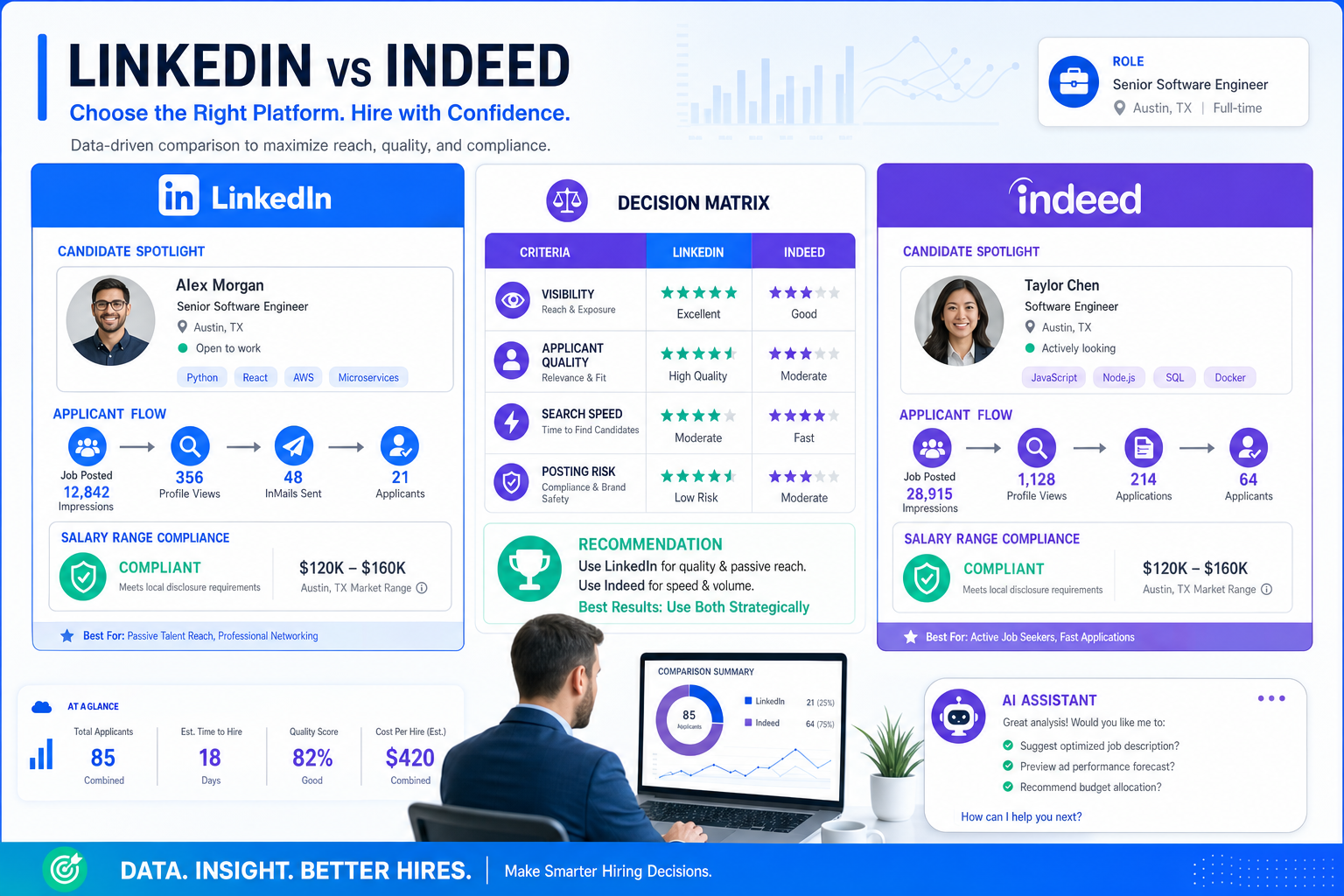
When recruiters weigh is LinkedIn or Indeed better for jobs, this comparison shows how to judge visibility, applicant quality, and posting risk to avoid wasted sourcing time.
That judgment matters more than it used to. A weak channel choice does not just slow sourcing; it can create the wrong applicant mix, bury qualified people under noise, and expose employers to avoidable posting mistakes. For smaller search firms, that means wasted recruiter hours and weaker client confidence. For in-house teams, it means slower shortlists, more screening fatigue, and harder stakeholder alignment on what a “good applicant source” actually is.
In my own LinkedIn-heavy recruiting workflow, tools that reduce repetitive outreach and candidate follow-up are most useful when they solve a real bottleneck rather than promise magic. I have found StrategyBrain AI Recruiter helpful for exactly that narrow layer: it can keep LinkedIn conversations moving, respond across time zones, and collect resumes or contact details from interested candidates while the recruiter still makes the final call on fit, resume quality, and whether to advance someone. For teams comparing platform effort as much as platform reach, that kind of support can reduce the operational drag around LinkedIn sourcing.
A more concrete pressure point appeared when pay transparency rules in British Columbia took effect on November 1, 2023. Employers posting jobs open to BC residents had to include expected pay or a pay range in publicly advertised roles, including jobs placed through third-party job boards and recruitment platforms. At the same time, employers could not ask applicants what they had earned in prior roles. In practice, that changed the first few hiring steps immediately: recruiters had to review live postings, confirm compensation language with hiring managers, and check whether a role advertised outside BC could still be filled by someone living in BC, remotely or in person.
That is why the old indeed or linkedin debate is too shallow for modern hiring. Once posting compliance, candidate visibility, search speed, and recruiter workflow all matter at once, the real question becomes broader: where does each platform help, where does it create friction, and when does a general LinkedIn alternative make more sense than either platform alone? That is the frame for this comparison of LinkedIn, Indeed, and the most useful alternatives.
Table of Contents
- Quick Answer: Is LinkedIn or Indeed Better for Jobs?
- Why This Choice Matters More Now
- LinkedIn vs Indeed at a Glance
- How Recruiters Actually Use Each Platform
- When LinkedIn Is Better
- When Indeed Is Better
- What Job Posting Rules Change in This Comparison
- Best General LinkedIn Alternatives
- A Better Workflow Than Choosing One Platform
- Decision Matrix
- FAQ
Quick Answer: Is LinkedIn or Indeed Better for Jobs?
If your goal is recruiter discovery, referrals, and professional positioning, LinkedIn usually performs better. If your goal is broad listing discovery, faster search behavior, and consistent application volume, Indeed often performs better. But the most accurate answer to is LinkedIn or Indeed better for jobs is that they solve different hiring moments.
- Use LinkedIn for visibility, credibility, and network-led hiring.
- Use Indeed for search breadth, listing comparison, and active application volume.
- Use alternatives when your field has stronger niche channels or different posting behavior.
Practical takeaway: The better platform is the one that matches the way your target market hires, not the one with the loudest brand recognition.
Why This Choice Matters More Now
Job platform choice used to be a simpler sourcing decision. Today it also touches employer branding, posting consistency, candidate trust, and in some markets even basic compliance execution. The British Columbia pay transparency changes are a useful example because they show how quickly a platform decision becomes a workflow decision.
When public job ads must show expected pay or a pay range, teams can no longer treat every channel as a passive distribution outlet. Recruiters need to know where a posting appears, what version is live, whether third-party job boards carry the same pay details, and whether a role advertised in another jurisdiction is still open to residents in a regulated market. That does not make LinkedIn or Indeed “bad.” It means channel selection now affects quality control.
For candidates, this also changes trust. A platform with clear compensation information and current listings creates a better application experience than one with stale or inconsistent postings. For recruiters, it means source strategy has to account for both conversion and posting discipline.
LinkedIn vs Indeed at a Glance
| Factor | Indeed | |
|---|---|---|
| Core model | Professional network plus jobs marketplace | Search-first job board |
| Best for | Recruiter visibility, referrals, personal brand | Broad job discovery, application throughput |
| Candidate strength | Richer profile context | Faster listing access |
| Recruiter use case | Direct sourcing and passive talent outreach | Active applicant flow and posting reach |
| Posting control concern | Brand visibility is strong, but social noise exists | Reach is broad, but listing freshness can vary |
| Main weakness | Algorithm friction and profile competition | Lower signal-to-noise ratio in applications |
Readers searching indeed vs LinkedIn often expect a universal winner. In practice, recruiters evaluate them more like different funnel inputs. One is stronger when relationships and profile depth matter. The other is stronger when search volume and easy application behavior matter.
How Recruiters Actually Use Each Platform
From a recruiting desk, LinkedIn is usually a sourcing and context platform. It helps identify passive talent, review professional history, map target companies, and approach candidates before they have applied anywhere. That is why headline clarity, experience framing, and visible credibility matter so much on LinkedIn.
Indeed is usually an active-search platform. Candidates go there to scan many openings quickly, compare locations and titles, and move directly toward applying. That creates more volume and often less relationship context. Neither pattern is inherently better; each just demands a different screening approach.
Where I have seen teams struggle is assuming the same recruiter habits work on both. On LinkedIn, slow follow-up and weak outreach hurt response rates. On Indeed, the bigger risk is poor filtering and delayed review of inbound volume. When a team uses LinkedIn heavily, that is where AI Recruiter can help at the communication layer. It keeps candidate conversations moving after hours, handles multilingual replies more smoothly than many recruiters can manage manually, and passes interested profiles back for human review. It does not replace assessment, but it can remove a lot of repetitive message handling.
When LinkedIn Is Better
LinkedIn tends to win when a job search depends on professional visibility and trust signals rather than pure listing volume. That is especially true for management roles, business development, recruiting, consulting, client-facing work, and many mid-to-senior professional functions.
1. When recruiter discovery matters
If you want to be found, LinkedIn has a built-in advantage because profiles are searchable and often reviewed before any application begins. This matters in markets where good candidates are sourced, not just screened from applicants.
2. When referrals shape outcomes
If hiring happens through warm introductions, alumni ties, peer recommendations, or manager-led outreach, LinkedIn usually has the edge. In those cases, the answer to is LinkedIn or Indeed better for jobs is often LinkedIn, because a referral pathway changes the odds more than a one-click application ever will.
3. When the profile tells a stronger story than the resume
Senior candidates often benefit from a fuller narrative: recommendations, visible career progression, shared connections, and thought leadership. A plain job board cannot carry that much context.
- Best for passive and semi-passive candidates
- Best for markets where social proof affects hiring
- Best for recruiters running targeted outreach
When Indeed Is Better
Indeed usually wins when search speed, market coverage, and active application behavior matter most. That is why many candidates comparing indeed or linkedin use Indeed as their daily search engine even if they still maintain a LinkedIn profile.
1. When you need broad discovery fast
Indeed is often more efficient for scanning many jobs by title, location, shift type, salary range, or work setup. Candidates who want a structured application routine usually prefer this format.
2. When branding yourself publicly is not a priority
Not everyone wants to post, comment, build an audience, or maintain a highly visible professional identity. For those users, Indeed is often a more comfortable search environment.
3. When your search is volume-driven
Some searches are simply about reaching enough real openings. In those cases, Indeed can outperform LinkedIn because the user intent is narrower and faster: search, compare, apply.
- Best for active applicants
- Best for title-and-location-driven searches
- Best when application pace matters more than networking
What Job Posting Rules Change in This Comparison
The BC pay transparency example is worth keeping in view because it changes how recruiters should think about job boards and social platforms. Publicly advertised roles open to BC residents must include the expected pay or pay range. That requirement can extend to roles posted by third parties and to jobs advertised in other places if someone in BC could still hold the role, onsite or remotely.
There are also process implications beyond salary disclosure. Employers should not ask applicants about past pay with other employers, and employees should not face punishment for discussing their pay. For recruiters, that means the opening conversation, posting copy, and application workflow all need tighter alignment.
This matters to the LinkedIn-versus-Indeed question because channel choice affects how easily teams can monitor posting language, update distributed listings, and keep compensation communication consistent. It also affects candidate perception. A visible mismatch in pay details across channels can lower trust before screening even starts.
So when people ask indeed vs LinkedIn, I now encourage them to add three practical filters:
- Can we keep postings current across channels?
- Does this platform support the candidate behavior we actually want?
- Will this source create more follow-up work than hiring value?
Best General LinkedIn Alternatives
For many searches, the better question is not LinkedIn or Indeed alone but which broader set of alternatives fits the role type. The strongest general LinkedIn alternatives usually fall into a few familiar buckets.
Indeed for broad search coverage
Indeed is the most direct alternative if your main need is job discovery at scale. It is broad, familiar, and efficient for active search routines.
Glassdoor for job search plus employer research
Glassdoor is useful when candidates want to compare openings alongside employer reputation, workplace sentiment, and company-level context. It can be especially useful where pay transparency and candidate trust are already sensitive issues.
Wellfound for startup hiring
For startup roles, early-stage teams, and high-variance growth environments, a startup-focused platform often surfaces better-fit opportunities than either LinkedIn or Indeed.
Other niche ecosystems
Students may do better on campus-oriented networks. Technical specialists may perform better on skill-specific boards. Creative and freelance talent may get more traction through communities and portfolio channels than through any broad professional network.
| Platform type | Best for | Why it can beat LinkedIn |
|---|---|---|
| Broad job board | High-volume search | Faster discovery workflow |
| Employer review platform | Company comparison | More culture and reputation context |
| Startup platform | Early-stage roles | Better intent matching |
| Niche community | Specialist work | Higher signal and better fit |
A Better Workflow Than Choosing One Platform
The most effective candidates and recruiting teams do not force a single-channel answer. They assign each platform a job in the process.
- Use broad boards for discovery. Find openings, compare titles, and build a realistic view of the market.
- Verify the role on the employer site. This is especially important where pay range disclosure or posting consistency matters.
- Use LinkedIn for context. Review the team, recruiter, manager, and relationship map around the role.
- Apply deliberately. Do not let one-click convenience replace fit judgment.
- Add a niche source if your field has one. Many higher-quality opportunities are not won on broad platforms alone.
In LinkedIn-led searches, I also like keeping outreach separate from evaluation. A support layer like StrategyBrain AI Recruiter can keep conversations active, answer basic role questions, and gather resumes while the recruiter remains responsible for shortlist quality. That division works best when the issue is communication throughput, not judgment.
Decision Matrix
| If your priority is... | Best starting point | Why |
|---|---|---|
| Recruiter visibility | Your profile can be sourced directly | |
| Broad job volume | Indeed | Search behavior is faster and simpler |
| Networking and referrals | Relationships materially affect outcomes | |
| Startup roles | Wellfound | Role intent is more targeted |
| Employer reputation research | Glassdoor | Better company context |
| Posting consistency checks | Company career site plus source platforms | Best way to confirm current details and compensation language |
If you still want a plain answer to is LinkedIn or Indeed better for jobs, use this rule: pick LinkedIn when the move depends on who can find you and trust you; pick Indeed when it depends on how many relevant openings you can review quickly; pick an alternative when your market hires through a more specialized channel.
FAQ
Which is better for recruiters, LinkedIn or Indeed?
LinkedIn is usually better for sourcing and relationship-led hiring. Indeed is often better for applicant volume and broad posting reach. Most recruiters need both, but for different parts of the funnel.
Is LinkedIn or Indeed better for jobs if I want remote work?
Indeed can help with broad remote-role discovery, but LinkedIn is useful for evaluating the company and people behind the job. For many remote searches, a niche remote board may outperform both.
Does Indeed usually have more listings than LinkedIn?
Many users experience Indeed as broader for listing search, but usefulness depends on freshness, relevance, and role type. More listings do not automatically mean better outcomes.
Why do recruiters still care so much about LinkedIn?
Because LinkedIn combines identity, career history, network signals, and direct outreach. It is not just a job board, which is why it remains central in many white-collar and mid-senior searches.
How do pay transparency rules affect where jobs are posted?
They raise the importance of posting consistency. If a role is publicly advertised in a regulated market, the pay range may need to appear across channels, including third-party platforms. That makes source management and career-site verification more important.
Should I apply on the company website instead of LinkedIn or Indeed?
Often yes. Use platforms to discover and research the role, then apply through the employer site when possible to confirm the most current version of the posting.
Conclusion
The best answer to is LinkedIn or Indeed better for jobs is conditional, but it is not vague. LinkedIn is stronger for recruiter visibility, referrals, and professional context. Indeed is stronger for fast discovery and active application volume. And in today’s market, where posting quality and compensation transparency can affect trust and compliance, platform choice also shapes workflow discipline.
So if you are weighing indeed or linkedin, do not reduce the decision to traffic alone. Ask how your target employers hire, how candidates behave on each platform, and how much operational control you need over the posting itself. That is usually where the right answer becomes clear.