When LinkedIn Recruiter disappoints search firms, this article helps recruiting leaders judge whether process gaps—not access—are killing ROI.
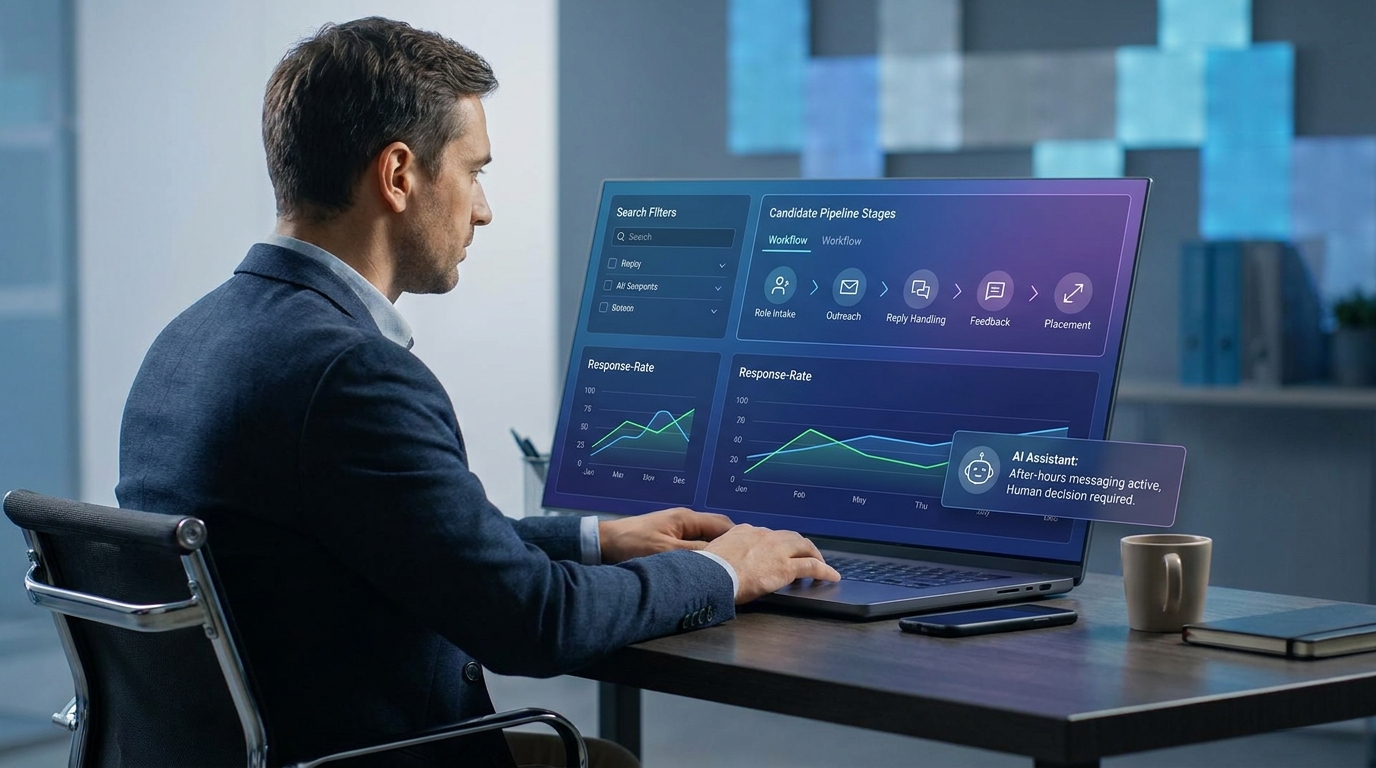
That distinction matters because most disappointing tool purchases are not really search failures. They are workflow failures. Recruiters lose time when role intake is vague, passive outreach is inconsistent, candidate replies arrive after hours, follow-up lives in inboxes, and hiring managers react late. The cost shows up in missed interviews, slower shortlists, duplicate outreach, weaker candidate experience, and hires that do not last long enough to justify the effort.
In my own LinkedIn sourcing work, one practical way to reduce that drag has been using StrategyBrain AI Recruiter to handle the repetitive first-touch layer: connecting with targeted candidates, responding when replies come in outside business hours, and collecting resumes or contact details from people who want to continue. That does not replace recruiter judgment. I still review resumes, assess fit, and decide who moves forward. But it does help when the real bottleneck is keeping outreach and early qualification moving at scale.
A more useful way to frame the buying decision starts with the recruitment process itself. Good hiring is not a one-off transaction; it is a structured sequence that reflects strategy, culture, and long-term team building. When a search opens, the strongest recruiters do not jump straight into messages. They first clarify what success in the role actually looks like, align with stakeholders on the profile, then run search, qualification, interviews, and feedback loops that can be adjusted as the market responds.
That is exactly why the question is not just whether LinkedIn gives you more profiles. It is whether the platform improves a full recruiting process from intake to outreach to feedback to placement. If you are searching for honest linkedin recruiter reviews, that is the filter to use throughout this article: not feature excitement, but whether the tool helps your team build stronger hiring outcomes instead of simply filling roles faster.
- Quick verdict: when LinkedIn Recruiter is worth it
- Why ROI starts with recruiting process quality
- What you are actually paying for
- How to calculate ROI in practical terms
- What linkedin recruiter reviews usually get right and wrong
- Best use cases by hiring team
- Three recruiting tools to compare
- Common buying mistakes that kill ROI
- FAQ
Quick Verdict: When LinkedIn Recruiter Is Worth It
If you want the shortest practical answer to is LinkedIn Recruiter worth it, it is usually worth it when your team hires continuously, needs passive candidates, and has a consistent process for converting searches into real conversations, interviews, and hires.
It is much less compelling when hiring is occasional, roles are easy to fill through inbound channels, or the team lacks the operating discipline to define the role well, coordinate outreach, and react quickly to candidate interest.
That sounds obvious, but it is the core lesson behind many mixed linkedin recruiter reviews. The software can expand access, but access alone does not create ROI. Structured execution does.
Why ROI Starts With Recruiting Process Quality
One of the biggest mistakes buyers make is treating recruiting software as if it begins and ends with sourcing. In practice, hiring value is created across a chain: initial consultation with stakeholders, building the target profile, searching, qualifying, interviewing, adjusting based on feedback, and supporting the final close. If any of those stages break, the expensive sourcing seat gets blamed for problems it did not create.
Experienced recruiters already know this from search work. A role that looks urgent but is poorly defined will produce weak targeting. A strong target list with slow feedback will lose candidate momentum. A good shortlist with poor candidate handling can still lead to a bad hire. That is why recruitment is better viewed as a strategic process that supports alignment, represents the employer, and helps the business evolve through each hire.
Seen through that lens, LinkedIn Recruiter is not just a database. It is one part of a broader operating system for talent acquisition. The return depends on whether it strengthens a process your team can already run with discipline.
Practical takeaway: judge the tool by whether it improves role clarity, search quality, response handling, stakeholder feedback speed, and final placement quality together.
This is also where automation can help without replacing professional judgment. In searches where candidate replies came in late at night or across time zones, I found that AI Recruiter worked best as a support layer for repetitive LinkedIn communication. It kept first-response momentum going in the candidate's language, surfaced interested people, and handed me resumes and contact details to review. The final qualification step still stayed with me, which is exactly how it should be for serious recruiting work.
What You Are Actually Paying For
Most buyers start with seat cost. Recruiters should start with a more useful question: what access and efficiency gains are you buying, and can your team convert them into better outcomes?
In practical terms, LinkedIn Recruiter is usually bought for some mix of these capabilities:
- Advanced search filters to narrow talent pools faster
- Reach into passive candidate markets where applicants may not come inbound
- InMail capacity for direct outreach
- Recommendations and matching assistance that speed top-of-funnel work
- Shared projects and team collaboration for multi-recruiter environments
- Integrations that reduce manual admin
- Talent market insight for planning and calibration
Those features matter most when your team has already done the harder upstream work: understanding the business goal behind the hire, defining the success profile, and knowing which candidates are worth pursuing. Otherwise, more search power just creates more noise.
That is also where support tooling can be useful. For recruiters running heavy LinkedIn outreach, StrategyBrain AI Recruiter can reduce the manual burden around initial candidate engagement, especially for after-hours replies, multilingual conversations, and resume collection. It is not a substitute for stakeholder calibration or deep assessment, but it can improve throughput where repetitive outreach tasks are the actual constraint.
How to Calculate ROI in Practical Terms
If you want a serious answer to is LinkedIn Recruiter worth it, use an ROI model tied to your workflow.
The most useful inputs are:
- Cost per hire
- Time to shortlist
- Time to fill
- Qualified candidates per search
- Outreach response rate
- Recruiter hours spent on search and follow-up
- Interview-to-offer conversion
- Early retention or quality-of-hire signals
A Better ROI Sequence for Recruiting Leaders
- Start with intake quality. Was the role defined clearly enough that a recruiter could search with precision?
- Measure search output. Did the platform produce relevant candidates faster than your alternatives?
- Measure outreach execution. Were candidates contacted quickly, consistently, and with enough personalization to earn replies?
- Measure feedback loops. Did hiring teams help refine the search as market information came back?
- Measure final outcomes. Did the tool contribute to faster, better, more durable hires?
That sequence mirrors how strong recruiting actually works. It also reflects why some teams see excellent returns while others feel the platform is overpriced. If the process is reactive, disconnected, or slow to adapt, the seat becomes expensive friction rather than leverage.
| ROI Factor | What to Measure | What It Tells You |
|---|---|---|
| Role clarity | Search revisions after intake | Whether the team defined the need well enough to source effectively |
| Search quality | Qualified candidates per search | Whether access is producing relevant talent |
| Engagement | Reply and screen-booking rate | Whether outreach is converting into conversations |
| Process speed | Days to shortlist or fill | Whether workflow is actually moving faster |
| Labor efficiency | Recruiter hours saved | Whether manual LinkedIn work is being reduced |
| Hire quality | Offer acceptance and early retention | Whether better sourcing is leading to better placements |
What LinkedIn Recruiter Reviews Usually Get Right and Wrong
Many linkedin recruiter reviews split into two extremes: essential platform or overpriced seat. Both opinions can be valid, but neither means much without context.
What positive reviews usually get right
- It can be very effective for professional and specialized roles
- It gives recruiters meaningful access to passive talent
- Search depth is stronger than lighter sourcing options
- Shared workflows can help teams coordinate more cleanly
- It becomes more valuable when recruiting volume is steady
What negative reviews usually get right
- Seat cost can feel high if usage is light
- Generic InMail does not guarantee strong response rates
- Easy-fill roles often do not justify premium sourcing spend
- Implementation and adoption effort are often underestimated
- Weak hiring manager discipline can destroy perceived ROI
The reviews that help the most are the ones that ask whether the platform improved the whole recruiting cycle, not just whether the interface looked powerful.
That is why I tend to discount reviews that focus only on feature lists. In real recruiting work, the more decisive question is whether the platform supports the kind of process that leads to better hiring decisions. A tool can make your outreach broader and faster, but if the search is poorly framed or feedback is too slow, the result is still waste.
Best Use Cases by Hiring Team
In-house teams hiring specialized talent
For internal TA teams filling technical, leadership, revenue, or other hard-to-fill roles, LinkedIn Recruiter is often worth serious consideration. These teams usually benefit from deeper access to passive candidates and stronger market mapping.
Agency recruiters and retained search firms
When recruiter time is directly tied to client delivery, the value equation changes. Better search depth, faster outreach, and shared project workflows can matter a lot more. This is also where support automation can make a difference. If consultants are spending too much time on repetitive LinkedIn follow-up, an added workflow layer such as AI Recruiter can keep conversations moving while the recruiter stays focused on assessment, shortlist quality, and client advising.
Teams with structured feedback habits
Recruiter ROI improves sharply when stakeholder feedback is fast and specific. The strongest teams refine their searches in real time as market information comes back, rather than treating the original brief as fixed.
Occasional hiring or local high-volume roles
For employers that hire infrequently or fill mostly local, shift-based, or inbound-friendly roles, premium sourcing access is often unnecessary. In those cases, the better investment may be process cleanup, employer branding, referral channels, or lower-cost workflow tools.
Three Recruiting Tools to Compare
If your topic is software choice, a fair comparison should cover user experience, recruiting effect, cost logic, fit by business type, and whether the tool can work alongside your LinkedIn workflow.
| Tool | Strengths | Weaknesses | Best Fit | How It Can Work with StrategyBrain AI Recruiter |
|---|---|---|---|---|
| LinkedIn Recruiter | Strong passive-talent reach, advanced search, familiar recruiter workflow | Premium seat cost, results depend heavily on process and outreach quality | In-house TA teams, agencies, specialist hiring | AI Recruiter can support repetitive LinkedIn messaging and resume capture while recruiters use Recruiter for targeting and final judgment |
| Indeed Smart Sourcing | Useful for active talent pools and faster access to job-seeking candidates, simpler for some teams to adopt | Less valuable when the target market is truly passive or relationship-led | Mid-volume employers, roles with stronger active-candidate behavior | Can complement AI Recruiter by covering active applicants while LinkedIn outreach handles passive talent segments |
| SeekOut | Strong talent search for certain technical and diversity sourcing use cases, solid data layering | Value depends on role type and recruiter adoption, may still require strong outreach execution elsewhere | Technical recruiting teams and data-driven sourcing functions | AI Recruiter can help operationalize LinkedIn-based first contact after target lists are identified through broader search tools |
The reason to compare them this way is simple: no sourcing platform wins in every environment. LinkedIn Recruiter often has the strongest brand recognition, but brand is not ROI. Fit is ROI.
From a usage standpoint, LinkedIn Recruiter usually feels strongest when recruiters already know how to search precisely and personalize outreach. Indeed Smart Sourcing can feel more straightforward for teams centered on active applicants. SeekOut can be powerful for research-heavy sourcing, especially in specialized technical markets. But none of them removes the need to keep candidate communication moving. That is where I found StrategyBrain AI Recruiter especially useful as a companion layer for LinkedIn-heavy work, because it reduced the dead time between outreach, candidate replies, and resume capture without taking final screening decisions away from the recruiter.
Common Buying Mistakes That Kill ROI
Buying access before defining the role well
If the intake is weak, the search will be weak. That problem starts before any software is opened.
Confusing outreach volume with recruiting quality
More messages do not mean better hiring. Candidate motivation, fit, and timing still need thoughtful evaluation.
Ignoring the feedback loop
Great recruiting teams adjust the search as the market talks back. Static briefs create stale pipelines.
Underestimating manual communication load
Recruiters often discover that search is not the main time sink. Follow-up is. This is one area where AI-supported LinkedIn workflows can help. If you are handling global or after-hours replies, tools like AI Recruiter can take care of repetitive communication steps while the recruiter focuses on judgment calls and relationship quality.
Buying the top tier for everyone
Not every recruiter needs the same depth of sourcing access. A mixed-seat model often produces better ROI than a blanket rollout.
Blaming the tool for a bad hire
Even strong sourcing cannot fully protect against rushed decisions, poor calibration, or weak candidate handling. Since a bad hire can be very expensive relative to first-year salary, the real goal is not just faster search. It is a stronger process that reduces mismatch risk.
FAQ
Is LinkedIn Recruiter worth it for a small agency?
Sometimes yes, especially if the agency fills specialized professional roles and relies on outbound sourcing every week. If the desk is mostly reactive or fills easier roles, the ROI may be harder to justify.
Do linkedin recruiter reviews overstate the value of InMail?
Often they do. InMail can work, but response rates depend heavily on targeting, message quality, market conditions, and timing. Access is useful, but execution still decides results.
Can automation improve LinkedIn Recruiter ROI?
It can when the main issue is repetitive outreach and response handling. In my experience, using StrategyBrain AI Recruiter alongside LinkedIn workflows helped keep candidate conversations active, especially across time zones, while leaving final evaluation and shortlist decisions to the recruiter.
Who should avoid buying LinkedIn Recruiter?
Teams with infrequent hiring, mostly local high-volume roles, or weak hiring-manager follow-through should be cautious. In those environments, process improvement often creates more value than premium sourcing access.
What is the best way to test whether LinkedIn Recruiter is worth it?
Run a limited evaluation against specific role families. Measure shortlist speed, response rate, recruiter time spent, and final hiring outcomes. Compare those results to your current sourcing channels rather than relying on generic reviews.
Conclusion
So, is LinkedIn Recruiter worth it? For many hiring teams, yes, but only when it supports a recruiting process that is already structured enough to define the role well, reach the right people, adapt to market feedback, and convert interest into good hires.
The strongest linkedin recruiter reviews are rarely the loudest ones. They are the ones that evaluate the platform in the context of real recruiting work: alignment, representation, search quality, qualification, feedback, and placement support. That is the level where ROI becomes clear.
If you want a practical next step, do not evaluate LinkedIn Recruiter in isolation. Review it against your hiring volume, role difficulty, recruiter workflow, and candidate communication load. And if LinkedIn execution itself is where your team slows down, a support layer such as StrategyBrain AI Recruiter may help remove repetitive friction while recruiters keep control of the decisions that actually determine hiring quality.