This article helps recruiters judge which professional networking social media sites improve fit and avoid low-signal outreach.
That matters because poor channel choice rarely fails loudly at first. It shows up as slower response rates, overqualified applicants in the wrong funnel, duplicated outreach, weaker recruiter credibility, and hiring managers losing confidence in where the search is headed. For a solo recruiter, that can mean missed fee opportunities and evening follow-up chaos. For a small agency owner, it can mean too much effort spent on visible activity and not enough on the few channels where the right candidates actually signal intent.
In my own LinkedIn-heavy sourcing work, tools only helped when they reduced that channel friction without pretending to replace recruiter judgment. I found that StrategyBrain AI Recruiter was most useful for the repetitive front end of outreach: sending timely first messages, handling after-hours replies, and collecting resumes or contact details from interested prospects. That was particularly helpful when market shocks created sudden candidate volume across LinkedIn. The recruiter still has to review the resume, decide whether the person fits the brief, and choose the next step, but the workflow becomes easier to control.
A good example comes from a familiar recruiting pattern in life sciences and other specialized markets. When a major acquisition lands, the headline usually focuses on deal size and shareholders, but recruiters feel a different impact first: anxious employed candidates start replying, jobseekers apply below level, and hiring teams suddenly face a flood of talent mixed with uncertainty. In the biotech merger cycle that followed large pharmaceutical deals, recruiters were not just watching stock moves or layoff speculation; they were fielding more applications per opening, hearing concerns about stability, and trying to work out which conversations were urgent before the market reset.
That sequence matters for anyone researching general LinkedIn alternatives. In disruption periods, the question is not whether one platform can replace LinkedIn. The real question is which professional networking social media sites help you sort credibility, intent, and fit when one channel becomes noisy. That is why the best social media platforms for professionals and the most useful social networking sites for business are usually different by use case, audience behavior, and the kind of evidence you need before moving a person into process.
Table of Contents
- Why LinkedIn Alternatives Matter More During Market Disruption
- What Counts as a Professional Networking Platform
- Quick Comparison of Platform Types
- Best LinkedIn Alternatives by Use Case
- How Recruiters Should Evaluate a Platform
- Where LinkedIn Still Fits and Where It Breaks
- Common Mistakes When Expanding Beyond LinkedIn
- FAQ
Why LinkedIn Alternatives Matter More During Market Disruption
One of the most useful lessons from merger-heavy sectors is that candidate behavior changes faster than most teams change their sourcing habits. In a large acquisition, employees worry about stability, focus drops, and many people begin exploring options before formal cuts even happen. For recruiters, that means a familiar platform like LinkedIn can become crowded with anxious traffic, low-signal applications, and inconsistent responsiveness.
I have seen the same pattern outside biotech as well. The public headline is about valuation, strategy, or market consolidation. The recruiting consequence is a fast shift in candidate intent. Some people become newly open to hearing from recruiters. Others apply broadly, including to roles they would normally ignore, because uncertainty changes their tolerance for title, salary, or sector fit. If your only sourcing habit is one broad feed, you end up spending time filtering panic instead of finding alignment.
That is the practical reason to evaluate LinkedIn alternatives. You are not abandoning the largest network out of principle. You are building resilience in your sourcing mix so that one market event, one algorithm shift, or one change in candidate behavior does not collapse your pipeline quality.
Key takeaway: the strongest channel strategy is not a one-platform replacement plan. It is a portfolio approach that gives recruiters different ways to verify skill, intent, and relevance.
What Counts as a Professional Networking Platform
Professional networking social media sites are platforms where people build work-related credibility and relationships through profiles, portfolios, code, referrals, industry discussion, or community participation. That definition is broader than many recruiters assume.
A job board mainly organizes listings and applications. A professional network, by contrast, gives you more context about how someone is known, what they contribute, and how they signal expertise. In practice, that is why the best social media platforms for professionals are often niche communities rather than the biggest general network.
From a recruiting standpoint, there are three useful signs that a platform belongs in this category:
- Identity signal: people show who they are professionally, not just socially.
- Credibility signal: the platform lets users demonstrate work, participation, or reputation.
- Relationship signal: the platform supports repeat interaction, not just one-click applications.
That distinction becomes especially important when candidate volume spikes after layoffs, restructures, or merger rumors. You need places where reputation is harder to fake and easier to interpret.
Quick Comparison of Platform Types
Below is a practical comparison for recruiters, hiring managers, and business owners evaluating alternatives by sourcing intent rather than by brand familiarity.
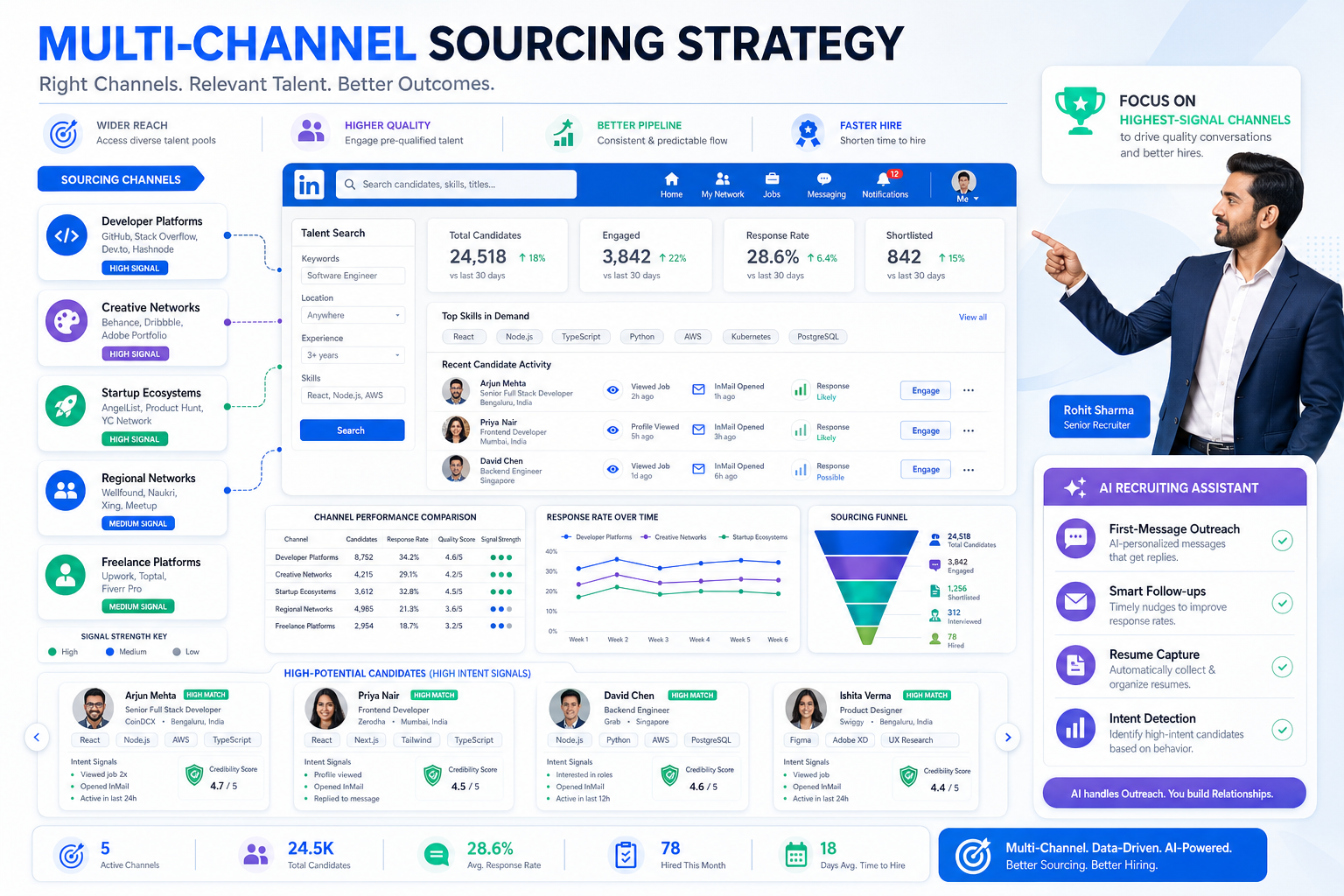
| Platform Type | Best For | Primary Audience | Main Proof of Fit | Typical Recruiter Advantage |
|---|---|---|---|---|
| Business referral communities | Local partnerships and referral-led hiring | Owners and operators | Introductions and trust | High relevance for local relationship building |
| Creative portfolio networks | Design and visual roles | Creatives and agencies | Published work | Fast portfolio review |
| Developer communities | Engineering and technical hiring | Developers and technical leaders | Code and contribution history | Stronger skill evidence than profile polish |
| Startup communities | Early-stage hiring and founder outreach | Founders, operators, startup talent | Conversation quality and domain relevance | Better signal on pace and adaptability |
| Regional professional networks | Country-specific or language-specific hiring | Regional professionals and employers | Local market participation | Higher geographic fit |
| Freelancer communities | Contract and project work | Independent specialists | Work samples and availability | Faster specialist matching |
If you recruit across multiple channels, keeping response handling under control matters just as much as platform choice. When I was running LinkedIn outreach alongside niche communities, I found that using AI Recruiter for first-touch messaging and resume capture made it easier to stay responsive when candidates answered outside office hours. It did not decide who deserved shortlist status, but it prevented warm replies from getting buried while I was comparing signal quality from different sources.
Best LinkedIn Alternatives by Use Case
1. Best for small business owners and local referrals
For local hiring, partnerships, and community trust, relationship-led business networks often outperform broad social feeds. Smaller employers do not always hire from polished online branding. They hire from repeated contact, trusted introductions, and known reputation.
This category belongs near the top of any serious list of social networking sites for business. If the business owner values practical referrals over self-promotion, a local or sector-specific business community can produce better conversations than a global networking platform.
Best for: owner-led firms, local agencies, referral-heavy hiring, community-based business development.
2. Best for startup hiring and founder access
Startup candidates and founders often signal fit through discussion quality, speed, and evidence of adaptability rather than through highly managed profiles. That makes startup communities a valuable alternative when you need people who are comfortable with ambiguity and early-stage execution.
Among the best social media platforms for professionals in startup environments, what matters most is whether the platform shows how people think, build, and respond. Resume polish usually matters less than operating style.
Best for: early-stage companies, startup operators, product and growth hires, founder networks.
3. Best for creative and portfolio-led roles
For design, branding, motion, content, and other visual disciplines, portfolio-first platforms are usually better than profile-first networks. Hiring managers want visible work, not generic claims.
This is one of the clearest examples of why professional networking social media sites should be evaluated by proof format. In creative hiring, the work itself is the credential. A broad professional feed may help with discovery, but a portfolio community often does more to validate taste and capability.
Best for: designers, art directors, creative leads, agencies, brand teams.
4. Best for developers and technical sourcing
Engineering hiring improves when recruiters can inspect contribution history, technical interests, and collaboration patterns. Developer communities are useful because they give stronger evidence than a headline and keyword-heavy profile ever can.
That is why they remain some of the best social media platforms for professionals in technical recruiting. A candidate who demonstrates technical depth in a working community usually gives a recruiter better signal than one who simply looks active on a broad business network.
Best for: software engineers, platform teams, technical recruiters, engineering managers.
5. Best for regional job markets
Some markets have strong local or language-specific networks that outperform global platforms for relevant hiring visibility. If your hiring depends on geography, language, or regional employer reputation, these networks deserve real attention.
That makes them an important category within social networking sites for business, especially for firms hiring in markets where local context affects trust and response behavior.
Best for: multilingual markets, regional expansion, country-specific roles, location-sensitive recruiting.
6. Best for freelancers and independent specialists
When the brief is project-based, speed and specificity matter more than broad networking presence. Independent professionals often prefer communities where they can signal capability, availability, and work history clearly.
Recruiters sometimes forget that not every search should run through the same process. Some professional networking social media sites are built for long-term identity and reputation. Others are better for rapid specialist matching.
Best for: freelance designers, contractors, consultants, short-term specialist hiring.
How Recruiters Should Evaluate a Platform
When a client asks me for the best LinkedIn alternative, I usually answer with a checklist rather than a name. The right decision depends on whether the platform helps you judge fit under real recruiting pressure.
- What kind of proof does the platform provide? Profile claims, portfolio evidence, code, referrals, or active discussion all mean different things.
- What happens to candidate behavior in a stressed market? Merger cycles, layoffs, and reorganizations change how people apply and respond.
- Does the platform support the audience you actually need? Creatives, founders, developers, and small business owners do not build trust in the same way.
- Can your team respond consistently? A promising channel becomes a liability if warm replies sit unanswered.
- Will the platform add signal or just add volume? Volume without interpretability is where recruiter time disappears.
That fourth point is where workflow support matters. In my experience, one of the most practical uses of StrategyBrain AI Recruiter is handling the repetitive LinkedIn communication layer while I focus on candidate judgment. It can keep outreach moving, answer routine role questions, and collect resumes from interested people, but I still make the call on fit, priority, and shortlist quality. That separation is exactly what most experienced recruiters want: automation for repetition, human judgment for hiring decisions.
Where LinkedIn Still Fits and Where It Breaks
LinkedIn is still useful. It remains one of the most accessible places for recruiter search, employer visibility, and initial contact across many industries. The problem is not that LinkedIn is obsolete. The problem is that recruiters often expect it to behave like a complete solution.
It works well when you need:
- broad market reach
- role discovery across industries
- employer branding visibility
- standardized initial outreach
It starts to break when you need:
- deeper proof of technical or creative skill
- strong local referral trust
- startup-native context
- signal filtering during layoffs or M&A-driven candidate surges
The merger example from biotech is useful here. When thousands of workers start thinking about risk at once, a broad platform becomes noisier. More candidates reply, more people apply beneath level, and recruiter attention gets fragmented. That is exactly when niche channels and disciplined response handling start outperforming one-channel habits.
In those periods, I have found it useful to keep LinkedIn as the broad top-of-funnel network, use niche communities for validation, and let AI Recruiter absorb the repetitive LinkedIn messaging workload that would otherwise spill into evenings. That is not a replacement strategy. It is a control strategy.
Common Mistakes When Expanding Beyond LinkedIn
- Looking for a single universal replacement. Different platforms validate different kinds of credibility.
- Ignoring market timing. Candidate behavior changes during layoffs, restructures, and acquisition waves.
- Confusing visibility with fit. A large feed can still produce weak sourcing signal.
- Using the same message style everywhere. Startup, technical, and portfolio communities respond to different outreach cues.
- Failing to separate automation from judgment. Tools can manage first-touch activity, but recruiters still need to evaluate resumes and decide who moves forward.
- Skipping workflow discipline. If candidate replies are scattered across channels, your sourcing quality falls even when interest rises.
The last two mistakes often happen together. Teams either refuse help with repetitive communication or overestimate what software should decide. The better balance is to automate consistency where possible and keep recruiter judgment at the center.
FAQ
What is the best LinkedIn alternative overall?
There is no single best option for every recruiter or business user. The right platform depends on whether you need local referrals, startup access, creative portfolios, developer credibility, regional visibility, or flexible project talent.
Are professional networking sites the same as job boards?
No. Job boards center on listings and applications. Professional networking social media sites center on relationships, reputation, visibility, and evidence of expertise.
Which are the best social media platforms for professionals?
The answer depends on profession and proof type. Developers often benefit most from technical communities, creatives from portfolio platforms, founders from startup communities, and small business owners from trust-based referral networks.
What are the best social networking sites for business owners?
For many business owners, the best options are communities built around referrals, local visibility, and repeat interaction. Those environments often support stronger partnerships and more credible introductions than broad professional feeds.
Should recruiters stop using LinkedIn?
No. LinkedIn still works well as a broad discovery layer. The more practical move is to use it alongside niche networks that give better evidence of fit, especially in noisy markets.
How can recruiters manage LinkedIn outreach without losing control of candidate replies?
Many recruiters use workflow support to keep first-touch communication organized. In my experience, StrategyBrain AI Recruiter is most helpful when it handles repetitive messaging, after-hours responses, and resume collection while the recruiter keeps control of evaluation and next-step decisions.
Conclusion
If you are evaluating general LinkedIn alternatives, the most useful answer is still the least flashy one: choose by use case, proof type, and market context.
The lesson from disruption-heavy sectors such as biotech is clear. When large events change candidate behavior, one broad network becomes harder to interpret. The best professional networking social media sites are the ones that make credibility easier to verify and recruiter effort easier to prioritize.
For hiring teams, agency recruiters, and business owners, that usually means keeping LinkedIn in the mix while expanding into niche channels where the right people already demonstrate relevance. And when LinkedIn itself becomes the busiest part of the workflow, support tools such as StrategyBrain AI Recruiter can help handle repetitive outreach and candidate response flow without taking final judgment away from the recruiter. That is the balance worth aiming for: broader reach, better signal, and tighter control.