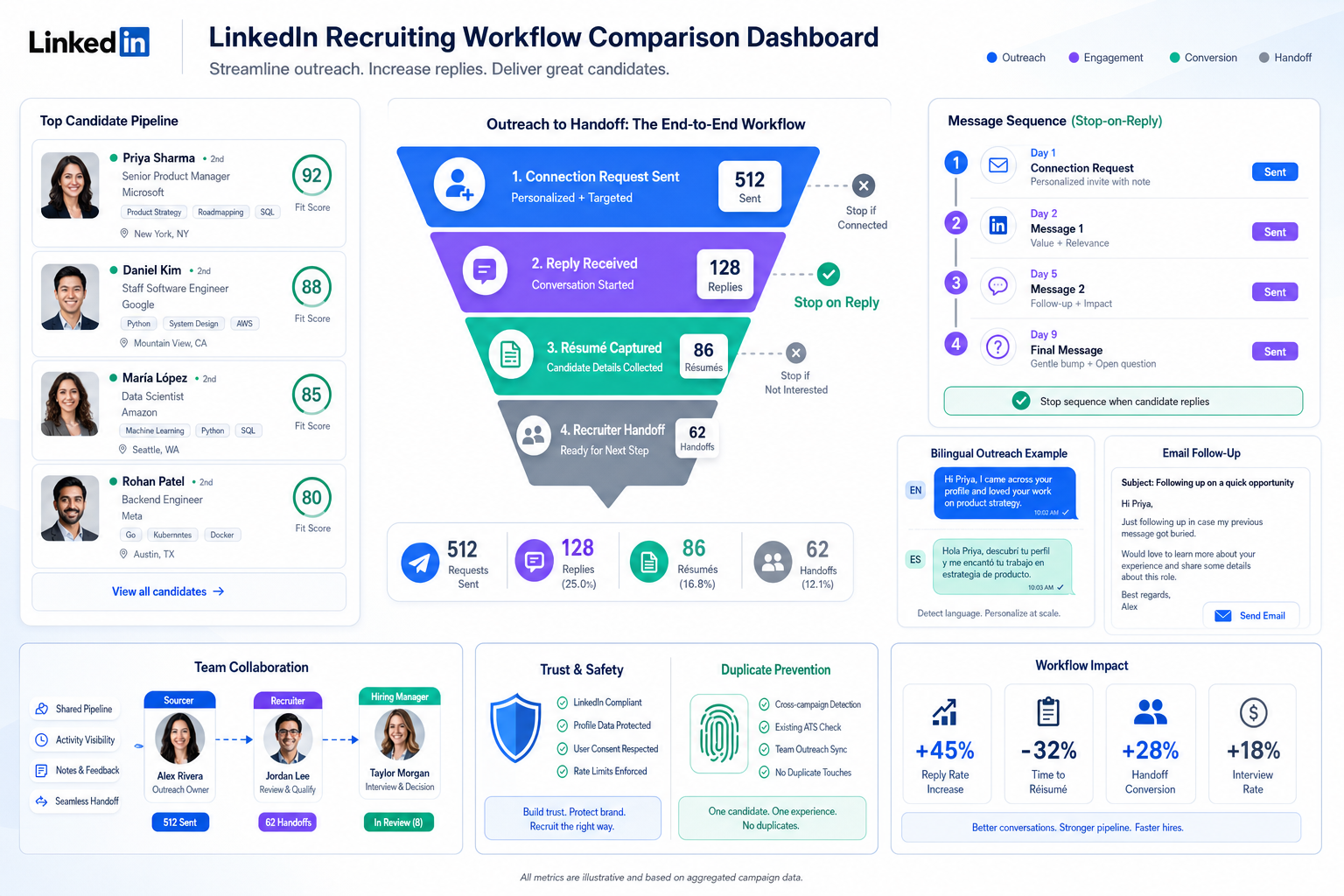
This article helps headhunters judge whether a linkedin connection automation tool will protect candidate trust, prevent messy handoffs, and improve real outreach outcomes.
That distinction matters more than most buying pages admit. When outreach is rushed, recruiters do not just lose reply rates. They risk weaker candidate trust, duplicated follow-ups, confused handoffs between sourcers and recruiters, and a hiring manager impression that the pipeline is active when it is actually disorganized. For a small search firm, that means wasted desk time and damaged relationships. For an in-house team, it can mean slower shortlists and a weaker employer brand in a market where candidates compare every interaction.
In my own workflow, I have found that StrategyBrain AI Recruiter is most useful when used as support for repetitive LinkedIn steps rather than as a replacement for recruiter judgment. It can help automate initial LinkedIn outreach, keep candidate replies moving after hours, and continue conversations in multiple languages when searches cross borders. What it does not remove is the recruiter's real job: deciding who is worth approaching, reviewing the résumé, and making the final call on fit, timing, and next steps.
The reason this matters becomes obvious when you think about what a strong start looks like from the candidate side. Someone stepping into a new accounting or finance job only gets one chance to make a solid first impression. In those first weeks, they look for quick wins, ask smart questions, try to understand how the team works, and make time to build relationships beyond their immediate department. They are not trying to look automated. They are trying to look prepared, thoughtful, and worth investing in.
Recruiting outreach works much the same way. A candidate's first touch with your team is a first-impression moment, and the process breaks down when automation sends connection requests without context, follow-ups without timing discipline, or handoffs without ownership. That is why choosing recruitment automation tools is not only about activity. It is about whether a linkedin connection automation tool, related sales automation tools, and sales email automation features can help recruiters create the kind of organized, credible introduction that leads to real conversations.
Table of Contents
- Why First Impressions Matter in Recruiting Automation
- What a LinkedIn Connection Automation Tool Actually Does
- The Best Tools Help Recruiters Create Quick Wins
- Ask Questions, But Also Build a Better Workflow
- Why Cross-Team Visibility Matters
- Where Sales Email Automation Fits Recruiting
- How to Compare Recruitment Automation Tools
- How to Implement Without Damaging Candidate Trust
- FAQ
Why First Impressions Matter in Recruiting Automation
Most recruiters first shop this category because they want to save time on sourcing. That is reasonable, but it is incomplete. The more important question is what kind of first impression your outreach process creates. If a candidate receives a generic connection request, an awkward follow-up, and then a disconnected email from someone else on the team, your automation is speeding up the wrong thing.
The reference point I come back to is simple: people judge early interactions fast. In a new job, professionals try to establish credibility by finding small ways to contribute, learning the team structure, and investing in one-to-one relationships. Candidate outreach should respect that same dynamic. The best recruitment automation tools help recruiters appear consistent and prepared. The weaker ones make them look careless at scale.
That is also why a recruiting workflow should not copy the logic of sales automation tools without translation. Sales teams can sometimes tolerate more aggressive sequencing because the goal is lead movement. Recruiters are dealing with career decisions, reputation, and timing. A linkedin connection automation tool should support that higher-stakes context, not flatten it.
What a LinkedIn Connection Automation Tool Actually Does
A linkedin connection automation tool automates repeatable sourcing actions such as profile targeting, connection requests, message follow-ups, inbox monitoring, reply routing, and sometimes contact capture. In recruiting, the value is not simply that these tasks happen faster. The value is that recruiters can run a more disciplined outreach process without tracking everything through browser tabs and manual reminders.
In practice, the category now overlaps with broader recruitment automation tools. Buyers often expect more than LinkedIn-only functionality. They want LinkedIn outreach tied to email sequencing, team visibility, notes, export logic, and clear handoff into the next stage of the hiring process.
That is where product categories start to blur. A lot of the mechanics come from sales automation tools, and some of the most useful sequence logic resembles sales email automation. But the recruiter still needs a hiring-specific standard for evaluating them. A good system should help start conversations, not just increase send count.
In my experience using AI Recruiter on active sourcing workflows, the most practical benefit is continuity. If a candidate replies late at night, the conversation does not stall immediately. If a search spans multiple regions, multilingual communication can keep the exchange clear. If interest is confirmed, résumé and contact collection can happen earlier. That said, I still treat the platform as a front-end support layer. I review the replies, assess the résumé, and decide whether the person belongs in the shortlist.
The Best Tools Help Recruiters Create Quick Wins
One useful way to evaluate recruitment automation tools is to borrow the idea of early quick wins from a new-hire environment. In a new accounting role, someone may earn credibility by fixing a file, contributing a practical idea, or helping a process run more smoothly. In recruiting, your technology should make similar quick wins possible for the team.
Those quick wins usually look like this:
- Cleaner first-touch outreach that reaches relevant candidates without forgetting follow-ups
- Faster response handling so interested candidates are not left waiting
- Earlier résumé capture when a candidate wants to move forward
- Less manual chasing across LinkedIn inboxes and spreadsheets
- Better recruiter focus on fit, market feedback, and hiring manager alignment
Tools that support those outcomes tend to be more valuable than tools that simply promise scale. This is especially true for agency desks and lean in-house teams where every hour spent on repetitive outreach is an hour not spent calibrating the shortlist.
From a user perspective, one reason I kept parts of StrategyBrain AI Recruiter in the workflow was that it addressed exactly these early-stage frictions. It handled repetitive connection and follow-up motions more consistently than a tired recruiter at the end of the day, while still leaving me in control of qualification and interview progression.
Ask Questions, But Also Build a Better Workflow
Another lesson from the first-impression model is that good newcomers do not only ask questions. They also bring possible solutions. Recruiting leaders should apply the same mindset when reviewing a linkedin connection automation tool. It is not enough to ask whether a platform automates messaging. You also need to ask what operational problem it solves and what new friction it might introduce.
Useful evaluation questions include:
- Does the system stop outreach when a candidate replies?
- Can recruiters review messages before the next step goes out?
- How does it handle résumé or contact collection when interest is confirmed?
- Can it support multilingual candidate conversations when needed?
- What happens after a positive reply: who owns the handoff, and where is it logged?
These are the questions that separate recruiting-grade software from generic sales automation tools. In hiring, unanswered workflow questions quickly become candidate experience problems.
They also shape whether a tool works for different team types. A solo headhunter may care most about reducing admin. A boutique agency may care about account coverage and consistency across multiple searches. An in-house talent team may care most about employer brand, stakeholder visibility, and safe message pacing.
Why Cross-Team Visibility Matters
The original first-impression logic also emphasizes relationship building across departments, not just within one immediate team. That carries directly into modern hiring workflows. Many outreach problems are not caused by bad copy. They happen because the recruiter, sourcer, coordinator, and hiring manager do not share one clear view of what happened.
A strong automation setup should therefore support collaboration, not isolate activity. Teams need to know:
- Who contacted the candidate first
- Whether the candidate replied on LinkedIn or by email
- What the candidate asked about the role
- Whether a résumé was received
- Who is responsible for the next human follow-up
Without that visibility, automation can create the same kind of awkwardness a new employee would create by ignoring people outside the core team. The process becomes narrower than the work actually is. In recruiting, that usually leads to duplicate outreach, inconsistent messaging, and preventable drop-off.
This is one reason I prefer systems that can support not just message sending but also structured conversation continuity. With AI Recruiter conversation handling, the practical gain is not that every message becomes magical. It is that replies, interest signals, and basic next-step information are less likely to disappear between shifts, time zones, or recruiter handoffs.
Where Sales Email Automation Fits Recruiting
Recruiters may not always use the commercial language, but the overlap with sales email automation is real. Once a candidate does not respond on LinkedIn, many teams want the option to continue through email, provided the data source and compliance approach are appropriate. The same need appears in sequence scheduling, reply detection, and channel coordination.
That does not mean recruiting should imitate outbound sales word for word. It means some mechanics from sales automation tools are genuinely useful when adapted carefully. The right tool can help a recruiter manage LinkedIn first touch, follow with email when appropriate, and pause the sequence the moment a real conversation starts.
What matters is etiquette and context. Candidate messaging should feel like a thoughtful introduction, not a campaign blast. This is where the first-impression frame remains useful. Just as a new professional would not try to build internal trust by acting needy or overly pushy, a recruiting workflow should not force urgency where credibility matters more.
How to Compare Recruitment Automation Tools
If you are comparing recruitment automation tools, evaluate them against the actual hiring motion your team runs rather than feature count alone. The table below is a practical framework.
| Evaluation Area | What to Look For | Why It Matters |
|---|---|---|
| LinkedIn outreach | Connection requests, follow-up logic, reply detection, pacing controls | Helps recruiters protect candidate first impressions while staying consistent |
| Email sequencing | Scheduling, personalization, stop-on-reply, shared visibility | Supports the multichannel workflows often associated with sales email automation |
| Conversation continuity | Inbox coverage, after-hours handling, multilingual communication | Useful for cross-border searches and delayed candidate response windows |
| Interest capture | Résumé requests, contact capture, recruiter notification | Reduces manual back-and-forth once a candidate wants to proceed |
| Team collaboration | Ownership tracking, notes, duplicate prevention | Prevents fragmented outreach across recruiters and stakeholders |
| Compliance and safety | Conservative sending behavior, permissions, data handling clarity | Protects account health, candidate trust, and process discipline |
| Best-fit team type | Solo desk, agency team, in-house TA, international hiring | Helps avoid buying a tool built for someone else's workflow |
When I evaluate platforms in this category, I look hardest at the moments where a process usually fails: first touch, follow-up timing, candidate reply handling, and handoff after interest is shown. Those are the moments where a good linkedin connection automation tool earns its keep.
Key insight: The strongest recruiting automation does not try to sound more human than a recruiter. It gives recruiters the time and structure to be more human where it counts.
How to Implement Without Damaging Candidate Trust
Implementation should start with one workflow, not every workflow. Pick a role family or search type where response timing and repetitive outreach are genuine problems. Then build around that.
- Define your first-impression standard. Decide what a good LinkedIn introduction should sound like and how much personalization is required.
- Set conservative outreach rules. Avoid volume-first settings that make the team look mechanical.
- Decide where automation stops. Recruiters should own fit assessment, résumé review, and interview decisions.
- Plan your handoff process. A positive reply should trigger a clear owner and next step, not another round of confusion.
- Review weekly for quality. Track not just responses, but whether responses lead to qualified conversations.
For teams using AI Recruiter in active sourcing, this boundary setting matters. I have had the best results when I let the tool take care of repetitive LinkedIn communication and basic information gathering, while I focused on shortlist quality, candidate motivation, and hiring manager calibration. That division of labor is what keeps automation helpful rather than intrusive.
FAQ
What is a linkedin connection automation tool for recruiters?
It is software that automates parts of LinkedIn sourcing outreach, such as connection requests, follow-ups, inbox handling, and sometimes candidate information capture. For recruiters, its main value is process consistency.
How is this different from sales automation tools?
Sales automation tools are usually built to move leads through a commercial pipeline. Recruiting tools may borrow similar sequencing logic, but they need to respect candidate experience, recruiter review, and hiring workflow handoff.
Why is sales email automation relevant in recruiting?
Because many recruiting teams want LinkedIn outreach and email follow-up to work together. Sales email automation features like scheduling, personalization, and stop-on-reply can be useful when adapted to hiring use cases.
Can automation replace recruiter judgment?
No. It can reduce repetitive work, maintain reply continuity, and collect early information, but recruiters still need to decide who to approach, how to assess a résumé, and whether a candidate should move forward.
Who benefits most from these tools?
Agency recruiters, headhunters, lean in-house sourcing teams, and teams hiring across time zones tend to benefit most, especially when manual follow-up and reply coverage are already causing delays.
What should I prioritize when choosing a tool?
Prioritize message quality, pacing control, reply handling, collaboration visibility, multilingual support if relevant, and a clean process for turning candidate interest into a recruiter-owned next step.
Conclusion
The best way to think about a linkedin connection automation tool is not as a volume engine, but as a first-impression system. Just as a professional entering a new job earns trust through preparation, useful questions, quick wins, and relationship building, a recruiter earns candidate attention through relevance, timing, and orderly follow-through.
That is why the strongest recruitment automation tools combine LinkedIn consistency with careful multichannel support, including the best parts of sales automation tools and sales email automation without importing their worst habits. If your process helps candidates feel informed, respected, and clearly handled from first message to next step, your automation is doing its job.