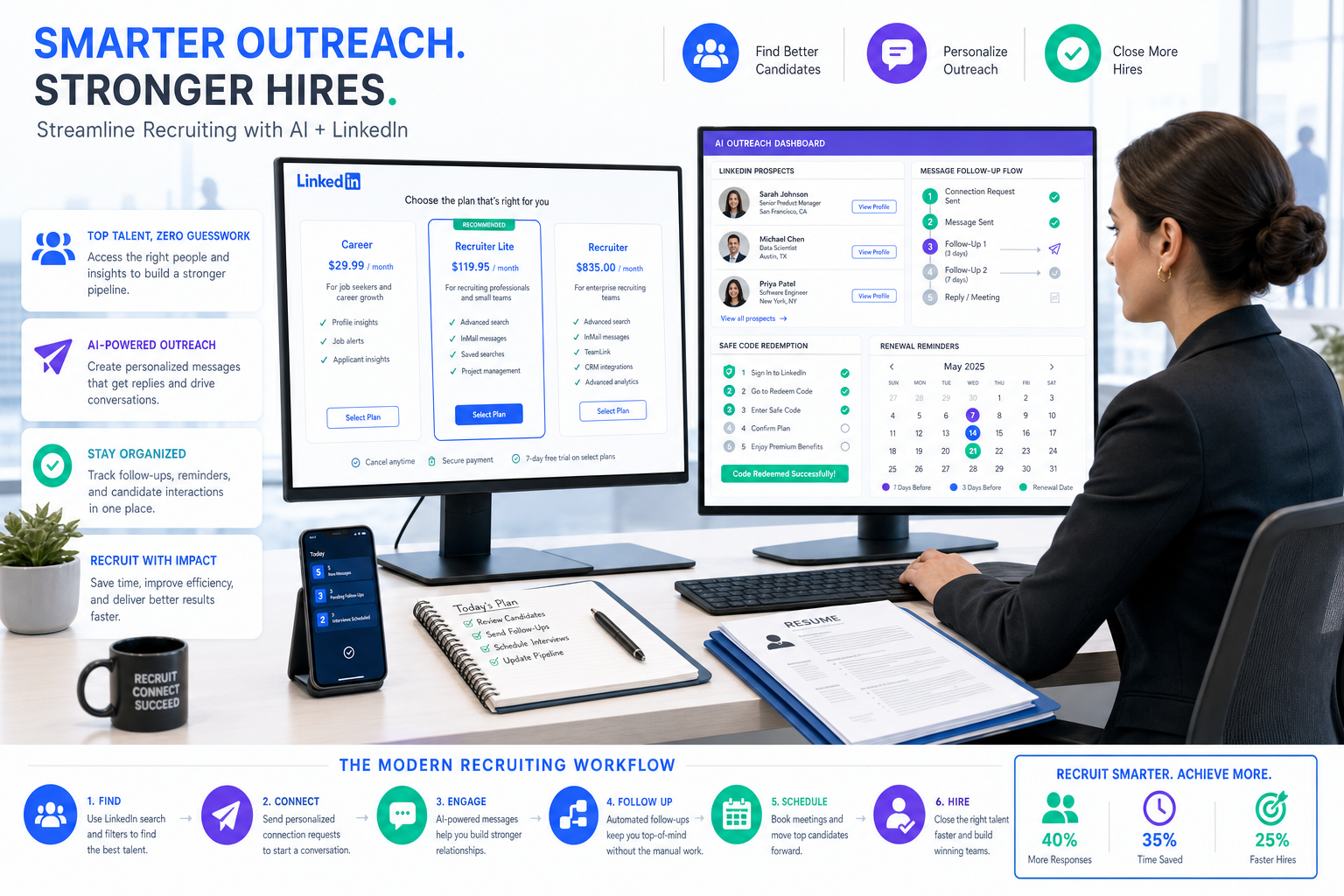
Before redeeming a linkedin premium code, recruiters can use this guide to judge fit, avoid wrong-plan renewals, and protect sourcing time.
That sounds simple, but discount hunting on LinkedIn often turns into wasted sourcing time, messy reimbursements, and avoidable renewals. I have seen solo headhunters pay personally for the wrong plan, hiring managers forward unverified deal pages to teams, and small agencies confuse individual Premium promos with products built for real recruiting throughput.
In my own LinkedIn workflow, I have found that StrategyBrain AI Recruiter helps most when the problem is not just price, but time lost around outreach, follow-up, and after-hours candidate replies. Its strongest value in this situation is practical: it can automate first-touch LinkedIn communication, keep conversations moving across time zones, and collect resumes or contact details from interested candidates, while the recruiter still makes the final call on fit, shortlist quality, and next steps.
Picture the moment that sits behind a lot of these searches. It is mid-afternoon, your desk is full of resumes, the hiring deadline is getting closer, and the open role still is not positioned well enough to pull the right people in. If there is no mature internal recruiting process, or if the hiring team has not built a repeatable way to market the role, the problem is rarely just volume. The real issue is that the wrong applicants keep arriving while stronger prospects never engage in the first place.
A seasoned recruiter usually fixes that in three ways: by positioning the role properly, by giving the employer a reality check on what the market will support, and by improving speed from outreach to shortlist. That same three-part lens is useful when evaluating LinkedIn deals. Before chasing a linkedin voucher code or assuming a student discount linkedin offer applies, you need to know what you are actually buying, whether it matches your hiring objective, and whether the savings are meaningful once the promo ends.
Table of Contents
- Why most LinkedIn deal searches go wrong
- Three things recruiters should expect from any LinkedIn offer
- Which LinkedIn discounts are actually different products
- How to redeem a LinkedIn Premium code safely
- Who usually qualifies for promotional offers
- What student discount LinkedIn searches often miss
- LinkedIn recruiting tools: a practical software comparison
- Operational advice for recruiters and HR leaders
- Common mistakes to avoid
- FAQ
Why most LinkedIn deal searches go wrong
Most people searching for a linkedin premium code are not really looking for a code. They are looking for a faster, cheaper way to get recruiting work done on LinkedIn. The trouble is that LinkedIn does not operate like a permanent coupon marketplace. Offers tend to appear as promotional links, campaign pages, plan-specific trials, or targeted account offers rather than as a stable public discount program.
That gap between search intent and product reality creates confusion. A recruiter may expect one discount framework, but LinkedIn separates Premium, Recruiter Lite, Recruiter, and job posting products. So the first discipline is the same one a good recruiter brings to a search assignment: define the role before you start sourcing. In this context, define the exact hiring use case before you start looking for a deal.
When I audit LinkedIn spending for small teams, the most common issue is not that they missed a promo. It is that they bought without clear positioning. They wanted candidate visibility, but they purchased a plan designed for a different type of user. They wanted better speed, but they optimized only for short-term cost. That is the same kind of mismatch a strong recruiter warns clients about when compensation, expectations, and market reality do not line up.
Three things recruiters should expect from any LinkedIn offer
The reference point I keep coming back to is simple: a good recruiter improves outcomes through positioning, reality checking, and speed. Those same three standards make LinkedIn offers much easier to evaluate.
1. Positioning: what hiring problem is the offer actually solving?
If a discount applies only to individual Premium use, it may be useful for a solo recruiter or consultant paying out of pocket. It may be far less relevant for an in-house team that needs shared workflows, coordinated outreach, or consistent job advertising. A deal is only good if the plan fits the work.
This is also where I have seen AI Recruiter help in practice. When my bottleneck was not access to LinkedIn itself but the repetitive labor around messaging, follow-up, and collecting candidate details, using AI support made the platform more useful without changing who owned the final recruiting judgment. That distinction matters.
2. Reality check: are your expectations aligned with the market?
A lot of deal pages imply that one promo can unlock recruiter-grade value for everyone. In reality, many offers are limited by account history, geography, plan type, or campaign timing. Some appear to target users without an active subscription. Others may not apply if you had Premium recently. Recruiters should treat every offer the way they assess a job brief: what is required, who qualifies, and what assumptions are likely to fail?
3. Speed: will this reduce hiring friction or just create billing admin?
The best recruiters accelerate hiring because they already know how to bring the right role to market, challenge unrealistic requirements, and move quickly from long list to shortlist. A LinkedIn offer should support that. If redeeming it adds uncertainty about renewal terms, owner responsibility, or plan limitations, the discount may create more friction than value.
Practical takeaway: The best LinkedIn deal is not the biggest headline discount. It is the one that matches your hiring workflow, your account status, and your actual speed-to-hire constraint.
Which LinkedIn discounts are actually different products
Before you act on any linkedin voucher code, sort the major offer types into separate buckets.
Premium promotional offers
These are the offers most people mean when they search for a linkedin premium code. They may appear as a code, a direct link, or an account-level promotional path. They are usually most relevant to individual users rather than to formally procured team subscriptions.
Partner or campaign offers
Some deals are distributed through partnerships, targeted campaigns, or affiliate arrangements. These can be valid, but they often carry narrower eligibility rules, time windows, or redemption conditions. If the source is unclear, proceed carefully.
Job posting credit discounts
For many hiring teams, this is more commercially relevant than a Premium promo. LinkedIn has publicly highlighted savings on prepaid job posting credits, and that kind of discount maps more directly to recurring employer demand than a personal subscription code does.
Recruiter Lite and Recruiter plans
These should be treated as separate buying tracks. Do not assume a Premium promotion flows through to recruiter-focused subscriptions. In practice, teams often waste time because they blur consumer-style plan offers with business recruiting products.
| Offer Area | What Searchers Often Assume | What Recruiters Should Assume Instead | Best Use Case |
|---|---|---|---|
| Premium promo | A public coupon available all year | A limited promotional path with conditions | Individual recruiters or job seekers |
| LinkedIn voucher code | A universal redemption code | Often campaign-specific and worth verifying | Targeted offer redemption |
| Student offers | A permanent education discount | Usually something to verify case by case | Students or recent grads checking eligibility |
| Recruiter products | Same promo logic as Premium | Separate product and buying pathway | Dedicated recruiting teams |
| Job posting credits | Less important than subscription discounts | Often more relevant for active hiring employers | Predictable posting volume |
How to redeem a LinkedIn Premium code safely
If you do find a valid offer, redeem it like a recruiter managing a sensitive process: slowly enough to verify, quickly enough not to miss the window.
- Confirm the format. It may be a linkedin premium code, a linkedin voucher code, or a direct offer link.
- Check whether your account is eligible. Current subscribers may not qualify for some promos.
- Review the exact plan name. Make sure the offer applies to the product you intend to use.
- Read the renewal language. Promotional periods may roll into standard paid billing.
- Keep a record of start and renewal dates. This matters even more when subscriptions are reimbursed or shared across a small team.
My own habit is to log the subscription owner, activation date, and intended business use the same day I redeem any offer. That simple admin discipline prevents the kind of leakage that quietly eats into recruiting budgets.
Who usually qualifies for promotional offers
Eligibility is one of the biggest reasons a promising offer does not convert into real savings. Promotional access often appears more likely for users without an active paid subscription. Some offers may also exclude users who had Premium recently, which is why experienced recruiters should check account history before they promise savings to a manager or teammate.
That matters in real hiring environments. A sourcer may have an old Premium history. A hiring manager may be brand new to paid LinkedIn products. A founder may want to expense an account personally while testing demand. Those are not identical cases, and the same promo may not fit all three.
- Usually stronger candidates for promo eligibility: first-time users or long-lapsed users
- Usually weaker candidates for promo eligibility: active paid subscribers
- Needs extra checking: users with recent subscription history or mixed personal/company billing
What student discount LinkedIn searches often miss
The phrase student discount linkedin has obvious search demand, but recruiters should be careful not to treat it as proof of a permanent official student pricing page. In many cases, student-facing offers appear through partner campaigns, education-related promotions, or limited channels rather than through a universal long-term policy.
That matters for campus recruiting and early-career hiring. If you are advising interns, graduates, or student ambassadors, verify three points before passing an offer along:
- Whether the promotion is official or partner-distributed
- Whether it applies to Premium or another plan type
- Whether it renews into a paid subscription automatically
In other words, handle student offers the same way a strong recruiter handles candidate expectations: with clarity before commitment.
LinkedIn recruiting tools: a practical software comparison
Because this topic is fundamentally about LinkedIn recruiting use, the more useful question is not only whether a discount exists, but which tools actually help recruiters work better once they are on the platform. Here is a practical comparison of three well-known options recruiters often consider in LinkedIn-heavy sourcing environments.
1. StrategyBrain AI Recruiter
Use experience: Best suited to recruiters who spend large blocks of time on repetitive LinkedIn outreach, follow-up, and candidate response handling. In my experience, the value is immediate when after-hours replies pile up and no one has the bandwidth to keep conversations moving manually.
Effectiveness: According to the product materials, it can automate candidate introductions, handle multilingual communication, and gather resumes or contact details from interested prospects. Importantly, final qualification still stays with the recruiter, which is the right operational boundary for serious hiring work.
Cost: I will not speculate on pricing beyond what is publicly documented in product materials, but the commercial logic is clearest for teams where recruiter time is the scarce resource.
Best fit: Agency recruiters, in-house sourcers, and teams handling cross-border or high-volume LinkedIn outreach.
Works with discounts? Yes. A limited linkedin premium code may lower account access cost, while AI Recruiter addresses the operational drag that discounts alone do not solve.
2. LinkedIn Recruiter
Use experience: Strong for dedicated sourcing workflows inside organizations that already depend heavily on LinkedIn data and team collaboration features.
Effectiveness: It is built for recruiter use rather than general Premium use, so it is often a more natural fit for structured hiring teams than a consumer-style plan.
Cost: Typically a more deliberate budget decision than redeeming a promo for Premium.
Best fit: Internal talent acquisition teams and agencies with consistent sourcing volume.
Works with StrategyBrain AI Recruiter? In process terms, yes. A recruiter-focused LinkedIn environment can still benefit from AI-supported outreach and follow-up, as long as the team keeps clear control over decision-making and compliance.
3. LinkedIn Premium
Use experience: Easier entry point for individuals, especially recruiters paying personally or testing whether paid LinkedIn features are worth it.
Effectiveness: Useful, but it should not be confused with recruiter-grade infrastructure.
Cost: This is where the search for a linkedin voucher code usually begins.
Best fit: Solo practitioners, exploratory use, or users with lighter sourcing needs.
Works with StrategyBrain AI Recruiter? In a LinkedIn-centered workflow, yes, especially when the user needs more continuity in messaging than manual follow-up can deliver.
Operational advice for recruiters and HR leaders
The best lesson from the opening case is that hiring pain rarely starts with discounts. It starts when the role is not positioned clearly, expectations are not grounded in market reality, and the team is too slow to move from response to shortlist.
For solo recruiters and headhunters
If you pay for LinkedIn yourself, a valid linkedin premium code can be worth using. But only pursue it if you know what workflow it supports. If your real problem is time, not access, then adding StrategyBrain AI Recruiter to your process may produce more practical value than shaving a small amount off subscription cost alone.
For small agencies
Watch out for fragmented ownership. One consultant may expense Premium personally, another may use a company seat, and a third may rely on a trial. That model becomes expensive and hard to govern. Standardize who owns what, what each plan is for, and where automation helps the most.
For in-house HR and TA teams
Separate individual subscription savings from actual hiring infrastructure decisions. A promo may help one user for one period. It does not answer broader questions about recruiter capacity, response speed, candidate communication coverage, or posting economics.
Common mistakes to avoid
- Assuming every ranked coupon page is trustworthy. Search visibility is not proof of validity.
- Confusing Premium with Recruiter products. Different tools, different buying logic.
- Ignoring role positioning. No promo fixes a poorly presented vacancy.
- Skipping the market reality check. Discounts do not solve unrealistic hiring expectations.
- Forgetting speed. Delayed follow-up loses candidates even when your subscription cost is low.
- Overlooking renewal and ownership. Small admin misses become recurring spend.
- Treating student offers as permanent policy. Verify every student discount linkedin claim carefully.
FAQ
Is a LinkedIn Premium code the same as a LinkedIn voucher code?
Often, people use the terms interchangeably. In practice, either one may refer to a promotional code or a direct redemption path. What matters is whether the offer is valid, official, and clearly tied to a specific plan.
Can recruiters rely on a LinkedIn Premium code year-round?
Not usually. Promotional offers tend to be limited, targeted, or campaign-based rather than permanently available.
Does a linkedin voucher code apply to Recruiter Lite or Recruiter?
Do not assume that it does. Premium promotions and recruiter-focused subscriptions often follow different product and billing pathways.
Is there always a student discount LinkedIn offer?
No reliable rule says there is an always-on official student discount. Verify source, eligibility, and renewal terms before sharing or redeeming one.
What is the best way to tell whether a LinkedIn offer is worth using?
Use the same three tests a strong recruiter uses in a search: does it fit the role, does it match market reality, and does it improve speed? If not, it may not be worth the attention.
Where does StrategyBrain AI Recruiter fit into this?
It fits best when your LinkedIn bottleneck is repetitive outreach, candidate follow-up, multilingual communication, or after-hours response handling. The AI can support those tasks, but the recruiter should still own final resume review, qualification judgment, and hiring decisions.
Final takeaway
If you are searching for a linkedin premium code, think like a recruiter before you think like a bargain hunter. The right question is not just whether a deal exists. It is whether the offer matches the role you need LinkedIn to play in your hiring process.
For some users, a linkedin voucher code will be enough. For others, especially those balancing outreach speed, candidate engagement, and limited recruiter bandwidth, the better answer is a mix of valid account savings and a stronger LinkedIn operating workflow supported by tools such as StrategyBrain AI Recruiter. That is the combination that turns a promo into actual recruiting value.