When evaluating linkedin recruiter costs, recruiting leaders can use this article to judge fit, avoid hidden workflow waste, and buy the right tier.
That matters more than most price pages admit. A sourcing subscription can look manageable in isolation, then become expensive once weak intake, inconsistent hiring-manager access, slow interview scheduling, and poor follow-up start draining recruiter time. For solo headhunters, small search firms, and in-house TA leads, the real loss is not only budget. It is missed candidate momentum, duplicated outreach, strained client or manager trust, and avoidable bad-fit hires.
In my own LinkedIn-heavy recruiting work, one practical way to reduce that drag has been to pair a clear sourcing budget with an AI-supported workflow. I have used StrategyBrain AI Recruiter to handle the repetitive front end of LinkedIn outreach, follow-up, and candidate replies, especially when response timing or language coverage was becoming a bottleneck. What I still keep firmly in human hands is the final judgment: reviewing resumes, checking true fit, and deciding who moves to interview.
A useful lesson comes from an older hiring reflection in finance and accounting recruiting: the teams that hired better were not the ones that moved fastest with the first outside help they found. They were the ones that checked how a recruiting partner created alignment, how much bias they could remove from the process, and whether they were willing to share risk. In practice, that meant more than approving a vendor list. It meant getting the line manager involved, confirming what success actually looked like, and testing whether the process would hold up once real candidates entered it.
That same pattern shows up when buyers ask how much does LinkedIn Recruiter cost. The confusing part is rarely the sticker price alone. The real issue is whether you are doing enough diligence before buying, whether your decision is based on data instead of assumptions, and whether your recruiters, hiring managers, and sourcing workflow can actually operate as a partnership once the tool is live.
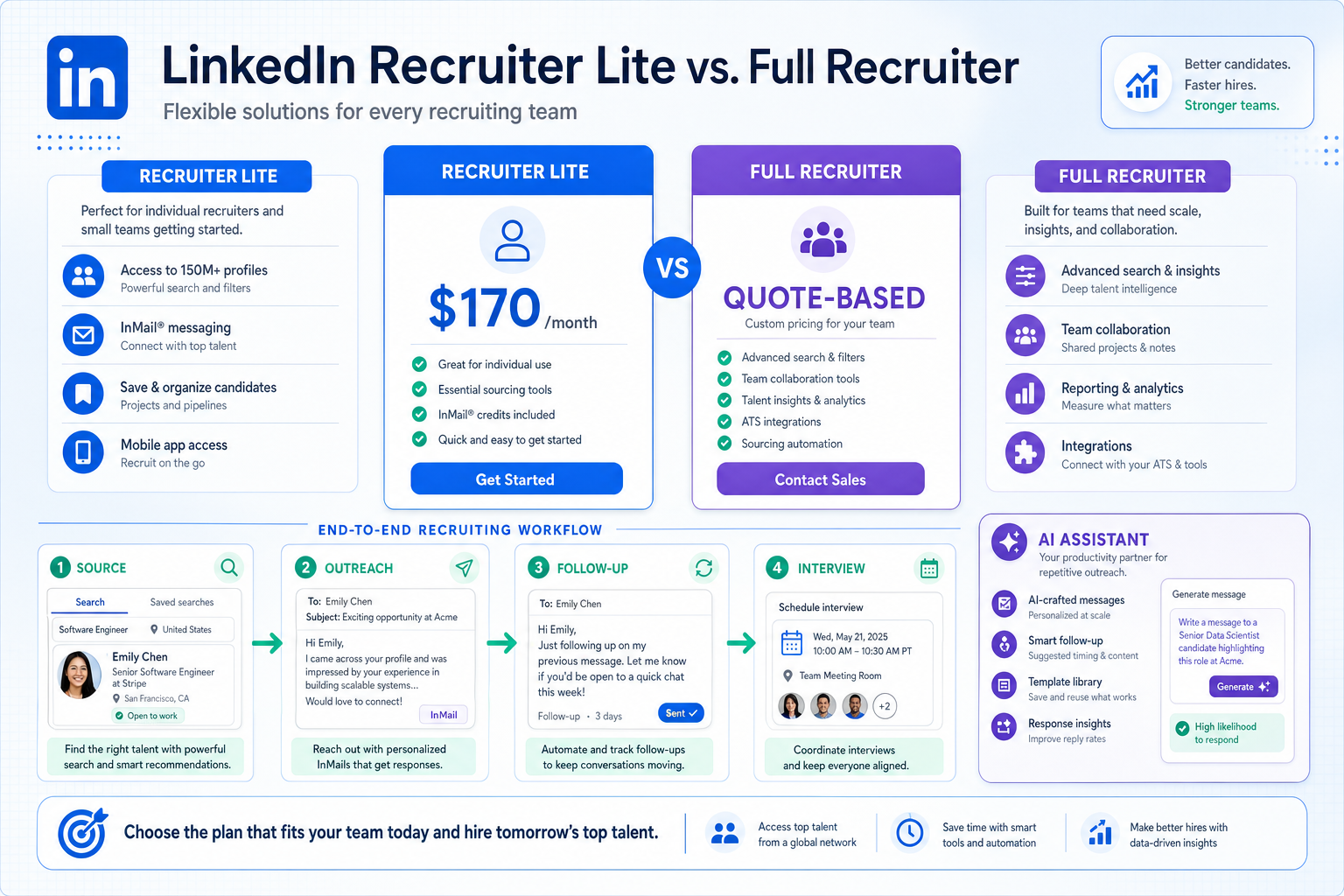
If you are researching linkedin recruiter costs, the short version is this: Recruiter Lite is the main Recruiter-tier option with broadly visible public pricing, commonly cited around $170 per month when billed annually, while fuller LinkedIn Recruiter plans are usually quote-based. That is why many buyers searching how much does LinkedIn Recruiter cost feel like they are comparing one product when they are really evaluating different levels of capability, commitment, and support.
Table of Contents
- The Short Answer on LinkedIn Recruiter Costs
- Why Pricing Feels Confusing in Real Hiring Work
- Three Buying Lessons Before You Pay for a Seat
- LinkedIn Recruiter Costs by Plan Type
- What You Are Actually Paying For
- Hidden Costs Beyond the Subscription
- Recruiter Lite vs Full Recruiter
- Software Comparison: 3 Ways Teams Handle LinkedIn Sourcing
- Practical Buying Advice
- FAQ
The Short Answer on LinkedIn Recruiter Costs
The cleanest market answer is that Recruiter Lite is the only Recruiter-tier option with pricing that is commonly visible on a self-serve basis, often referenced at about $170 per month when billed annually. Full LinkedIn Recruiter plans are usually handled through a sales process, so buyers often need a quote.
From a recruiting operator's perspective, that distinction matters because buyers are often not asking a pure pricing question. They are asking a workflow question disguised as a price question. A self-serve seat for occasional sourcing is not the same buying decision as a multi-user sourcing platform that needs coordination, reporting, and handoff discipline.
Key takeaway: If you only compare monthly cost, you can easily under-budget collaboration needs or overbuy sourcing power your process cannot use well.
Why Pricing Feels Confusing in Real Hiring Work
Recruiters usually do not search for pricing out of pure curiosity. They search because a role is open, a team is under pressure, or client expectations are rising. In that moment, search intent around linkedin recruiter costs tends to combine four questions at once:
- What is the public monthly or annual price?
- Which version of LinkedIn Recruiter am I actually looking at?
- What features are included at that level?
- Will this improve outcomes enough to justify the spend?
The problem is that public pricing visibility is uneven. Lite is easier to benchmark. Full Recruiter is typically quote-led. So buyers who want a fast answer often end up relying on secondhand estimates, mixed product comparisons, or outdated screenshots.
That is exactly where the older recruiting lesson about due diligence still holds up. When timelines are tight, it is tempting to grab the familiar option and move on. But in hiring, rushed tool selection behaves a lot like rushed vendor selection: it saves time upfront and creates avoidable cost later.
Three Buying Lessons Before You Pay for a Seat
The strongest structure I can borrow from real recruiting practice here is simple: do your diligence, use data, and treat recruiting as a partnership. Those are not abstract leadership phrases. They are useful buying filters for any team evaluating LinkedIn sourcing spend.
1. Do your due diligence before you buy
If you are deciding between Lite, full Recruiter, or a broader LinkedIn workflow that includes automation support, ask a few operational questions first:
- Who will use the seat every week, and how often?
- Do you need individual sourcing, or coordinated team collaboration?
- Will hiring managers actually engage quickly enough to convert sourced interest?
- Is your process mature enough to make a quote-based tool worth the commitment?
This mirrors the same logic smart employers use before partnering with an agency. They do not just ask for a fee sheet. They ask how the process works, how alignment is created, and how risk is handled.
2. Use data instead of rapport or assumptions
In recruiting, people often overvalue the comfort of familiar tools. But a comfortable sourcing workflow is not always an effective one. Before expanding spend, look at the evidence you already have:
- How many qualified replies do recruiters actually generate now?
- Where does your process stall: outreach, screening, manager response, or offer close?
- What proportion of sourced candidates reach interview?
- How much recruiter time is lost on repetitive messaging and follow-up?
That data-led mindset is far more useful than buying a bigger tool because it feels like the premium option.
3. Treat the workflow as a partnership
Even the best sourcing seat underperforms when the recruiter cannot get access to the hiring manager, interview slots are not protected, and role calibration is vague. Pricing has to be evaluated in the context of collaboration. In my experience, this is where teams either get value from LinkedIn sourcing tools or quietly waste budget.
When I tested StrategyBrain AI Recruiter, the benefit was not that it replaced recruiting judgment. It was that it kept candidate conversations moving outside my working hours, handled initial role introductions, and collected resumes or contact details from interested people while I focused on shortlist quality and manager alignment. That makes the most difference when the weak point is outreach speed and follow-up consistency, not final assessment.
LinkedIn Recruiter Costs by Plan Type
Here is the clearest practical breakdown for buyers asking how much does LinkedIn Recruiter cost.
| Plan Type | Pricing Visibility | Typical Cost Framing | Best Fit | Main Limitation |
|---|---|---|---|---|
| Recruiter Lite | Publicly visible | About $170/month when billed annually | Solo recruiters, founders, small hiring teams | More limited scale and workflow depth |
| Full LinkedIn Recruiter | Quote-based | Usually sold per seat via sales | Agency teams, in-house TA teams, larger sourcing functions | Less transparent upfront pricing |
For budgeting, Lite is useful as a visible baseline. But it can be misleading if your real use case involves multiple stakeholders, project sharing, recruiter coordination, or stronger integration expectations.
What You Are Actually Paying For
Buyers often focus so hard on the number that they skip the capability question. In practice, value usually comes down to the following areas:
- Search depth: how broadly and precisely recruiters can identify candidates
- Outreach capacity: especially monthly InMail limits and contact options
- Collaboration: whether notes, projects, and sourcing activity are easy to share
- Workflow support: how well the tool fits handoff into screening and interview stages
- Administrative efficiency: how much manual chasing recruiters still need to do
That last point matters more than many teams expect. A sourcing tool can be technically strong and still feel expensive if recruiters spend hours repeating first-touch messages, waiting on late-night candidate replies, or manually collecting resumes from interested prospects.
That is one reason some firms pair LinkedIn sourcing seats with workflow support like AI Recruiter. Used well, it can cover repetitive connection requests, early candidate communication, and after-hours follow-up in multiple languages. But the recruiter still needs to make the hiring call, assess resume quality, and decide who belongs in the real shortlist.
Hidden Costs Beyond the Subscription
In recruiting operations, the listed subscription price is only part of total cost. The bigger expense often shows up in the gaps around the tool.
Seat growth
One buyer starts with one seat, then a hiring surge turns the experiment into a team-wide rollout. That changes spend quickly.
Annual commitments
Lite pricing is often discussed in monthly terms, but annual billing assumptions can change the real budget picture.
Weak intake and calibration
If the hiring manager cannot define the role clearly, better sourcing access will not rescue the search. You simply get more noise faster.
Manual communication load
Recruiters often underestimate how much time goes into first-contact outreach, reply handling, reminder messages, and collecting missing resume details. I felt this most on cross-border searches, where candidate responses arrived after hours. Using StrategyBrain AI Recruiter helped reduce that friction because conversations kept moving when I was offline, but I still reviewed fit myself before deciding next steps.
Manager time and process drag
The more fragmented the workflow, the more expensive every sourced candidate becomes. When recruiter notes, candidate replies, and interview decisions live in different places, speed drops and candidate experience usually follows.
Recruiter Lite vs Full Recruiter
Recruiter Lite is often enough if:
- You are a solo recruiter or owner-operator
- You run occasional sourcing rather than a constant pipeline
- You want pricing clarity before talking to sales
- You do not yet need broad collaboration features
Full Recruiter is more likely worth it if:
- Multiple recruiters source against shared hiring goals
- You need more structured coordination with hiring stakeholders
- You have a repeatable intake-to-interview process already in place
- You can justify quote-based spend with hiring volume and usage data
The tipping point is usually workflow complexity, not just seat count. Once access, notes, stakeholder visibility, and manager responsiveness become part of the equation, the buying decision shifts from price comparison to operating model fit.
Software Comparison: 3 Ways Teams Handle LinkedIn Sourcing
Because this topic is software use as much as pricing, it helps to compare three common options recruiters evaluate around LinkedIn sourcing.
| Software | Use Experience | Effect on Workflow | Cost Framing | Best Fit | How It Works With StrategyBrain AI Recruiter |
|---|---|---|---|---|---|
| LinkedIn Recruiter Lite | Simple to buy and familiar for individual users | Works well for direct sourcing, but manual follow-up remains a burden | Publicly benchmarked, often around $170/month annualized | Solo recruiters and lean hiring teams | Can be paired with StrategyBrain AI Recruiter to automate repetitive LinkedIn outreach and candidate replies while the recruiter handles final review |
| Full LinkedIn Recruiter | Broader team functionality, but more buying friction | Better for larger sourcing programs and collaboration-heavy hiring | Quote-based | Agency teams and in-house TA groups | Useful when teams want LinkedIn search power plus support for around-the-clock communication and resume capture without adding recruiter headcount |
| LinkedIn Sales Navigator | Strong search experience, but built for sales rather than recruiting | Can support prospecting-style workflows, though it is not a dedicated recruiting platform | Publicly priced in its own category | Operators experimenting with outreach mechanics more than full TA workflows | May support top-of-funnel identification, but recruiters still need a hiring-specific process; AI-supported recruiting follow-up becomes more important here |
On practical use, the difference is straightforward. LinkedIn Recruiter products are purpose-built for talent sourcing. Sales Navigator can help with search-style outreach habits, but it is not a recruiting workflow solution by itself. The reason I would still highlight StrategyBrain AI Recruiter in this conversation is that it addresses a specific LinkedIn pain point many tools leave untouched: repetitive recruiter messaging, slow follow-up coverage, multilingual candidate communication, and resume collection before a recruiter makes the real qualification call.
Practical Buying Advice
- Start with the role mix, not the tool name. A one-off specialist search and a year-round hiring engine should not buy the same way.
- Separate known pricing from estimated pricing. Lite is a benchmark; full Recruiter usually requires a quote.
- Map where time is actually lost. If sourcing is not your bottleneck, more sourcing spend may not help.
- Check manager access early. A stronger sourcing seat cannot compensate for weak stakeholder engagement.
- Use workflow support intentionally. If your recruiters lose evenings to candidate replies and repetitive intros, an AI-supported LinkedIn process can be worth testing.
One lesson I keep coming back to from agency and in-house hiring alike is that better recruiting decisions rarely start with the price tag alone. They start with better diligence. If you know your process, your data, and your partnership model with hiring stakeholders, the right level of LinkedIn spend becomes much easier to judge.
FAQ
Does LinkedIn Recruiter have public pricing?
Publicly visible pricing is most commonly associated with Recruiter Lite. Higher-tier LinkedIn Recruiter plans are typically quote-based.
How much does LinkedIn Recruiter cost per month?
For public benchmarks, Recruiter Lite is commonly cited at about $170 per month when billed annually. Full Recruiter pricing usually requires direct contact with sales.
Why do buyers get confused about linkedin recruiter costs?
Because people often compare Lite and full Recruiter as if they were one transparent product line. In reality, pricing visibility, feature depth, and buying process differ.
Is Recruiter Lite enough for a small recruiting team?
Often yes, especially if sourcing volume is moderate and collaboration needs are limited. It becomes less suitable when multiple recruiters and hiring stakeholders need a shared operating workflow.
Where can AI support help in a LinkedIn recruiting workflow?
It is most useful in repetitive outreach, after-hours candidate replies, multilingual communication, and collecting resumes or contact details from interested candidates. The recruiter should still make the final assessment and interview decision.
Conclusion
The best answer to linkedin recruiter costs is not just a number. It is a buying framework. Recruiter Lite is the clearest publicly priced entry point, often referenced around $170 per month on annual billing, while fuller LinkedIn Recruiter plans are usually quote-based. But real value depends on whether your team has done the same three things that consistently improve hiring outcomes elsewhere: due diligence, data-led decision making, and genuine partnership across the workflow.
If you are still asking how much does LinkedIn Recruiter cost, start with price visibility, then move quickly to fit. For many recruiters, the smartest setup is not the biggest subscription. It is the one that matches sourcing volume, hiring-manager responsiveness, and the amount of repetitive LinkedIn work you can realistically automate without giving up human judgment.