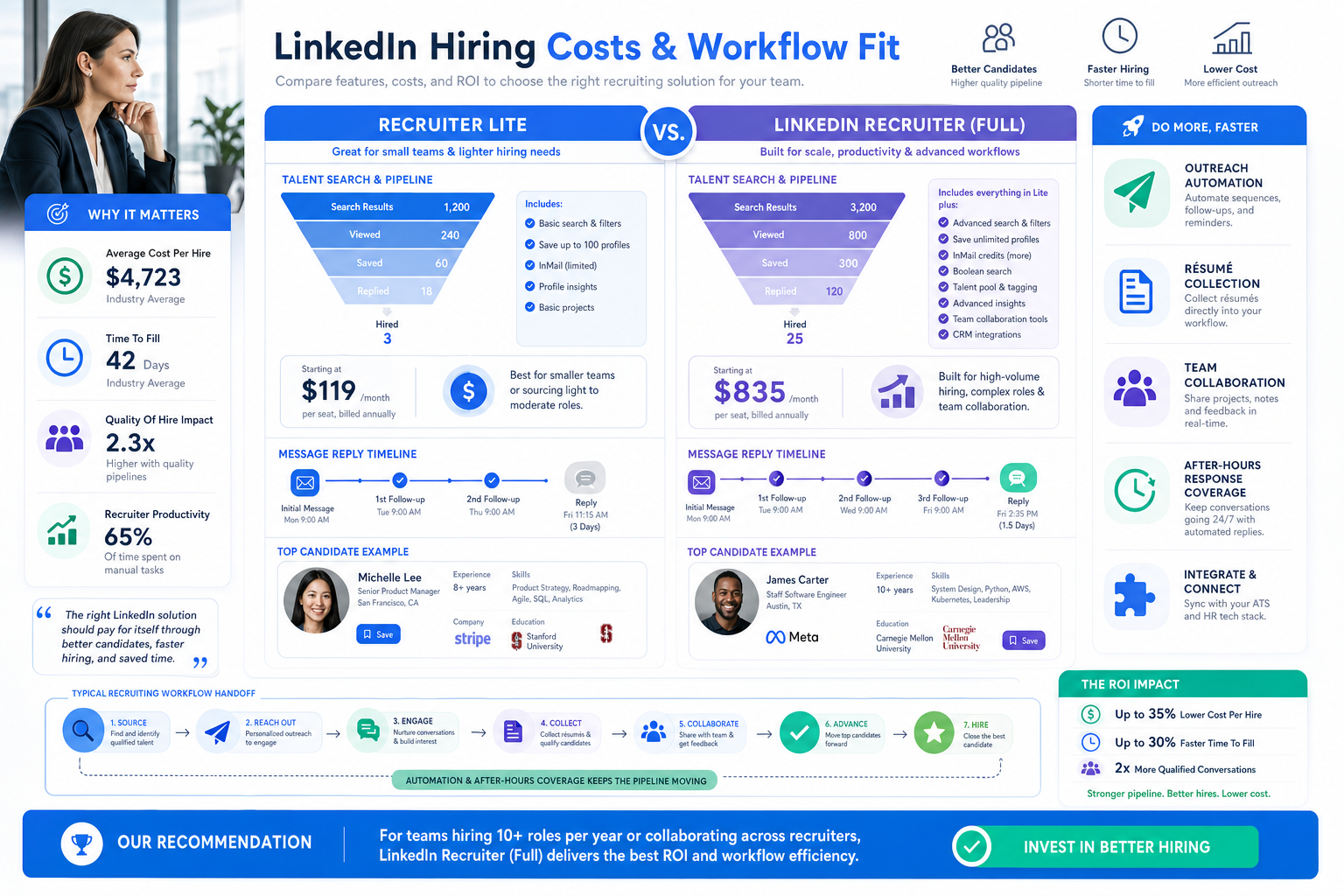
Linkedin recruiter costs matter less than workflow fit, and this article helps recruiting leaders judge both before budget drag sets in.
That is where direct pricing inquiries often go wrong. A solo recruiter sees a visible monthly number and assumes the buying decision is finished. But once outreach volume rises, candidates reply after hours, hiring managers want context, and multiple recruiters touch the same search, the real cost problem becomes operational. Missed replies slow momentum, weak handoffs damage candidate trust, and paying for the wrong level of access creates budget drag without improving placements.
In that gap between sticker price and actual workflow, tools that reduce repetitive LinkedIn work can help. I have seen StrategyBrain AI Recruiter work best when a recruiter needs faster candidate outreach, around-the-clock reply coverage, and cleaner résumé collection without surrendering final judgment. It can automate first-touch messaging, continue conversations in the candidate's language, and capture contact details or résumés from interested prospects, while the recruiter still decides fit, reviews the CV, and moves the process forward.
A useful way to think about this comes from a career story outside pure recruiting. One finance leader spent years in marketing roles at brands and entertainment companies before moving into acquisitions and then startup finance. He was not hired into finance because his background matched on paper line for line. He won the opportunity because he could pull transferable skills from earlier work, explain why they mattered in a new setting, and defend that relevance in front of decision-makers.
That same pattern shows up in LinkedIn recruiting every day. Recruiters do not just buy search access; they buy the ability to frame a candidate's story, maintain continuity across conversations, and turn fragmented experience into a credible hiring narrative. When buyers ask about linkedin recruiter costs or linkedin recruiter cost, the better question is whether the plan supports that work cheaply enough for one recruiter, or consistently enough for a team.
Direct Answer on Pricing
If you need the shortest possible answer, visible self-serve pricing is usually easiest to find for Recruiter Lite. It is commonly shown around $170 per month on an annual commitment or about $199.99 month to month. Full LinkedIn Recruiter pricing is typically handled through a sales conversation rather than a simple public rate card.
That means anyone researching linkedin recruiter costs should separate two buying paths immediately:
- Recruiter Lite: the public benchmark and the easiest number to verify
- LinkedIn Recruiter: usually quote-based, especially for multiple seats or broader team workflows
- Larger recruiting packages: often structured around annual agreements, seat counts, and added services
The important part is not just the number itself. It is what level of recruiting work that number can realistically support.
Why Price Alone Is a Bad Buying Signal
The reference story about changing industries is useful here because it highlights something recruiters know well: hiring value often depends on context, not surface labels. A candidate can look nontraditional on paper and still be the right hire if their story is framed well. Buying LinkedIn recruiting access works in a similar way. The cheapest visible subscription is not automatically the best fit if your team's work depends on coordinated outreach, context-rich candidate notes, and shared ownership.
In practice, I look at three buying signals before I care too much about the headline price:
- How much of your recruiting success depends on storytelling? If your recruiters regularly place career changers, hard-to-map candidates, or high-context profiles, your workflow needs more than basic search access.
- How often do candidates reply outside recruiter hours? If response timing matters, delayed follow-up can waste sourcing effort.
- How many people need continuity on the same search? Once a recruiter, hiring manager, and sourcer all need visibility, a low entry price can become expensive friction.
Practical takeaway: the best way to evaluate linkedin recruiter cost is to ask whether the subscription supports the candidate story your team has to tell, not just how much the seat costs.
Recruiter Lite vs Full LinkedIn Recruiter
Buyers often start with cost, but a smarter comparison starts with operating model. Recruiter Lite is generally the simpler entry point. Full LinkedIn Recruiter is usually the team-grade option when process complexity grows.
| Category | Recruiter Lite | LinkedIn Recruiter |
|---|---|---|
| Pricing visibility | Public self-serve path | Usually quote-based |
| Typical public number | Often near $199.99 monthly or roughly $170/month annualized | Usually requires a sales quote |
| Best operating model | Solo recruiter or light sourcing use | Team-based, higher-volume recruiting |
| Candidate narrative support | Works for straightforward individual outreach | Better when multiple stakeholders need shared context |
| Workflow coordination | More limited | Stronger fit for shared recruiting activity |
| Budget planning | Easier for quick entry | Needs annual-spend evaluation |
| Upgrade trigger | When one person's process starts to break | When collaboration becomes the bottleneck |
For many headhunters and in-house recruiters, that table is more useful than asking for one universal list price. The point is not just what LinkedIn charges. The point is what breaks first in your current process.
The Workflow Costs Buyers Miss
When people search linkedin recruiter costs, they usually mean subscription price. But experienced recruiters know the hidden cost often sits in the workflow around the tool.
1. Slow follow-up weakens good sourcing
A strong LinkedIn search is wasted if interested candidates wait too long for a response. This is especially true when a recruiter is trying to reposition someone whose background does not fit a standard template. The story needs momentum. If replies pile up overnight or across time zones, candidate intent cools.
This is one place where I found AI Recruiter useful in practice. It can keep the first layer of communication moving, answer role basics, and collect contact details from interested candidates while I focus on whether the person's background actually fits the assignment. That is valuable when the bottleneck is response coverage, not final evaluation.
2. Fragmented notes make non-obvious candidates harder to place
The industry-transition case in the reference text matters because recruiters often win searches by connecting dots others miss. If a candidate has moved across functions or industries, the recruiter has to preserve context: why the move makes sense, what commercial or operational skills transfer, and how that argument should be presented to a hiring manager.
If that context lives in scattered messages, inboxes, or memory, the recruiting tool may be cheap but the process becomes unreliable.
3. Extra seats can be cheaper than repeated confusion—or more expensive than needed
Some teams underbuy and create communication gaps. Others overbuy and give full seats to stakeholders who only need periodic updates. The right answer depends on named users, hiring volume, and whether candidate ownership is centralized or shared.
4. Renewal risk matters more than buyers expect
A first-year number may look acceptable, but renewals and package changes can alter the economics. That is why recruiting leaders should ask not just for base pricing, but for a line-by-line explanation of seats, terms, optional modules, and renewal assumptions.
Tools and Alternatives Recruiters Compare
If your team is evaluating LinkedIn recruiting workflow rather than LinkedIn alone, the practical comparison set often includes sourcing automation and outbound tools. The exact fit depends on whether your problem is search access, outreach execution, or follow-up continuity.
| Tool | Use Experience | Likely Impact | Cost Position | Best Fit | How It Can Work With StrategyBrain AI Recruiter |
|---|---|---|---|---|---|
| LinkedIn Recruiter / Recruiter Lite | Native environment for search and recruiter workflows | Strong for direct sourcing inside LinkedIn | Lite is easier to benchmark; full product is usually quote-based | Solo recruiters through large TA teams | Can be paired with StrategyBrain AI Recruiter when the team needs automated outreach continuity and résumé capture around LinkedIn activity |
| Gem | Often favored for recruiting coordination and outbound workflow visibility | Useful when teams need process analytics and structured follow-up | Typically sales-led | Structured internal recruiting teams | Can complement AI-driven LinkedIn conversations if the recruiter wants another layer of process tracking while keeping final screening human-led |
| hireEZ | Often used for broader sourcing reach beyond a single channel | Helpful for teams prioritizing multi-source talent discovery | Usually enterprise or sales-led pricing | Growing teams with broader sourcing programs | Can sit alongside StrategyBrain AI Recruiter when LinkedIn remains the core outreach channel but discovery needs are wider |
| SeekOut | Known for deeper search workflows and talent mapping use cases | Useful for harder-to-find profiles and research-heavy searches | Generally quote-based | Technical hiring and research-led sourcing teams | Can work with StrategyBrain AI Recruiter when a team wants better LinkedIn follow-up after talent identification |
I would not treat this as a simple winners-and-losers list. Each option solves a different part of the recruiter's day. The reason StrategyBrain AI Recruiter is worth mentioning in a LinkedIn workflow discussion is that it addresses the repetitive communication layer directly: connecting, introducing roles, handling replies, and collecting materials, while leaving the recruiter in control of shortlist quality and hiring judgment.
Which Option Fits Which Team
Solo recruiter, independent headhunter, or founder-recruiter
If the search load is manageable and outreach is mostly individual, Recruiter Lite is often the first number to benchmark. It offers a clear starting point and lower buying friction. If the real pain is message volume rather than search itself, adding an outreach-support layer may matter more than jumping immediately to a larger contract.
Small agency or in-house team
This is where many buyers get stuck. The team is large enough to feel workflow pain, but not large enough to absorb unnecessary platform spend. If your recruiters routinely have to frame unusual candidate backgrounds, explain lateral moves, or keep conversations alive after hours, evaluate the process around the seat—not just the seat.
In that situation, I have found StrategyBrain AI Recruiter most useful as a support layer for repetitive messaging. It helped me keep candidate conversations moving without pretending that automation should decide who gets submitted. I still reviewed résumés myself, made fit calls, and adjusted the narrative for the client or hiring manager.
Larger recruiting function
When multiple recruiters, sourcers, and stakeholders need shared visibility, full LinkedIn Recruiter is usually the more realistic path. At that point, pricing has to be evaluated against governance, consistency, and collaboration. Lite may still look cheaper in isolation, but the cost of broken ownership can be higher.
A Practical Buying Checklist
Before you ask for a quote or approve a subscription, use this checklist:
- Define the type of candidates you hire. Straightforward profiles and story-heavy transitions create very different workflow needs.
- Map where candidate momentum is lost. Search, outreach, reply speed, résumé collection, handoff, or stakeholder alignment.
- Count true seat users. Separate active recruiters from observers.
- Ask what happens outside recruiter hours. If response timing matters, process support may be worth more than another search seat.
- Model annual spend, not just monthly spend. Especially for multi-seat purchases.
- Request a renewal and add-on breakdown. Do not compare year one only.
- Test the story-transfer workflow. Can one recruiter explain a non-obvious candidate clearly enough that another recruiter or hiring manager can continue the process without losing context?
That last question is the one most teams skip, and it is often the one that determines whether the tool truly supports recruiter performance.
FAQ
How much does LinkedIn Recruiter cost?
The most visible public number is usually for Recruiter Lite, commonly shown around $170 per month on an annual commitment or about $199.99 month to month. Full LinkedIn Recruiter pricing is typically quote-based.
Why is full LinkedIn Recruiter pricing harder to find?
Because larger plans are commonly structured around seat count, contract term, and team requirements rather than a single public checkout price.
What is the difference between linkedin recruiter costs and linkedin recruiter cost in search intent?
They are very similar. In practice, both queries usually come from buyers seeking a direct number, comparing Recruiter Lite versus full Recruiter, or trying to understand total cost before a sales conversation.
Is Recruiter Lite enough for an agency recruiter?
Sometimes, yes. It can work well for individual recruiters with moderate sourcing volume. But if candidate communication, follow-up coverage, and shared context are becoming problems, Lite may stop being the cheapest real-world option.
Can AI tools reduce LinkedIn recruiting workload without replacing recruiter judgment?
Yes. A tool such as StrategyBrain AI Recruiter can handle repetitive LinkedIn communication, collect résumés, and maintain responsiveness, while the recruiter still owns screening, fit assessment, and submission decisions.
Final Takeaway
The clearest public benchmark for linkedin recruiter costs is still Recruiter Lite. But the smarter buying decision comes from asking whether your team needs simple access, stronger collaboration, or better outreach continuity. The reference story about moving from marketing into finance is a useful reminder: outcomes improve when the right narrative can be built and carried forward.
That is why the best answer to a direct pricing inquiry is rarely just a number. It is a judgment about how your recruiters actually work, how candidate stories get translated into hiring decisions, and whether your chosen setup supports that process without wasting budget.