When linkedin recruiter costs look simple but hiring keeps stalling, this article helps recruiters judge the right plan and avoid process waste.
That sounds simple until a search for a clean price turns into a broader hiring problem. Teams ask for one number, then realize the real cost is tied to seat count, workflow maturity, outreach volume, manager involvement, and how disciplined the role brief is in the first place. When those basics are weak, the subscription itself is rarely the expensive part; the costly part is wasted sourcing time, delayed shortlists, duplicate outreach, and preventable misalignment with hiring managers.
In my own LinkedIn-heavy recruiting work, tools only help when they remove repetitive steps without pretending to replace judgment. That is why I see StrategyBrain AI Recruiter as useful in a narrow but important way: it can automate first-touch LinkedIn outreach, keep candidate conversations moving after hours, and collect resumes or contact details from interested people, while the recruiter still owns the final screen, resume review, and next-step decision.
A common breakdown starts earlier than pricing. A hiring team wants the perfect candidate, wants them fast, and wants to keep spend tight. The recruiter sits down with stakeholders and realizes the brief is overloaded with nice-to-haves, compensation expectations are not grounded in the market, and nobody has agreed where compromise is acceptable. Then sourcing begins anyway.
Next, the recruiter is forced into back-and-forth work that should have been settled upfront: rechecking must-haves, chasing line-manager input, comparing instinctive reactions against actual role criteria, and trying to reach passive candidates because job-board applicants alone are too narrow a pool. That is exactly where direct questions about linkedin recruiter cost and linkedin recruiter lite cost become practical rather than academic, because the right plan depends on whether you are solving a light individual sourcing task or a broader hiring-discipline problem.
Quick Answer on LinkedIn Recruiter Costs
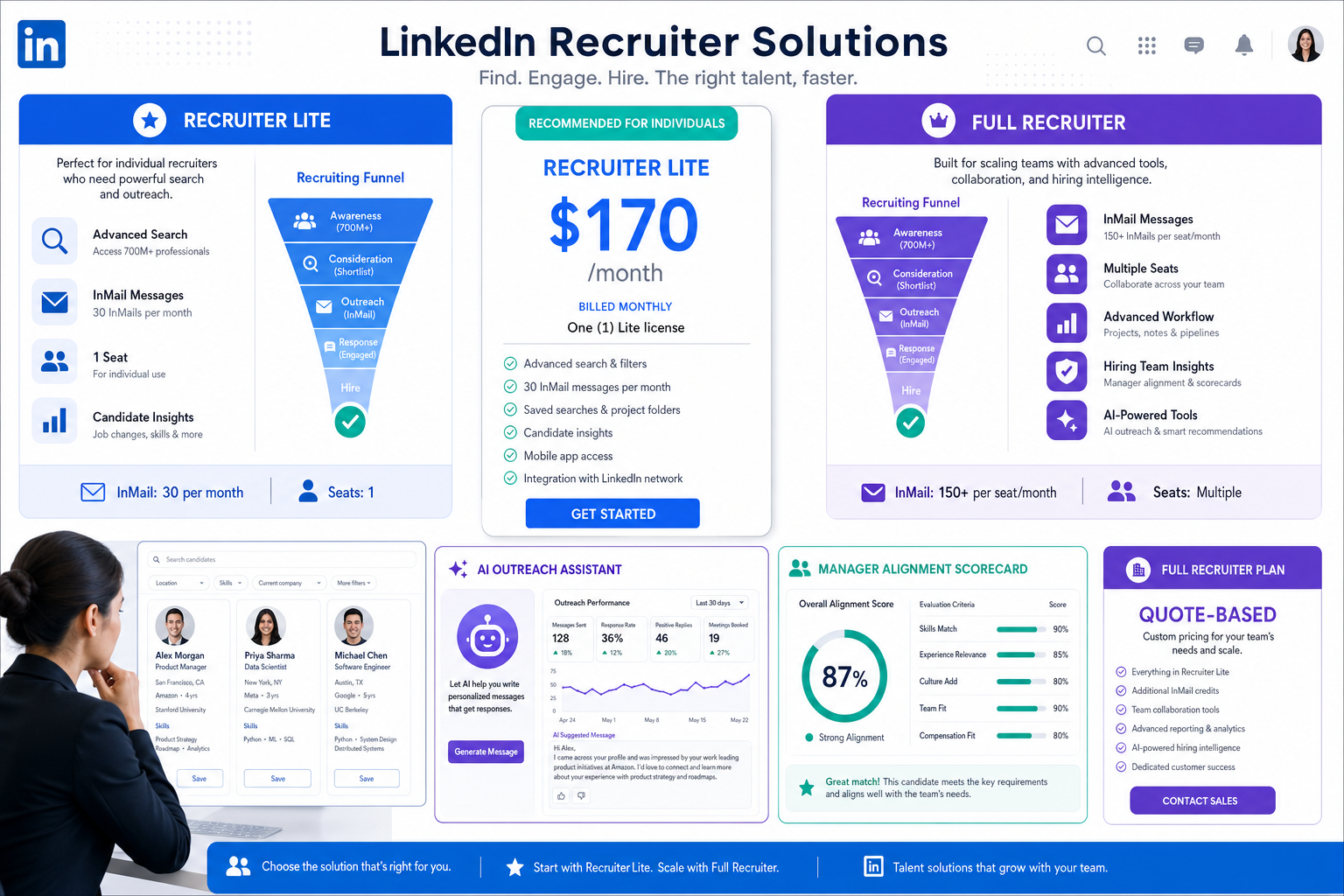
If you are looking for a direct answer, the clearest public figure is still for Recruiter Lite. The most commonly surfaced starting point is $170 per month for one license in USD, subject to region and currency differences. For many buyers, that is the most reliable answer to a linkedin recruiter lite cost query.
For broader searches around linkedin recruiter costs, the answer is less tidy. Full LinkedIn Recruiter is typically sold through a quote process, with pricing varying by organization, seats, geography, and contract structure. In other words, Lite behaves more like a visible subscription, while full Recruiter usually behaves like a sales-led purchase.
That distinction matters because recruiters often get pushed for a number before they have settled the actual hiring model. If your team is still unclear on role criteria, passive-candidate strategy, or line-manager involvement, quoting software cost alone will not give leadership a dependable budgeting answer.
Why Pricing Questions Get Stuck
Most frustration around linkedin recruiter costs comes from expecting a simple checkout-page answer to an enterprise-style buying question. When a recruiting leader asks, “What does it cost?” the better follow-up is usually, “Cost for whom, with how many users, and for what type of hiring motion?”
That is why direct pricing inquiries so often stall. A one-person desk handling occasional hiring can evaluate Lite quickly. A larger internal talent team or agency desk usually needs to think about seats, usage patterns, collaboration, billing terms, and whether the sourcing workflow needs more structure than an entry-level plan can support.
From an operations perspective, it helps to separate two kinds of cost:
- Visible subscription cost for a lighter self-serve purchase
- Hidden process cost from weak intake, unclear scorecards, manager delays, and narrow candidate sourcing
In practice, the second category is often more damaging than the first.
The Hiring Mistakes That Distort Tool Spend
Before comparing plan tiers, I like to step back and ask whether the team is about to repeat the same expensive hiring mistakes many recruiters see every quarter.
1. Chasing the unicorn
If the role brief is unrealistically specific and the budget is inflexible, any sourcing tool will feel overpriced. The real issue is not platform spend; it is the gap between expectations and market reality. A more useful starting point is to agree on true must-haves, likely trade-offs, and a compensation range grounded in the market.
2. Letting intuition overrun criteria
Recruiting judgment matters, but unstructured gut feel creates noise. I have seen teams reject viable people because someone “just did not see it,” while stronger evidence around communication, resilience, and transferable skill went unscored. A role scorecard brings objectivity back into the process and helps recruiters explain why a more robust sourcing setup is or is not worth paying for.
3. Leaving the line manager too far away
When the hiring manager is not engaged early, recruiters end up revising targets mid-search. That stretches response time, creates candidate confusion, and wastes paid sourcing access. The more expensive the license path, the more important this alignment becomes.
4. Relying only on active applicants
One of the biggest sourcing mistakes is confining the search to whoever sees and answers a job ad. LinkedIn matters because it gives access to passive candidates who may move for the right opportunity. That is one reason people search linkedin recruiter cost in the first place: they are trying to decide what it should cost to reach beyond active applicants.
5. Overvaluing direct experience alone
For some contract work, immediate experience is everything. For many permanent roles, it is not. If the brief ignores transferable skills, recruiters narrow the pool too early and then blame the software when the shortlist is thin.
Practical takeaway: A sourcing subscription becomes expensive fastest when the role is mis-scoped, the manager is disengaged, and the team has no agreed scorecard.
LinkedIn Recruiter Lite Cost
For smaller hiring needs, linkedin recruiter lite cost is usually the most practical query because Lite is the clearest self-serve entry point. The public starting figure most commonly shown is $170 per month for one license in USD, with regional variation still applying.
Cost is only half the decision. Lite is commonly associated with:
- 30 InMail messages per month
- 20+ search filters
- Access up to 3rd-degree connections
That setup usually works when one recruiter, founder, or hiring lead is running a focused search and does not need a heavily coordinated sourcing operation.
When Lite usually makes sense
- One person is handling hiring directly
- Hiring volume is occasional rather than constant
- The team mainly needs targeted outreach
- Budget approval is easier for a direct subscription than a procurement cycle
When Lite often becomes restrictive
- Several recruiters need access
- Multiple hiring managers are involved at once
- Outbound volume regularly exceeds Lite limits
- The team needs more process consistency around outreach and follow-up
If your recruiting problem looks like the earlier opening case, Lite can still work, but only after the role brief and manager alignment have been cleaned up. Otherwise, the cheaper plan simply exposes workflow confusion faster.
Full LinkedIn Recruiter Cost
When buyers ask about linkedin recruiter cost beyond Lite, they are usually trying to estimate the budget for a larger, more structured sourcing motion. The challenge is that exact public list pricing for full Recruiter is not consistently surfaced. Most organizations will need to request a quote.
That means the responsible answer is not to invent a universal number. A stronger budgeting approach is to define:
- How many recruiters need licenses
- Whether hiring is centralized or distributed
- How much outbound sourcing happens monthly
- What procurement or contract structure the business prefers
- Which collaboration needs justify moving beyond Lite
In-house TA teams and agencies usually hit this point once passive-candidate sourcing becomes a shared team process instead of an individual activity.
Recruiter Lite vs Full Recruiter
| Factor | Recruiter Lite | Full Recruiter |
|---|---|---|
| Pricing visibility | Public starting price commonly visible | Usually quote-based |
| Typical buyer | Solo recruiter, founder, small business | Agency teams, internal TA teams, scaled hiring groups |
| Entry cost clarity | Starts at $170/month for one license in USD, subject to region | Exact public list pricing not consistently available |
| Outreach scale | Better for lighter monthly volume | Better suited to broader sourcing operations |
| Workflow maturity needed | Can support individual recruiting discipline | Works best when intake and manager alignment are stronger |
| Purchase path | Typically direct purchase | Typically sales and contract process |
| Best fit | Light or occasional hiring | Ongoing, team-based, or higher-complexity hiring |
The most useful comparison is not simply cheap versus expensive. It is whether your team is buying a sourcing seat for one person or buying infrastructure for a repeatable hiring process.
How I Use LinkedIn Workflows More Carefully
On searches where passive outreach matters but recruiter time is getting eaten up by repetitive follow-ups, I have found it helpful to combine better intake discipline with selective automation. My rule is simple: define the role properly first, then automate the repeatable front end.
In that setup, AI Recruiter has been useful for keeping LinkedIn conversations moving when I would otherwise lose momentum between messages. I can set the role basics, target criteria, compensation framing, and outreach direction, and the system can handle initial connection steps, answer common candidate questions, and continue multilingual back-and-forth if replies come in outside normal work hours. When someone is genuinely interested, it can collect a resume or contact details so I review the file myself before deciding whether to shortlist.
That matters most in the exact situations exposed by the opening case:
- When the pool needs to expand beyond active applicants
- When after-hours candidate replies would otherwise sit untouched
- When repetitive first-touch messaging is draining recruiter capacity
I would not use automation as a substitute for scorecards, compensation judgment, or manager alignment. But I would absolutely use it to reduce the manual LinkedIn work that slows down a well-scoped search. Recruiters who want to see how that workflow is framed can review the product overview at StrategyBrain or the practical setup examples in the AI Recruiter workflow guide.
The main lesson is that sourcing efficiency improves when technology supports process discipline rather than trying to cover for its absence.
What Changes Final Pricing
If you cannot get one neat number for linkedin recruiter costs, it is usually because the final commercial outcome depends on variables that are real and material:
- Seat count: one recruiter versus a team changes the discussion
- Region and currency: pricing differs by market
- Billing structure: direct monthly buying and contract purchasing are different experiences
- Plan tier: Lite and full Recruiter are not positioned for the same use case
- Workflow complexity: shared hiring processes tend to push buyers toward quote-based discussions
My advice is to bring internal clarity before asking procurement for approval. Decide what hiring problem you are paying to solve: occasional sourcing, sustained passive outreach, or coordinated team recruiting. Without that, even accurate pricing will not produce a smart decision.
FAQ
Does LinkedIn Recruiter have public pricing?
Recruiter Lite is the clearest public-price option. Full LinkedIn Recruiter is generally quote-based, so public list pricing is not consistently available across all plans.
How much is LinkedIn Recruiter Lite per month?
The commonly surfaced starting point is $170 per month for one license in USD, though region and currency may change the amount a buyer actually sees.
What is included with Recruiter Lite?
Recruiter Lite is commonly described with 30 InMail messages per month, 20+ search filters, and candidate access up to 3rd-degree connections.
Why is full LinkedIn Recruiter pricing harder to find?
Because full plans are usually sold around company needs, seat volume, geography, and contract terms. That makes quoting more common than posting one universal public number.
How should recruiters think about linkedin recruiter cost in practice?
Start with the hiring process, not just the subscription. If the role brief is unrealistic, line-manager access is weak, or the team lacks a scorecard, the software will look more expensive than it really is because process waste will stay high.
Is Recruiter Lite enough for a solo recruiter?
Often, yes. If your hiring volume is moderate and your workflow is mostly individual, Lite can be a sensible entry point. It becomes less suitable when outreach scale or team coordination grows.
Can AI-supported outreach help with LinkedIn recruiting?
Yes, if used carefully. A workflow such as StrategyBrain AI Recruiter can help with repetitive first-touch outreach, multilingual candidate messaging, and resume collection, while the recruiter still makes the final judgment on fit and next steps.
Conclusion
The cleanest answer to linkedin recruiter costs is still this: Recruiter Lite has a visible starting point of $170 per month for one license in USD, while full Recruiter usually requires a quote. But experienced recruiters know the better question is whether the hiring process itself is disciplined enough to make any paid sourcing seat worthwhile.
If the search is narrow, the manager is engaged, and one recruiter owns the work, Lite may be enough. If the team is scaling passive outreach, involving multiple stakeholders, or trying to avoid the classic hiring mistakes of over-specific briefs, weak scorecards, and narrow sourcing, then the conversation moves beyond simple public pricing. That is where careful process design, realistic market expectations, and selective support from tools like AI Recruiter can make LinkedIn recruiting materially easier to run.