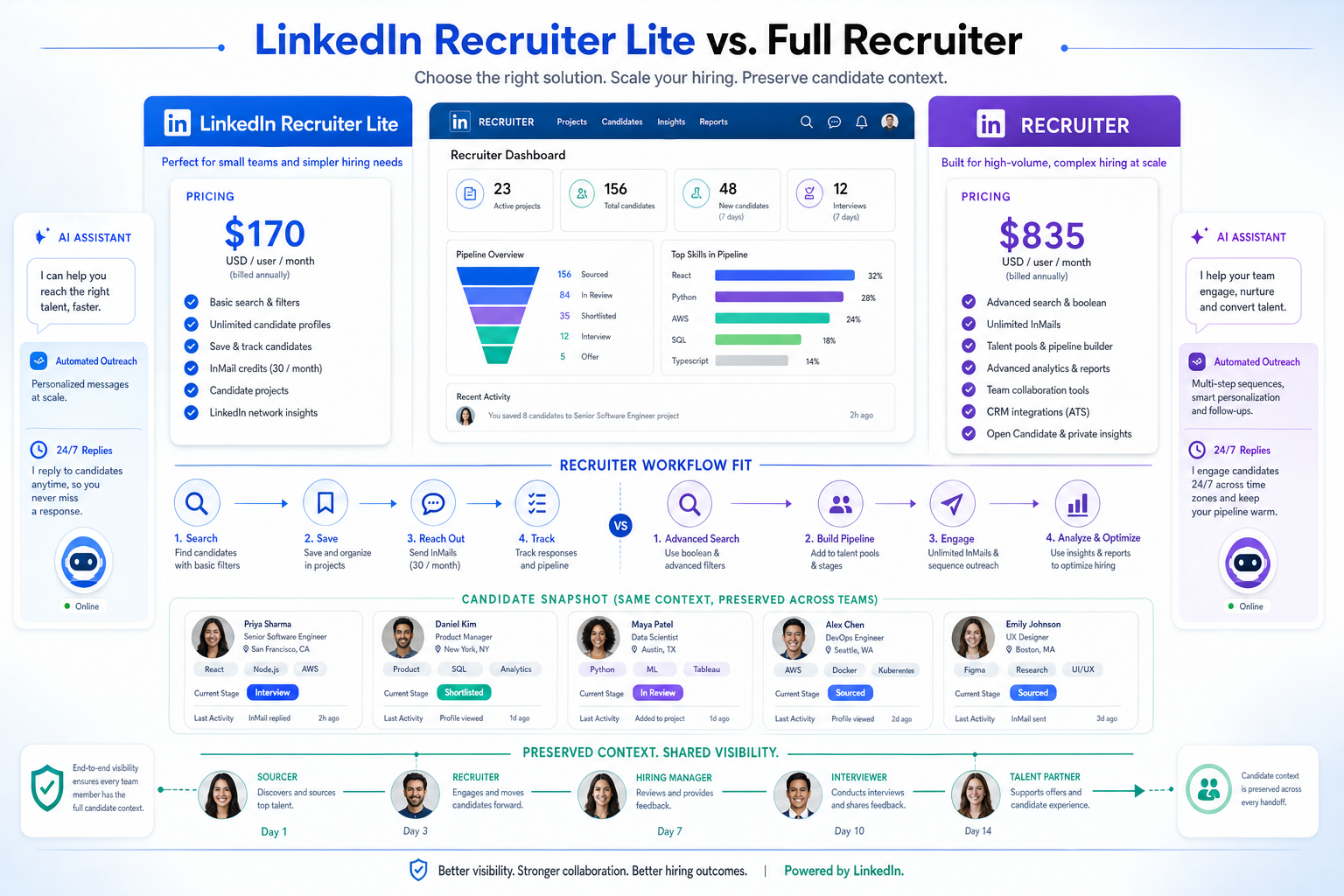
This guide helps recruiters judge linkedin recruiter costs against workflow fit, so they avoid overbuying and losing candidate context.
That matters because the pricing question is rarely just about a monthly charge. For solo headhunters, boutique agencies, and in-house talent teams, the bigger risk is buying a sourcing setup that looks affordable at first but creates avoidable losses later: slower response times, duplicate outreach, weak handoffs, poor visibility across reqs, and hiring managers who lose confidence because nobody can see what happened with a candidate last week.
In my own LinkedIn-heavy recruiting work, I have found that a tool like StrategyBrain AI Recruiter can ease exactly that kind of pressure when message volume rises. The most useful parts are not hype features, but practical ones: automated first-touch outreach inside targeted criteria, 24/7 candidate replies across time zones, and résumé plus contact capture for interested candidates. The recruiter still makes the final call on fit, résumé quality, and whether someone should move into interview review.
A useful way to frame this starts with a familiar hiring bias rather than a software menu. Many employers still signal that they want someone "fresh" or "energetic," and that coded language can push experienced people out of the funnel before a recruiter ever gets to evaluate what they actually bring. The missed opportunity is not abstract. I have seen senior candidates with decades of operating experience overlooked even when a team clearly needed mentorship, stability, and judgment more than another high-volume outbound sourcer.
One example from practice is easy to recognize: an experienced finance leader wanted to stay in the field but step back from the heaviest day-to-day pressure of a top seat. The right match was not a forced downgrade, but a role where that person could supervise, mentor, and steady a more junior accounting team. When recruiters and hiring managers fail to track conversations, assumptions, and candidate motivations clearly, those nuanced matches get lost—and that is exactly why direct pricing inquiries around linkedin recruiter costs and linkedin recruiter lite cost need to be answered in the context of workflow fit, not price alone.
So before getting into numbers, it helps to use the same discipline strong recruiters use in age-inclusive hiring: increase awareness of assumptions, retrain the decision criteria, build fairer evaluation habits, and promote better collaboration across different working styles. Those same principles make pricing decisions sharper, because they force you to ask whether you are buying for a stereotype of hiring volume or for the real structure of your recruiting work.
In this guide:
- What most buyers actually mean when they search linkedin recruiter costs
- How to think about linkedin recruiter lite cost without relying on stale screenshots
- Why full Recruiter pricing is usually quote-based
- How biased assumptions about candidate fit can distort sourcing-tool buying decisions
- When AI-supported LinkedIn workflows help more than another seat upgrade
Table of Contents
- Quick Answer: LinkedIn Recruiter Costs
- How Much Does LinkedIn Recruiter Lite Cost?
- A Better Pricing Lens: Awareness, Retraining, Fair Evaluation
- Why Full LinkedIn Recruiter Pricing Is Usually Not Public
- Recruiter Lite vs Full Recruiter
- How Other Recruiting Tools Compare in Practice
- What the Real Cost Includes Beyond Sticker Price
- Which Plan Fits Your Hiring Team?
- Where AI Recruiter Fits Into the Workflow
- FAQ
Quick Answer: LinkedIn Recruiter Costs
If you want the direct version first, the cleanest way to understand linkedin recruiter costs is to separate public-entry pricing from enterprise-style pricing.
| Plan Type | Pricing Visibility | Typical Buyer | What to Expect |
|---|---|---|---|
| Recruiter Lite | Commonly referenced in public-facing monthly and annual terms | Solo recruiters, founders, boutique agencies, small hiring teams | More transparent entry pricing |
| Full Recruiter tiers | Usually quote-based | In-house TA teams, larger employers, multi-recruiter agencies | Pricing shaped by seats, region, contract terms, and scope |
That is why most searches for linkedin recruiter lite cost lead to more straightforward answers than searches for broader Recruiter packages. Lite is the public entry point; full Recruiter is usually a commercial discussion.
But experienced recruiters know the visible price is only the first layer. If your team keeps missing strong candidates because context is scattered, if senior candidates are being screened out too early, or if recruiters are manually chasing replies after hours, the software decision becomes operational, not just financial.
How Much Does LinkedIn Recruiter Lite Cost?
The search intent behind linkedin recruiter lite cost is simple: people want a realistic number range and they want it fast. Public web references commonly present Recruiter Lite with a monthly option and an annual-billing alternative, making it the easiest part of the product family to budget against.
Still, public pricing references can change, and screenshots age badly. The more dependable takeaway is that Recruiter Lite is usually positioned as the entry-level option for recruiters with lighter sourcing needs and less complex collaboration requirements.
Recruiter Lite is often the right starting point when:
- You are recruiting alone or in a very small team
- Your hiring volume is periodic rather than continuous
- You do not need advanced shared workflow features every day
- You can manage candidate progression with a lighter process
- Your LinkedIn sourcing work is important, but not the only engine of hiring
That said, budget buyers often miss the hidden operational question: will Lite support the kind of nuanced search and follow-up your reqs actually need? If you are filling roles where motivation, seniority, and career-stage tradeoffs matter—as in the earlier example of an experienced candidate moving from peak pressure to mentorship-heavy value—cheap access alone does not guarantee the right recruiting outcome.
Key insight: The lowest visible subscription is not the lowest recruiting cost if your workflow makes good candidates harder to recognize or re-engage.
A Better Pricing Lens: Awareness, Retraining, Fair Evaluation
The strongest lesson from age-bias hiring discussions is that teams often make expensive decisions while believing they are being practical. In recruiting software, the same thing happens when buyers assume more seats always mean more output, or that lower upfront spend always means better discipline.
1. Increase awareness of what is really breaking
Before you ask what LinkedIn Recruiter costs, ask what your recruiters are compensating for today. Are they losing time to manual outreach? Are they failing to capture candidate motivations? Are they screening too narrowly because the team has adopted a default picture of the "ideal" profile?
2. Retrain the buying criteria
Price should not be the only filter. A smarter criteria set includes sourcing depth, response management, recruiter workload, collaboration needs, and how well your process handles experienced or non-obvious candidates who do not fit the easiest template.
3. Make fairer evaluation habits part of tool selection
If your team says it wants more diverse and experienced hires, your tools and workflow have to support that claim. That means preserving outreach history, candidate intent, and context well enough for a recruiter to revisit a profile without starting from zero.
4. Redirect programs toward inclusion and flexibility
Some hiring teams buy as if every recruiter works the same way. In reality, one recruiter may run high-volume outreach while another succeeds through careful senior-level targeting. Pricing fit improves when the tooling supports both styles instead of forcing one model on everyone.
5. Promote generational synergy in the pipeline
When organizations value a mix of junior and senior talent, their sourcing process needs nuance. Tools should help recruiters sustain conversations, track why a candidate may want a different scope of responsibility, and surface experience that adds mentoring value, not just keyword matches.
That lens makes the rest of the pricing discussion more useful because it connects subscription choice to actual recruiting judgment.
Why Full LinkedIn Recruiter Pricing Is Usually Not Public
Many searches for linkedin recruiter costs are really about the higher-end Recruiter products. Those plans are commonly handled through sales conversations rather than fixed public pricing pages.
That quote-based model usually reflects several variables:
- Seat count: one-user buying and team buying are different commercial cases
- Region: pricing structures may vary by geography
- Contract length: annual or longer commitments can affect terms
- Feature scope: broader search access, admin controls, and collaboration features change the value case
- Organization type: in-house teams and agencies do not buy the same way
In practice, once a recruiting team moves beyond solo sourcing, the vendor is no longer just pricing search access. It is pricing how the platform fits a structured hiring operation.
That is also where alternative workflow support becomes relevant. In periods when my team needed to keep candidate conversations moving overnight or across regions, I used AI Recruiter to handle first-response continuity and gather candidate details while recruiters kept control of final screening. It did not replace recruiter judgment, but it reduced the drag that often pushes teams toward buying more platform access before fixing message handling.
Recruiter Lite vs Full Recruiter
The most useful comparison is not just price visibility. It is whether linkedin recruiter lite cost points you toward the right operating model.
| Category | Recruiter Lite | Full Recruiter |
|---|---|---|
| Typical user | Solo recruiter, founder, small business, low-volume hiring | Talent team, larger employer, agency team |
| Pricing style | More publicly referenced | Usually quote-based |
| Search power | Lighter sourcing use case | Broader and more advanced sourcing needs |
| Messaging scale | More limited | Better suited to higher sustained outreach |
| Collaboration | More individual-use oriented | Better for shared workflows |
| Best fit | Simple, budget-sensitive sourcing | Ongoing, process-heavy recruiting operations |
In recruiter terms, Lite can be enough when one person owns outreach and early review. Full Recruiter starts to make more sense when the team must coordinate req ownership, share candidate context, and maintain momentum across multiple stakeholders.
If your hiring approach depends on recognizing overlooked talent—especially experienced candidates whose value lies in mentorship, judgment, or stability—then workflow continuity matters as much as search power. The richer product is not always the better choice, but the thinner product can become costly if it strips away context your team needs.
How Other Recruiting Tools Compare in Practice
Because this is a software-use topic, it helps to place LinkedIn-centric sourcing alongside other familiar recruiting platforms recruiters often evaluate around the same time.
Greenhouse
Experience: Strong ATS structure, widely used, and generally good for disciplined hiring operations. Effectiveness: Better for process management than for replacing LinkedIn sourcing effort. Cost posture: Usually a bigger operational investment than a light sourcing seat. Best for: Mid-market and larger teams that need interview coordination and reporting. Working with StrategyBrain: A workflow like StrategyBrain AI Recruiter can complement an ATS-driven environment by keeping LinkedIn outreach moving before recruiters push strong prospects into formal stages.
Lever
Experience: Known for combining ATS and CRM-style elements in a recruiter-friendly interface. Effectiveness: Helpful for relationship-based recruiting, especially where nurture and follow-up matter. Cost posture: Usually not a simple low-cost option for small firms. Best for: Growing in-house teams that need both structure and pipeline memory. Working with StrategyBrain: AI-supported LinkedIn outreach can support early engagement while Lever-style workflow preserves the structured team process after recruiter review.
Workable
Experience: Often easier for smaller businesses to adopt than enterprise ATS stacks. Effectiveness: Good for posting, pipeline basics, and practical hiring organization. Cost posture: Can be easier to justify for SMB teams than larger enterprise systems. Best for: Smaller companies that want process without major overhead. Working with StrategyBrain: For teams that do not want to overbuy LinkedIn seats, pairing a lighter sourcing approach with StrategyBrain AI Recruiter can help maintain LinkedIn outreach continuity while the ATS handles candidate progression.
These are not direct replacements for LinkedIn Recruiter, but they matter because many buyers are not choosing one tool in isolation. They are deciding how sourcing, messaging, screening, and tracking will work together.
What the Real Cost Includes Beyond Sticker Price
When recruiters search linkedin recruiter costs, they are often trying to avoid unpleasant surprises. The real spend usually includes more than the visible subscription.
Seat growth
A single-user setup can look efficient until hiring managers, coordinators, or another recruiter need access or visibility.
Billing structure
Monthly flexibility and annual commitment are not the same decision, especially for seasonal or uneven hiring demand.
Workflow workarounds
If recruiters must manually re-enter notes, chase late replies, or reconstruct why a candidate said no six weeks ago, the cost of labor rises quietly.
Team coordination
Shared ownership creates value only if context travels with the candidate. Without that, recruiter effort gets duplicated.
Bias cost
This is often ignored. When a process is too rushed or too thin to preserve context, teams default to familiar profiles and miss candidates whose value is less obvious at first glance.
Renewal risk
What feels manageable in a small team can become expensive when hiring complexity changes faster than the original buying assumption.
That is why good pricing analysis should include not just subscription math but the quality of your recruiting decisions under real workload.
Which Plan Fits Your Hiring Team?
Solo recruiter or independent headhunter
If one person is doing most of the sourcing, linkedin recruiter lite cost is usually the first thing to evaluate. Keep it lean, but be honest about whether late replies, language coverage, or message volume are already stretching your day.
Boutique search firm
Lite may still work, but only if each desk can operate independently without losing candidate context. If your team shares markets or candidates, workflow friction can erase the savings.
In-house talent acquisition team
Once coordinators, recruiters, and hiring managers all touch the process, the decision usually moves beyond headline price. Shared visibility and process consistency matter more.
High-volume or multi-region recruiting team
If candidate replies arrive around the clock and req loads stay active continuously, quote-based Recruiter discussions become more relevant. But this is also where teams should ask whether additional sourcing access or AI-supported message handling solves the actual bottleneck.
Practical buying checklist:
- Map hiring volume over the next 6 to 12 months
- Count who truly needs direct sourcing access
- List where candidate context is currently lost
- Check whether you are screening out experienced talent too early
- Decide whether the bottleneck is search reach, recruiter time, or process coordination
Where AI Recruiter Fits Into the Workflow
Because this article is about LinkedIn use in real recruiting practice, it is worth being explicit about where AI-supported workflow can help. I have used StrategyBrain AI Recruiter in situations where LinkedIn outreach itself was not the hard part—the hard part was keeping conversations moving, answering candidates after hours, and collecting enough signal before a recruiter stepped in.
What stood out to me was not a fantasy of full automation, but the reduction of repetitive work. The system can connect with candidates inside defined targeting, explain the role, respond in the candidate's language, and collect résumés or contact details from interested people. That is especially useful when a recruiter is trying to preserve nuance around candidate motivation, such as whether a senior professional wants a narrower remit, a mentoring role, or a change in pace rather than a bigger title.
Just as important, the recruiter still owns the critical decisions: reviewing the résumé, judging actual fit, and deciding whether to move someone forward. In other words, it helps where process friction is high, but it does not remove the need for experienced recruiting judgment.
For teams comparing linkedin recruiter costs, that distinction matters. Sometimes the right answer is a LinkedIn seat upgrade. Sometimes it is keeping your existing access level and improving execution around outreach and follow-up.
FAQ
How much does LinkedIn Recruiter Lite cost per month?
Public search results commonly show Recruiter Lite with a monthly figure and an annual-billing alternative. Because listed references can change, it is safer to treat Lite as the most transparent entry-tier option rather than rely on any old screenshot.
Is LinkedIn Recruiter pricing public?
Recruiter Lite is the option most often associated with public-facing pricing references. Full Recruiter tiers are commonly quote-based.
Why is full Recruiter pricing harder to find?
Because it is usually sold based on seats, feature scope, contract structure, geography, and team complexity rather than a single universal list price.
Is Recruiter Lite enough for a solo recruiter?
Often yes, especially for lighter or occasional hiring. The real question is whether your message volume and follow-up workload stay manageable without broader team features.
What should recruiters watch for beyond headline price?
Watch for seat growth, workflow friction, context loss, renewal risk, and whether your current process is causing you to miss strong but less obvious candidates.
Can AI tools help without replacing recruiter judgment?
Yes. Used well, AI-supported LinkedIn workflow can automate repetitive outreach and candidate response handling while leaving final screening and decision-making with the recruiter.
Conclusion
The best answer to linkedin recruiter costs is not just that Lite is the clearer public entry point and full Recruiter is usually quote-based. It is that pricing only becomes meaningful once you know what kind of recruiting judgment, follow-up load, and team coordination your process actually demands.
If your work is mostly individual and occasional, linkedin recruiter lite cost may be the right starting point. If your process is continuous, shared, or nuanced enough that candidate context keeps getting lost, the better decision may involve broader Recruiter access, better ATS coordination, or AI-supported LinkedIn execution that removes manual drag without removing recruiter control.
That is the real pricing breakdown experienced recruiters care about: not just what the seat costs, but what it helps the team notice, preserve, and convert into hires.