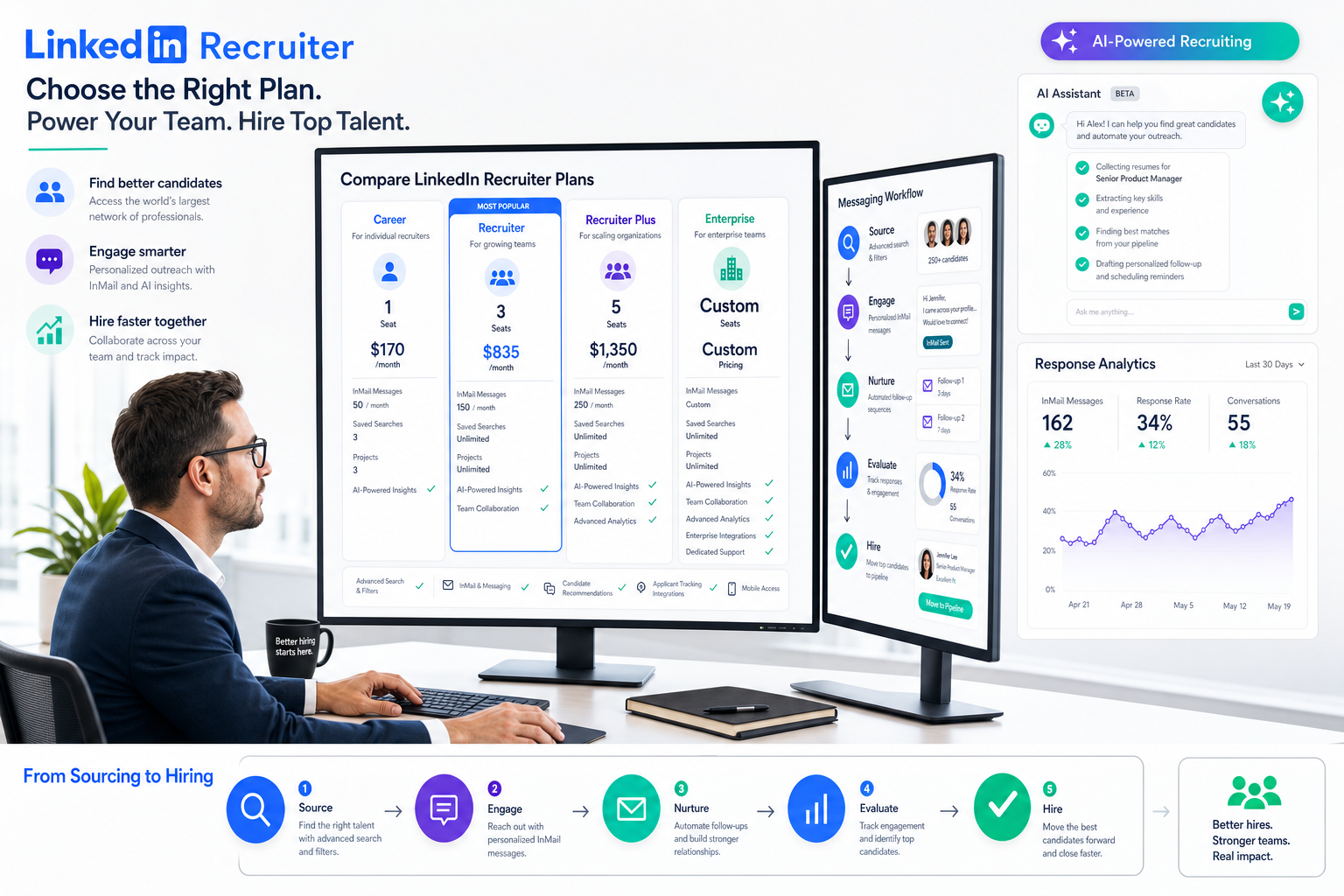
Recruiting leaders sizing linkedin recruiter costs can use this article to avoid overbuying seats, weak workflows, and slower hiring.
That matters more than it sounds. A solo headhunter can overbuy collaboration features that never get used, while an in-house TA team can underbuy and then lose time to manual handoffs, missed candidate replies, duplicated outreach, weak records, and awkward hiring-manager follow-up. In practice, the real damage is rarely just budget creep. It is slower hiring, poorer candidate experience, and harder internal alignment when the sourcing workflow no longer fits the team using it.
One way I have reduced that friction is by pairing LinkedIn sourcing with StrategyBrain AI Recruiter for the repetitive front end of outreach. In my own workflow, it has been most useful for automatic candidate messaging, after-hours follow-up, and collecting resumes or contact details from interested people without forcing me to babysit every reply. The recruiter still makes the final call on fit, reviews resumes, and decides who moves forward, but the communication gap that usually distorts cost decisions becomes much easier to see and manage.
A useful comparison comes from a recent employment-law update discussing what happens when an employer makes an offer, accepts it, and then wants to pull back before day one because of a hiring freeze or a reference issue. The legal point was not recruiting software at all. It was that timing, contract language, and process assumptions can create bigger liabilities than managers expect. In that situation, the employer is not simply asking, “Can we do this?” They are checking the offer terms, reviewing whether a condition precedent exists, and deciding whether to settle risk early or wait and see what follows.
The same pattern shows up when teams try to price LinkedIn sourcing tools too casually. They look for a public number, assume all tiers behave the same, and only later discover that timing, user count, workflow depth, and change risk shape the real commitment. That is why searches for linkedin recruiter costs, cost of linkedin recruiter, and linkedin recruiter cost are really about decision criteria, not just sticker price.
Table of Contents
Why LinkedIn Recruiter Pricing Feels Unclear
The confusion around pricing is not accidental. Buyers are often comparing two very different motions: a self-serve subscription meant for individual use, and a broader recruiting product that is sold more like a business system. In the same way employers in the legal update had to think beyond a simple yes-or-no answer and examine timing, obligations, and risk, recruiting teams need to look beyond a single visible price and ask what kind of operating model they are committing to.
That is the first practical lesson. When someone asks about the cost of linkedin recruiter, the answer changes based on whether they are a solo recruiter, a small agency, or a corporate team with multiple stakeholders touching the process. Public pricing may exist for one path, while the other path usually depends on a sales conversation, seat count, workflow needs, and contract structure.
Practical takeaway: pricing confusion usually means you are not buying one thing. You are choosing between a personal sourcing tool and a team recruiting workflow.
What You Can Usually Price Publicly
If your immediate question is what you can verify without talking to sales, the clearest public benchmark is generally Recruiter Lite. It is commonly presented as a self-serve option with monthly or annual billing and is typically aimed at low-volume hiring or individual recruiter use.
By contrast, fuller LinkedIn Recruiter tiers are often handled through quote-based pricing. That means many teams researching linkedin recruiter cost will not find a stable public number for the broader plans they actually need.
| Pricing Question | Practical Reality |
|---|---|
| Which option usually shows public pricing? | Recruiter Lite |
| Which options often require a quote? | Full Recruiter tiers for larger teams or more complex workflows |
| Who tends to fit the self-serve model? | Individual recruiters, small firms, occasional hiring users |
| Who usually needs a sales discussion? | Teams needing multiple seats, collaboration, deeper search, or system integration |
That is why budget planning often starts with the wrong question. Instead of asking only for the number, ask what can be bought directly and what requires scope definition first.
A Better Way to Judge Cost Before You Buy
The legal update’s strongest lesson was that decision quality depends on what happens before the trigger event. In recruiting technology, the equivalent is defining your requirements before you chase a price. I use a simple framework with clients and internal teams:
- Check the trigger for buying. Is this for one urgent role, ongoing sourcing, or a growing team that will add users soon?
- Review the commitment point. Are you choosing a monthly self-serve tool or entering a broader contract discussion?
- Clarify who touches the workflow. One recruiter, several sourcers, hiring managers, coordinators, or agency partners?
- Identify failure risk. If the plan is too light, will candidates go unanswered, records split across systems, or outreach become inconsistent?
- Decide what must stay human. Search judgment, resume review, shortlist decisions, and stakeholder calibration usually remain recruiter-led even if messaging gets automated.
This framework gives more useful answers than a generic search for linkedin recruiter costs. It also prevents the common mistake of treating all LinkedIn recruiting subscriptions as if they were interchangeable.
Recruiter Lite vs Full Recruiter
Most buyers are effectively deciding between Lite and a fuller Recruiter environment. The price gap makes more sense once you compare workflow scope rather than feature labels.
| Area | Recruiter Lite | Full Recruiter Tiers |
|---|---|---|
| Buying model | Self-serve | Usually quote-based |
| Typical user | Individual recruiter | Team or larger recruiting function |
| Hiring volume fit | Lower-volume sourcing | Broader, ongoing, or multi-role hiring |
| Search depth | More limited | Generally more advanced |
| InMail capacity | More limited | Typically designed for heavier outreach |
| Collaboration | Light personal use | Shared workflows and team coordination |
| Integrations | Less central | More relevant for structured recruiting stacks |
For a founder, independent recruiter, or low-volume desk, Lite may be enough. For a talent acquisition team running shared requisitions and structured outreach, the cheaper visible option can become the more expensive operational choice.
The Operational Cost Behind the License
Experienced recruiters rarely judge software by subscription fee alone. The real cost of linkedin recruiter usually comes from how well the tool matches the workflow around it.
Seat count and role clarity
If you add users over time, total spend grows, but so does the coordination challenge. Buying multiple seats without a clear sourcing model is wasteful. Buying too few seats can be just as costly when one person becomes the bottleneck.
Contract timing
The legal update’s discussion of pre-start rescissions highlighted how timing changes liability. Pricing decisions work similarly. Monthly flexibility and annual commitment are not interchangeable procurement details; they affect how much room you have if hiring priorities shift.
Candidate communication load
If outreach is heavy and responses come in after hours, recruiter time disappears into inbox maintenance. That is where technology support matters more than the base license number.
Collaboration overhead
When sourcing notes, candidate responses, and next steps live in different places, recruiters spend more time reconstructing context than advancing hiring.
Integration and reporting discipline
Once you need consistency across recruiters or across provinces, departments, or clients, disconnected workflows become expensive. The legal reference discussed the difficulty of operating under fragmented rules across jurisdictions; recruiting teams face a similar problem when candidate information sits across LinkedIn, email, spreadsheets, and the ATS.
How Other Tools Fit the Cost Question
Because this topic is about software use, it helps to compare LinkedIn Recruiter with other tools recruiters commonly evaluate around it. The point is not to force one winner, but to understand where each option fits.
LinkedIn Recruiter
Use experience: strongest when your team needs direct access to LinkedIn’s sourcing environment and recruiter-grade search workflows.
Effectiveness: very strong for proactive candidate discovery, especially for passive talent.
Cost: Lite is easier to budget publicly; fuller tiers are harder to model without a quote.
Best fit: recruiting teams that rely heavily on LinkedIn as a sourcing channel.
Working with AI Recruiter: useful when LinkedIn is already central, but human recruiters need help covering message volume and follow-up consistency.
Indeed Smart Sourcing
Use experience: often easier for teams already hiring from high-volume applicant markets rather than pure passive outreach.
Effectiveness: useful when speed and applicant flow matter more than deep relationship-led sourcing.
Cost: pricing structure is different from LinkedIn-led sourcing and may be easier to justify for some volume roles.
Best fit: employers filling repeatable frontline or broad-market roles.
Working with AI Recruiter: less directly aligned with LinkedIn messaging workflows, so the overlap is smaller.
ZipRecruiter
Use experience: often simpler for posting-driven hiring motions than recruiter-led search-heavy sourcing.
Effectiveness: can work well where inbound applicant flow is the main engine.
Cost: easier to evaluate when compared as a posting channel rather than a recruiter seat product.
Best fit: SMBs and teams that need reach without building a sophisticated sourcing function.
Working with AI Recruiter: complementary only if LinkedIn outreach remains a separate channel you still need to run well.
The practical point is that software comparisons only help if you compare the hiring motion behind them. LinkedIn Recruiter is usually part of an outbound sourcing decision, not just a general recruiting-software purchase.
Where AI Recruiter Helped in My Workflow
In my own LinkedIn-heavy recruiting work, the biggest cost distortion was not the subscription itself. It was the amount of recruiter time spent handling repetitive first-contact activity and late replies. That is where AI Recruiter changed the workflow for me.
I used it mainly in three situations. First, when outbound candidate messages needed to continue after my workday ended. Second, when prospects asked basic role, company, or compensation questions before deciding whether to engage. Third, when I wanted interested candidates to send resumes or contact details without losing momentum between messages. In those moments, AI Recruiter conversations were useful because they kept communication moving in a way that felt personal enough to preserve response flow.
What I liked most was not the idea of replacing recruiter judgment. It did not replace it. I still reviewed resumes myself, checked whether the candidate’s background matched the requisition, and decided who should be shortlisted or interviewed. What it reduced was the manual drag that makes recruiters misread the real linkedin recruiter cost. Once repetitive communication became easier to manage, it was much clearer whether I truly needed more seats, more InMail capacity, or simply a better outreach process.
For teams doing international outreach or juggling replies across time zones, the multilingual and 24/7 messaging angle can be especially practical. If you want to see how it is positioned for LinkedIn hiring, the setup overview is a useful starting point.
Common Buying Mistakes
These are the mistakes I see most often when teams research linkedin recruiter costs:
Assuming every tier should have a public price
That expectation leads buyers in circles. Lite is usually the public benchmark, not the universal answer.
Trying to solve a workflow problem with a seat-count decision
More licenses do not fix weak handoffs, poor response coverage, or fragmented records.
Ignoring change risk
If hiring volume changes, can you adapt easily, or are you locked into a structure that no longer fits?
Underestimating after-hours candidate behavior
Passive candidates often reply when recruiters are offline. If nobody catches the thread promptly, response quality drops.
Treating messaging effort as free
It is not. Recruiter attention is expensive, and repetitive outreach work should be counted as part of total cost.
FAQ
How much does Recruiter Lite cost?
Recruiter Lite is generally the clearest LinkedIn recruiting option with visible self-serve billing. Because billing presentation can vary by monthly or annual selection, verify the current checkout page before budgeting.
Is full LinkedIn Recruiter pricing public?
Often no. Broader Recruiter tiers are commonly handled through a quote process, especially for teams needing multiple seats or more complex workflows.
Why is there so much confusion around linkedin recruiter costs?
Because buyers often compare a personal self-serve plan with larger quote-based recruiting products as if they were the same purchase.
What most affects the cost of linkedin recruiter?
Usually the plan tier, number of users, contract structure, outreach volume, collaboration needs, and whether your recruiting process needs stronger integration and reporting.
Can I justify LinkedIn Recruiter if I already have other recruiting tools?
Yes, if LinkedIn is a core sourcing channel and passive outreach matters to your hiring model. The decision depends less on owning other software and more on how candidates are actually found.
Does automation replace the recruiter?
No. In a well-run workflow, automation supports repetitive outreach and follow-up, while the recruiter keeps control of qualification, resume review, and hiring decisions.
When does AI support help most with LinkedIn recruiting?
Usually when your team loses time to repetitive messages, after-hours replies, multilingual outreach, or resume collection from interested candidates.
Conclusion
The clearest public answer on linkedin recruiter costs still usually starts with Recruiter Lite, while fuller Recruiter tiers often require a quote. But that is only the surface answer.
The better answer is operational: judge the buying trigger, the commitment structure, the number of users, the communication workload, and the cost of poor workflow fit. The legal update that inspired this article was really about how timing and hidden obligations can turn a simple decision into a costly one. LinkedIn recruiting software works the same way. If you evaluate it only by a visible price, you are likely to miss the bigger commitment hiding behind it.