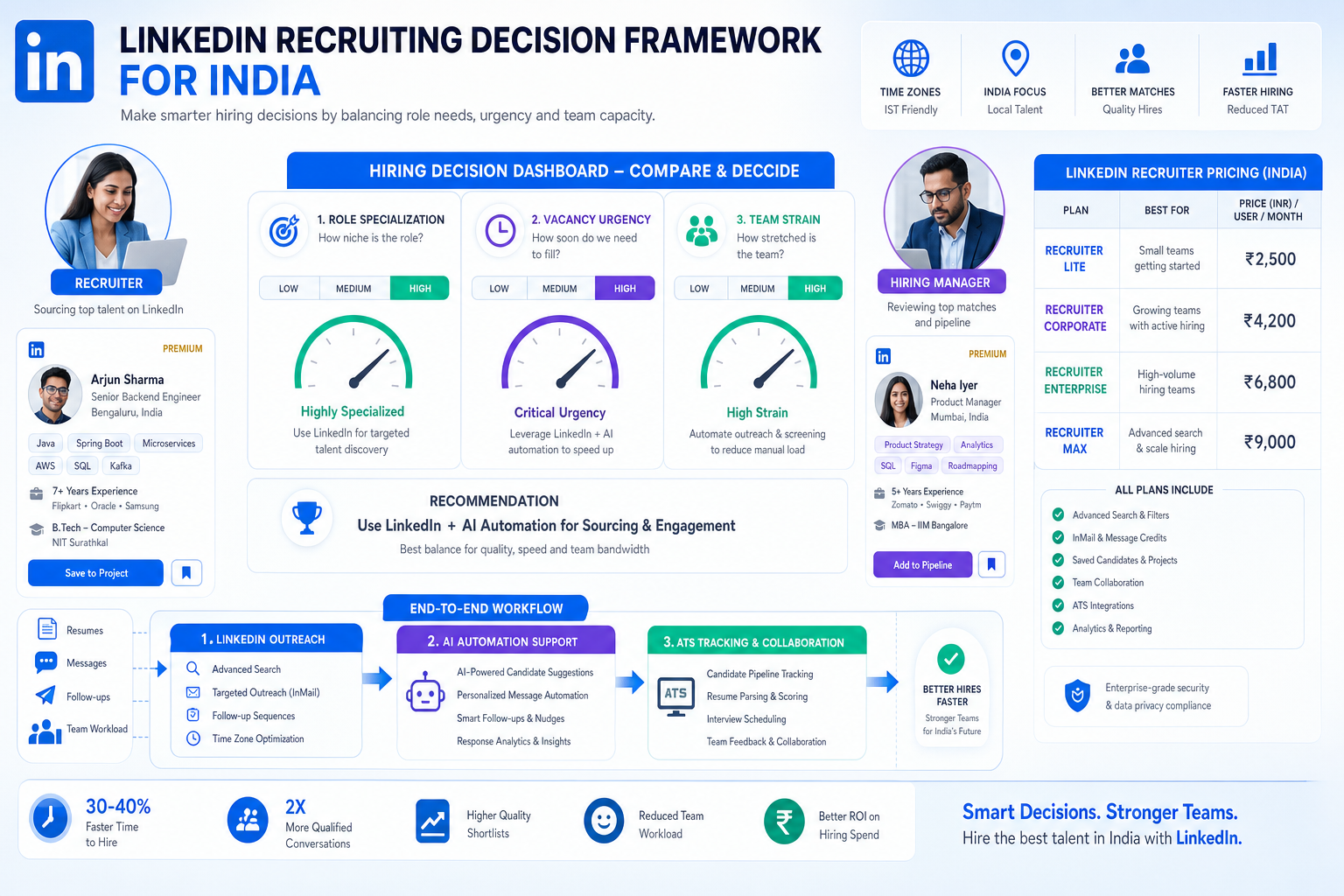
Use this article to evaluate recruiter linkedin licence cost india by role urgency, team strain, and workflow fit before buying.
That sounds simple, but most hiring teams do the reverse. They start with a price screenshot, then discover too late that the real issue was not only licence cost. It was whether the role was specialized, whether the vacancy was urgent, whether remaining recruiters or hiring managers could absorb the load, and whether the organization had enough sourcing capacity to run the process internally without slowing delivery, damaging candidate experience, or burning out the team.
In my own LinkedIn-heavy recruiting work, that is exactly where StrategyBrain AI Recruiter has been most useful—not as a replacement for recruiter judgment, but as support for the repetitive front end of sourcing. When response follow-up, candidate interest checks, and after-hours outreach start piling up, its ability to automate LinkedIn outreach, keep conversations moving across time zones, and collect resumes or contact details helps relieve pressure. The recruiter still owns the final review, shortlist quality, and next-step decisions.
Picture the decision point from a real hiring manager's side: a vacancy has opened on the team, the requisition is approved, colleagues say an internal process should work, and market pay expectations are already known well enough to begin. But the role may not be generic, the internal talent team may be stretched, and once the role is posted internally you still have to judge whether interested people are actually suitable. If they are not, the process shifts outward, and every day spent in the wrong channel adds delay.
Then the pressure widens. You start asking the hard questions: how many open roles are already active, which time-sensitive deliverables will slip without this hire, and what is your realistic internal time to fill? At the same time, the remaining team is carrying extra work. If the vacancy puts too much stress on them, one resignation can become two. That is the transition point where linkedin recruiting automation, recruiter linkedin licence cost india, linkedin pricing tiers, and linkedin business pricing stop being abstract subscription research and become an operating decision about whether your team can source, respond, and hire at the speed the business needs.
Table of Contents
- Start With the Hiring Decision, Not the Price Page
- How Much Does LinkedIn Recruiter Cost in India?
- What LinkedIn Recruiting Automation Actually Helps With
- A Practical Way to Compare LinkedIn Pricing Tiers
- When LinkedIn Business Pricing Is Not Enough
- What Affects Local Pricing in India
- Monthly vs Annual Licences and Team Growth
- Three Software Paths Recruiters Usually Compare
- Where Automation Fits With Your ATS
- Common Buying Mistakes
- FAQ
Start With the Hiring Decision, Not the Price Page
The most useful lesson from real hiring operations is that tooling decisions make sense only after the hiring situation is clear. Before comparing recruiter subscriptions, I usually work through three questions first.
- How specialized is the role? A fairly generic hire may be manageable with a lighter internal process. A niche finance, technical, or leadership search usually needs stronger sourcing reach and more disciplined follow-up.
- How urgent is the vacancy? If open roles are already stacking up and business-critical work will stall without the hire, speed matters more than theoretical feature comparisons.
- What is the impact on the remaining team? If recruiters, coordinators, or hiring managers are already overloaded, leaving the process manual creates hidden cost even before software spend is considered.
That framework matters because people often search recruiter linkedin licence cost india when the deeper problem is workflow capacity. A single recruiter doing occasional hiring may not need a broad team product. A hiring function handling specialized, urgent, or multi-stakeholder roles often does.
Practical rule: if the vacancy is specialized, urgent, and likely to strain the remaining team, the real comparison is not just licence price. It is manual effort versus supported workflow.
How Much Does LinkedIn Recruiter Cost in India?
If you are searching recruiter linkedin licence cost india, the honest answer is still: it depends on the product family, account type, billing cycle, region, and whether you are buying for one recruiter or a team.
From a buyer's perspective, there are two broad paths:
- Entry-level, more visible purchase options that are easier for individuals or smaller businesses to review.
- Team or enterprise recruiter options that often involve consultation, seat planning, or quote-based purchasing.
For recruiters in India, that means there is rarely one universal public rate card covering every recruiting scenario. Some plans are easier to self-serve. Others require account-level discussion to confirm local pricing, seat setup, billing terms, and feature access.
My advice to solo recruiters and founders is straightforward: validate first whether your hiring volume truly needs a larger recruiter setup. If your work is mostly occasional sourcing, an entry route may be enough. If you are managing specialized roles, collaborative shortlists, or repeated outreach at scale, the buying decision quickly becomes operational rather than purely financial.
What LinkedIn Recruiting Automation Actually Helps With
The phrase linkedin recruiting automation gets overused, so it helps to define it in practical recruiting terms. In day-to-day work, the real value is not putting hiring on autopilot. It is reducing the repetitive tasks that slow recruiters down before final evaluation begins.
That usually means support with:
- Finding and contacting relevant candidates faster
- Keeping outreach active when recruiters are busy or offline
- Handling first-response conversations more consistently
- Capturing resume and contact handoff cleanly
- Reducing dropped follow-up during busy requisition periods
I have found that this matters most in exactly the situations described earlier: when a role is urgent, internal capacity is limited, and delays start affecting team morale or business delivery. In those cases, AI Recruiter is useful because it can take over repetitive LinkedIn messaging, continue conversations outside working hours, and gather resume or contact details from interested candidates while the recruiter stays focused on screening judgment and stakeholder alignment. If you want to understand the workflow more deeply, the usage notes here give a good sense of how recruiters apply it in active sourcing.
The important boundary is this: automation can support outreach and continuity, but the recruiter still decides whether the candidate is actually right for the role.
A Practical Way to Compare LinkedIn Pricing Tiers
When recruiters research linkedin pricing tiers, the mistake is treating every tier as if it serves the same hiring workflow. It does not. A better comparison starts with the type of recruiting work being done.
| Plan Category | Best For | Buying Style | Recruiting Fit | Main Caution |
|---|---|---|---|---|
| Entry recruiter plan | Individual recruiters, consultants, low-volume hiring | More visible or easier to evaluate | Basic sourcing and outreach | Can feel limiting once collaboration grows |
| Team recruiter plan | In-house teams, staffing firms, multi-seat recruiting | Often consultative or quote-led | Broader search, teamwork, workflow support | Requires seat and process planning |
| Business subscription | General professional networking | Common self-serve path | Adjacent to hiring, not built around recruiter operations | Easy to overestimate for structured recruiting |
| External automation layer | Recruiters needing better outreach continuity | Software evaluation | Supports messaging and candidate engagement workflow | Still needs recruiter oversight |
This is the lens I use in practice: compare plans against sourcing depth, collaboration needs, urgency, and recruiter workload. If you skip that step, you end up comparing prices across tools that solve different problems.
When LinkedIn Business Pricing Is Not Enough
Linkedin business pricing often appears in the same search journey because it is easier to find publicly. But it is important not to confuse general professional visibility with recruiter-grade workflow support.
A business subscription may help with broader profile viewing or networking activity. What it does not automatically solve is the operational side of recruiting: structured sourcing, coordinated candidate handling, multi-role follow-up, or handoff discipline between recruiter and hiring manager.
If the hiring situation looks like the earlier case—specialized role, urgency, pressure on the remaining team—then the question is not whether a business plan looks affordable. The question is whether it helps you execute a hiring process reliably enough to avoid delay and overload.
What Affects Local Pricing in India
For India-based buyers, the total cost picture usually depends on several variables rather than one advertised number.
- Region and currency: local display and billing conditions may differ from what global buyers assume.
- Product family: recruiter-focused plans and business-focused plans are not priced or positioned the same way.
- Billing cycle: monthly and annual commitments change flexibility and budget planning.
- Seat count: a single-user test can become a broader team expense quickly.
- Feature depth: stronger search, collaboration, and workflow support usually move the plan upward.
India-based teams should also factor in payment administration and recurring billing mechanics. In real recruiting operations, admin friction becomes very visible when a team is hiring actively and a subscription issue interrupts sourcing.
That is why finance, procurement, and recruiting should review the buying path together, especially if more seats may be added later.
Monthly vs Annual Licences and Team Growth
Billing cycle is not just a finance detail. It affects how safely a team can test a workflow before committing further.
Three practical issues matter here:
- Testing flexibility: monthly options may be easier for solo recruiters or uncertain hiring demand.
- Forecasting: annual commitments may suit stable teams with predictable requisition volume.
- Seat expansion: adding licences mid-cycle can change budget assumptions through proration or current-rate adjustments.
If one recruiter proves the workflow works, the next decision usually becomes a team design question: who needs a seat, who only needs visibility, and which manual tasks should be absorbed by automation rather than by another recruiter headcount.
That is one area where I have seen StrategyBrain AI Recruiter help as a complement. If your bottleneck is not final assessment but repetitive outreach and candidate response handling, adding automation support can sometimes relieve pressure before you expand recruiter seats further.
Three Software Paths Recruiters Usually Compare
Because this topic is software-related, recruiters usually compare three categories in practice: native LinkedIn recruiter subscriptions, a business-oriented LinkedIn subscription, and an external automation workflow layered onto LinkedIn usage.
1. Native LinkedIn recruiter subscriptions
Use experience: Familiar environment for sourcing and recruiter-led outreach.
Effectiveness: Strong fit for direct search work, especially when recruiters need platform-native recruiting functions.
Cost: Can range from more accessible entry points to quote-based team setups.
Best fit: Individual recruiters up to enterprise talent teams, depending on product tier.
Working with StrategyBrain AI Recruiter: Best when recruiters want to keep LinkedIn as the sourcing base but reduce manual outreach effort around it.
2. LinkedIn business subscription
Use experience: Easier for general professional usage and often simpler to understand publicly.
Effectiveness: Helpful for visibility and networking, but not always enough for structured recruiting operations.
Cost: Often clearer at the public-plan level than recruiter products.
Best fit: Professionals with light hiring adjacency, founders, or occasional network-based recruiting.
Working with StrategyBrain AI Recruiter: Less direct for full recruiter workflows; stronger when the recruiter's main challenge is still LinkedIn messaging continuity.
3. External LinkedIn automation workflow
Use experience: Adds a separate process layer focused on repetitive outreach and engagement tasks.
Effectiveness: Especially useful when recruiters are losing time to follow-up, time zones, or after-hours candidate responses.
Cost: Should be judged against recruiter time saved and vacancy pressure, not as an isolated software line item.
Best fit: Agencies, in-house recruiters, and independent headhunters who rely heavily on LinkedIn sourcing.
Working with StrategyBrain AI Recruiter: This is where StrategyBrain AI Recruiter stands out. It is built around LinkedIn recruiting activity itself, supports multilingual communication, and can keep candidate conversations moving while the recruiter remains responsible for final qualification and interviewing decisions.
I am deliberately not making unverified performance claims here. What I can say from a workflow perspective is that recruiters who live inside LinkedIn usually feel the biggest benefit when repetitive contact work is separated from judgment-heavy work.
Where Automation Fits With Your ATS
Many teams think they are shopping for LinkedIn pricing, when they are actually trying to fix the mess that starts after sourcing begins.
That is where an applicant tracking system matters. LinkedIn helps identify and engage talent; the ATS keeps process discipline intact. The advantage of pairing the two is straightforward:
- Candidate records stay centralized
- Hiring managers get clearer visibility
- Interview stages are easier to track
- Notes do not stay trapped in inboxes
- Reporting becomes more reliable
If your current issue is that candidate replies arrive at all hours and resume handoff is inconsistent, an automation layer can support the sourcing side while the ATS governs the downstream process. In other words, recruiting automation is most useful when it removes friction before evaluation, not when it tries to replace evaluation itself.
Common Buying Mistakes
These are the errors I see most often when teams compare recruiter linkedin licence cost india, linkedin pricing tiers, and linkedin business pricing.
- Starting with price instead of hiring conditions. Role complexity and urgency should come first.
- Assuming public plan visibility means recruiting fit. The easiest plan to find is not always the right one to buy.
- Ignoring team impact. If recruiters and hiring managers are already stretched, manual sourcing has a real operational cost.
- Separating outreach from process. Candidate engagement without ATS discipline creates downstream disorder.
- Adding seats before fixing workflow. Sometimes the bottleneck is repetitive work, not recruiter headcount.
The opening hiring case in this article matters because it shows the real decision sequence. First determine whether the role can be handled internally, how urgent it is, and what strain it creates. Then decide whether software, seats, or automation support are the right answer.
FAQ
How much does LinkedIn Recruiter cost in India?
There is no single number that applies to all recruiter products in India. Pricing can vary by plan family, billing cycle, region, currency, and seat count. Entry options may be easier to view publicly, while team plans often require direct confirmation.
Is recruiter linkedin licence cost india the same as LinkedIn business pricing?
No. Recruiter-focused subscriptions and business-focused subscriptions serve different workflows. Business plans may support networking, while recruiter plans are more closely aligned with sourcing and hiring operations.
How should recruiters compare LinkedIn pricing tiers?
Compare them by workflow, not by label alone. Check whether you need only light individual sourcing, broader recruiter collaboration, or additional support for repetitive outreach and candidate engagement.
What does LinkedIn recruiting automation really do?
In practical recruiting terms, it supports repetitive front-end work such as outreach, follow-up continuity, and candidate response handling. It does not replace recruiter judgment on shortlist quality or hiring decisions.
When is LinkedIn business pricing enough for hiring?
It can be enough for light networking or occasional sourcing. It is usually not enough for teams running structured, urgent, or high-volume recruiting workflows.
Where does StrategyBrain AI Recruiter fit?
It fits best when LinkedIn is already a major sourcing channel and the team needs help with repetitive outreach, multilingual communication, and keeping candidate conversations active outside normal recruiter hours. The recruiter still makes the final call on fit and progression.
Should I choose software first or define the hiring problem first?
Define the hiring problem first. Start with role specialization, urgency, and team strain. Those three factors usually tell you whether a lighter licence, a broader recruiter setup, or workflow automation support is the better investment.
Conclusion
If your search begins with recruiter linkedin licence cost india, do not stop at the price question. The better buying path is the one experienced hiring leaders already use: judge how specialized the role is, how urgent the vacancy is, and what pressure the opening creates for the remaining team. From there, compare linkedin pricing tiers and linkedin business pricing against the workflow you actually need.
That is also the most realistic way to think about linkedin recruiting automation. It is not magic. It is a way to keep sourcing and candidate communication moving when manual effort becomes the bottleneck. And when used well—especially alongside a structured ATS and recruiter oversight—it can turn a stretched hiring process into a more stable one.