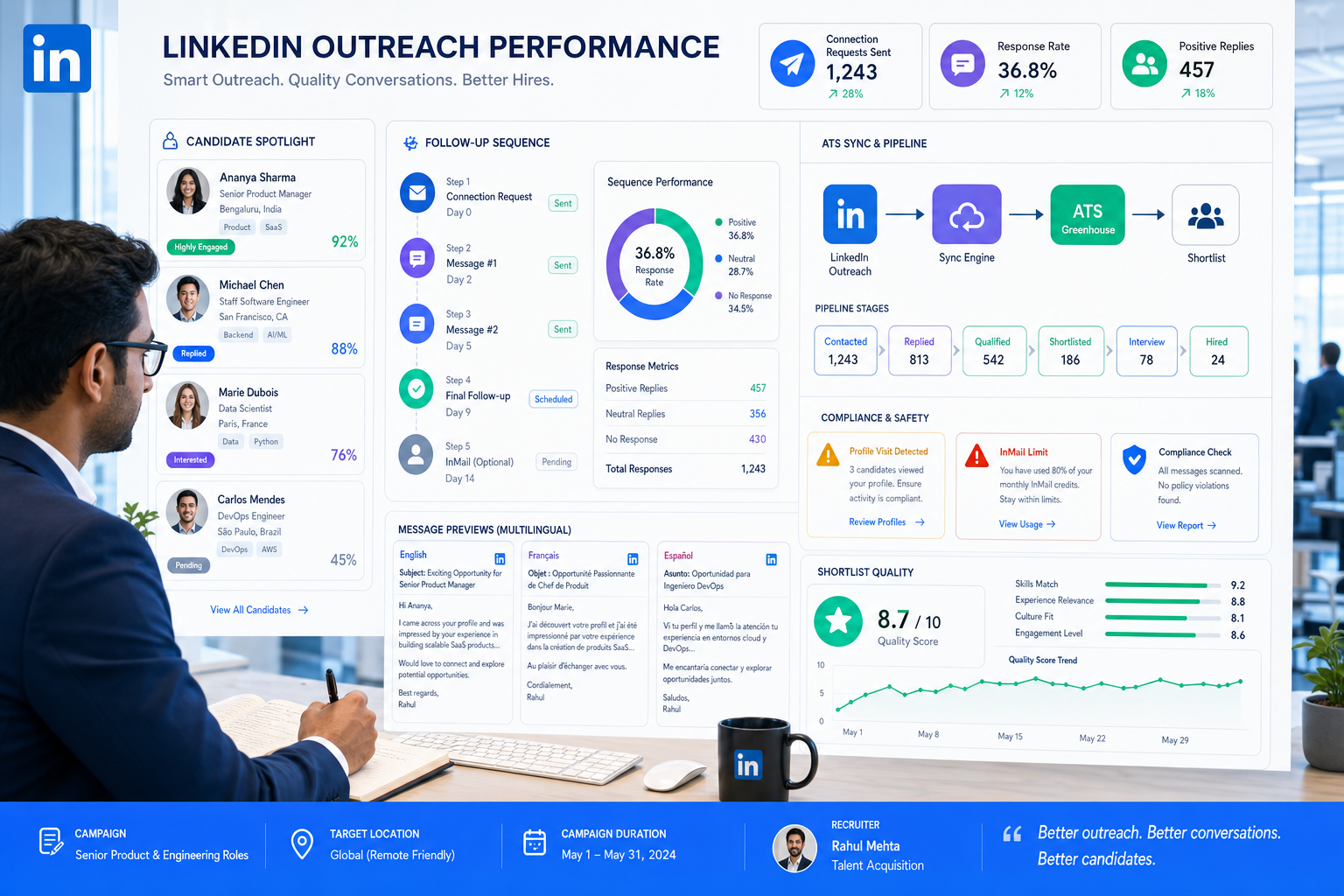
See how recruiting teams can evaluate linkedin sales automation tools to avoid poor-fit workflows, policy risk, and lost candidates.
That matters most in markets where strong people are already employed, salary expectations move quickly, and candidates compare several options at once. In those conditions, missed follow-ups, clumsy sequencing, slow recruiter response, and weak handoff between sourcing and ATS records do more than waste time. They cost searches, damage credibility with hiring managers, and make candidate relationships feel transactional.
In my own workflow, StrategyBrain AI Recruiter has been most useful when a search requires fast first-touch coverage without turning outreach into a template blast. The practical value is not that it replaces recruiter judgment. It helps handle repetitive LinkedIn steps, keeps conversations moving after hours, and supports multilingual candidate messaging when a market includes international talent. I still make the final call on shortlist quality, resume review, and whether a candidate should move forward.
You can see why this matters in a market like Vancouver. Hiring there is shaped by a highly educated talent base, strong cross-industry demand, and constant competition from technology, healthcare, construction, engineering, and professional services employers. A recruiter opens a requisition for a technical manager or finance leader, starts sorting profiles, sends first messages, then has to revisit compensation assumptions and relocation realism because housing costs and remote competition affect whether the role is attractive at all.
The friction builds quickly. Passive candidates need direct outreach rather than a job post, but the recruiter also has to log replies, update stage ownership, remind the hiring manager to move faster, and adjust messaging for candidates who care more about flexibility, leadership stability, or long-term growth than title alone. That is exactly where linkedin recruiting automation becomes a serious workflow question rather than a shiny-tool question, and why searches for linkedin sales automation tools, the best linkedin automation software, and linkedin prospecting automation often come from recruiting teams under real market pressure.
Table of Contents
- Why market pressure changes automation needs
- What LinkedIn recruiting automation actually means
- Where sales automation overlaps with recruiting
- Vancouver-style hiring lessons for recruiters
- Benefits and risks for hiring teams
- Best use cases for recruiters
- How to evaluate the best linkedin automation software
- Recruiting-focused comparison table
- My experience using AI Recruiter in sourcing workflows
- Common mistakes to avoid
- FAQ
Why market pressure changes automation needs
Recruiters do not usually start looking at automation because they want more software. They start looking because the market stops forgiving manual process gaps.
In a competitive hiring environment, three conditions tend to appear at the same time:
- Candidate scarcity: qualified people are not actively applying, so direct sourcing matters more.
- Compensation pressure: cost of living, remote employers, and fast-moving benchmarks change candidate expectations.
- Speed pressure: top candidates disappear while internal teams are still aligning on next steps.
Those conditions were described clearly in the Vancouver hiring context, but the same logic applies to many recruiting markets now. When employers compete for the same transferable skills, recruiter discipline around outreach timing, message relevance, and data handoff becomes a real differentiator.
Key takeaway: The need for LinkedIn recruiting automation usually starts with market pressure, not tool curiosity.
What LinkedIn recruiting automation actually means
LinkedIn recruiting automation is the use of software, connected systems, and structured operating rules to reduce manual work in sourcing and candidate outreach. In a recruiting setting, that usually includes shortlist organization, follow-up timing, candidate messaging support, CRM or ATS syncing, and communication tracking.
The important distinction is that recruiters are not trying to automate hiring judgment. They are trying to remove repetitive work around finding people, initiating contact, staying organized, and moving candidate information into the right system of record.
That is why so many searches for linkedin sales automation tools actually come from talent teams. The terminology may come from sales, but the underlying pain is familiar to recruiters: too many manual actions between finding a good profile and getting that person into a controlled, reviewable hiring workflow.
Where sales automation overlaps with recruiting
There is real overlap between outbound sales operations and modern sourcing. Both involve list building, segmentation, first-touch outreach, follow-up sequencing, and record management. That is where linkedin prospecting automation enters the recruiting conversation.
But in practice, recruiters have different success criteria. A sales team may optimize for meetings booked. A recruiting team needs:
- fit against a live role
- candidate timing and openness
- clean handoff into ATS or CRM records
- employer-brand quality in outreach
- alignment with compensation and growth expectations
That last point matters more than many tool buyers expect. In a market like Vancouver, where cost of living and multiple employer options shape decision-making, the message has to reflect the full opportunity, not just the fact that a role exists.
Vancouver-style hiring lessons for recruiters
The Vancouver recruitment backdrop is useful because it highlights how local labor pressure changes sourcing strategy. The market combines international talent, broad sector demand, and candidate expectations shaped by housing costs, hybrid work, and competition from remote employers.
For recruiters, that creates several practical lessons:
1. Job postings are often not enough
When specialized talent is scarce, passive candidates have to be approached directly. That means outreach quality and follow-up discipline matter more than usual.
2. The value proposition must be realistic
If compensation is based on outdated assumptions, or relocation expectations ignore cost-of-living reality, automation only helps you fail faster.
3. Speed is part of candidate experience
Slow hiring processes cost good candidates. Outreach systems should support faster coordination, not just more sending.
4. Candidate priorities are broader than salary
Work-life balance, hybrid flexibility, leadership quality, purpose, and role progression all shape response quality. Recruiters need systems that preserve those nuances in messaging and notes.
5. Local knowledge still matters
The reference article emphasized that local insight helps employers understand where talent comes from and how candidates evaluate offers. The recruiting equivalent is simple: your automation workflow still needs market context. Software can support execution, but it cannot substitute for knowing whether a role is actually compelling in that geography or industry cluster.
Benefits and risks for hiring teams
The value of linkedin recruiting automation becomes clearer when you look at both sides together.
Potential benefits
- Stronger follow-up discipline: fewer candidates go cold because a recruiter missed the second or third touch.
- Faster sourcing operations: repetitive LinkedIn tasks take less manual effort.
- Better coordination: activity can be logged and reviewed more consistently across team members.
- Improved response coverage: candidates who reply outside regular hours do not always wait until the next business day.
- Support for international searches: multilingual messaging can help when candidate pools cross regions and time zones.
Real risks
- Platform-policy exposure: any workflow that automates prohibited activity creates account and compliance risk.
- Message quality decay: generic sequencing harms employer reputation.
- Pipeline inflation: more touches can create more noise instead of more qualified interest.
- Broken handoffs: disconnected tools leave recruiter notes, replies, and stage ownership scattered.
- False confidence: teams may confuse activity volume with effective recruiting.
Experienced recruiters know the pattern. The best process is not the loudest or most automated one. It is the one that keeps communication timely, preserves targeting quality, and leaves a clean record for the hiring team.
Best use cases for recruiters
If you are researching best linkedin automation software, evaluate by recruiting use case rather than broad feature count.
Candidate sourcing and shortlist organization
Automation helps most when it supports list management, segmentation, and orderly review. Human qualification should still happen before serious outreach begins.
Follow-up sequencing
This is the most common need. Recruiters want consistent reminders and next steps so good prospects do not disappear into inbox clutter.
After-hours response handling
Many candidates reply at night, especially passive professionals balancing full-time jobs. This is one area where AI-supported messaging can keep momentum without requiring recruiters to stay online constantly.
Multilingual outreach support
In markets with international talent, native-language communication can reduce friction and improve early engagement.
Resume and contact capture
Once a candidate is interested, the workflow should make it easy to collect resumes or contact details and move that information into the next recruiting step.
ATS or CRM handoff
This is often underestimated. The process only becomes valuable at scale if candidate data, conversation status, and ownership move cleanly into the system the team actually uses.
How to evaluate the best linkedin automation software
Recruiters should score options against workflow fit, compliance clarity, recruiter experience, and operational usefulness. The most expensive mistake is buying on promise language instead of process detail.
1. Start with the real hiring environment
Borrow a lesson from the Vancouver market discussion: recruitment outcomes depend on actual labor conditions. Before comparing tools, define the environment:
- Are candidates scarce or plentiful?
- Are you competing with remote employers?
- Does compensation pressure reduce reply quality?
- Do candidates care strongly about flexibility or leadership stability?
If you do not understand the market, you cannot judge whether automation will help.
2. Ask what part of the workflow is being automated
Be precise. Is the software helping with list management, first messages, ongoing conversations, follow-up timing, multilingual communication, resume collection, or record sync? Each function has different risk and value.
3. Check whether recruiter judgment stays in the loop
The right setup supports execution but leaves role calibration, candidate evaluation, and shortlist decisions with the recruiter.
4. Review policy and account-safety implications
Any LinkedIn-connected workflow should be reviewed carefully. If the explanation of how it operates is vague, that is a warning sign.
5. Evaluate for recruiting fit, not pure sales logic
Some platforms are optimized for lead generation, not talent conversations. Recruiting requires better nuance around timing, role relevance, and candidate experience.
6. Test the handoff process
Once a candidate engages, can the team capture the resume, notes, interest level, and next action without messy manual copying? If not, scale will create more admin, not less.
Recruiting-focused comparison table
| Evaluation Area | What Good Looks Like | Why It Matters | Common Failure Mode |
|---|---|---|---|
| Market fit | Workflow matches scarce-candidate or fast-moving markets | Prevents generic outreach strategy | Tool chosen without labor-market context |
| Outreach support | Personalized, structured first-touch and follow-up logic | Improves candidate experience | Template-heavy messaging |
| Conversation continuity | Fast replies, including outside office hours | Protects momentum with passive candidates | Delayed response handling |
| Multilingual capability | Natural communication across regions | Useful for global or immigrant-rich talent pools | English-only workflows in mixed markets |
| Resume/contact capture | Interested candidates can share materials easily | Moves sourcing into screening faster | Manual chasing and copy-paste admin |
| Recruiter control | Final qualification remains human-led | Preserves hiring quality | Over-automation of judgment |
| ATS/CRM handoff | Clear ownership and record sync | Supports team collaboration | Side-channel sourcing chaos |
| Compliance clarity | Plain-language explanation of workflow boundaries | Reduces policy risk | Ambiguous automation claims |
My experience using AI Recruiter in sourcing workflows
I have found AI Recruiter most helpful on searches where the real problem is not finding a few names, but keeping conversations alive across time zones, languages, and recruiter bandwidth limits. In one recurring workflow, I set the search criteria, prepared the role information, and let the system handle initial LinkedIn engagement and basic interest discovery while I focused on evaluating who was actually worth advancing.
What stood out to me was not mass activity. It was continuity. Candidates often reply after work, ask practical questions, or want a quick sense of whether the opportunity is serious before sending a resume. In that gap, an always-on workflow helped prevent promising conversations from stalling. The multilingual support also made more sense than I expected for markets shaped by international talent pools, which is very relevant to the kind of urban hiring pressure described earlier.
I also like the fact that the process can gather resumes and contact information from interested candidates without pretending that early engagement equals qualification. The final judgment still sits with the recruiter, which is exactly where it should sit. For teams exploring scale, the broader AI Recruiter workflow approach is worth reviewing carefully, especially if after-hours messaging and repetitive LinkedIn tasks are slowing your desk down.
If you want to understand the conversation style and operating model in more depth, the available conversation examples and the company’s notes on active sourcing on LinkedIn are useful starting points. My practical advice is to treat it as a recruiter-support layer: let it reduce repetitive contact work, but keep shortlist decisions, resume interpretation, and hiring-manager counsel firmly human.
Common mistakes to avoid
Automating before the role is calibrated
If the target profile is unclear, automation multiplies confusion. The market examples above show why this matters: role realism, compensation, and candidate priorities all affect response quality.
Using sales-style pressure in candidate outreach
Mechanics can transfer from sales, but tone should not. Recruiting messages need to respect career timing and professional identity.
Ignoring local market signals
Vancouver was a good reminder that geography changes the recruiting equation. Commute patterns, housing pressure, sector competition, and remote alternatives influence candidate behavior.
Measuring only message volume
Qualified conversations, resume quality, and stage movement matter more than sends.
Forgetting the handoff
The search is not improved if sourcing lives in one place and the real hiring process lives somewhere else.
FAQ
What is LinkedIn recruiting automation?
It is the use of software and connected workflows to reduce manual work in sourcing, follow-up, candidate communication, and record management while keeping recruiter judgment in place.
Why do recruiters search for linkedin sales automation tools?
Because many of the operational features they need, such as sequencing, prospect organization, and outreach support, are described more often in sales language than in recruiting language.
What makes the best linkedin automation software for recruiters?
The best linkedin automation software for recruiting is the option that fits a real hiring workflow, supports message quality, keeps recruiter control over qualification, and does not create avoidable policy risk.
How is linkedin prospecting automation different from recruiting automation?
Linkedin prospecting automation is a broader category often associated with lead generation. Recruiting automation applies similar mechanics to candidate sourcing, but the goals, tone, and decision standards are different.
Can AI handle candidate conversations without replacing recruiters?
Yes, in the right setup it can support first-touch messaging, follow-up continuity, multilingual communication, and resume collection, while the recruiter still owns assessment and next-step decisions.
Why does a market like Vancouver matter to this topic?
Because it shows how competitive labor conditions change the value of automation. When talent is scarce, compensation pressure is real, and speed matters, process discipline becomes a recruiting advantage.
Should recruiters automate everything on LinkedIn?
No. The strongest recruiting operations automate repetitive tasks selectively while protecting personalization, compliance review, and human judgment.