When LinkedIn replies pile up, this article helps recruiters judge a linkedin connection automation tool to prevent lost candidate interest.
That matters because recruiting pressure usually builds in the same places: too many profiles to review, too many follow-ups to remember, and too many candidate conversations going cold between the first LinkedIn touch and the next real step. For a solo recruiter, that means lost time and weaker desk economics. For a small agency owner, it means uneven delivery across searches and more dependence on late-night manual outreach. For an in-house talent team, it means response delays, messy handoffs, and a candidate experience that feels generic right when the market expects personal attention.
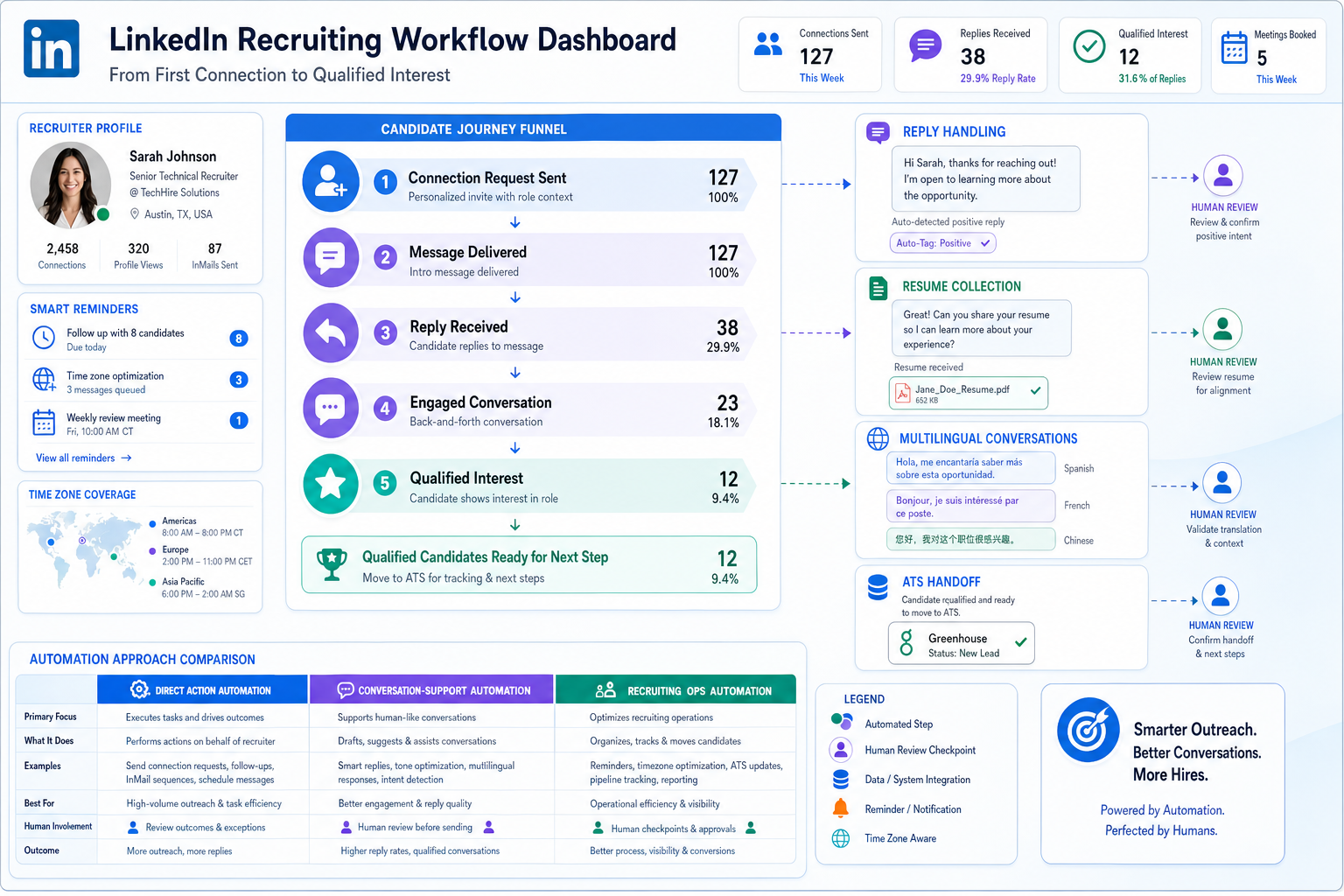
In my own testing, the more useful role for StrategyBrain AI Recruiter was not replacing recruiter judgment but absorbing the repetitive gap between first outreach and candidate signal. Its LinkedIn automation support, multilingual reply handling, and résumé/contact collection can help when candidates respond after hours or across time zones, while the recruiter still makes the final call on fit, résumé review, and interview next steps. That distinction is important if you are comparing a linkedin connection automation tool with broader linkedin automation software.
The candidate-side reality behind this is not new. As the reference infographic on job jumps and career changes highlighted, millions of younger workers were entering the workforce while changing jobs more readily than earlier generations, and employers were being pushed to understand what these workers actually wanted from a company. In recruiting terms, that means a sourcer is not just sending connection requests into a static market. They are reaching people who are actively reassessing fit, values, growth, and timing, often long before they apply anywhere.
When that shift meets LinkedIn outreach, the workflow problem becomes obvious. A recruiter scans a shortlist, sends a personalized invitation, gets a reply asking about role context, compensation, or team direction, then has to remember who is merely curious, who wants to see a job brief, and who is willing to share a résumé. If that sequence is handled manually across dozens of parallel searches, even a promising linkedin recruiting automation setup breaks down unless the team sets clear boundaries for a linkedin connection automation tool, supporting linkedin automation software, and when linkedin automation consultation is worth bringing in.
- A linkedin connection automation tool should be evaluated first as a workflow-risk decision, not a shortcut purchase.
- The reference market shift behind job changing behavior reinforces why recruiters need more relevance and follow-up discipline, not just more volume.
- Safer gains usually come from automating response handling, résumé collection, reminders, CRM or ATS updates, and candidate routing rather than brute-force LinkedIn activity.
- Linkedin automation consultation becomes useful when a team is unclear about boundaries, personalization rules, or how recruiters should hand off candidates after interest is confirmed.
- Why Candidate Expectations Changed the Automation Question
- What a LinkedIn Connection Automation Tool Should Really Do
- Where the Risk Boundary Usually Sits
- The Candidate Journey Recruiters Forget to Map
- Three Categories of LinkedIn Automation Software
- A Recruiter Workflow Experience With AI Support
- When LinkedIn Automation Consultation Makes Sense
- A Practical Implementation Framework
- Common Mistakes Recruiting Teams Make
- FAQ
Why Candidate Expectations Changed the Automation Question
Recruiters often discuss automation as if the main problem were click volume. In practice, the bigger change has been candidate behavior. The reference infographic framed a workforce reality that still matters today: many younger professionals enter the market with different expectations around growth, fit, and employer value, and they do not necessarily stay put just because a role looks stable on paper.
That has two consequences for recruiting teams. First, more candidates are open to hearing about opportunities, but they need a credible reason to engage. Second, the first reply is no longer the end goal. It is the start of a short evaluation cycle in which candidates assess whether the job, the company, and the recruiter sound worth their attention.
This is why linkedin recruiting automation cannot be judged only by how many invitations or messages a system can trigger. The real test is whether it supports the moment when a candidate starts weighing change: Is the role aligned with their goals? Is the company worth a conversation? Is the recruiter responsive enough to keep momentum alive?
Practical takeaway: When candidates are already more willing to consider change, recruiter advantage comes from timing and relevance, not mechanical outreach volume.
What a LinkedIn Connection Automation Tool Should Really Do
If you strip away the marketing language, a linkedin connection automation tool is being hired to do one of two jobs. It either automates visible activity on LinkedIn itself, or it supports the recruiter around LinkedIn so conversations move forward with less manual drag.
The first model is the one most buyers think of immediately: profile views, invitations, messaging, and follow-up actions executed at scale. The second model is less flashy but usually more durable: helping recruiters manage replies, collect candidate information, trigger reminders, organize response states, and move qualified interest into a structured workflow.
From an operator's perspective, the second model is where value is easier to defend. It supports the candidate's decision process rather than treating every prospect like a batch target. That matters because the people changing jobs are not all ready for the same next step. Some want details. Some want to compare opportunities quietly. Some will only send a résumé after a few clarifying exchanges.
So the better question is not, “Can this tool automate LinkedIn?” It is, “Can this system help a recruiter respond properly when a candidate starts evaluating a move?”
Where the Risk Boundary Usually Sits
Any serious review of linkedin automation software has to separate convenience from account exposure. Tools that automate direct actions on LinkedIn raise obvious policy, reliability, and reputation questions. Even when teams are tempted by speed, they should treat direct, scaled simulation of recruiter behavior as a high-scrutiny zone.
That is not just a compliance issue. It is an operational one. If an account is restricted, the recruiter loses active conversations, sourcing continuity, and message history. If outreach quality drops because automation becomes too generic, candidates read the interaction as spam rather than opportunity.
The safer optimization zone is usually adjacent workflow design: capturing candidate intent, routing follow-up tasks, logging outreach outcomes, collecting résumés, and surfacing who needs a human reply next. In other words, automate the friction around the recruiter before trying to automate the recruiter's identity.
The Candidate Journey Recruiters Forget to Map
The reference piece about job changes is useful here because it reminds us that career movement begins with evaluation, not application. Candidates do not wake up as ATS records. They move through a small sequence of internal questions first.
- Recognition: “Am I open to something different?”
- Comparison: “Is this role or company better aligned with what I want now?”
- Commitment: “Is this conversation worth taking to the next step?”
Recruiters lose momentum when their process does not support those stages. A candidate replies after work asking for more context. No one answers until the next day. Another asks about compensation range and location flexibility, but the note sits in a LinkedIn inbox with no task created. A third says they are interested and willing to send a résumé, but there is no structured capture or handoff.
That is why many teams get more from operationally aware linkedin recruiting automation than from a pure send-more approach. The system has to recognize candidate movement and help the recruiter act on it.
Three Categories of LinkedIn Automation Software
Buyers often compare unlike tools under the same label. In recruiting, that creates bad decisions. Here are the three categories that matter most.
1. Direct action automation
This category covers invitation sending, browser-driven activity, message automation on LinkedIn, and similar behavior. The appeal is obvious: fewer clicks and more visible activity. The drawbacks are equally obvious: account risk, weaker personalization, and a tendency to optimize for volume over fit.
2. Conversation-support automation
This is the category many recruiters actually need. It includes systems that help introduce roles, handle candidate replies, keep the conversation moving across time zones, collect résumés and contact details, and surface interested candidates for human review. Used carefully, this is where a lot of modern linkedin automation software becomes practical rather than reckless.
3. Recruiting operations automation
This category sits around LinkedIn rather than inside it. It includes ATS syncing, task routing, status tracking, talent segmentation, reminders, reporting, and outreach orchestration outside direct LinkedIn actions. It is less glamorous, but for most firms it is the category with the strongest long-term operational return.
| Category | Main Use | Strength | Main Concern | Best Fit |
|---|---|---|---|---|
| Direct action automation | Invites, views, LinkedIn message actions | Fast activity output | Policy and account exposure | High-risk buyers chasing volume |
| Conversation-support automation | Role introduction, reply handling, résumé capture | Keeps momentum after first contact | Needs clear human-review rules | Agencies and TA teams with active sourcing desks |
| Recruiting ops automation | ATS, reminders, routing, reporting | Process consistency | Requires setup discipline | Teams scaling repeatable hiring workflows |
A Recruiter Workflow Experience With AI Support
I have found that AI-supported outreach becomes most useful in the awkward middle of the sourcing process: after a candidate accepts or replies, but before a recruiter has enough signal to spend deeper time. In that gap, I tested AI Recruiter as a support layer rather than a decision-maker.
What helped most was not a promise of replacing the recruiter. It was the ability to keep conversations active when candidates responded outside office hours, to continue exchanges in the candidate's language where needed, and to collect résumé or contact details from people who had already signaled real interest. That reduced inbox drag. It also made it easier to separate the merely polite from the genuinely open.
The boundary still mattered. I did not treat the tool as final qualification. The recruiter still has to judge relevance, review the résumé, decide whether the job is a real fit, and choose the next step. But for searches where candidates often ask practical follow-up questions before committing, StrategyBrain AI Recruiter can relieve the repetitive back-and-forth that usually steals sourcing time.
For recruiters researching a linkedin connection automation tool, that distinction is worth holding onto. The strongest use case is often not “send more.” It is “handle interest signals more consistently without losing human control.”
When LinkedIn Automation Consultation Makes Sense
Many teams do not need more software first. They need better boundaries. That is where linkedin automation consultation becomes valuable.
In my experience, consultation is most useful when the team has one of these problems:
- Recruiters are unsure which LinkedIn actions should remain fully manual.
- Response handling is inconsistent across consultants, sourcers, or regions.
- The firm lacks a clean rule for when a candidate moves from curiosity to qualification.
- Hiring managers want more visibility into sourcing progress, but the data is scattered.
- The team is considering AI-supported outreach and needs guardrails for review, privacy, and handoff.
A strong consultation process should cover workflow mapping, candidate-stage definitions, personalization standards, message boundaries, after-hours response strategy, and ATS or CRM handoffs. That is usually more valuable than buying a tool in isolation and hoping process discipline appears later.
A Practical Implementation Framework
If you are evaluating linkedin recruiting automation in a real desk environment, the safest implementation model is layered.
Layer 1: Keep opportunity judgment human
Recruiters should decide who is worth contacting, why they are relevant, and how much nuance the opportunity requires. Career-change decisions are personal, and the first meaningful judgment still belongs to the recruiter.
Layer 2: Support the early conversation
Use automation carefully where candidates ask routine but important questions, where timing matters, and where interest needs to be confirmed before a recruiter invests screening time.
Layer 3: Capture candidate signals quickly
When someone expresses interest, the system should help collect résumé and contact details, log the response state, and make the next action obvious.
Layer 4: Move qualified interest into a structured system
Whether you use an ATS or recruiting CRM, candidate momentum should not live only in a LinkedIn inbox. A good process turns response into visible workflow.
Layer 5: Review outreach quality regularly
Teams should audit whether messages still feel relevant, whether candidate questions are being answered clearly, and whether automation is helping trust or eroding it.
This layered approach aligns better with how job changes actually happen. Candidates move step by step, and automation should support those steps rather than flatten them into one mass action.
Common Mistakes Recruiting Teams Make
- Confusing interest with qualification. A candidate who replies is not yet a matched hire.
- Automating before defining the candidate journey. If the team has no rule for recognition, comparison, and commitment stages, automation only speeds up confusion.
- Using one message logic for every search. Career-change motivations differ by role, seniority, and market context.
- Letting LinkedIn become the only source of truth. If candidate state is trapped in inboxes, managers and teammates lose visibility.
- Ignoring after-hours and multilingual reality. Good candidates often respond when the recruiter is offline or in another region.
- Buying software before deciding on governance. Tool choice is easier than operating discipline, but discipline matters more.
FAQ
What is a linkedin connection automation tool in recruiting?
It usually refers to software that helps automate or support recruiter activity tied to LinkedIn outreach. In practice, buyers should distinguish between tools that automate direct LinkedIn actions and tools that support conversation handling, follow-up, or candidate capture around LinkedIn.
Is linkedin recruiting automation always risky?
No. The highest risk tends to sit around direct platform actions at scale. Lower-risk use cases often involve workflow support, response management, candidate information capture, and ATS or CRM handoffs.
How does candidate job-changing behavior affect automation strategy?
When more professionals are open to career changes, recruiters need systems that support evaluation conversations, not just first-touch volume. That means faster replies, clearer role context, and cleaner movement from curiosity to qualification.
Can linkedin automation software replace recruiters?
No responsible recruiting team should treat it that way. Software can reduce repetitive work, but recruiter judgment still matters for fit, résumé review, compensation alignment, and final next-step decisions.
When should a team seek linkedin automation consultation?
It makes sense when the team is unclear about boundaries, seeing uneven outreach quality, struggling with candidate handoffs, or considering AI-supported workflow changes without a clear operating model.
Where can AI-supported workflow help most?
It is often most useful after the first touch, when candidates start asking questions, replying across time zones, or showing interest that needs to be captured consistently before the recruiter reviews the case in depth.
Conclusion
The best reading of this topic is not that recruiters need more aggressive automation. It is that a changing workforce has made candidate evaluation more fluid, more personal, and more timing-sensitive. That is why a linkedin connection automation tool should be judged by how well it supports recruiter relevance, candidate trust, and structured follow-through.
If you are comparing linkedin automation software or exploring linkedin automation consultation, start with the real workflow: a candidate considers change, asks a few practical questions, and decides whether to move forward. Good systems help that process without pretending recruiter judgment is optional. In that sense, the safest and smartest form of linkedin recruiting automation is not mechanical outreach at scale. It is disciplined support around the exact moments where candidate interest can either convert or disappear.