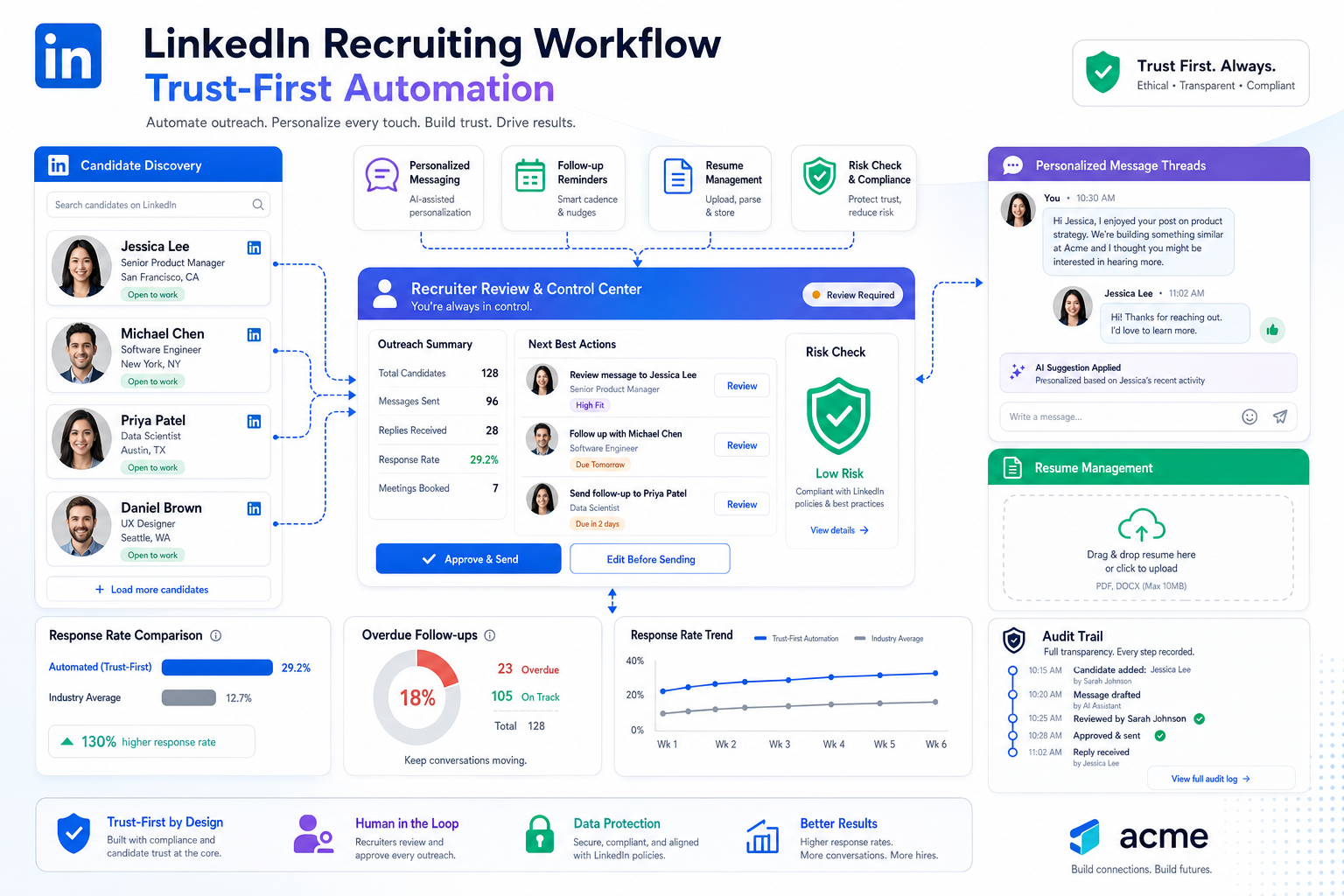
When agency recruiters assess a linkedin connection automation tool through trust and review discipline, they avoid generic outreach, missed replies, and client-facing process risk.
That point sounds obvious until a team is trying to fill several roles at once, replies are coming in after hours, and no one can clearly see which outreach was personalized, which follow-up is overdue, or which LinkedIn activity is creating avoidable account risk. For a solo recruiter, that means lost response windows and weaker candidate relationships. For a small agency owner, it means inconsistent delivery and a harder time defending process quality to clients. For an in-house hiring lead, it can mean reputational damage when outreach feels automated in the wrong way.
In my own workflow, the most useful support has come from AI Recruiter when the problem was not sourcing alone, but keeping conversations moving across time zones, collecting candidate interest signals, and avoiding manual back-and-forth on repetitive first-touch questions. What matters is that the recruiter still owns final judgment, resume review, and next-step decisions. Used that way, AI Recruiter can reduce the operational drag around LinkedIn outreach without turning recruiter accountability into a black box.
A useful trust benchmark comes from a recruiting firm announcing its Better Business Bureau accreditation in May 2017. The point of that announcement was not software at all. It was confidence. The firm highlighted that accreditation reflected business standards, professionalism, integrity, and a stronger sense of security for both companies buying recruiting services and individuals exploring new employment options.
That same trust logic applies directly to linkedin recruiting automation. When recruiters evaluate whether to automate linkedin connection request activity or adopt broader linkedin outreach tools, the first question should not be volume. It should be whether the workflow increases confidence for clients and candidates, preserves recruiter control, and supports a process you would be comfortable defending publicly.
- A linkedin connection automation tool should be evaluated as a trust and process decision, not just a speed decision.
- Candidate-facing recruiting automation works best when it supports personalization, timely follow-up, and recruiter review.
- Trust signals matter in recruiting because both clients and candidates are judging professionalism at every outreach touchpoint.
- Safer automation usually happens around drafting, sequencing, reminders, multilingual response handling, and resume collection rather than blind mass connection activity.
Table of Contents
- Why Trust Comes First in LinkedIn Recruiting Automation
- What a LinkedIn Connection Automation Tool Should Really Do
- Connection Automation vs LinkedIn Outreach Tools
- My Experience Using AI Support Around LinkedIn Outreach
- How to Evaluate a LinkedIn Connection Automation Tool
- How Recruiting Firms Operationalize Trust and Scale
- Safer Automation Workflows for Recruiters
- Common Mistakes Teams Make
- A Practical LinkedIn Recruiting Automation Workflow
- FAQ
Why Trust Comes First in LinkedIn Recruiting Automation
The Better Business Bureau reference is a useful opening frame because it highlights the real product of recruiting before any software enters the conversation: confidence. Recruiting firms do not just sell access to candidates. They sell judgment, discretion, responsiveness, and process integrity. Candidates make career decisions based partly on whether the recruiter feels credible. Clients decide whether to continue a search relationship based partly on whether outreach reflects professionalism rather than mechanical volume.
That is why linkedin recruiting automation should be discussed through trust risk as much as efficiency gain. If a workflow speeds up outreach but makes interactions feel careless, generic, or difficult to audit, it can undermine the very standards a recruiting firm needs to maintain. In practice, the strongest automation setups are the ones that help recruiters act consistently while keeping human ownership over targeting, message relevance, and qualification.
For agency leaders, this is also a brand issue. Any system that touches candidate communication influences how your market perceives your firm. The same principle matters for in-house teams. A candidate who receives weak outreach does not separate the tool from the employer. They judge the employer.
What a LinkedIn Connection Automation Tool Should Really Do
Many buyers search for a linkedin connection automation tool because they want more candidate conversations at the top of funnel. But the business need is usually broader than auto-sending connection requests. Most recruiters are actually trying to solve one or more of these problems:
- Too much manual time spent on repetitive first-touch outreach
- Slow response handling outside working hours
- Inconsistent follow-up discipline across open searches
- Poor visibility into who replied, who shared a resume, and who needs a recruiter decision
- Difficulty scaling multilingual or cross-border conversations
Seen through that lens, the best interpretation of the seed keyword is not “How can I click less?” It is “How can I create a repeatable LinkedIn outreach process without damaging trust, control, or candidate experience?” That framing leads to better decisions because it shifts attention from raw automation to workflow design.
Connection Automation vs LinkedIn Outreach Tools
Recruiters often group several different categories together under one search. That creates confusion during evaluation. A team that wants better organization may accidentally shop for auto-sending software. A team that needs multilingual first-touch support may end up comparing reminder tools. The categories overlap, but they are not the same.
| Category | Primary Function | Main Benefit | Main Concern |
|---|---|---|---|
| Connection request automation | Automates LinkedIn invitation actions | Higher activity volume | Trust, compliance, and loss of control |
| LinkedIn outreach tools | Support messaging workflows, follow-ups, tracking, and organization | More consistent outreach operations | Quality varies depending on how much recruiter review remains |
| Recruiting automation | Broader support for sourcing, qualification, response handling, resume capture, and pipeline handoff | Scalable top-of-funnel execution | Needs clear role boundaries between system support and recruiter judgment |
If your immediate goal is to automate linkedin connection request activity, that is the narrowest and riskiest interpretation of the problem. If your real goal is better speed, candidate coverage, and cleaner handoff into the recruiting process, then carefully chosen linkedin outreach tools or AI-supported messaging workflows are usually more practical.
My Experience Using AI Support Around LinkedIn Outreach
In my experience, AI support becomes most useful when a search starts generating the exact friction that human recruiters are bad at handling consistently at scale: the same role explanation repeated dozens of times, candidate replies landing overnight, interest checks that need quick responses, and resumes arriving through different channels. That is where I found StrategyBrain AI Recruiter worth testing as an operational layer around LinkedIn activity.
What stood out was not a fantasy of replacing the recruiter. It was the ability to keep communication moving, answer common role questions in a timely way, and collect resumes or contact details from interested candidates while I stayed focused on shortlist quality and client-facing judgment. The platform is designed to support LinkedIn recruiting conversations, multilingual communication, and ongoing follow-up, which makes it relevant when searches extend across time zones or when candidates tend to respond outside normal business hours.
I would still not hand over final fit assessment to software, and the system does not remove that need. The recruiter still has to review resumes, assess whether experience actually matches the brief, and decide who moves forward. But if your bottleneck is repetitive outreach administration rather than strategic search judgment, tools in this category can reduce friction. For teams that want to see how that conversation layer works in practice, the public conversation examples are useful for understanding the operating model.
Practical takeaway: The best LinkedIn automation setups do not replace recruiter credibility. They protect it by making early outreach more responsive, organized, and reviewable.
How to Evaluate a LinkedIn Connection Automation Tool
Once you bring trust into the frame, the evaluation process becomes clearer. I recommend using the following checklist before adopting any workflow marketed around LinkedIn automation.
1. Start with the confidence test
Ask whether the process would increase confidence for two groups: the client paying for the search and the candidate receiving the outreach. The BBB accreditation announcement is useful here because it ties professional reputation to standards and integrity. If your outreach process becomes harder to explain, harder to supervise, or easier to misuse at scale, confidence drops.
2. Separate communication support from recruiter judgment
A strong workflow can support introductions, interest checks, follow-up timing, and resume collection. It should not pretend that qualification is solved just because a candidate replied. Real recruiting still requires human interpretation of background, motivation, and fit.
3. Check whether the tool solves a real operating problem
Some teams do not need a connection tool at all. They need better sequencing, cleaner response handling, or multilingual support. Buying the wrong category creates more noise than value.
4. Review how it handles candidate data and recruiter access
Any software involved in outreach, resumes, or contact details should be reviewed through a privacy and security lens. Recruiters need clarity on data handling, permissions, and what is stored where.
5. Test whether personalization survives scale
If the process produces messages that sound generic, trust erodes quickly. A system should help recruiters adapt communication by role, geography, seniority, and market context rather than flattening every outreach into one script.
6. Confirm the handoff after interest is expressed
The real work starts after a candidate responds. Can the workflow capture resumes, surface contact details, flag interest, and create a clean next step for the recruiter? If not, the team will simply inherit another admin burden later.
How Recruiting Firms Operationalize Trust and Scale
The accreditation reference also suggests a wider operating lesson. Recruiting firms build market confidence through visible standards, not just promises. In practical recruiting operations, that means maintaining reviewable outreach practices, clear service expectations, and feedback loops that reassure both sides of the market.
Three well-known U.S. recruiting brands illustrate the point at a process level, even though each runs a different model. Robert Half is known for structured recruiter training and disciplined client-candidate communication. Korn Ferry operates with a strong emphasis on advisory credibility and stakeholder alignment, especially in higher-value searches. ManpowerGroup has long relied on process consistency and scalable coordination across markets. The shared lesson is not that these firms all use the same software. It is that scale only works when trust standards are explicit.
If a firm wanted to support that kind of discipline with AI-assisted LinkedIn outreach, the sensible use case would be narrow and practical: automate repetitive first-touch conversation handling, maintain coverage across time zones, and surface interested candidates with resumes attached so the recruiter can step in quickly. That is the kind of collaboration model where AI Recruiter fits better than a blunt volume-first approach.
Safer Automation Workflows for Recruiters
For most teams, the best way to use linkedin recruiting automation is not to chase maximum invitation count. It is to reduce repetitive friction around a high-trust outreach process.
Role introduction and FAQ handling
When candidates ask the same early questions about a role, employer, compensation range, or process, AI-supported workflows can help keep responses timely and consistent. That is especially useful when a recruiter is juggling multiple open assignments.
After-hours candidate response coverage
One of the biggest operational gaps in LinkedIn outreach is timing. Candidates often reply when recruiters are offline. Systems built for continuous response support can keep the conversation alive until the recruiter is ready to review and decide.
Multilingual communication
Cross-border recruiting often slows down at the first outreach stage, not because candidates lack interest but because language friction creates hesitation. A multilingual communication layer can reduce that barrier while preserving recruiter oversight.
Resume and contact detail capture
Once a candidate expresses interest, the workflow should make it easy to collect resumes and relevant contact information without losing context. This sounds basic, but it often breaks in practice when recruiters are switching between LinkedIn, email, and internal notes.
Human review before shortlist action
The final safeguard is simple: the recruiter reviews, interprets, and advances candidates. Automation can identify interest and gather materials, but it should not be treated as the final authority on fit.
Common Mistakes Teams Make
- Confusing activity volume with recruiting quality. More automated actions do not automatically create more credible conversations.
- Ignoring the candidate trust test. Candidates can tell when outreach feels detached from real recruiter intent.
- Buying a connection tool to fix a workflow problem. Many teams need better process design, not more sending power.
- Removing recruiter review too early. Interest is not the same as qualification.
- Underestimating off-hours communication. A surprising amount of candidate engagement happens when recruiters are unavailable.
- Forgetting the client-facing side of trust. Agencies need a process they can defend to clients, not just a tool they can operate internally.
A Practical LinkedIn Recruiting Automation Workflow
If you want a usable operating model, this is the workflow I would recommend for most recruiting teams evaluating a linkedin connection automation tool or adjacent automation category:
- Define the search clearly. Confirm target background, location, must-have signals, and likely candidate objections.
- Build a focused sourcing list. Start with quality targeting rather than broad-volume outreach.
- Prepare recruiter-approved role context. Document the company story, role basics, compensation boundaries, and likely candidate questions.
- Use AI support for repetitive first-touch communication. Let the system help introduce the role, respond promptly, and keep the conversation moving where appropriate.
- Collect interest signals, resumes, and contact details. Centralize what matters for recruiter review.
- Have the recruiter review every serious lead. This is where fit, motivation, and search strategy are actually decided.
- Track outcomes and message quality. Monitor which role narratives earn replies and where the process loses momentum.
- Refine the workflow based on trust and response quality. If outreach starts feeling generic, slow down and reset.
This process aligns speed with professional credibility. It also reflects the logic behind the BBB-style trust lens: systems matter, but what candidates and clients remember is whether the recruiter acted with clarity, professionalism, and follow-through.
FAQ
What is a linkedin connection automation tool?
It usually refers to software or workflows that reduce the manual effort involved in LinkedIn outreach, often by automating part of the connection or communication process. In recruiting, the more useful question is whether the tool supports a trustworthy and reviewable process.
Is it a good idea to automate linkedin connection request activity?
It depends on how narrowly you define automation. In most recruiting environments, the safer approach is to automate the surrounding workflow such as messaging support, follow-up timing, response handling, and resume capture rather than treating connection volume as the primary goal.
How are linkedin outreach tools different from connection automation?
Linkedin outreach tools often support broader workflow management: drafting, sequencing, reminders, response tracking, and handoff into the recruiting process. Connection automation is a narrower category focused on invitation actions.
Can AI help without replacing the recruiter?
Yes. The strongest use case is operational support. AI can help maintain timely communication, handle repetitive early-stage messaging, and capture resumes or contact details. The recruiter should still make the final decision on fit and next steps.
What should agencies care about most when evaluating LinkedIn automation?
Agencies should look at trust, auditability, candidate experience, and whether the workflow protects the firm's professional reputation. Speed matters, but not more than credibility.
Who benefits most from this kind of workflow?
Small and mid-sized recruiting agencies, independent headhunters, and lean internal talent teams tend to benefit most when they need to scale early outreach without losing control over shortlist quality.
How does AI Recruiter fit into this?
AI Recruiter is relevant when the bottleneck is repetitive LinkedIn communication, multilingual candidate engagement, and collecting resume or contact details from interested prospects. It is best used as recruiter support rather than recruiter replacement.
Conclusion
The strongest way to think about linkedin recruiting automation is through the same lens that governs lasting recruiting relationships: trust first, process second, tools third. The Better Business Bureau accreditation example matters because it reminds us that recruiting credibility is built on visible standards, not just claimed efficiency.
So if you are evaluating a linkedin connection automation tool, do not stop at feature lists. Ask whether it helps you automate linkedin connection request workflows in a way that preserves professionalism, supports candidate confidence, and leaves final hiring judgment where it belongs: with the recruiter. That is also the standard by which the best linkedin outreach tools should be judged.