This article shows recruiters how do you use LinkedIn for recruitment without losing candidates to weak handoffs, scattered notes, and slow follow-up.
That matters because LinkedIn recruiting breaks down in the same place many internship programs do: the opportunity may look promising, but once real work starts, unclear ownership, weak documentation, and inconsistent follow-up create avoidable risk. For agency owners, that means consultants waste hours chasing replies and re-entering notes. For solo recruiters, it means missed resumes, late responses, and preventable candidate drop-off. For in-house teams, it means hiring managers see fragmented updates and lose confidence in the search.
In my own sourcing workflow, I have found that StrategyBrain AI Recruiter is most useful when the bottleneck is repetitive LinkedIn outreach rather than final selection. It can keep conversations moving, respond across time zones, and collect resumes or contact details from interested prospects, which reduces the manual back-and-forth that usually clogs the top of funnel. The recruiter still has to review the resume, judge fit, and decide whether the person should move into interview process, but the early-stage admin load becomes easier to manage.
That distinction becomes clearer when you look at opportunity-based roles such as internships. A student or early-career candidate often evaluates an internship the same way a passive candidate evaluates recruiter outreach on LinkedIn: Is this genuinely useful, who benefits more, and what will I actually get from saying yes? In the internship context, the promise may be experience, industry access, and a foothold in a hard-to-enter field. But the risk is equally real if the role turns into unpaid routine work with little learning value.
Once that candidate enters the organization, the same operational questions surface for recruiters and hiring teams. Someone has to track the conversation, confirm expectations, capture documents, explain what happens next, and show whether the opportunity is more beneficial to the candidate than to the company. That is why the best recruiting software is not just a feature list. It is the system that keeps sourcing, candidate communication, compliance-sensitive roles, and hiring judgment connected. It also explains why related searches such as how to get a job recruiter and become a recruiter naturally sit beside the seed question in this guide.
Table of Contents
- Why LinkedIn recruiting needs more than search
- How do you use LinkedIn for recruitment
- What the best recruiting software stack includes
- Three recruiting software options recruiters compare
- What to look for in an applicant tracking system for recruiters
- Applicant tracking system benefits that matter in practice
- How to choose by team type
- Internships, candidate value, and workflow discipline
- For job seekers and people who want to become a recruiter
- FAQ
Why LinkedIn recruiting needs more than search
The practical mistake many teams make is assuming that sourcing skill alone will carry the search. It rarely does. LinkedIn is excellent for finding people, checking career patterns, and opening conversations, but it does not automatically solve documentation, process consistency, stakeholder alignment, or candidate handoff.
The internship example is useful here because it reveals a decision standard recruiters often ignore. In legally sensitive unpaid internship discussions, one rule of thumb is that the opportunity should be demonstrably more beneficial to the intern than to the company. In recruiting terms, that same mindset sharpens outreach quality. If your message, process, and role framing do not clearly create value for the candidate, response rates suffer and trust erodes.
That is one reason experienced recruiters separate three questions:
- Can we identify the right people?
- Can we engage them in a way that feels relevant and fair?
- Can we move them through a visible process without losing information?
The best recruiting software helps with all three, but not always in one product. Most teams still need a stack.
How do you use LinkedIn for recruitment?
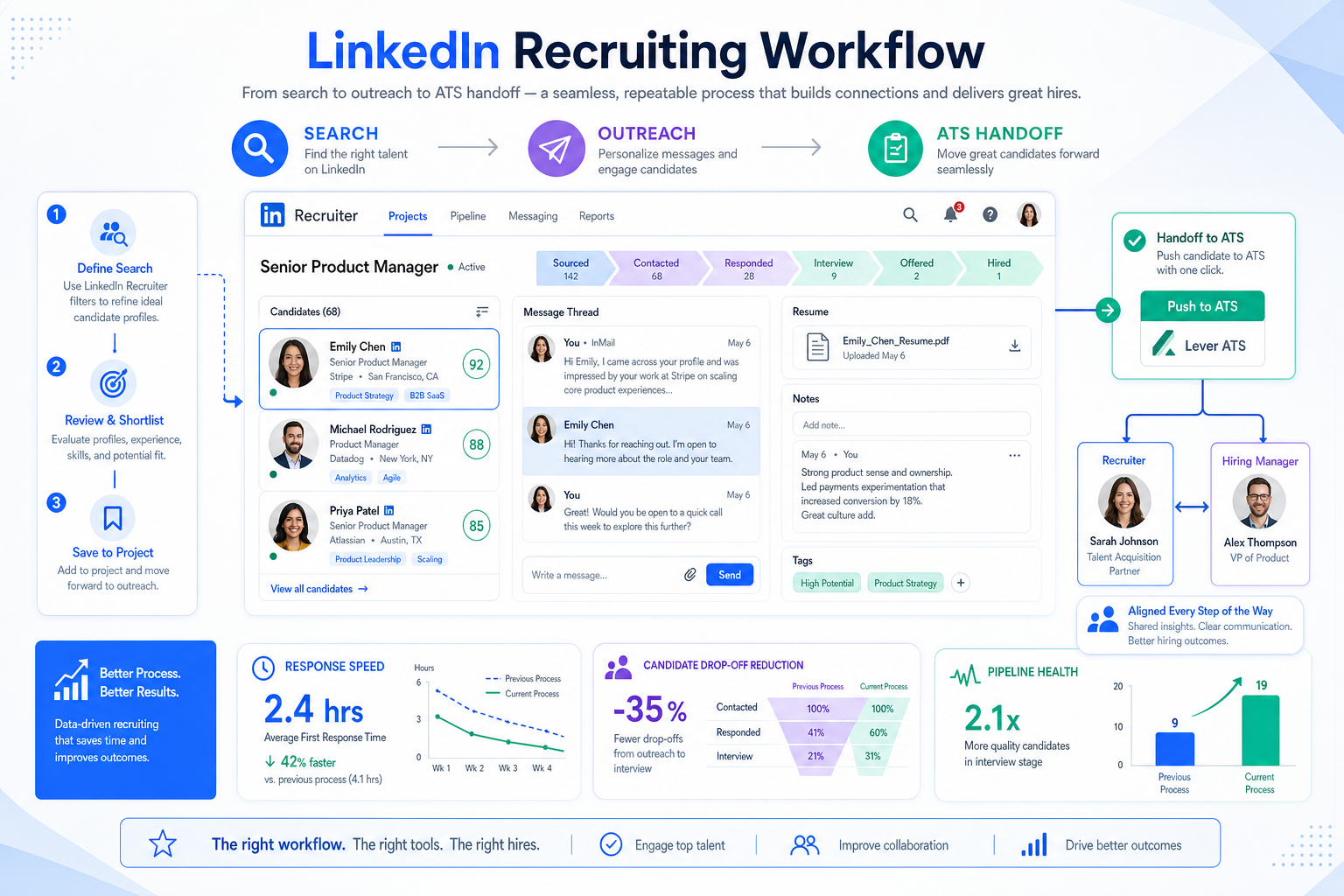
The best answer to how do you use LinkedIn for recruitment is to treat it as a market-mapping and conversation platform, then connect it to a system that can handle process control.
A reliable workflow usually looks like this:
- Clarify the opportunity. Before searching, define the role, likely backgrounds, must-have skills, location constraints, and what the candidate actually gains by taking the conversation.
- Study the talent pool. Use LinkedIn to see how titles vary, where talent clusters, and how broad the search should be.
- Build a focused search. Filter by seniority, function, geography, industry, and adjacent backgrounds.
- Start targeted outreach. Send concise messages with a specific reason for contact rather than broad generic copy.
- Capture response signals. Note interest, timing, objections, and follow-up commitments.
- Move qualified prospects into structured workflow. Once the person is genuinely in process, your ATS should become the source of truth.
In my own work, the biggest improvement came from reducing the dead space between steps four and six. I tested AI Recruiter mainly for after-hours LinkedIn response coverage and early resume collection. It was helpful in searches where candidates replied outside business hours or needed a few back-and-forth messages before sharing contact details. What it did not replace was recruiter judgment. I still had to assess whether the resume matched the brief, whether compensation alignment was realistic, and whether the person should speak with the client or hiring manager.
Where LinkedIn tools fit in the workflow
Some recruiters need full-seat sourcing and collaboration capabilities. Others only need lighter search and messaging support. Either way, the core operational question stays the same: can the team move from discovery to documented hiring action without duplicate work?
- Search and filtering: useful for mapping talent and narrowing outreach.
- Messaging: useful for initial engagement and qualification of interest.
- Collaboration: useful when recruiters and hiring managers need to align on sample profiles early.
- Automation support: useful when reply volume, time zones, or multilingual communication create bottlenecks.
Key insight: LinkedIn works best when it helps recruiters identify and start conversations with the right people, not when teams expect it to carry the entire hiring process by itself.
What the best recruiting software stack includes
Best recruiting software usually means a coordinated set of tools rather than a single system. The exact mix depends on team type, but most mature recruiting workflows need some version of the following:
| Category | Main purpose | Why recruiters need it | Risk if missing |
|---|---|---|---|
| Applicant Tracking System | Manage candidates, stages, notes, feedback, and requisitions | Creates process control and reporting | Candidates get lost in email and spreadsheets |
| Recruiting CRM | Nurture prospects before application | Supports long-cycle relationship building | Passive candidates receive inconsistent follow-up |
| LinkedIn sourcing workflow | Find and engage talent | Drives active search and outreach | Talent discovery stays too narrow |
| Recruiting automation | Handle repetitive outreach and status tasks | Reduces manual admin at top of funnel | Recruiters spend too much time on low-value repetition |
| Analytics and reporting | Measure source quality and stage movement | Supports better decisions with hiring leaders | Teams cannot explain what is working |
For most buyers, the correct sequence is still simple:
- Choose the ATS first.
- Map LinkedIn sourcing handoff into that system.
- Add CRM or automation only where a real bottleneck exists.
- Test adoption with hiring managers, not just recruiters.
Three recruiting software options recruiters compare
When teams ask about recruiting software for LinkedIn-heavy work, they usually compare broad ATS platforms, workflow automation tools, and specialist sourcing support. The right answer depends on what problem is actually slowing the desk.
1. LinkedIn Recruiter
Best for: teams that rely heavily on search, filtering, and recruiter-seat collaboration.
Strengths: strong sourcing environment, familiar profile data, useful for market mapping and talent targeting.
Limits: it is not a full ATS, and teams can still end up with fragmented notes if handoff is weak.
Cost reality: generally a meaningful budget line for teams that need dedicated sourcing access, so seat planning matters.
Good fit: agency desks, in-house sourcing teams, and specialized recruiters who spend significant time in active search.
How it works with StrategyBrain AI Recruiter: this is the combination I find most practical when reply handling is the bottleneck. Search strategy and target definition still come first, then StrategyBrain AI Recruiter can help keep outreach conversations moving and collect resume or contact signals before the recruiter makes the next judgment call.
2. Greenhouse
Best for: structured in-house hiring teams that need a mature ATS with consistent process control.
Strengths: strong workflow discipline, scorecards, hiring team visibility, and reporting depth.
Limits: not designed to replace LinkedIn sourcing behavior, so recruiters still need a separate top-of-funnel motion.
Cost reality: usually better suited to organizations with established recruiting operations rather than very small teams.
Good fit: scaling companies and talent acquisition functions that care about process consistency across many stakeholders.
How it works with StrategyBrain AI Recruiter: useful when the ATS is already the system of record but top-of-funnel LinkedIn engagement is still too manual. Automation can reduce message handling while Greenhouse remains the place for stage progression and interview management.
3. Lever
Best for: teams that want ATS structure with lighter relationship-management style workflows.
Strengths: approachable interface, easier recruiter adoption in some teams, and useful visibility into candidate progression.
Limits: sourcing quality still depends on recruiter search skill and disciplined follow-up.
Cost reality: often attractive to growing companies that need more than spreadsheets but want workflow simplicity.
Good fit: mid-sized internal teams balancing speed and process maturity.
How it works with StrategyBrain AI Recruiter: if LinkedIn conversations are scattered across evenings, regions, or languages, AI Recruiter workflows can support earlier engagement while Lever holds the structured candidate record once interest is real.
Across all three comparisons, the main lesson is consistent. Search tools help you find people. ATS platforms help you run the process. Automation helps when repetitive message handling or follow-up is consuming recruiter time. None of them remove the need for recruiter judgment.
What to look for in an applicant tracking system for recruiters
If your team sources on LinkedIn, your ATS needs to absorb that activity cleanly. A useful applicant tracking system for recruiters should support not just applicants, but sourced candidates who begin life as conversations rather than applications.
- Centralized candidate records: one place for resumes, notes, status, and stakeholder comments.
- Clean source tracking: clear attribution for LinkedIn, referrals, inbound, and other channels.
- Flexible stage design: enough structure for sourced and applied candidates without overcomplication.
- Interview coordination: practical scheduling and scorecard collection.
- Hiring manager usability: the tool fails if managers avoid it.
- Reporting: funnel health, source quality, and stage timing should be visible.
| Feature area | Why it matters | What to test |
|---|---|---|
| Candidate creation from sourcing | Prevents drop-off after initial LinkedIn interest | How many steps to create a clean record? |
| Notes and communication history | Keeps follow-up consistent across recruiters | Can the next person understand the full context quickly? |
| Interview scorecards | Improves decision quality | Will hiring managers complete them on time? |
| Source reporting | Shows what is actually producing qualified candidates | Can LinkedIn-sourced prospects be measured separately? |
| Workflow adoption | Turns process into habit | Does the tool reduce admin or add it? |
Applicant tracking system benefits that matter in practice
The most useful applicant tracking system benefits are operational, not cosmetic.
Better consistency
This matters especially in roles where candidate value must be clear, such as internships, apprenticeships, and early-career programs. If expectations, learning scope, or documentation are vague, recruiters and hiring teams expose themselves to avoidable risk.
Stronger visibility
When leaders ask what is happening, recruiters need more than memory. Visibility shows where candidates enter, where they stall, and whether LinkedIn sourcing is converting into interviews.
Faster handoffs
The real delay in hiring often comes after a candidate replies. The handoff from message to structured process is where many teams lose momentum.
Better candidate experience
Candidates notice confusion quickly. Repeated questions, long silence, and unclear next steps make even strong opportunities feel less credible.
How to choose by team type
Solo recruiters and small agencies
Prioritize response speed, simple pipeline control, and a way to avoid losing LinkedIn conversations. If you handle many passive candidates, lightweight automation can save time, but only if you still review fit personally.
Mid-sized recruiting firms
Look for clearer workflow rules, better reporting, and more disciplined handoff between sourcing and active process. This is often where automation starts to pay off because consistency becomes harder to maintain across desks.
In-house talent acquisition teams
Focus on hiring manager participation, process transparency, and compliance-sensitive documentation. Internship and early-career recruiting especially benefit from stronger recordkeeping because the opportunity itself may require closer scrutiny.
Enterprise teams
Governance, workflow control, analytics, and cross-team adoption matter most. Search activity, candidate communication, and ATS records all need to line up.
Internships, candidate value, and workflow discipline
The unpaid internship debate may seem separate from recruiting software, but it exposes an important hiring truth: some opportunities require a higher standard of documentation and candidate-value clarity. Not all internships are alike. Some provide meaningful learning, practical access, and a path into difficult industries. Others drift into low-value labor that benefits the organization more than the intern.
That difference matters in recruiting because software should help teams prove the quality of the opportunity and the fairness of the process. If a role is tied to education, early-career learning, or other special conditions, recruiters need records showing what was communicated, what the candidate received, and how the organization managed the relationship.
A responsible team should ask:
- Is the opportunity genuinely beneficial to the candidate?
- Are expectations and scope documented clearly?
- Can we show what was promised and how the process was handled?
- Do recruiters and hiring managers see the same information?
Those are not abstract legal questions. They are workflow questions, and good recruiting software helps answer them before problems escalate.
For job seekers and people who want to become a recruiter
How to get a job recruiter
If you are searching how to get a job recruiter, start by making your LinkedIn profile easy to understand in search. Use a clear headline, list the work you actually do, and show concrete achievements or scope. Recruiters search by title patterns, skill clusters, geography, and seniority. If your profile is vague, you are harder to find and harder to assess.
You should also evaluate recruiter outreach the same way an intern evaluates an opportunity: what is the real benefit, what happens next, and is the process credible? That mindset helps you avoid wasting time on poorly run searches.
How to become a recruiter
If you want to become a recruiter, understand that the job is part sales, part research, part operations, and part judgment. Good recruiters learn intake discipline, market mapping, outreach writing, screening, stakeholder management, and pipeline control.
They also learn when tools help and when they do not. In my experience, LinkedIn automation support is useful for repetitive first-touch work, especially when candidates reply late, across regions, or in different languages. But the recruiter still owns search design, candidate evaluation, client calibration, and final movement into process.
- Core skill: turning a hiring request into a realistic target market.
- Process skill: keeping candidate information clean and actionable.
- Communication skill: writing outreach that offers real value.
- Judgment skill: knowing which responses deserve recruiter attention next.
FAQ
What is the best recruiting software for LinkedIn-heavy hiring?
Usually it is a combination: LinkedIn-based sourcing capability, an ATS for process control, and selective automation if top-of-funnel communication is too manual.
How do you use LinkedIn for recruitment without creating admin chaos?
Use LinkedIn for search, outreach, and market mapping, then move genuinely interested prospects into an ATS with clear notes, source tagging, and next steps.
What is an applicant tracking system for recruiters?
An ATS is the system recruiters use to manage candidates, stages, notes, interview feedback, and reporting in one place.
What are the advantages of applicant tracking system adoption?
The main advantages of applicant tracking system adoption are better visibility, faster handoffs, stronger consistency, and a cleaner candidate experience.
Can automation replace a recruiter on LinkedIn?
No. Automation can reduce repetitive outreach and help capture resumes or contact details, but recruiters still need to assess fit, manage stakeholders, and make hiring decisions.
Why bring internships into a recruiting software discussion?
Because internships highlight a core recruiting principle: the opportunity must be clearly valuable to the candidate, and the process must be documented well enough to prove that value.
Conclusion
If you are evaluating the best recruiting software, start with a simple operational truth. Good recruiting technology should make candidate value clearer, not hide weak process behind more messaging. That is why how do you use LinkedIn for recruitment is really a workflow question, not just a sourcing question.
Use LinkedIn to define the market, find talent, and begin relevant conversations. Use an ATS to manage the actual hiring process. Add automation only where repetitive work is slowing the desk, and keep recruiter judgment at the center. That approach serves agency recruiters, internal teams, candidates trying to learn how to get a job recruiter, and anyone planning to become a recruiter with a realistic view of how modern hiring actually runs.