Recruiters can apply this guide to improve screening for manufacturing engineering careers and avoid losing qualified finalists.
When those standards are missing, candidates may interpret verification requests as distrust or an invasion of privacy. Independent recruiters and smaller search firms can lose finalists after investing weeks in sourcing, while corporate recruiters face delayed starts, inconsistent decisions, unnecessary screening costs, and reputational damage. The risk is particularly high in aerospace and defense searches, where degree verification, employment history, citizenship conditions, export-control restrictions, and security-clearance eligibility are frequently—and incorrectly—treated as one requirement.
A well-configured recruiting platform can reduce that confusion by recording candidate consent, preserving communication history, answering routine process questions, and reminding recruiters when follow-up is due. Automation should support timely, consistent communication rather than decide whether an engineer is qualified or whether screening information is job-related. The recruiter must still review the résumé, interpret the requisition, assess technical evidence, and determine the appropriate next step.
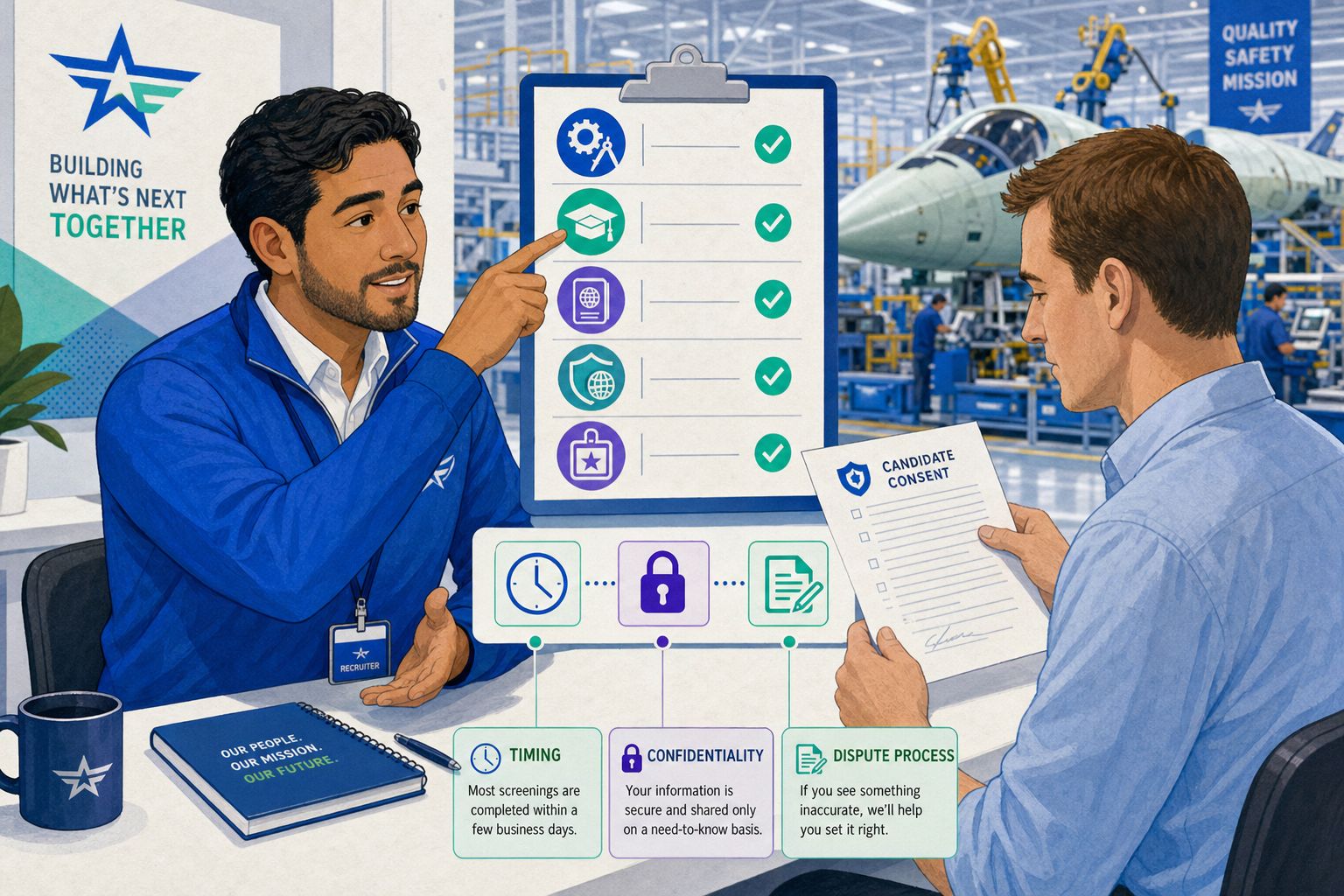
The tension becomes visible when a manufacturing engineer receives a screening request after reaching the finalist stage. Before authorizing it, the candidate asks what will be checked, whether every finalist undergoes the same review, and whether an inaccurate report can be challenged. The recruiter checks the requisition and screening policy, follows up on the candidate’s previous message, and sends a written explanation covering the scope, expected timing, confidentiality safeguards, and dispute process. Without those actions, a qualified candidate with nothing to conceal may still withdraw because the employer has not explained why the request is relevant.
That moment connects candidate communication directly to aerospace and defense hiring. It shows why searches for manufacturing engineering careers, engineering technology careers, and construction engineer jobs need both accurate technical evaluation and a screening process proportionate to the work. The rest of this guide examines the roles, qualifications, transferable skills, work conditions, and candidate-screening decisions recruiters must distinguish.
Key insight: Screening should be determined by the responsibilities and legal conditions of a position, not by an unexplained impression about an individual candidate. Clear notice, consistent treatment, documented consent where required, and an opportunity to address inaccurate information protect both the candidate relationship and the hiring decision.
Table of Contents
- Screening Principles for Engineering Searches
- What Manufacturing Engineering Careers Include
- Aerospace and Defense Role Comparison
- Manufacturing Engineering Responsibilities
- Education and Entry Routes
- Technical Skills and Evidence
- Work Environment, Citizenship, and Clearances
- Transferable Construction Engineering Skills
- A Candidate-Respectful Screening Workflow
- Salary and Career Outlook
- Career Paths and Advancement
- Job Search and Hiring Guidance
- Common Mistakes
- Frequently Asked Questions
Screening Principles for Aerospace and Defense Engineering Searches
Pre-employment screening is not a substitute for technical assessment. Its purpose is to verify information or evaluate a job-related condition after the hiring team has defined why that information matters. For an aerospace manufacturing position, relevant checks might include employment or education verification. A driving-record check may be relevant to a field engineer who regularly operates company vehicles but difficult to justify for a factory-based process engineer who never drives for work.
Recruiters should be prepared to answer four questions before requesting any check:
- Why is the information necessary? Connect every requested item to an actual responsibility, legal condition, customer requirement, or documented risk.
- Is the same standard applied consistently? Candidates considered for substantially similar positions should encounter the same established process rather than checks triggered by intuition.
- What will the candidate be told? Explain the scope, timing, authorization requirements, confidentiality practices, and likely next step.
- How can inaccurate information be addressed? Establish a process for notices, report access, disputes, and individualized review where applicable.
In the United States, an employer using a third-party consumer reporting agency must consider the Fair Credit Reporting Act and other applicable federal, state, and local rules. The FCRA generally requires appropriate disclosure and written authorization before obtaining a covered employment report. If an employer may make an adverse decision based on that report, pre-adverse action procedures generally include providing the candidate with a copy of the report and a summary of applicable rights before the decision is finalized. Employers should obtain qualified legal guidance because requirements vary by jurisdiction and screening type.
Recruiting takeaway: Put material screening conditions in the job advertisement or explain them early in the process. A finalist should not learn for the first time that a position involves extensive travel, a particular work authorization condition, or eligibility for a government clearance after several interviews.
What Do Manufacturing Engineering Careers Include?
Manufacturing engineering careers in aerospace and defense concentrate on making technically demanding products buildable, repeatable, safe, and traceable. These professionals connect design intent with physical production. They develop processes, support tooling, investigate defects, control documentation, improve flow, and coordinate decisions among design engineering, quality, operations, supply chain, technicians, and program teams.
The career cluster is broader than the title “aerospace engineer.” A design engineer may establish product requirements, while a manufacturing engineer determines how the product will be assembled or fabricated. An industrial engineer studies capacity, labor, layout, and flow. A quality engineer develops prevention and verification methods. An engineering technologist may work closely with automated equipment, controls, tests, production data, or process implementation.
Titles differ among employers. Comparable work can appear under manufacturing engineer, methods engineer, process engineer, production support engineer, industrial engineer, tooling engineer, quality engineer, test engineer, field engineer, or manufacturing engineering technologist. Recruiters should read the responsibilities before deciding that a candidate’s current title is either a match or a mismatch.
The larger business objective also matters. A team increasing production volume needs different evidence from one stabilizing a new process, recovering a delayed program, installing equipment, or reducing recurring nonconformances. Candidates need that context to decide whether the role advances their career, and interviewers need it to ask job-relevant questions.
Aerospace and Defense Engineering Role Comparison
The best route depends on whether a candidate prefers product design, production systems, applied technology, quality assurance, or project execution. The comparison below shows where manufacturing, construction, and engineering technology backgrounds can intersect.
| Role | Primary Focus | Typical Education Route | Common Setting | Useful Screening Evidence |
|---|---|---|---|---|
| Aerospace engineer | Aircraft, spacecraft, structures, systems, or performance | Bachelor’s degree in aerospace or a related engineering discipline | Engineering office, laboratory, test site, or production facility | Relevant design, analysis, test, or systems projects |
| Manufacturing engineer | Processes, tooling, work instructions, flow, and manufacturability | Engineering degree; some positions accept closely related applied backgrounds | Factory floor and engineering office | Process ownership, drawing interpretation, and problem-solving examples |
| Industrial engineer | Capacity, layout, labor, ergonomics, cost, and continuous improvement | Industrial engineering or related degree | Production and analytical environments | Data analysis, flow improvement, capacity, or optimization work |
| Engineering technologist | Equipment, automation, controls, testing, quality, and implementation | Associate or bachelor’s degree in engineering technology | Laboratory, factory, test cell, or field site | Equipment experience, applied projects, tests, and troubleshooting |
| Quality engineer | Defect prevention, inspection systems, root cause, and corrective action | Engineering or technical degree; requirements vary | Production floor, laboratory, supplier site, or office | Investigation methods, quality records, and validation evidence |
| Construction or field engineer | Constructability, inspections, materials, schedules, safety, and turnover | Civil, construction, mechanical, electrical, or related technical degree | Project or installation site | Drawing control, RFIs, traceability, inspections, and field coordination |
Recruiting takeaway: Do not use a degree title as a shortcut for capability unless the credential is genuinely required. Screen for the analysis level, technical work, decision authority, and operational problem the position actually contains.
What Does a Manufacturing Engineer Do?
A manufacturing engineer translates product requirements into a controlled production method. The role is practical, cross-functional, and documentation-intensive. A successful process must function on the factory floor, produce conforming hardware, and create a reliable record of what was performed.
Core responsibilities
- Develop production processes: Define operation sequences, required resources, inspection points, and process controls.
- Interpret drawings and specifications: Read dimensions, tolerances, notes, material requirements, and geometric dimensioning and tolerancing.
- Create work instructions: Convert design intent into clear, controlled steps that operators and technicians can execute consistently.
- Maintain product records: Help align bills of materials, revisions, configuration data, tooling, and instructions.
- Investigate defects: Contain the immediate problem, gather evidence, identify causes, and support corrective action.
- Support tooling: Specify, validate, improve, or replace fixtures, jigs, gauges, and production aids.
- Improve production flow: Reduce waiting, excessive motion, bottlenecks, rework, and unstable handoffs.
- Assess manufacturability: Work with design teams to improve buildability without compromising technical requirements.
What strong interview evidence sounds like
A list of terms such as CAD, Lean, ERP, or root-cause analysis does not demonstrate proficiency. Strong candidates describe a sequence of work: what requirement applied, what problem appeared, which evidence they reviewed, who participated in the decision, what changed, and how the result was validated.
For example, a candidate might explain how a drawing revision affected the bill of materials, fixture configuration, work instructions, inspection plan, operator training, and production schedule. That answer reveals systems thinking. It also gives the recruiter specific claims that can be explored through reference checks or employment verification without requesting irrelevant personal information.
Education Requirements and Entry Routes
Many aerospace and defense engineering jobs require a bachelor’s degree in an appropriate discipline. The suitable path depends on the balance of theoretical analysis, formal design responsibility, applied implementation, and hands-on technical work.
Traditional engineering degrees
Engineering programs generally emphasize mathematics, physical principles, analysis, and design. Mechanical, aerospace, industrial, manufacturing, electrical, civil, and construction engineering can all lead to relevant roles when the coursework and experience align with the position.
Engineering technology careers
Engineering technology careers emphasize applied implementation. Programs commonly prepare graduates to work with modern manufacturing equipment, automation, controls, testing methods, quality systems, and operational tools. Available routes include associate and bachelor’s degrees, although employer requirements and permitted responsibilities vary.
An associate degree may support technician, quality, test, production, automation, or field-support work. A bachelor’s degree in engineering technology can qualify a candidate for technologist positions and some engineering roles, depending on the employer, customer requirements, accreditation expectations, and scope of work. Candidates should not assume that every employer interprets “engineer” and “technologist” identically.
| Education Route | Potential Starting Opportunities | Evidence That Strengthens a Candidacy |
|---|---|---|
| Associate degree in engineering technology | Technician, quality, test, automation, production, or field support | Laboratory work, equipment exposure, CAD projects, and documented troubleshooting |
| Bachelor’s degree in engineering technology | Engineering technologist, manufacturing support, controls, quality, or test | Applied projects, internships, process data, and implementation experience |
| Bachelor’s degree in engineering | Manufacturing, industrial, aerospace, quality, civil, or construction engineering | Internships, design projects, drawing interpretation, and production exposure |
| Experienced technical pathway | Specialist, lead technician, planner, tooling, or selected engineering-support roles | Progressive responsibility, technical competence, and clearly documented scope |
Recruiting takeaway: Separate mandatory credentials from preferences. If a degree is required by law, contract, customer, or delegated engineering authority, say so. If equivalent applied experience is acceptable, define what “equivalent” means.
Skills, Software, and Technical Evidence
Aerospace and defense employers need technical depth and disciplined execution. Candidates must understand the product or process while communicating effectively with design, quality, operations, supply chain, technicians, program leadership, and customers.
Frequently requested technical skills
- Engineering drawing and specification interpretation
- GD&T fundamentals
- CAD and product-definition tools
- Lean manufacturing and continuous improvement
- Root-cause analysis and corrective action
- Quality control, measurement, and process capability
- Design for manufacturability
- Enterprise resource planning and manufacturing execution systems
- Work instructions, bills of materials, and configuration control
- Automation, controls, equipment, and testing for applied technology positions
Technical knowledge becomes more valuable when accompanied by judgment. Employers need people who can distinguish a symptom from a cause, document assumptions, recognize when a decision exceeds their authority, escalate risk, and make recommendations that other functions can implement.
Certifications in quality, Lean, Six Sigma, project management, safety, or specialized software can support a profile when they match the work. They do not replace evidence of application. Candidates can use sanitized project summaries, school assignments, process maps, CAD examples, or test plans, but they should never disclose proprietary, export-controlled, classified, or otherwise protected information.
Recruiting takeaway: Ask what the candidate produced with a tool and how that output influenced a decision. Counting software names encourages keyword matching rather than credible technical assessment.
Work Environment, Citizenship, and Security Clearances
Many aerospace and defense positions are connected to physical products, specialized equipment, controlled technical information, or secure facilities. Onsite work is therefore common in manufacturing, tooling, quality, testing, construction, and field engineering. Some planning, analysis, and documentation duties may be hybrid, but that depends on the program and facility.
Manufacturing engineers often divide their time between an office and the production floor. Construction and field engineers may spend most of the day at a project site, where safety, inspections, material availability, contractors, and schedule constraints determine priorities. Engineering technologists may work around laboratories, test cells, automated equipment, or production shifts.
Do not merge distinct eligibility questions
Citizenship, work authorization, export-control access, facility access, and security-clearance eligibility are not interchangeable concepts. A job may involve one, several, or none of them. Recruiters should obtain precise language from compliance or legal teams instead of telling candidates broadly that “defense work requires citizenship” or that every position requires an active clearance.
| Work Factor | What Candidates Should Confirm | What Employers Should State |
|---|---|---|
| Onsite presence | Schedule, shift, facility, and remote-work limitations | Required attendance and why physical access matters |
| Travel | Frequency, duration, and domestic or international scope | Realistic travel expectations rather than vague percentages |
| Citizenship or work authorization | The exact condition stated for the position | The role-specific legal or contractual requirement |
| Security clearance | Whether current eligibility or the ability to obtain it is required | Level, timing, sponsorship status, and program dependency |
| Controlled information | Restrictions affecting remote work and portfolio disclosure | Data-handling rules and interview boundaries |
Recruiting takeaway: Place material eligibility, shift, travel, and onsite conditions near the beginning of the posting. Transparency allows candidates to evaluate the opportunity before either side invests in an extensive interview process.
How Construction Engineer Jobs Transfer to Aerospace and Defense
Construction engineer jobs can provide relevant experience for aerospace and defense facilities, equipment installations, secure sites, infrastructure projects, and field integration. The strongest overlap involves configuration awareness, documentation, traceability, safety, inspections, project controls, and coordination across technical groups.
Transferable construction and field responsibilities
- Reviewing drawings and specifications for constructability
- Tracking revisions and resolving requests for information
- Maintaining material identification and traceability
- Coordinating inspections and documenting acceptance
- Managing nonconformances and corrective actions
- Monitoring schedules, dependencies, and project constraints
- Supporting site safety and quality requirements
- Preparing turnover records for owners or operations teams
The transfer is not automatic. Candidates moving from construction engineer jobs should learn production terminology such as work instructions, bills of materials, process capability, manufacturability, ERP, MES, takt time, and production flow. They also need to translate project experience into engineering outcomes rather than relying only on contract value or facility size.
Recruiters can evaluate transferability with a scenario. Ask the candidate to describe a drawing discrepancy, then follow how it affected materials, schedule, inspection, field execution, and turnover. The answer reveals whether the candidate can manage controlled technical change—an ability that matters in both construction and manufacturing.
A Candidate-Respectful Engineering Screening Workflow
The opening finalist’s questions—why the check is needed, whether everyone is treated alike, what the process includes, and whether errors can be corrected—should not be handled improvised. A documented workflow creates a more consistent experience.
1. Define the requirement before sourcing
Before publishing the position, confirm the degree, experience, work authorization, onsite, travel, export-control, clearance, license, and screening conditions. Identify which items are mandatory and why. Recruiters should be able to connect each requirement to a responsibility, law, contract, customer condition, or established policy.
2. Explain the process before requesting consent
Tell candidates what type of screening is planned, when it occurs, what information is required from them, who handles the information, and how long the stage is expected to take. Never imply that authorization guarantees employment unless the employer is genuinely prepared to make that commitment.
3. Apply the standard consistently
Checks should follow the nature of the position and the employer’s established process. A recruiter should not add an intrusive check because of a vague concern about one candidate. If substantially similar positions receive different treatment, the employer should have a legitimate, documented reason.
4. Keep technical qualification separate
The hiring manager should assess engineering fundamentals, project evidence, problem solving, documentation, and cross-functional judgment. Screening information should not compensate for a weak technical interview, and automated messaging should not make final qualification decisions.
5. Communicate status and timing
Candidates should know whether the check is a final condition or one factor among several finalists. They should also receive a realistic timeframe. Silence after requesting sensitive information undermines trust and can cause the candidate to accept another offer.
6. Follow applicable adverse-action procedures
If information from a covered third-party report may affect the decision, follow applicable notice, report-access, waiting-period, dispute, and final-action requirements. Consider whether the information is accurate, job-related, legally usable, and subject to individualized assessment. This is an area for qualified legal guidance rather than improvised recruiter judgment.
Practical documentation checklist:
- The job-related reason for each check
- The policy or requisition authorizing it
- The candidate disclosure and authorization record
- The screening provider and information scope
- Candidate communications and expected timing
- Any required pre-adverse and final notices
- The process used to receive disputes or corrections
- The final decision-maker and documented rationale
Salary Factors and Career Outlook
Compensation varies by discipline, degree, experience, location, technical specialization, clearance status, shift, travel, program complexity, and leadership scope. No single salary figure accurately represents the entire aerospace and defense career cluster.
A production-floor position covering an off shift may be structured differently from an entry-level office role. A field engineer with extensive travel may receive different allowances or overtime treatment from a salaried manufacturing engineer. Candidates should review base pay, overtime classification, shift expectations, travel arrangements, benefits, paid leave, retirement provisions, and development opportunities.
For reliable occupational data, candidates and recruiters should consult current government labor statistics and compare them with recent job postings in the relevant location. Aerospace engineers, industrial engineers, civil engineers, engineering technicians, and construction managers are separate occupational groups; a broad market statistic should not be presented as a guarantee for one employer or specialty.
Recruiting takeaway: Benchmark compensation against actual responsibilities rather than title alone. Explain how location, seniority, shift, travel, technical scarcity, and clearance conditions influence the stated range.
Career Paths and Advancement
Manufacturing engineering careers can progress through technical specialization, project leadership, operations, or people management. Advancement usually follows increased ownership: first for a task, then a process, product area, project, team, or manufacturing system.
| Career Stage | Typical Scope | Possible Next Steps |
|---|---|---|
| Entry level | Data collection, document changes, testing, inspections, floor support, or defined improvement work | Engineer, technologist, quality specialist, or field engineer |
| Experienced contributor | Process ownership, defect investigation, tooling support, capability improvement, or project coordination | Senior engineer, specialist, project engineer, or technical lead |
| Technical leadership | Complex problem solving, standards, mentoring, risk decisions, and program-wide methods | Principal engineer, subject-matter expert, chief engineer, or manager |
| Management | Staffing, priorities, budgets, delivery, risk, and team development | Senior manager, operations leader, program leader, or functional director |
Engineering technologists can advance into automation, test, quality, controls, operations, or applied technical leadership. Construction and field engineers may move into project engineering, commissioning, facilities engineering, construction management, project controls, or program management.
Candidates should record the processes they owned, decisions they influenced, risks they evaluated, and improvements they validated. These details support future interviews and reference checks without requiring disclosure of protected program information.
How to Prepare for Aerospace and Defense Engineering Jobs
- Choose a role family. Decide whether the target is manufacturing, industrial, quality, test, design, technology, construction, or field engineering.
- Read responsibilities before requirements. Identify what the employee will own and whether the work is analytical, hands-on, production-based, or field-based.
- Map keywords to evidence. For every term such as GD&T, root-cause analysis, CAD, ERP, or MES, prepare a project, class, internship, or work example.
- Use defensible measures. Describe team size, process steps, equipment supported, schedule duration, or document types without inventing business impact.
- Prepare a structured problem-solving example. Cover the requirement, observed problem, evidence, cause, action, validation, and lesson learned.
- Confirm work conditions early. Ask about location, shift, travel, citizenship language, export-control access, and clearance expectations.
- Expect transparent screening. Ask what will be checked, when authorization is required, how long the process takes, and how inaccurate information can be disputed.
- Protect sensitive information. Do not place proprietary, classified, export-controlled, or confidential material in a résumé, portfolio, or interview presentation.
Entry-level evidence can come from internships, co-ops, capstone projects, laboratories, student teams, apprenticeships, military technical work, or production jobs. A modest project explained in depth is more credible than a long list of tools without context.
Common Career and Hiring Mistakes
Treating aerospace and defense as one occupation
Interest in aircraft or defense systems does not define a function. Manufacturing, design, quality, test, technology, and field positions require different evidence. Employers should avoid combining several jobs into one unrealistic requisition.
Running checks without a job-related reason
More information is not automatically better. Unnecessary checks can increase expense, delay hiring, damage candidate trust, and create legal exposure. Define necessity before requesting personal information.
Applying screening inconsistently
A check triggered by a recruiter’s unsupported feeling is difficult to defend. Use established, position-based rules and document legitimate reasons for differences.
Confusing authorization with a guaranteed offer
Candidates need to know whether they are the selected finalist or one of several people still under consideration. Recruiters should make only promises the employer is prepared to honor.
Listing tools without showing application
“CAD, ERP, MES, Lean, and Six Sigma” is not a qualification story. Candidates should explain what they created, investigated, changed, or validated.
Assuming every defense role requires an active clearance
Clearance requirements depend on the position and program. Some jobs require an active clearance, some require eligibility to obtain one, and others require none.
Overlooking technology and construction backgrounds
Applied technical graduates and field engineers may bring valuable experience in equipment, controls, quality, inspections, traceability, safety, and execution. Assess whether the experience matches the role’s work and required analytical level.
Frequently Asked Questions
Do aerospace manufacturing engineers need an engineering degree?
Many positions require a bachelor’s degree in engineering, particularly when the work includes formal analysis, design authority, or customer-mandated qualifications. Other roles may accept engineering technology education or related applied experience. The posting should distinguish mandatory credentials from preferences.
What is the difference between engineering and engineering technology?
Engineering programs generally place greater emphasis on theory, mathematics, analysis, and design. Engineering technology programs emphasize applied implementation through equipment, automation, controls, testing, quality methods, and operational systems. Eligibility for a particular title or responsibility varies by employer and position.
Do all U.S. defense engineering jobs require citizenship or a clearance?
No. Requirements vary according to the role, program, information access, contract, and facility. Citizenship, work authorization, export-control access, and clearance eligibility are separate questions that should be stated precisely.
Why would an employer conduct pre-employment screening?
A legitimate screening step should verify information or evaluate a condition relevant to the position. Examples can include employment history, education, professional credentials, or other role-specific records. The employer should be able to explain why each check is necessary.
Does every candidate receive the same background check?
Candidates applying for substantially similar positions should generally encounter the same established process. Different jobs may require different checks because their responsibilities and legal conditions differ. Employers should not change the process for one person based on an unsupported impression.
Can a candidate refuse a background check?
A candidate may decline to authorize a check, but the employer may be unable to continue if the check is a lawful and necessary condition of the position. The employer should explain the scope and consequences without coercion or misleading promises.
Can a candidate challenge inaccurate screening information?
Applicable procedures depend on the jurisdiction and type of report. Under the U.S. FCRA, candidates have rights relating to covered consumer reports, including procedures relevant to disputes and adverse employment decisions. Candidates should receive the required notices and contact the reporting company promptly if information is inaccurate.
Which software and certifications are useful?
Frequently requested systems include CAD, ERP, and MES platforms. Useful methods include Lean manufacturing, Six Sigma, root-cause analysis, corrective action, and process capability. Certifications can help, but documented application usually carries more weight than a credential without project evidence.
Can experience from construction engineer jobs transfer to aerospace?
Yes. Constructability reviews, controlled drawings, material traceability, inspections, RFIs, nonconformance management, schedules, safety, project controls, and turnover documentation can all transfer. Candidates should also learn production systems and manufacturing terminology.
Are aerospace and defense engineering jobs mostly onsite?
Many are onsite because production, tests, inspections, tooling, secure information, and field execution depend on physical facilities. Some analysis, planning, and documentation work may be hybrid. Candidates should verify the schedule and access limitations for each position.
Conclusion: Match the Engineer and the Process
A successful aerospace or defense search requires more than matching titles. Recruiters must understand whether the employer needs process ownership, equipment expertise, quality investigation, production optimization, formal design analysis, or field execution. That distinction creates fairer access to manufacturing engineering careers and prevents qualified candidates from being screened out because their degree or current title looks unfamiliar.
The same discipline should govern pre-employment screening. Explain why information is needed, apply standards consistently, obtain authorization when required, communicate timing, protect confidentiality, and provide the appropriate route for correcting errors. Candidates can then evaluate the opportunity with confidence, while employers make decisions based on relevant technical evidence and a defensible hiring process.