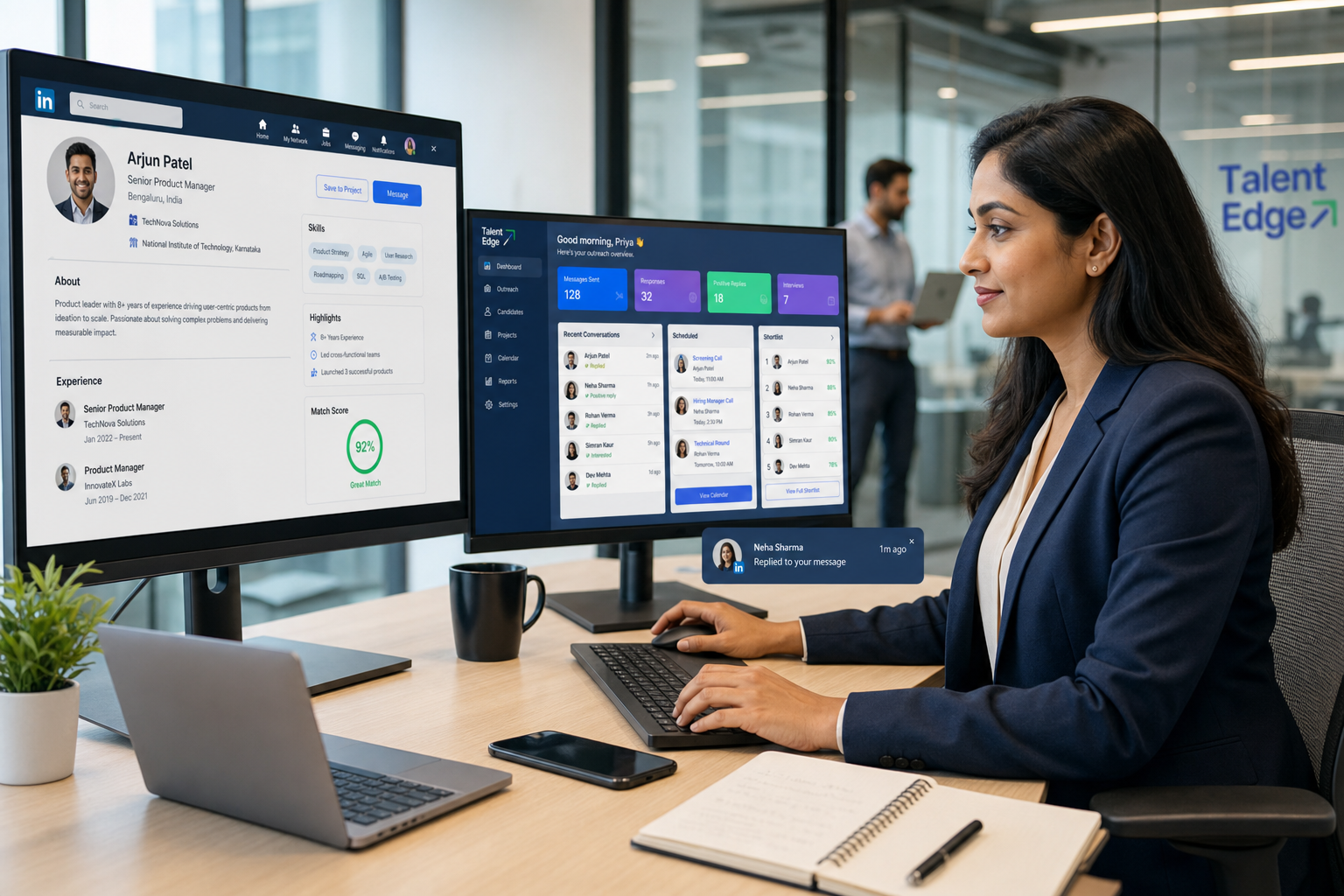
When people gpt search looks strong but outreach and call setup break down, recruiters can use this article to judge workflow fit, avoid guarded candidate conversations, and build better shortlists faster.
That alignment matters because sourcing does not fail only at the search box. It also breaks when outreach feels cold, when candidates arrive tense, when recruiters over-filter too early, and when a rushed first interaction makes a strong person look weaker than they are. For agency recruiters, in-house talent teams, and smaller search firms, the damage shows up as missed replies, thinner shortlists, slower placements, weaker hiring-manager trust, and avoidable revenue leakage.
In that gap between finding a name and earning a real conversation, I have found StrategyBrain AI Recruiter useful as a support layer rather than a replacement for recruiter craft. Its strengths are most relevant when the problem is repetitive LinkedIn outreach, delayed follow-up, and cross-border communication friction: it can automate first-touch messaging on LinkedIn, keep candidate conversations moving across time zones, and collect resumes or contact details from interested people. The recruiter still makes the final call on fit, reviews the resume, and decides whether the candidate should move forward.
That matters because the interview experience starts earlier than most teams admit. A candidate who has just agreed to speak is already deciding whether your process feels tense or thoughtful. If the first exchange is silent, overly transactional, or full of tricks, anxiety rises before the meeting even starts. The older interviewing advice still holds: welcome people properly, explain who they will meet, give them enough context to settle in, and avoid creating the sense that they are walking into a trap.
In practice, the same pattern shows up in sourcing. A recruiter identifies a promising engineer, sends a vague note, waits too long to answer a response, then drops the candidate into a first call without setting the stage about the role, team, or working relationship. The candidate becomes guarded, the conversation stays shallow, and both sides lose signal. That is exactly why ai candidate sourcing cannot be judged only by how many profiles an ai person finder or ai people finder can surface. It has to be judged by whether the workflow helps recruiters create a calmer, clearer path from discovery to conversation.
Table of Contents
- Why People GPT Matters in AI Candidate Sourcing
- Set the Stage Before the First Call
- Boolean Search vs Semantic Search
- How an AI People Finder Workflow Actually Works
- Where LinkedIn Outreach and Follow-Up Fit
- What Good Sourcing Output Should Look Like
- How to Evaluate Tools and Workflow Fit
- How Recruiting Brands Operationalize the Workflow
- Responsible Use: Bias, Transparency, and Candidate Experience
- Common Mistakes in AI Candidate Sourcing
- FAQ
Why People GPT Matters in AI Candidate Sourcing
For most recruiting teams, people gpt is best understood as a prompt-led way to search for talent in plain English. Instead of forcing recruiters to predict every title variant and skill synonym up front, the system interprets intent. You can describe the kind of person you need, the likely backgrounds that signal fit, and the deal-breakers that matter, then refine from there.
That is useful because recruiters rarely hire from exact title matches alone. Real sourcing depends on adjacent experience, transferable skills, industry context, timing, and candidate openness. A capable ai person finder should recognize that a solutions architect may overlap with a senior sales engineer in one search, while a platform engineer may overlap with a site reliability engineer in another. A practical ai people finder expands recruiter reach without taking away recruiter control.
The more experienced lesson, though, is that search quality and candidate experience are linked. If your search logic is shallow, your outreach becomes generic. If your outreach is generic, the conversation starts cold. And if the candidate begins the process tense or uncertain, your assessment quality drops. In that sense, AI candidate sourcing is not just about finding more people. It is about creating better conditions for a fairer first interaction.
Set the Stage Before the First Call
One of the strongest lessons from traditional interviewing still applies in AI-enabled sourcing: candidates perform better when they know what is happening and why. Good recruiters do not create unnecessary tension. They reduce it.
Before the first live conversation, the workflow should do four things well:
- Welcome the candidate clearly rather than dropping them into a hard sell.
- Explain who is involved so they know whether they are speaking with a recruiter, hiring manager, or peer.
- Provide enough role context for a meaningful discussion without over-scripted selling.
- Avoid trick-question energy in early interactions that makes candidates defensive.
This is where many sourcing teams underperform. They spend hours on search construction, then lose momentum with weak follow-up. In my own workflow, I have used AI Recruiter to keep the warm-up phase from collapsing between message one and scheduled call. What helped most was not automation by itself, but continuity: candidates got timely replies, basic role questions were answered quickly, and interested people were nudged toward sharing contact details or resumes without me having to sit in LinkedIn all evening. I still handled shortlist decisions and qualification review, but the handoff into the conversation felt calmer and more professional.
Practical takeaway: A better shortlist is less valuable if the first interaction makes the candidate guarded. Good AI candidate sourcing should improve both discovery and the setup for a real conversation.
Boolean Search vs Semantic Search
Boolean search still has a place in recruiting. It helps when you need precision, source-specific logic, and controlled narrowing. But it also assumes that the recruiter can guess the right labels in advance and that the market uses titles consistently. That is not how many searches behave in real life.
Semantic search changes the workflow. Instead of writing a long string and hoping you captured every title variation, you can search by intent. You might enter, “Find first enterprise sales hires with founder-led growth exposure in B2B SaaS,” and expect the engine to recognize likely equivalents even where the profile language differs.
The right choice usually looks like this:
- Use Boolean when the candidate pool is easy to define and precision matters most.
- Use semantic search when the role has messy title variation or transferable backgrounds.
- Use both together when the search is difficult and the market language is inconsistent.
This is one reason the people gpt concept resonates. It gives recruiters a more natural way to express hiring intent, then lets them refine the result with structured filters and human judgment.
How an AI People Finder Workflow Actually Works
A useful ai people finder workflow starts with a hiring brief, not a database syntax test. The recruiter describes the target role, likely career paths, must-have capabilities, geography, seniority, and constraints. The system then interprets those inputs into related titles, skill families, and profile evidence.
In mature recruiting teams, the workflow usually looks like this:
- Prompt intake: the recruiter describes the role in natural language.
- Intent mapping: the system interprets related titles, adjacent skills, and probable fit signals.
- Multi-source review: public professional signals are gathered and organized.
- Ranking: candidates are prioritized with visible reasons for the match.
- Recruiter calibration: the recruiter tightens or broadens the search based on what surfaced.
- Conversation setup: outreach, follow-up, and scheduling move interested people into the next step.
The best version of an ai person finder is not a black box. You should be able to see why someone appeared, what evidence supports the match, and where that evidence came from. That transparency matters even more once a candidate enters outreach, because a stronger first conversation depends on recruiters understanding what they are actually leading with.
Where LinkedIn Outreach and Follow-Up Fit
LinkedIn is often where sourcing momentum is won or lost. Recruiters may find the right person quickly, but the process still stalls if replies come in after hours, if language barriers slow clarification, or if early interest never gets converted into a scheduled conversation.
This is where an AI-assisted communication layer can help. StrategyBrain AI Recruiter is built around LinkedIn recruiting workflows, especially repetitive outreach and qualification conversations. Based on the product materials, the most relevant support points for sourcing teams are:
- Automated first-touch and follow-up with candidates who match your search criteria
- 24/7 multilingual communication to reduce delay and language friction
- Resume and contact collection from candidates who express interest
I would still separate that from actual qualification. Messaging automation can keep a candidate warm and move the process forward, but it does not replace reading the resume, checking depth of experience, or deciding whether the person truly fits the brief. That final judgment remains the recruiter’s job.
For teams hiring across regions or running high-volume LinkedIn outreach, this support layer can prevent the exact failure pattern described in the opening case: a good candidate gets found, but the experience between first message and first meeting feels disjointed. If you want to see how the workflow is positioned, the AI Recruiter overview and conversation examples are the most relevant starting points.
What Good Sourcing Output Should Look Like
Recruiters should judge AI candidate sourcing by output quality, not by how polished the search box looks. A better shortlist is one that improves recruiter judgment and prepares a stronger conversation.
Strong output usually includes:
- Ranked relevance tied to the search brief
- Visible match reasons such as title overlap, skill depth, industry context, or career pattern
- Source citations so the recruiter can verify the signal
- Consolidated profile context instead of scattered tabs
- Filters for practical narrowing such as location, function, seniority, and likely availability
- Shortlist readiness so hiring managers can review quickly
The overlooked test is whether the output helps you set the stage well. Can you explain to a candidate why you reached out? Can you answer likely first questions about the role and reporting line? Can you describe what made their background relevant? If not, your sourcing output is not yet doing enough work for the recruiter.
How to Evaluate Tools and Workflow Fit
When teams evaluate AI sourcing tools, they often focus too much on volume claims and not enough on workflow quality. A better evaluation framework asks whether the tool improves the recruiter’s judgment, the candidate’s early experience, and the team’s consistency.
Use this checklist:
- Search flexibility: Can recruiters search naturally and still apply precise controls?
- Semantic quality: Does the engine understand adjacent titles and transferable skills?
- Source visibility: Can recruiters verify where the match came from?
- Conversation readiness: Does the workflow support clear, timely, human-sounding follow-up?
- Recruiter control: Is the recruiter still deciding who is qualified and what happens next?
- Candidate experience: Does the process reduce tension and confusion rather than increase it?
That last point matters more than most software demos suggest. A sourcing tool may surface impressive profiles, but if it creates abrupt, unclear, or robotic interactions, it weakens the very assessment quality the search was supposed to improve.
How Recruiting Brands Operationalize the Workflow
Large U.S. recruiting firms have long shown that process quality matters as much as sourcing reach, even when the exact tools differ by team.
Korn Ferry
Korn Ferry is widely associated with structured assessment and role calibration. The useful lesson here is not a specific product stack but the discipline of defining success signals before candidate outreach scales. In a people gpt workflow, that means your prompt should reflect business outcomes, stakeholder expectations, and realistic adjacent backgrounds, not just a title.
Robert Half
Robert Half has long emphasized speed and relationship continuity in staffing operations. For AI candidate sourcing, the process lesson is fast response hygiene. Finding candidates quickly is less meaningful if follow-up lags. A LinkedIn communication layer such as StrategyBrain AI Recruiter can support that continuity, especially when recruiters need after-hours coverage, but recruiters still need to own qualification and client-facing judgment.
Aerotek
Aerotek is known for operational rigor in matching and delivery. The relevant workflow principle is clear handoff. In AI sourcing, that means deciding when a sourced profile becomes a contacted prospect, when interest becomes an active candidate, and what evidence is required at each stage. If a communication tool is added, it should strengthen those transitions rather than create another disconnected inbox.
Across all three examples, the common lesson is simple: better sourcing is not only about search breadth. It is about clear criteria, consistent follow-up, and a candidate experience that lets people show their best.
Responsible Use: Bias, Transparency, and Candidate Experience
AI candidate sourcing should be fast, but it also needs guardrails. Any system that ranks people or accelerates contact can amplify weak assumptions if recruiters stop checking the logic behind the match.
Teams should set a few baseline rules:
- Review before outreach instead of auto-accepting ranked results
- Watch for proxy bias in prompts, filters, and evaluation habits
- Check source quality when profiles are aggregated from multiple signals
- Document why candidates surfaced so hiring managers see the actual logic
- Protect candidate experience by avoiding spammy volume just because automation is available
The best people gpt workflow keeps a recruiter in the loop. It widens the search, supports follow-up, and reduces repetitive work, but it should not make the final call on who deserves to move forward.
Common Mistakes in AI Candidate Sourcing
Using vague prompts
If the brief is generic, the results will be generic. Recruiters should define must-have capabilities, likely backgrounds, and the real business problem behind the hire.
Overvaluing exact titles
The best candidates often come from adjacent labels. A good ai people finder should help you spot them, but only if you are willing to review beyond literal title matches.
Skipping the stage-setting step
Many teams find someone good and then create friction by offering too little context before the first conversation. That tension reduces signal and hurts conversion.
Blind trust in automation
Automation can handle outreach continuity and message timing, but it should not replace recruiter assessment. Resume review and qualification still require human judgment.
Confusing volume with coverage
More profiles do not automatically mean a better search. The goal is a sharper shortlist and a cleaner path into meaningful conversation.
FAQ
What is people gpt in recruiting?
In recruiting, people gpt usually refers to prompt-based candidate search where recruiters describe the talent they need in plain English and the system interprets titles, skills, and likely fit semantically.
How is an ai person finder different from Boolean search?
An ai person finder relies more on semantic understanding than exact keyword logic. It is better suited to roles with messy title variation or transferable backgrounds, while Boolean remains useful for precision and tightly defined searches.
What does an ai people finder need to do well?
A good ai people finder should surface relevant people, explain why they matched, show source evidence, and help the recruiter move into a strong first conversation rather than just produce a long list of names.
Can AI candidate sourcing replace recruiter judgment?
No. AI candidate sourcing can speed up discovery and support outreach, but recruiters still need to evaluate resumes, judge fit, manage stakeholder expectations, and decide who moves forward.
How does LinkedIn automation fit into AI candidate sourcing?
LinkedIn automation can help with repetitive outreach, timely follow-up, multilingual messaging, and collecting resumes or contact details from interested candidates. It is most useful as a support layer after sourcing, not as a substitute for actual assessment.
Why does candidate comfort matter in sourcing?
Because the process starts shaping candidate behavior before the formal interview. Clear context, prompt replies, and a professional tone help candidates engage more openly, which improves assessment quality for both sides.
Conclusion
AI candidate sourcing works best when recruiters stop treating search, outreach, and interview quality as separate problems. The same workflow that finds talent also shapes how that talent experiences the process. That is why the people gpt idea matters: it should make search more natural, not make recruiting more mechanical.
For headhunters, in-house teams, and hiring managers, the real test of an ai person finder or ai people finder is not just whether it expands reach. It is whether it helps recruiters create a clearer, calmer, and more evidence-based path from first search to first conversation. When AI supports that path well, recruiters get better signal, candidates show up less guarded, and the shortlist becomes far more useful.