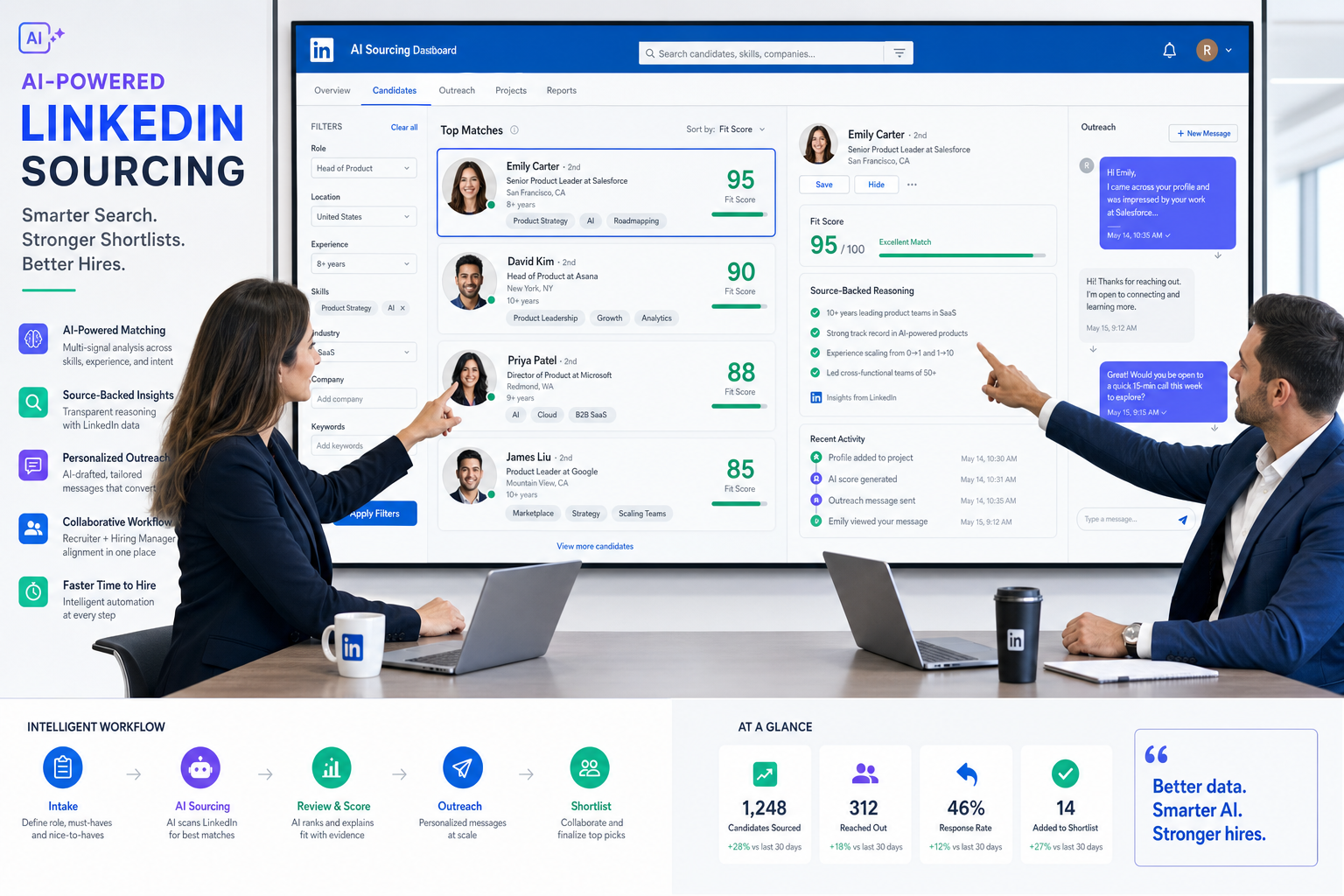
When hiring teams test people gpt through this workflow, they can judge match quality faster, align stakeholders earlier, and avoid noisy shortlists.
When that discipline is missing, the damage is not limited to slower searches. Agency recruiters lose momentum with clients, in-house teams frustrate hiring managers, and strong candidates disappear while stakeholders debate what the role actually means, how fast they can interview, and why a shortlist was built the way it was.
That is where a workflow tool like StrategyBrain AI Recruiter can help without replacing recruiter judgment. In my own testing, its value was not in pretending to make the hire for me, but in handling repetitive LinkedIn outreach, replying across time zones, and collecting resumes or contact details so I could stay focused on final fit decisions, resume review, and stakeholder calibration.
The underlying problem is older than AI. A hiring manager brings urgency because the team has a vacancy hurting delivery; the recruiter pushes for speed because good talent will not wait; and both sides still need the same things before a search can work well: a clear picture of the ideal candidate, a fuller explanation of the job beyond the title, and a realistic timetable for feedback, interviews, and decisions.
That tension is exactly why ai candidate sourcing cannot be judged by search speed alone. If a recruiter runs an ai people search without strong intake, prompt feedback, and source-backed reasoning, even a capable ai people finder will surface noise. People gpt works best when it strengthens the recruiter-hiring manager partnership rather than trying to bypass it.
- Why people gpt is really a sourcing-and-alignment workflow
- What AI changes in recruiter and hiring manager collaboration
- How ai people search differs from Boolean and filter-only sourcing
- What an ai people finder should show before outreach begins
- How to use AI on LinkedIn without losing recruiter control
- What to evaluate before adopting AI candidate sourcing at scale
Table of Contents
- What People GPT Actually Means in Recruiting
- Why AI Candidate Sourcing Starts With Alignment
- Using AI to Reduce LinkedIn Sourcing Friction
- Boolean Search vs AI People Search
- What an AI People Finder Should Search and Show
- How to Judge Match Quality and Trust
- A Practical Workflow for Recruiters and Hiring Managers
- Common Mistakes in AI Candidate Sourcing
- Privacy, Compliance, and Human Oversight
- FAQ
What People GPT Actually Means in Recruiting
People gpt is not just a new label for typing a search in plain English. In recruiting, it describes a shift from building long strings of keywords to translating a hiring brief into candidate discovery, evaluation, and refinement.
That distinction matters because recruiters do not simply search for people; they interpret hiring intent. A backend engineer may never use the exact title your manager wrote in the requisition. A commercial leader may look wrong in title-only search but be exactly right when you consider market, team size, reporting line, and deal complexity.
So the practical way to think about people gpt is this: it helps turn an intake conversation into a candidate set with reasoning attached. That makes it useful not only for search execution, but for the much harder part of sourcing—getting recruiters and hiring managers aligned on what a strong match actually looks like.
Key insight: The real promise of modern AI sourcing is not faster retrieval alone. It is better translation of hiring intent into evidence-based candidate matches.
Why AI Candidate Sourcing Starts With Alignment
One of the most useful lessons from traditional recruiter-hiring manager partnerships still applies in an AI era: bad briefs create bad shortlists, no matter how advanced the search layer becomes.
Before a recruiter runs an ai people search, four inputs should be clarified:
- The ideal candidate profile
Define must-have skills, likely backgrounds, workable substitutes, compensation realities, and the intangible traits that matter in the team.
- The actual job
Go beyond the formal job description. What will the person really do each week? Which projects matter first? Who do they report to? What outcomes define success?
- The hiring timetable
Set expectations for shortlist review, interview scheduling, stakeholder availability, and decision speed. Great candidates are often lost in waiting time, not sourcing time.
- The company story
Recruiters need enough context to position the opportunity credibly. That includes culture, leadership, business direction, and why the role matters now.
This is where many teams misunderstand AI candidate sourcing. They assume the model will compensate for poor intake. In reality, AI magnifies the quality of the brief it receives. A thoughtful role narrative usually produces smarter discovery; a vague request simply produces vague confidence at higher speed.
Using AI to Reduce LinkedIn Sourcing Friction
For many recruiters, the day-to-day pain is not only finding names. It is everything around the search: connection requests, first-touch messaging, after-hours replies, multilingual follow-up, collecting resumes, and keeping momentum while the hiring manager is still calibrating.
That is why I see value in using AI Recruiter as an operational support layer rather than as an autonomous decision-maker. In practice, it can automate repetitive LinkedIn tasks, continue candidate communication outside business hours, and gather resume or contact details from interested prospects. The recruiter still decides whether the candidate is truly qualified, whether the resume supports the role, and whether the person should move forward.
My own takeaway from using that kind of workflow was simple: AI was most helpful when the search direction was already clear but the manual communication burden was slowing me down. It did not remove the need to assess fit. It removed the drag created by repetitive outreach and uneven response handling.
That makes this especially relevant for headhunters, lean agency teams, and internal recruiters covering multiple requisitions at once. If the sourcing process depends too heavily on one person manually keeping every LinkedIn conversation alive, speed becomes inconsistent and candidate experience suffers.
Boolean Search vs AI People Search
Experienced sourcers should not frame this as old versus new. The better comparison is query precision versus intent interpretation. Both matter, but they help at different points in the workflow.
| Area | Traditional Boolean Search | AI People Search |
|---|---|---|
| Input style | Keywords, operators, exclusions, filters | Natural-language hiring criteria |
| Best use case | Known-profile searches with clear titles | Ambiguous, changing, or adjacency-heavy roles |
| Discovery pattern | Exact or near-exact retrieval | Broader intent-based candidate surfacing |
| Iteration method | Manual query rewriting | Prompt refinement and conversational feedback |
| Trust requirement | Visible search logic | Visible match reasoning and evidence |
| Recruiter role | Search builder | Search director and evaluator |
If you already source well with Boolean, keep it. It remains strong for narrow roles with predictable titles. But when the hiring manager describes fit in narrative terms, when adjacent backgrounds matter, or when talent signals sit across scattered public profiles, ai people search becomes much more useful.
The strongest teams use both. They let people gpt widen the field early, then apply filters, manual review, and recruiter judgment to sharpen the shortlist.
What an AI People Finder Should Search and Show
An ai people finder should do more than return a list of names. It should help recruiters verify why those names belong on the list.
At a minimum, recruiters should expect the workflow to support:
- Multi-source discovery: talent signals beyond a single profile database
- Attribute extraction: skills, seniority, domain experience, geography, and career trajectory
- Natural-language search: the recruiter can describe the target profile in plain English
- Fit-based ranking: results are prioritized by match quality, not just keyword density
- Source visibility: the recruiter can see where claims came from
- Refinement control: the search can be expanded or narrowed without starting over
This is where many sourcing tools disappoint practitioners. They can retrieve candidates quickly, but they do not make the evidence visible enough for a recruiter to defend the shortlist to a hiring manager.
And that brings us back to the opening case. When manager expectations, role definition, and response timing are already fragile, black-box search makes the relationship worse. Transparent search makes it easier.
How to Judge Match Quality and Trust
The best AI sourcing workflows help recruiters answer the same questions a skeptical hiring manager will ask five minutes after seeing a shortlist.
- Why did this person match?
The result should tie visible profile evidence to the role brief: relevant systems experience, target-market exposure, leadership scope, technical depth, or functional adjacency.
- Where did the information come from?
If a skill, credential, or specialization is shown, the source should be inspectable. Public web data, portfolio content, publications, repositories, and internal records are not equally reliable.
- How confident is the system?
Not every inferred attribute deserves the same trust. Confidence signals help recruiters know what to validate before outreach or submission.
- Can I defend this shortlist?
A good sourcing result is not just usable by the recruiter. It is explainable to the hiring manager and stable enough to support a real conversation.
In practical terms, if your AI workflow gives you a score without reasoning, you still have a search problem. If it gives you reasoning and source evidence, you have something a recruiter can actually work with.
A Practical Workflow for Recruiters and Hiring Managers
The most effective use of people gpt is not isolated search. It is a structured sourcing rhythm that keeps recruiter speed and hiring manager precision working together.
1. Start with a real intake, not a title
Document outcomes, must-haves, trade-offs, likely substitutes, target environments, and known deal-breakers. If the hiring manager can point to a past top performer in the role, capture why that person worked.
2. Translate the brief into broad discovery
Run a first-pass ai people search using natural-language criteria. Keep the search broad enough to include adjacent profiles and hidden-fit talent.
3. Review match logic before outreach
Check whether the reasoning actually reflects the brief. If the results look noisy, the answer is often to improve the brief, not just rerun the search.
4. Use AI to manage repetitive communication
This is the point where LinkedIn workflow support can help. I have used StrategyBrain AI Recruiter most effectively after calibration, when the target pool was set and I needed consistent outreach, timely follow-up, and smoother resume collection. It kept candidate conversations moving, while I kept control of qualification and shortlist decisions.
5. Get fast, constructive feedback
Once candidates are presented, the recruiter needs prompt feedback with reasons. “Not a fit” is less useful than “too enterprise-heavy,” “too hands-off technically,” or “comp too far above range.” This helps the next search round improve quickly.
6. Keep the recruiter informed on process changes
If headcount urgency changes, interviewers become unavailable, or the role shifts in scope, the sourcing strategy should change too. AI will not solve a moving target if the humans are not communicating.
7. Feed outcomes back into future searches
Track who moved forward, who declined, who failed at interview, and why. That history improves future prompts and improves recruiter judgment over time.
Best practices:
- Use conversational search for discovery, then structured narrowing for shortlist quality
- Require visible evidence before presenting candidates
- Set response expectations with hiring managers at kickoff
- Use AI communication support where manual LinkedIn follow-up slows progress
- Keep final qualification and progression decisions human-led
Common Mistakes in AI Candidate Sourcing
1. Letting AI substitute for role clarity
If the hiring brief is weak, the search will be weak. People gpt improves translation of intent; it does not invent high-quality intent from nothing.
2. Mistaking responsiveness for qualification
An interested candidate is not automatically a strong match. This matters especially in LinkedIn workflows where outreach automation can increase reply volume.
3. Ignoring the recruiter-hiring manager operating rhythm
Slow feedback, unclear stakeholders, and changing requirements can break sourcing momentum faster than poor search syntax ever did.
4. Treating ranking as truth
A ranked list is a starting point. Recruiters still need to validate credibility, motivation, compensation fit, and timing.
5. Hiding data origin
If the source of a claim is unclear, the shortlist becomes harder to trust and harder to defend internally.
6. Over-automating candidate communication
AI can support high-volume first touch and follow-up, but nuanced conversations about fit, career risk, relocation, compensation, and closing usually still need an experienced recruiter.
Privacy, Compliance, and Human Oversight
As AI sourcing becomes more common, trust is operational, not theoretical. Recruiters need to know what data is being used, how candidate information is handled, and where human review is required.
When evaluating your workflow, ask:
- Are source boundaries clear, especially for public web and platform-based discovery?
- Can recruiters verify the evidence behind candidate matches?
- Is candidate information handled with appropriate privacy and security controls?
- Does the workflow avoid using recruiter or candidate data in ways the team cannot approve?
- Is there mandatory human review before outreach escalation, submission, or hiring decisions?
For teams using LinkedIn communication support, those questions also extend to messaging control, account security, and how resumes or contact details are captured. Any AI layer should reduce manual burden without obscuring accountability.
FAQ
What is people gpt in recruiting?
People gpt refers to a conversational, AI-assisted way of turning a hiring brief into candidate discovery and match evaluation. Instead of relying only on exact keywords, it interprets intent, adjacent experience, and fit signals.
How is ai people search different from Boolean search?
Boolean search depends on operator logic and exact phrasing. Ai people search starts with natural-language intent and is better suited to roles where titles vary, adjacent backgrounds matter, or the hiring brief is more narrative than literal.
What should an ai people finder include?
A strong ai people finder should offer broad discovery, attribute extraction, fit-based ranking, source transparency, and easy refinement controls. Recruiters should be able to see why each candidate appeared.
Can AI replace recruiter judgment in candidate sourcing?
No. AI can speed up discovery, outreach, and follow-up, but recruiters still need to validate skills, resumes, motivation, process readiness, and stakeholder fit.
How can AI help with LinkedIn sourcing?
AI can reduce repetitive LinkedIn work by supporting connection requests, ongoing messaging, after-hours follow-up, multilingual communication, and resume collection. That gives recruiters more time for qualification and stakeholder management.
What is the biggest mistake teams make with AI candidate sourcing?
The biggest mistake is using AI before agreeing on the role. If the recruiter and hiring manager are not aligned on what success looks like, faster sourcing simply creates faster confusion.
Conclusion
People gpt is most valuable when it improves both search quality and working relationships. The technology helps recruiters describe hiring intent more naturally, discover adjacent-fit candidates more effectively, and support shortlists with clearer reasoning. But the deeper lesson is still human: strong sourcing depends on alignment, response speed, and shared standards between recruiter and hiring manager.
If you are exploring ai candidate sourcing, start by fixing the operating model before obsessing over the search box. Clarify the role, define feedback timing, insist on source-backed matches, and use AI where it reduces repetitive friction—especially in LinkedIn outreach and follow-up. That is how ai people search and an ai people finder become genuinely useful instead of just sounding modern.