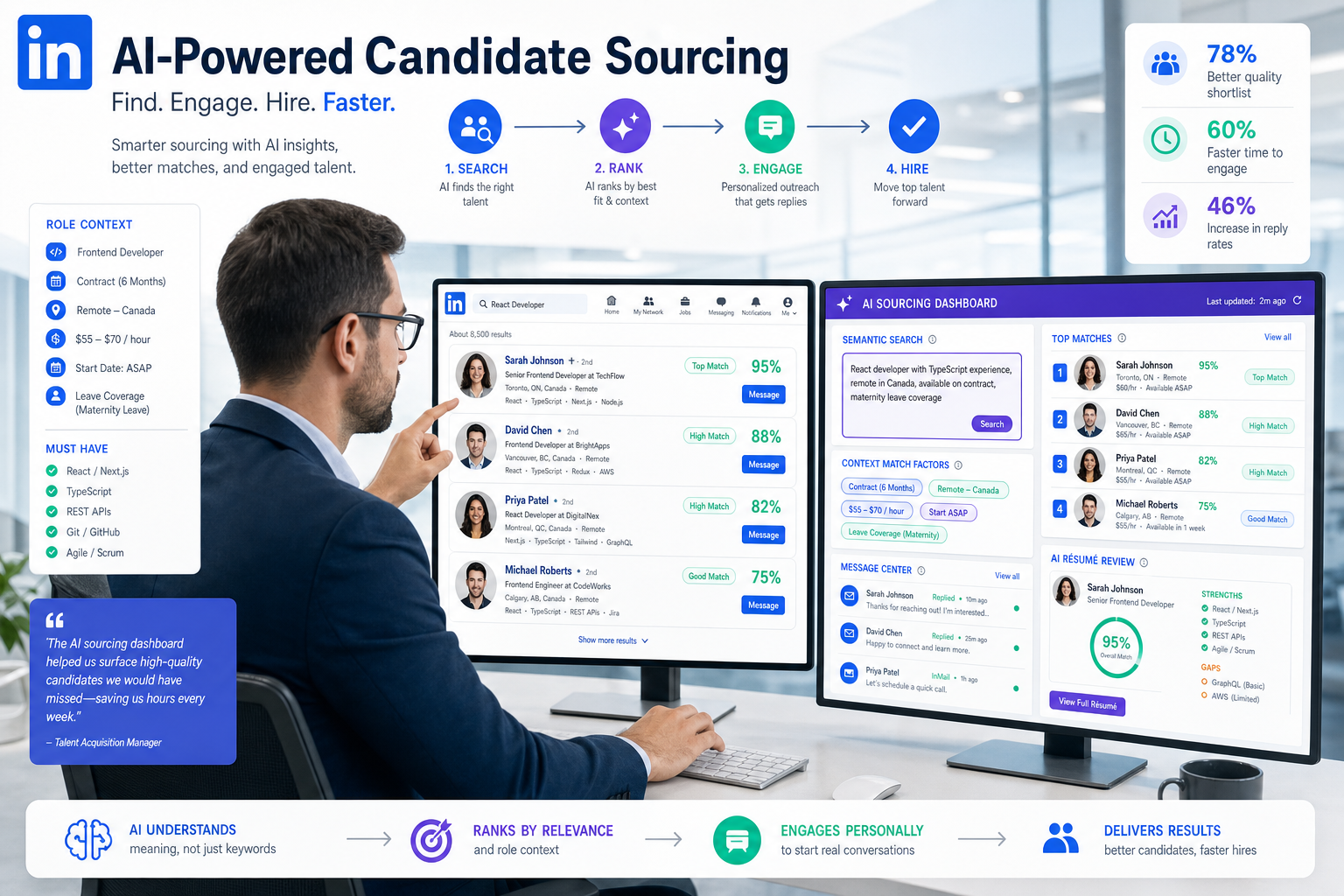
When hiring variables keep shifting, this article helps recruiters judge people gpt more accurately to avoid wasted outreach and weak shortlists.
That matters more than it sounds. In agency and in-house recruiting, sourcing quality drops fast when the brief changes mid-search, wage pressure shifts the target profile, or contractor versus employee questions alter who is actually viable for the role. The result is wasted outreach, confused hiring managers, duplicate work across systems, and shortlist debates that should have been resolved at intake.
In my own workflow, I have found that StrategyBrain AI Recruiter is most useful when the sourcing problem is not just finding names but keeping outreach and response handling moving while the recruiter keeps control of judgment. Its always-on candidate communication, multilingual follow-up, and automated résumé collection can reduce the delay between search, first contact, and recruiter review. The recruiter still decides whether the profile truly fits, whether the résumé supports the claim, and what the next step should be.
A good example comes from the kind of labour-market change many recruiters faced in late 2025 in British Columbia. Employers were not dealing with just one hiring variable. They were adjusting to a new 27-week job-protected illness leave under Bill 30, preparing for minimum wage increases tied to inflation, and rechecking whether remote or project-based workers were actually contractors or employees. In practice, that meant recruiters were reopening req lists, revising candidate criteria, and checking with hiring managers whether a role should stay permanent, shift contract, or be paused.
At that point, the sourcing bottleneck is no longer a simple keyword issue. A recruiter may search one way for an employee covered by leave replacement planning, another way for an hourly role affected by wage compression, and another way again for remote talent where classification risk matters. That is where this topic becomes practical: people gpt, an AI people finder, and even ai people search free tools are useful only if they help recruiters translate shifting business conditions into better searches, clearer ranking, and cleaner follow-through.
- People gpt is most useful when recruiters need to search by business context, not just title keywords.
- An AI people finder helps when roles are affected by open-web discovery needs, changing labour conditions, or non-standard career paths.
- AI people search free options are useful for testing relevance and explainability, but usually not enough for full recruiting operations.
- When hiring conditions shift, the best sourcing process combines semantic search, recruiter judgment, and structured follow-up.
Table of Contents
- Why People GPT Matters in a Changing Hiring Market
- How Labour and Policy Changes Reshape Candidate Searches
- How AI Candidate Sourcing Actually Works
- Where an AI People Finder Helps Most
- What to Expect From AI People Search Free Tools
- How Sourcing, Outreach, and Workflow Fit Together
- Traditional Search vs AI Search
- Best Practices for Recruiters Using People GPT
- Common Mistakes in AI Candidate Sourcing
- FAQ
Why People GPT Matters in a Changing Hiring Market
Most sourcing articles treat search as if the role definition is stable. Experienced recruiters know that is rarely true. A req can shift because an employee goes on extended leave, compensation bands tighten under inflation pressure, or a supposedly flexible contractor role turns out to require employee-level control and supervision. In those moments, the search method matters because the hiring target itself has changed.
That is why people gpt has become a useful recruiting concept. Instead of forcing the recruiter to rebuild long Boolean strings every time the brief moves, it allows a natural-language search tied to the actual business need. You are no longer asking only for “Java developer Toronto.” You are asking for someone who can stabilize a team during a leave period, work inside a defined wage band, or handle remote work in a structured environment without creating classification confusion.
In other words, the value is not novelty. The value is that conversational sourcing can map better to how hiring decisions are really made: by constraints, tradeoffs, and evidence.
How Labour and Policy Changes Reshape Candidate Searches
The employment-law update behind this discussion is not a sourcing guide on its face, but it highlights a sourcing reality recruiters deal with every quarter. In British Columbia, employers were told to prepare for several overlapping developments:
- Bill 30 created up to 27 weeks of unpaid, job-protected leave for serious illness or injury within a 52-week period.
- Minimum wage indexing became tied to annual inflation-based CPI adjustments and cannot move downward even if CPI drops.
- Gig work, contractor status, and remote work continued to draw closer scrutiny, with substance taking priority over labels.
Each of those changes affects how recruiters source. Leave rules can trigger backfill hiring or temporary coverage plans. Wage indexing can compress pay bands and change who will realistically engage with the role. Classification scrutiny can eliminate candidate types that looked attractive on paper but are risky in practice.
When I have sourced under these conditions, the biggest lesson is that search quality depends on intake quality. If the hiring manager cannot explain whether the need is replacement, growth, or stopgap coverage, no sourcing tool will fix the mismatch. But once that context is clear, semantic search becomes far more useful than strict keyword filtering.
Practical takeaway: Before running a people gpt search, confirm whether the role changed because of leave coverage, wage pressure, or worker classification. The answer affects the target profile more than the title does.
How AI Candidate Sourcing Actually Works
At a practical level, AI candidate sourcing still follows a familiar recruiting sequence: understand the need, search, review, contact, and qualify. What changes is how much of the interpretation layer can happen earlier and more accurately.
- Translate the hiring brief: The recruiter writes the role need in plain language, including must-haves, environment, and constraints.
- Retrieve profiles: The system searches a talent pool, prior records, public sources, or a mix of all three.
- Enrich the result: Profiles are organized around skills, likely role fit, chronology, and visible evidence.
- Rank candidates: Results are prioritized by relevance rather than only exact term overlap.
- Move to outreach and review: The recruiter validates the fit, contacts the person, and decides whether to advance.
The last step is where many teams still lose time. Search may be better, but recruiter follow-up is uneven. That is where a workflow tool can support the process without replacing recruiter judgment. In my experience, using AI Recruiter after the search stage is helpful when replies come in outside work hours or across languages. It can keep the initial conversation moving, answer routine role questions, and gather résumés or contact details, while I stay responsible for the actual fit decision.
| Step | What good AI sourcing should do | Why recruiters care |
|---|---|---|
| Brief interpretation | Understand natural-language role context | Reduces search rewriting when requirements shift |
| Retrieval | Search beyond exact indexed fields | Finds adjacent-fit talent |
| Evidence | Show source-linked context where possible | Improves trust in shortlist quality |
| Ranking | Explain why a profile surfaced | Helps recruiter defend recommendations |
| Outreach handling | Support timely first-response communication | Prevents good prospects from going cold |
Where an AI People Finder Helps Most
The phrase AI people finder usually points to discovery. For recruiters, that is most valuable when the right candidate may not share the exact title, may sit outside your existing ATS, or may need context-based evaluation because the hiring need changed.
1. Backfill and temporary coverage hiring
When an employee may be away for an extended period, the recruiter often needs someone productive quickly, but not necessarily a perfect title match. A strong AI people finder can surface people with comparable functional exposure, recent hands-on experience, and likely availability signals.
2. Wage-sensitive frontline and mid-level roles
When minimum wage or inflation changes compress compensation bands, title search alone becomes blunt. Recruiters need candidates whose likely expectations fit the revised pay reality. Contextual search helps narrow to people from comparable markets, environments, and seniority bands.
3. Remote and contractor-heavy searches
When classification risk is in the background, the search must reflect substance. If the company needs fixed hours, close supervision, and exclusive service, the candidate target may need to be treated like an employee search even if the business first asked for a contractor. Semantic sourcing helps make that adjustment explicit.
These are the situations where I have seen an AI people finder outperform standard database filtering. It is not because the machine “knows talent” better than a recruiter. It is because it can widen the first pass without losing the context that matters.
What to Expect From AI People Search Free Tools
The keyword ai people search free shows real recruiter curiosity, especially among smaller agencies and solo headhunters. Free tools can be useful, but they should be tested for practical value, not novelty.
In most cases, free access means one or more of the following:
- Search caps or limited monthly usage
- Preview-only profile access
- Restricted exports
- Weak workflow support after discovery
- Little visibility into why candidates matched
That does not make them irrelevant. A free tool is often enough to test whether the query logic is strong, whether result explainability exists, and whether source transparency is acceptable. For a recruiter evaluating ai people search free options, those are the right questions to ask first.
Where free tools usually fall short is the handoff from search to outreach. That is why some recruiters pair discovery tests with a separate communication workflow. If the sourcing logic is good but follow-up volume becomes the bottleneck, a tool like StrategyBrain AI Recruiter can help by handling repetitive first-response messaging and collecting resumes from interested candidates, while the recruiter reviews the real fit afterward.
How Sourcing, Outreach, and Workflow Fit Together
The opening case from British Columbia points to a larger operating lesson: hiring complexity rarely arrives alone. Policy changes, compensation pressure, and classification questions often hit at the same time. When that happens, the best sourcing system is the one that keeps interpretation, communication, and decision-making connected.
That workflow usually has three parts:
- Search logic: A people gpt style query that reflects the real business need.
- Response handling: A system that keeps candidates engaged while the recruiter is working other reqs.
- Decision control: A structured place where the recruiter and hiring manager review evidence and decide next steps.
My own experience is that the communication layer is the most underestimated part. Search gets attention because it is visible. But the actual loss often happens later, when candidates reply after hours, ask follow-up questions in another language, or send a résumé while the recruiter is buried in intake calls. Using StrategyBrain AI Recruiter for that middle layer can keep momentum going on LinkedIn-based outreach without forcing the recruiter to stay online constantly. It handles repetitive exchanges well; the recruiter still owns selection, résumé assessment, and interview decisions.
Traditional Search vs AI Search
The best comparison is not old versus new. It is literal search versus context-aware search.
| Criteria | Traditional keyword search | AI candidate sourcing |
|---|---|---|
| Query style | Boolean strings and filters | Natural-language requests |
| Role changes | Requires manual rebuilds | Adapts more easily to revised context |
| Title dependency | High | Lower when adjacent skills matter |
| Open-web usefulness | Often limited | Better suited to broader discovery |
| Explainability | Often minimal | Can show matching reasons |
| Recruiter time burden | Higher query maintenance | Higher review quality, lower rewrite effort |
Traditional search still matters when the role is standardized and terms are stable. But in situations like leave replacement, pay-band pressure, or classification-sensitive remote work, AI sourcing tends to map better to how the req is actually discussed internally.
Best Practices for Recruiters Using People GPT
Recruiters get better results from people gpt when they search like operators, not like database technicians.
Write queries around the real hiring constraint
- State whether the role is backfill, growth, or temporary coverage.
- Clarify if compensation is fixed or flexible.
- Include whether remote work still requires employee-like structure.
- Describe outputs and environment, not just title.
A weak search asks for “operations manager remote logistics.” A stronger one asks for “find operations leaders with hands-on logistics execution experience who can step into a structured remote environment quickly and manage vendor coordination without a long ramp.”
Check evidence before trusting rank
Scoring helps, but recruiters still need chronology, visible proof, and source context. This becomes especially important when you are sourcing around legal or pay constraints, where a near match may still be unusable.
Separate communication efficiency from hiring judgment
AI can assist with repetitive outreach, candidate replies, and résumé collection. It should not replace recruiter evaluation. That boundary matters for quality and for credibility with hiring managers.
Use candidate responses to refine the search
If candidates repeatedly decline because pay is off, schedule is too rigid, or the role is really employee-like despite contractor language, feed that back into the next search. Good sourcing is iterative.
Common Mistakes in AI Candidate Sourcing
Most mistakes come from intake and workflow gaps, not from the search engine itself.
- Searching before clarifying the business reason for the role: Backfill, growth, and stopgap needs should not be sourced the same way.
- Ignoring compensation reality: Inflation and wage pressure can make an otherwise good target market unrealistic.
- Treating contractor labels as search criteria: Classification depends on the working relationship, not the title on the req.
- Overvaluing rank without evidence: A strong score is not a documented fit.
- Letting replies sit too long: Better search results still fail if recruiter follow-up is slow.
The safest operating rule is simple: every shortlisted candidate should have a reason-to-match, visible evidence, and a documented next action.
FAQ
What does people gpt mean in recruiting?
In recruiting, people gpt usually refers to natural-language people search that turns a recruiter’s plain-English brief into ranked candidate matches based on skills, context, and relevance signals.
How is an AI people finder different from normal people search?
An AI people finder is more useful for contextual discovery. It can help surface candidates with adjacent titles, transferable experience, or open-web visibility that exact-match searching might miss.
Is ai people search free good enough for recruiters?
AI people search free tools can be good for testing search quality and match explainability. They are usually less reliable for sustained team workflows, export needs, and structured outreach.
Why do labour-market changes matter to AI candidate sourcing?
Because the role definition changes when leave rules, pay pressure, or worker classification issues change. Better sourcing starts with understanding those constraints, then translating them into search logic.
Can AI replace recruiter judgment in candidate sourcing?
No. AI can improve search quality, speed up repetitive messaging, and help organize results. Recruiters still need to assess résumés, confirm fit, manage client or hiring manager expectations, and make advancement decisions.
Where does StrategyBrain AI Recruiter fit in this workflow?
It fits best after sourcing begins producing viable prospects. It can support LinkedIn outreach automation, multilingual candidate communication, and résumé collection, while the recruiter remains responsible for qualification and hiring decisions.
Conclusion
AI candidate sourcing becomes genuinely useful when it reflects how recruiters actually work under pressure. The British Columbia example shows why: hiring decisions can change because of leave requirements, inflation-driven wage adjustments, and contractor classification risk all at once. In that environment, people gpt is valuable because it helps recruiters search by real constraints rather than title strings alone.
An AI people finder is strongest when the role needs contextual discovery, and ai people search free tools can still be worthwhile for testing relevance and explainability. But better search alone is not the full answer. Recruiters also need responsive outreach, disciplined review, and a clear handoff from AI assistance to human judgment. That is what turns sourcing from an interesting demo into a reliable recruiting process.