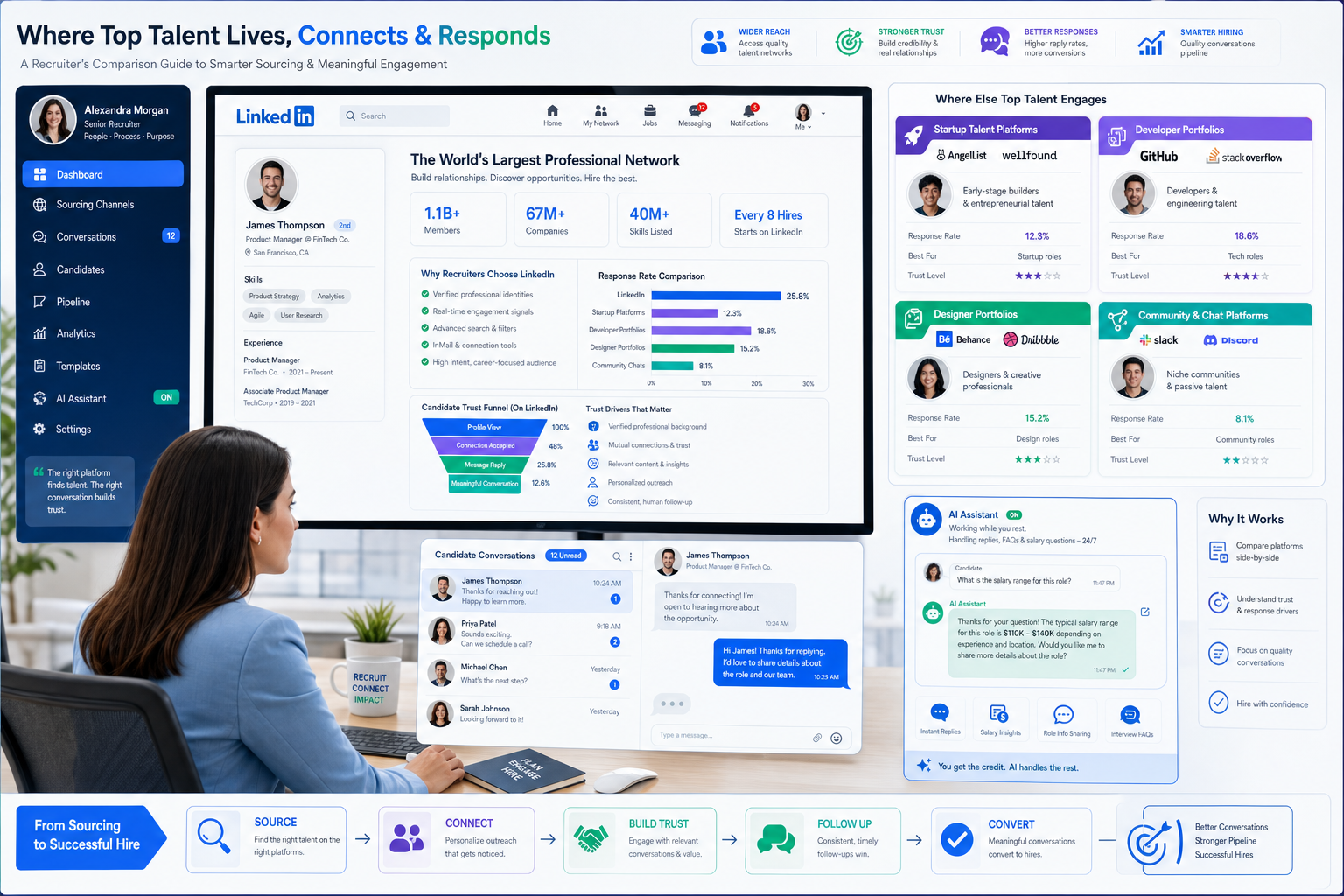
This guide helps headhunters judge which professional networking social media sites build trust faster and reduce candidate drop-off.
That sounds obvious, but it is where a lot of recruiting effort gets diluted. Small agencies lose hours chasing broad outreach on the wrong platform, in-house teams mistake profile volume for candidate intent, and independent recruiters often have no clean way to keep follow-up, compensation questions, and timing-sensitive replies moving once conversations start. The result is not just slower hiring. It is weaker candidate trust, more ghosting after first contact, and avoidable drop-off when a good prospect wants specifics before agreeing to the next step.
In my own LinkedIn-heavy workflows, tools like StrategyBrain AI Recruiter have been most useful when they handle the repetitive parts of outreach, after-hours replies, and initial compensation or availability questions without pretending to replace recruiter judgment. I still make the final call on fit, résumé review, and whether a candidate should move forward, but having an AI-supported layer for follow-up and candidate messaging reduces the lag that often kills momentum in competitive searches.
The career advice behind that is familiar. Young professionals are often told not to avoid salary negotiation, whether they are responding to a first offer or preparing to ask for a raise later. The useful parts of that advice are practical: come in with a researched range, compare roles by scope rather than title alone, and remember that if an employer made an offer, they have already invested in choosing you. In a recruiting conversation, that moment matters because the candidate is not only evaluating pay. They are judging whether the process feels informed, respectful, and worth continuing.
That negotiation scene explains why general LinkedIn alternatives matter. If the real question is which social media platform is primarily used for professionalnetworking, the broad answer is still LinkedIn, but the better recruiting question is where a candidate can compare opportunity, ask informed questions, show proof of work, and keep a conversation moving without friction. That is why the best professional networking social media sites are not one-for-one substitutes. They serve different points in the trust-building process.
Why LinkedIn Alternatives Are Not Simple Replacements
When people search for general LinkedIn alternatives, they usually assume they are comparing one big platform against another. In practice, that is the wrong frame. Some channels are built around searchable profiles, some around portfolios, some around startup opportunity matching, some around local referrals, and some around live discussion inside niche communities.
From a recruiter’s chair, the difference is not academic. A candidate considering whether to negotiate an offer, ask about compensation range, or respond to outreach needs enough context to judge the opportunity. General networks help with broad visibility, but specialized channels often create stronger trust signals because they show work, community reputation, or industry-specific engagement.
That is why searches around social networking sites for business and social networking sites for business professionals should be answered by intent, not by logo list. You need to know whether the platform helps with:
- discoverability by recruiters
- evidence of skill or portfolio quality
- peer credibility and discussion
- local referral strength
- startup or founder-context alignment
- faster, more natural candidate communication
Key insight: The strongest alternative to LinkedIn is usually not a single site. It is the platform category that best supports the candidate decision happening at that stage of the hiring process.
How Candidates Actually Evaluate Opportunities
The salary-negotiation advice in the reference piece is useful here because it highlights how professionals make decisions. They do not just ask, “Is this job available?” They ask whether the compensation is realistic, whether the responsibilities match the title, and whether the employer understands the market.
That same logic affects platform choice. A recruiter sourcing on broad business social networking sites may get reach, but if the role is technical, creative, local, or startup-specific, the candidate often wants more than a polished profile exchange. They want signals that help them compare the opportunity on fair terms.
Three evaluation habits that matter in networking
- Range beats vagueness. Candidates trust outreach more when role level, compensation logic, and expectations are reasonably clear.
- Comparable scope beats job-title theater. People know that the same title can mean very different responsibility from one company to another.
- Confidence grows with context. A professional is more likely to keep talking when the platform and the conversation both help them understand the actual opportunity.
That is also why a recruiter’s channel mix matters. The wrong platform can make even a good opportunity look generic.
Quick Comparison of Professional Networking Social Media Sites
Below is a recruiter-friendly comparison of the main platform categories often used as LinkedIn alternatives.
| Platform Type | Best For | Primary Audience | How Trust Forms | Main Strength | Main Limitation |
|---|---|---|---|---|---|
| General professional network | Broad visibility | Cross-industry professionals | Profile and experience history | Large searchable audience | High message noise |
| Startup talent network | Early-stage hiring | Founders, operators, startup candidates | Mission and opportunity fit | Better startup alignment | Narrower total pool |
| Developer portfolio network | Engineering recruiting | Developers and technical contributors | Public work and collaboration history | Strong proof of work | Weak for nontechnical roles |
| Designer portfolio network | Creative and product hiring | Designers and visual creatives | Case studies and portfolio quality | Fast skill evaluation | Limited for general business roles |
| Small-business referral network | Local relationships | Owners, service firms, SMB professionals | Reputation and referrals | High local trust | Less scalable for corporate hiring |
| Slack or Discord communities | Niche peer access | Specialist communities | Ongoing discussion and contribution | High engagement | Fragmented and harder to search |
| Regional professional network | Country-specific hiring | Professionals in local markets | Regional relevance | Strong geography fit | Lower global reach |
For recruiters, this table matters because candidate behavior follows trust, not just traffic. A platform that helps someone weigh an offer or compare responsibility more realistically can outperform a bigger network in the right niche.
Best Professional Networking Sites by Use Case
1. General professional networks for broad market visibility
If someone asks which social media platform is primarily used for professional networking, the mainstream answer remains LinkedIn. It is still the default for recruiter search, employer presence, and broad professional discoverability. That said, it works best as a foundation, not as the whole strategy.
Use this category when you need reach across multiple functions, when a candidate needs baseline visibility, or when the role is not highly portfolio-led.
2. Startup-focused networks for mission and stage fit
These platforms tend to attract candidates who already understand smaller teams, uncertainty, and cross-functional work. That reduces one common recruiting problem: spending time with people who like the job title but not the operating environment.
Best for: founding roles, early-stage operators, startup-ready talent.
3. Portfolio-led platforms for engineering talent
Developers often reveal more through public projects and contribution history than through summary text on general social networking sites for business. For technical hiring, this makes outreach more credible because you can reference visible work rather than relying on generic personalization.
Best for: software engineers, open-source contributors, technical screening context.
4. Portfolio-led platforms for design and creative hiring
Design candidates are often judged on thinking, execution, and case presentation. Platforms that center on visual work make it easier to compare scope and craft, which fits the same principle used in salary discussions: compare like with like, not title with title.
Best for: product design, brand design, freelance creatives.
5. Community platforms for peer trust and live discussion
Slack groups, Discord communities, and similar spaces are often underestimated because they do not look like traditional business social networking sites. Yet they can be excellent for specialist recruiting because reputation forms through contribution and discussion, not just profile polish.
Best for: niche hiring, referrals, long-game relationship building.
6. Local and small-business networks for referral-driven hiring
In local markets, referrals still outperform many polished online profiles. If your role depends on geography, local reputation, or SMB relationships, these platforms can surface people who would never look strong in a broad keyword search but are highly trusted in-market.
Best for: local sales, operations, service roles, SMB hiring.
LinkedIn Workflow Experience and Where AI Helps
Because this topic sits close to LinkedIn usage, it is worth being direct about what breaks first in real recruiting workflows. It is usually not sourcing alone. It is the handoff between outreach, candidate questions, response timing, and the recruiter’s own capacity to keep every thread moving.
In practice, I have found that AI Recruiter is most helpful when a search generates steady candidate replies outside normal hours. It can introduce the role, ask whether someone is open to hearing more, answer routine questions about the opportunity, and collect résumés or contact details from interested candidates. That matters when a candidate is in the same position described in the salary-negotiation article: they are weighing risk, comparing market value, and deciding whether this conversation deserves their time.
The reason I would still treat it as workflow support rather than a replacement for a recruiter is simple. Final qualification still depends on human review. I need to assess whether the résumé really matches the role, whether the compensation expectations are workable, and whether the conversation shows the right kind of intent. But using StrategyBrain AI Recruiter in a LinkedIn workflow can reduce dead time between candidate interest and recruiter action, which is often where good prospects disappear.
Where it fits best
- After-hours replies: useful when candidates answer after work and momentum would otherwise be lost.
- Early intent checking: useful for confirming whether someone is open to a move before the recruiter spends more time.
- Résumé and contact capture: useful when interested candidates are ready to proceed and the recruiter needs the handoff organized.
For teams doing heavy LinkedIn outreach, this kind of support is most practical when the recruiter remains responsible for judgment, shortlist quality, and interview next steps.
How to Build a Practical Networking Stack
The best answer to general LinkedIn alternatives is usually a stack, not a switch.
For recruiters
- Keep one broad professional network for visibility and search coverage.
- Add one specialist trust layer such as a community or portfolio platform.
- Use one workflow support layer to keep candidate conversations moving when response timing becomes the bottleneck.
- Add a local or regional channel when market geography affects trust and responsiveness.
This approach aligns better with how candidates evaluate opportunities. A broad profile can open the conversation, but proof of work, relevant context, and timely replies often decide whether it continues.
For candidates
- Maintain one strong public professional profile.
- Keep one proof-of-work channel current.
- Join at least one relevant community.
- Be ready to discuss value with market-based examples, not just titles.
That last point comes straight from the negotiation logic in the reference article. Whether you are asking for a raise or responding to outreach, comparable scope matters more than inflated labels.
Common Mistakes to Avoid
Treating every platform like a search database
Some of the best professional networking social media sites work through conversation, referrals, or portfolios. If you apply a database mindset everywhere, you will miss what makes the platform effective.
Using title-only comparisons
This is one of the clearest lessons from salary negotiation advice. The same title can represent very different responsibilities. Recruiters should source, message, and benchmark roles based on scope, not title match alone.
Assuming broad visibility equals candidate confidence
A visible profile does not mean a candidate trusts the opportunity. Confidence usually improves when the recruiter can provide context, relevant comparisons, and responsive communication.
Letting reply lag kill intent
When good candidates ask practical questions and wait too long for a response, intent cools quickly. This is where workflow support, including AI-assisted messaging, can make a real operational difference.
FAQ
What is the best alternative to LinkedIn?
There is no single best alternative for every use case. For broad visibility, general professional platforms still lead. For engineering, design, startup, local, or niche-community hiring, specialized platforms often perform better.
Which social media platform is primarily used for professional networking?
LinkedIn is still the platform most widely used for broad professional networking. But many recruiters and candidates now combine it with portfolio sites, startup networks, regional platforms, and community-based channels.
Are there social networking sites for business besides LinkedIn?
Yes. There are many social networking sites for business, including startup communities, portfolio platforms, small-business referral networks, regional professional platforms, and specialist discussion groups.
Why do recruiters need more than one networking platform?
Because different hiring stages need different trust signals. One channel may help with reach, another with proof of work, another with referrals, and another with faster candidate communication.
Can AI help with LinkedIn recruiting workflows?
Yes, especially with repetitive outreach, candidate follow-up, and collecting next-step information from interested prospects. Recruiters should still own final judgment, résumé review, and interview decisions.
Conclusion
If you are evaluating general LinkedIn alternatives, the real takeaway is not to hunt for a single clone of one platform. The stronger move is to choose professional networking social media sites based on how professionals actually judge opportunities: they compare scope, ask about compensation, look for credible context, and respond better when the conversation moves without friction.
For recruiters, that means matching the platform to the trust signal you need. For candidates, it means combining visibility with proof and context. And for LinkedIn-heavy teams, it often means supporting outreach with a workflow that keeps candidate interest alive long enough for human judgment to do its job well.