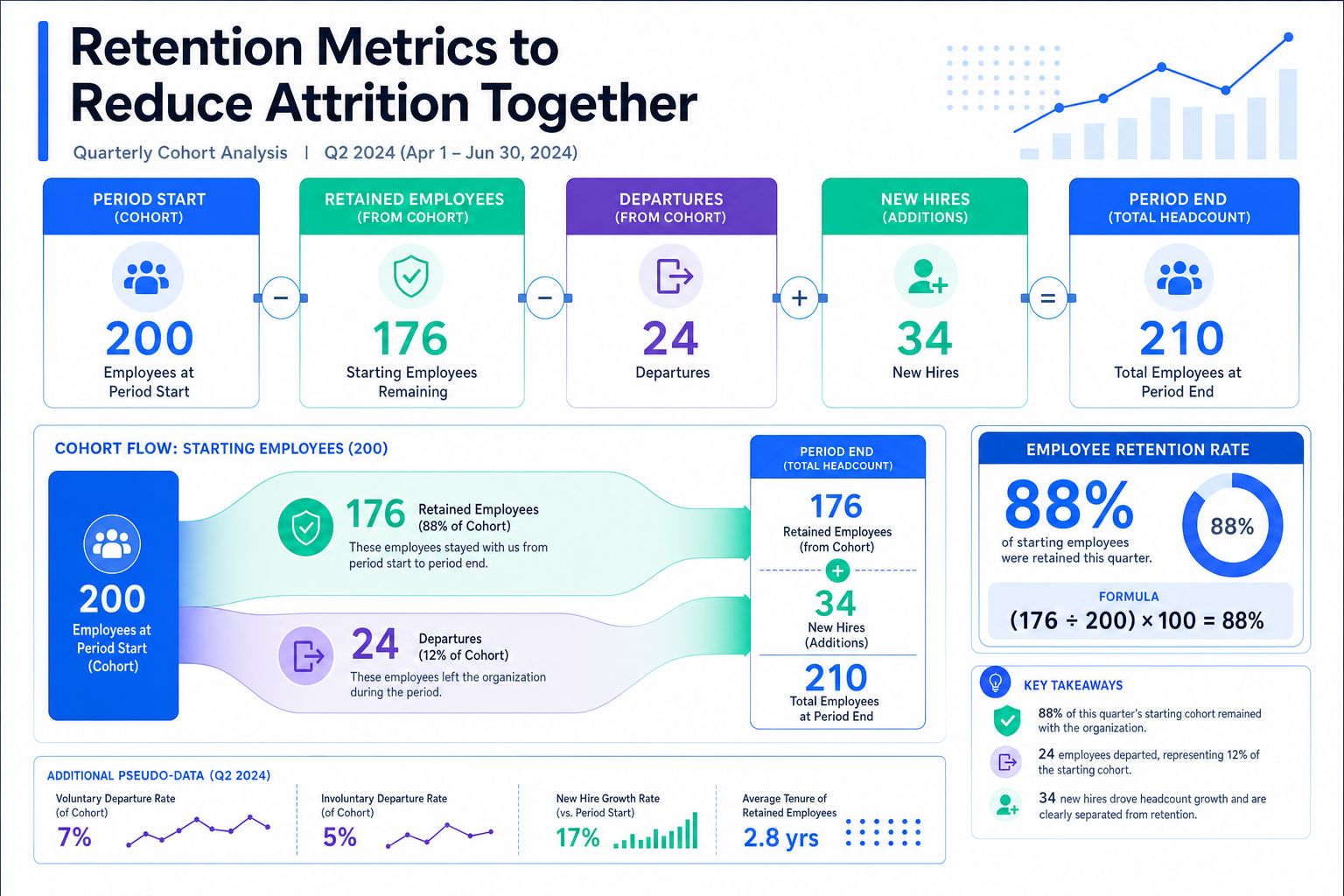
This framework helps recruiters assess retention metrics, find hiring and management failures, and stop growth from masking attrition.
When recruiters, HR partners, and hiring managers keep candidate intelligence and workforce lessons in separate silos, the consequences extend beyond slower hiring. The same roles reopen, preventable resignation themes go unshared, candidate relationships deteriorate, and small recruitment firms absorb replacement work that produces no additional revenue. Growing headcount can then disguise the loss of experienced employees.
Recruiting automation can relieve part of that pressure by recording outreach, maintaining timely candidate communication, and organizing responses across active searches. It is most useful when it supports a shared workflow rather than creating another private database. Recruiters must still evaluate résumés, interpret retention risks, protect candidate data, and make the final decision about interviews or referrals.
The collaboration problem becomes visible as soon as a recruiter fills a Java developer vacancy and reviews the qualified people who were not selected. Instead of leaving those candidates in an inactive folder, the recruiter updates their stages, confirms whether they want to hear about other opportunities, and contacts a trusted peer whose Java role requires a different technical environment. The job title is similar, but the fit is not interchangeable; sharing the connection may help the candidate without weakening either search.
That moment exposes the operating issue behind employee attrition: recruitment teams need shared definitions, responsible handoffs, and feedback loops that continue after placement. The same measurement discipline also clarifies how to measure customer retention rate and how to measure client retention—first name the population, then follow the original cohort without allowing new acquisition to conceal losses.
Key takeaway: Use retention metrics as a shared operating system. Follow starting cohorts, separate departure types, circulate relevant lessons, and connect hiring data with management, career development, workload, recognition, and internal mobility.
Table of Contents
- How talent communities strengthen retention work
- How to calculate employee retention rate
- Retention rate versus turnover rate
- Retention metrics for a practical dashboard
- How to segment retention data
- How to reduce employee attrition
- Customer and client retention comparison
- Common measurement mistakes
- Frequently asked questions
How Talent Communities Strengthen Retention Work
Recruitment veteran Matt Buckland has described an earlier agency culture in which candidates were treated as individual recruiter assets. Commission structures encouraged consultants to protect their own lists, even when a candidate suited another vacancy better. That approach created internal competition, duplicated sourcing work, and placed recruiter interests ahead of the candidate's next career step.
The alternative emerged through recruiter communities built around reciprocal help. In Buckland's historical account, a small messaging group that began with five people developed into a network of approximately 3,050 recruiters across several countries. Members exchanged candidate referrals, policy examples, operational advice, and answers to questions about remote work, internal academies, and specialist hiring.
The useful lesson is not that every employer should create a large external group. It is that retention improves when recruiters and HR professionals stop treating information as personal territory. A strong community can help practitioners compare exit patterns, challenge weak assumptions, find relevant expertise, and refer candidates after a vacancy has closed. Candidates benefit because a rejection does not automatically end the relationship.
Collaboration requires boundaries
A talent community is not permission to circulate personal information without control. Candidate consent, a legitimate processing purpose, access restrictions, retention periods, and applicable privacy laws must shape every referral. Recruiters should share an introduction or request permission before transferring a résumé or contact details to another organization.
Internal workforce information needs similar care. A hiring manager may need to know that early-tenure turnover is increasing in a role, but not the identity behind every confidential exit comment. Small-group reporting should be suppressed or combined across periods when disclosure could identify an employee.
Turn community knowledge into an operating standard
- Define the question: Specify whether the team is investigating early-tenure exits, regrettable turnover, manager-level variation, or another workforce risk.
- Gather comparable evidence: Use consistent formulas, periods, cohorts, and departure categories before comparing experiences across teams.
- Seek informed perspectives: Ask recruiters, HR partners, managers, and relevant professional peers what they have observed in similar roles or labor markets.
- Adapt rather than copy: A policy or intervention that works elsewhere must be adjusted for the organization's workforce, legal environment, management capacity, and business goals.
- Return the learning: Record what changed, review the result, and share an appropriately anonymized lesson with the people who contributed.
In recruiting operations, I have found that this final step is often missed. Teams ask for advice when a vacancy is difficult but rarely report whether the revised job scope, onboarding plan, or manager intervention affected retention. Closing that loop turns informal networking into reusable workforce knowledge.
How to Calculate Employee Retention Rate
Employee retention rate follows a defined starting cohort rather than comparing total headcount at two dates:
Employee retention rate = (employees from the starting cohort who remain at period end ÷ employees in the starting cohort) × 100
This distinction matters to recruiters. New hires can raise ending headcount and make a workforce appear stable even when established employees are leaving. Following the original cohort prevents recruitment activity from concealing attrition.
A worked employee retention example
Suppose an organization begins a quarter with 200 employees. At the end of the quarter, 176 members of that starting group remain. The company also hired 34 people during the period.
(176 ÷ 200) × 100 = 88% employee retention
The company finishes with 210 employees, but its retention rate is still 88%. The 34 new employees are excluded because they were not part of the starting cohort. Looking only at net headcount growth would hide the departure of 24 established employees.
Match the period to the decision
- Monthly measurement: useful for early warning in fast-growing teams and high-volume roles.
- Quarterly measurement: suitable for operating reviews, workforce forecasts, and manager action plans.
- Annual measurement: useful for historical trends and long-term workforce planning.
- Tenure-based cohorts: necessary for reviewing new-hire retention at consistent milestones such as 30, 90, 180, and 365 days.
Keep the formula and inclusion rules consistent across periods. Review new-hire cohorts separately because early departures often indicate inaccurate job expectations, weak onboarding, unclear responsibilities, or insufficient manager support.
Retention Rate Versus Turnover Rate
Retention measures who stayed from a defined starting group. Turnover measures separations and usually uses average headcount as its denominator. Because the calculations use different populations, the percentages should not automatically be treated as opposites or expected to total 100%.
| Metric | Calculation | What it reveals | Recruiting use |
|---|---|---|---|
| Employee retention rate | Starting-cohort employees remaining ÷ starting headcount × 100 | Stability of a defined employee group | Compare workforce and hiring cohorts |
| Turnover rate | Separations ÷ average headcount × 100 | Frequency of departures during a period | Forecast replacement demand |
| Voluntary turnover | Voluntary separations ÷ average headcount × 100 | Employee-initiated exits | Prioritize retention interviews and interventions |
| Involuntary turnover | Employer-initiated separations ÷ average headcount × 100 | Dismissals, reductions, and other employer decisions | Separate retention issues from restructuring or performance action |
| Regrettable turnover | Regrettable separations ÷ relevant average headcount × 100 | Loss of employees the organization intended to retain | Identify succession and replacement risk |
| Early-tenure turnover | Departures within a defined tenure window ÷ relevant hiring cohort × 100 | Exits shortly after joining | Test role accuracy, selection, onboarding, and manager readiness |
| Role-specific turnover | Departures in a role group ÷ average headcount in that group × 100 | Attrition concentrated in particular jobs | Adjust sourcing and workforce plans by role |
If a business records 30 separations and an average quarterly headcount of 205, its turnover rate is approximately 14.6%. That result should not be subtracted from the earlier 88% retention example. One calculation uses all separations and average headcount; the other follows employees present at the beginning.
The reason behind each separation also matters. Ten retirements, ten avoidable resignations, and ten performance-related exits create different recruitment requirements even though each category contains the same number of departures.
Retention Metrics for a Practical Dashboard
An effective dashboard combines lagging indicators, which confirm outcomes, with leading indicators that may reveal risk before an employee resigns. The objective is not to collect every available measure. It is to maintain a small, clearly defined set that supports decisions.
Lagging retention metrics
- Employee retention rate: the proportion of a starting cohort that remains.
- Turnover by type: voluntary, involuntary, regrettable, early-tenure, retirement-related, and role-specific departures.
- Average tenure: workforce stability viewed by comparable role, department, or location.
- Internal movement rate: the proportion of employees who transfer, receive promotions, or move into development assignments.
- Turnover cost: relevant recruiting, vacancy coverage, onboarding, and productivity-disruption costs.
Leading retention metrics
- Intent to stay: whether employees expect to remain for a defined future period.
- Manager effectiveness: the consistency of expectations, feedback, recognition, workload support, and career conversations.
- Engagement and advocacy: employees' connection to their work and willingness to recommend the workplace.
- Internal opportunity access: whether employees can see and pursue realistic career options.
- Absence patterns: changes that may indicate strain, disengagement, or work-design problems.
- Onboarding milestones: role clarity, manager contact, training completion, and early employee feedback.
No leading indicator proves that a particular employee will leave. The stronger signal is a connected pattern—for example, falling intent to stay, limited internal movement, weak manager scores, and rising regrettable turnover within the same function.
Data governance for retention reporting
Every metric should have a named owner, formula, reporting period, source system, exclusions, and minimum reporting group. Without those controls, operating reviews tend to become debates about definitions rather than decisions about employees.
Professional communities can help teams test their assumptions, but external benchmarks require caution. The U.S. Bureau of Labor Statistics Job Openings and Labor Turnover Survey provides useful labor-market context. It does not replace internal analysis by role, tenure, location, and departure type.
Segment Retention Metrics to Find the Cause
A company-wide retention percentage is useful for orientation but weak for diagnosis. An organization may appear stable while one location loses experienced staff, one manager experiences repeated new-hire exits, or one specialist role produces persistent regrettable turnover.
| Segment | Question to ask | Practical response |
|---|---|---|
| Department | Which functions differ materially from the company baseline? | Review workload, leadership, career paths, and hiring demand by function. |
| Manager | Are departures concentrated within particular reporting lines? | Compare manager practices and provide support without drawing conclusions from tiny samples. |
| Location | Do labor-market or workplace conditions vary by site? | Adjust local workforce planning, pay context, and recruiting assumptions. |
| Role | Which jobs have the highest voluntary or regrettable turnover? | Reassess responsibilities, compensation, career options, and replacement difficulty. |
| Tenure | At what stage are employees most likely to leave? | Improve preboarding, onboarding, development, or career discussions at the relevant point. |
| Performance level | Is the organization retaining the capabilities it most needs? | Distinguish critical losses from other exits and assess succession exposure. |
| Hiring cohort | Did employees hired during the same period share a similar experience? | Compare like with like and identify process-specific problems. |
Protect confidentiality when segmenting. If a group is too small for a reliable or safe percentage, combine reporting periods, use a broader category, or present anonymized qualitative themes.
For recruiters, one of the most informative combinations is role × tenure × manager. If qualified employees repeatedly leave one role within six months under similar conditions, adding more candidates to the funnel will not correct the underlying problem.
How to Reduce Employee Attrition Using the Data
Measurement should finish with a specific action for a defined employee population. Shared knowledge is valuable, but another employer's policy should be treated as a starting point rather than a ready-made solution. Business goals, workforce structure, legal requirements, and management capacity all affect what will work.
1. Make career opportunities visible
If career-related exits cluster among experienced or high-performing employees, clarify progression criteria and publish internal opportunities. Measure application, interview, transfer, and promotion rates so the organization can distinguish genuine mobility from a policy that exists only on paper.
2. Improve routine manager conversations
Where manager effectiveness and intent to stay decline together, focus on the daily management experience. Employees need clear expectations, credible feedback, workload discussions, recognition, and realistic career conversations. HR should also assess whether managers have enough time, training, and authority to provide that support.
3. Address work-life balance through job design
A wellness message will not correct persistent understaffing, unstable schedules, excessive workload, or routine after-hours demands. Recruiters and hiring managers should revisit vacancy coverage, job scope, staffing ratios, and the expectations communicated during hiring.
4. Review compensation in context
Pay can contribute to attrition without being the sole cause. Compare voluntary and regrettable turnover by role, performance, and location, then examine compensation alongside career access, manager quality, workload, and job security. Recruiters should avoid making promises that the organization cannot deliver consistently.
5. Build meaningful recognition
Recognition is more credible when it is timely, specific, and connected to valuable work. If engagement is weak despite acceptable pay and workload, determine whether employees understand their contribution, can use their strengths, and receive useful feedback.
6. Repair early-tenure attrition at its source
When new hires leave early, review the entire chain: recruiter briefing, job description, interview consistency, offer expectations, preboarding, onboarding, role clarity, and manager check-ins. Repeated departures should prompt a process review before the organization adds more screening stages or labels every departure a hiring mistake.
7. Use the talent community responsibly
Recruiters can consult peers about difficult roles, onboarding practices, labor-market conditions, and policy design without exposing personal information. When a vacancy is filled, they can also ask unsuccessful candidates whether they want an introduction to another appropriate opportunity. This creates value for the candidate while preserving consent and professional trust.
A 90-day retention operating cycle
- Weeks 1–2: validate formulas, define cohorts, and separate departure types.
- Weeks 3–4: segment results by role, department, manager, location, tenure, and hiring cohort.
- Weeks 5–6: compare lagging outcomes with manager effectiveness, mobility, absence, engagement, and intent-to-stay signals.
- Weeks 7–8: consult the people closest to the work and, where appropriate, seek anonymized insight from professional peers.
- Weeks 9–10: select one or two priority populations and implement a focused intervention.
- Weeks 11–12: record the decision, assign an owner, schedule the next measurement, and share the learning with relevant contributors.
A targeted intervention is easier to evaluate than a broad retention campaign. Improving career conversations for experienced employees in one function, for example, creates a clearer test than launching an organization-wide message about engagement.
How to Measure Customer Retention Rate and Client Retention
Employee, customer, and client retention follow related cohort logic, but they measure different populations. The formulas must remain separate in operating reports.
How to measure customer retention rate
To understand how to measure customer retention rate, remove newly acquired customers from the ending count and compare the remaining customers with the starting base:
Customer retention rate = ((customers at period end − new customers acquired during the period) ÷ customers at period start) × 100
If a business begins with 500 customers, ends with 540, and acquires 90 new customers, its customer retention rate is ((540 − 90) ÷ 500) × 100 = 90%. Subtracting new acquisition prevents growth from hiding the loss of existing customers.
How to measure client retention
The standard answer to how to measure client retention uses the same account-based structure:
Client retention rate = ((clients at period end − new clients acquired during the period) ÷ clients at period start) × 100
A recruitment agency may count retained client accounts, but account retention is not the same as revenue retention. A firm can retain a client while receiving fewer assignments, or lose a small account while expanding revenue among retained clients. Track account retention and revenue retention separately.
| Measure | Population | Primary question | Do not confuse it with |
|---|---|---|---|
| Employee retention | Starting employee cohort | How many starting employees remained? | Turnover or net headcount growth |
| Customer retention | Starting customer base | How many starting customers remained after excluding acquisitions? | Customer acquisition or revenue retention |
| Client retention | Starting client accounts | How many starting client relationships remained? | Revenue retained or expanded |
The collaborative lesson from the opening case still applies: every retention measure needs a named population, shared definition, responsible owner, and feedback loop. The word retention alone is too ambiguous for a management review.
Common Retention Measurement Mistakes
Using ending headcount as evidence of retention
Rapid hiring can replace or outnumber departures. Follow the starting cohort so new employees do not conceal the loss of established staff.
Reporting only a company-wide rate
A blended percentage can hide a serious problem in a role, location, manager group, or tenure band. Segment the data to the level at which someone can take responsible action.
Combining every departure type
Voluntary resignations, dismissals, retirements, restructuring, relocation, and early-tenure exits do not require the same response. Categorize them before setting recruitment or retention priorities.
Assuming one benchmark is universally good
No single retention rate fits every industry, workforce model, occupation, or labor market. Compare current performance with internal history and genuinely comparable groups, then use external labor data only as context.
Watching only lagging indicators
Retention and turnover confirm events after employees stay or leave. Pair them with manager effectiveness, internal mobility, intent to stay, engagement, advocacy, absence, and onboarding signals.
Sharing data without privacy controls
Collaboration should not expose identifiable employee comments or candidate records. Apply access controls, consent requirements, reporting thresholds, and documented retention periods.
Collecting insight without closing the loop
Every material pattern needs an owner, target population, proposed response, and review date. If external peers contributed ideas, return an anonymized account of what the team learned instead of treating the community as a one-way source.
Frequently Asked Questions
What is the best formula for employee retention rate?
Use (employees retained from the starting cohort ÷ starting headcount) × 100. Include only employees who were present at the beginning and remained through the end. Track people hired during the period in separate cohorts.
How often should retention metrics be measured?
Review core measures monthly or quarterly for operational decisions and annually for long-term trends. Fast-growing or high-turnover environments may require monthly monitoring. New-hire cohorts should also be reviewed at consistent tenure milestones.
What is a good employee retention rate?
A useful target depends on the industry, role, location, workforce model, and labor market. Begin with internal history and comparable employee segments. Do not treat a broad external percentage as a universal standard.
What is the difference between attrition and turnover?
Both terms describe employee departures, but organizations use them differently. Turnover is commonly calculated as separations divided by average headcount. Attrition sometimes refers to workforce reduction through departures that are not immediately replaced. Define both terms in the dashboard.
Should new hires be included in employee retention rate?
Not unless they were employed on the first day of the period. Track new employees as separate hiring cohorts to preserve the starting-cohort calculation and reveal early-tenure outcomes.
Which retention metrics should recruiters monitor?
Recruiters should monitor early-tenure retention, role-specific turnover, regrettable turnover, hiring-cohort outcomes, internal mobility, and documented departure reasons. These metrics help distinguish sourcing or expectation problems from issues involving management, workload, career access, or job design.
Can a talent community reduce employee attrition?
A community cannot compensate for poor management or unsustainable work. It can help recruiters and HR professionals exchange relevant experience, refer candidates responsibly, compare assumptions, and avoid repeatedly designing solutions in isolation. Any shared practice must still be adapted and measured internally.
How are customer and client retention different from employee retention?
Employee retention follows a starting employee cohort. Customer and client retention subtract newly acquired accounts from the ending count before dividing by the starting account base. Commercial teams should also distinguish account retention from revenue retention.
Conclusion: Make Retention a Shared Discipline
Retention metrics should reveal who remains, who leaves, where departures concentrate, and which conditions deserve attention. Start with a clean cohort formula, measure turnover separately, protect personal information, and combine lagging outcomes with leading workforce signals.
The wider recruitment lesson is equally important. Recruiters produce better outcomes when they exchange knowledge responsibly, refer candidates with permission, and return what they learn to the community. Choose one priority employee segment, validate the evidence, assign a focused intervention, and review the result together.