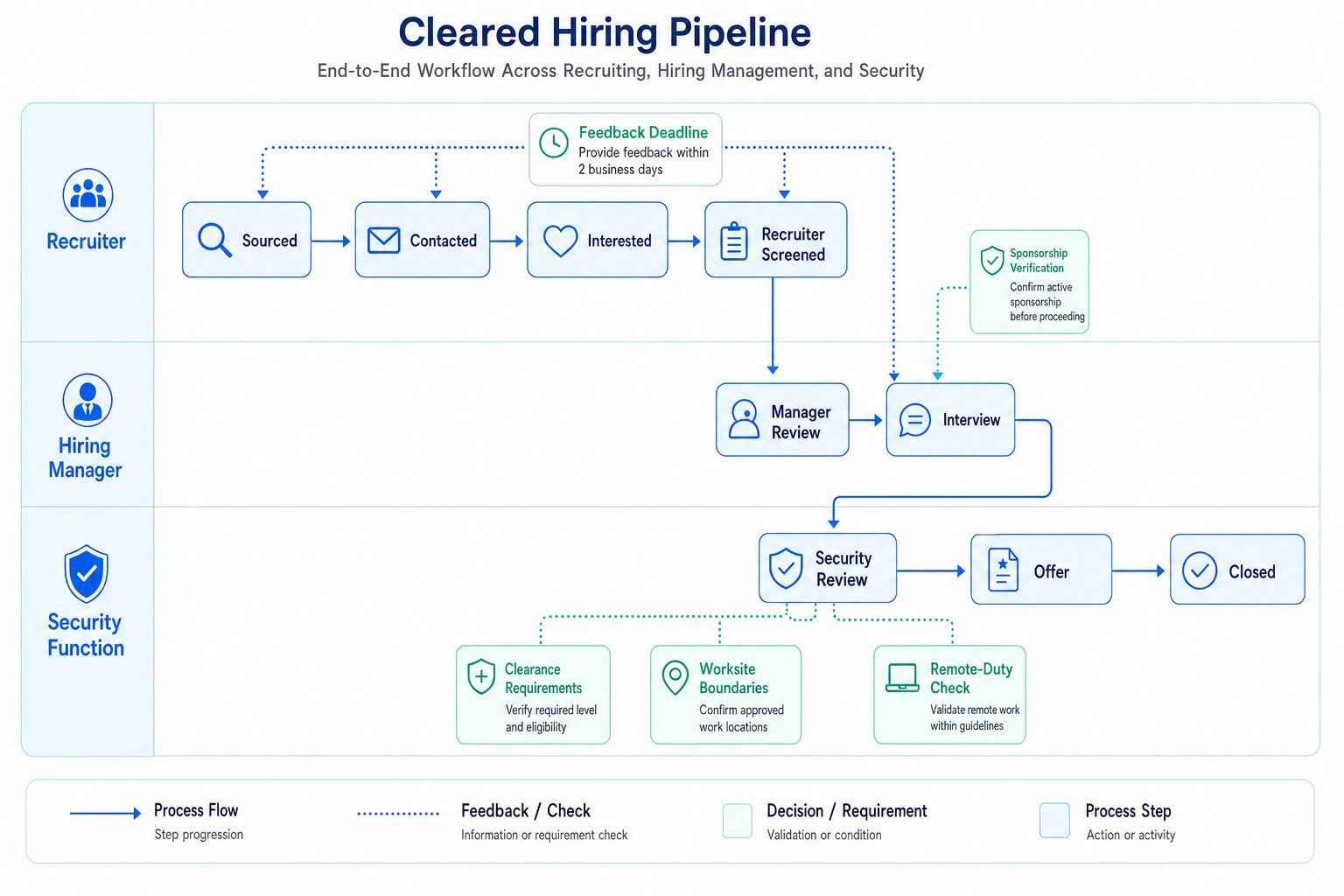
Hiring leaders can use this framework to diagnose stalled pipelines for security clearance jobs before qualified candidates drop out.
Without that visibility, agency recruiters repeatedly chase feedback, in-house recruiters lose qualified applicants during approval gaps, and smaller search firms absorb sourcing costs without knowing whether a vacancy is still actionable. The damage is particularly serious in cleared hiring, where candidates may have scarce technical skills, narrow location preferences, and several competing opportunities.
A shared applicant-tracking and outreach workflow can reduce those losses by keeping candidate conversations, screening outcomes, clearance requirements, and stage changes visible in one place. Automation may assist with initial outreach, follow-up, multilingual communication, and collecting résumés, but the recruiter must still assess the evidence, verify how closely a candidate meets the requirement, and decide what happens next.
Consider the moment a cybersecurity hiring manager sends a job description to recruiting and waits for a shortlist. The recruiter reviews the requisition, contacts prospective candidates, records their replies, and reports that 100 people applied. The manager receives only five attached résumés, emails comments on two of them, and then waits again while the recruiter reconstructs which candidates remain interested.
That sequence exposes the central challenge behind recruiting for security clearance jobs: sourcing volume is not pipeline control. Hiring managers and recruiters need a common view of candidate stages, sponsorship constraints, technical evidence, and remote-work boundaries—especially when searches also attract applicants looking for information security remote jobs or physical security jobs remote.
Practical takeaway: An individual cannot independently obtain a U.S. personnel security clearance. The process must be initiated for an eligible person in connection with a position requiring classified access. Candidates and recruiters should verify the sponsoring organization, exact access requirement, worksite, citizenship conditions, and remote arrangement for every vacancy.
Table of Contents
- Why pipeline ownership matters in cleared hiring
- Cybersecurity, information security, and physical security
- How clearance requirements and sponsorship work
- Security career comparison
- Cybersecurity careers by NICE Framework function
- High-interest roles in security clearance jobs
- Remote information and physical security work
- Qualifications employers evaluate
- Candidate job-search checklist
- Pipeline guidance for recruiting teams
- Common mistakes
- Frequently asked questions
Why Pipeline Ownership Matters in Cleared Hiring
The hiring manager owns the team outcome, while the recruiter owns critical parts of market engagement and process execution. Neither can succeed with a recruiting pipeline hidden inside email threads, résumé attachments, private notes, and unrecorded conversations. Shared ownership does not mean duplicating work. It means establishing who can see the pipeline, who must act at each stage, and how quickly decisions are expected.
In my recruiting work, the most useful intake conversations have not started with a list of keywords. They have started with the business result: what the new hire will protect, which systems or facilities are involved, why access is needed, and what must be accomplished during the first six to twelve months. That context helps a recruiter distinguish a mandatory qualification from a preference and explain the opportunity without revealing sensitive information.
A workable cleared-recruiting pipeline
- Calibrate the requisition. Confirm the mission, work to be performed, required clearance or suitability condition, citizenship rules, location, schedule, travel, compensation range, and sponsorship position.
- Make all candidate sources visible. Applications, referrals, direct-sourcing prospects, and agency submissions should enter a shared system rather than separate inboxes.
- Record screening outcomes. Capture relevant tasks, technical scope, clearance representation, location constraints, candidate interest, and unresolved questions.
- Move candidates through defined stages. Use consistent stages such as sourced, contacted, interested, recruiter screened, manager review, interview, security review, offer, and closed.
- Set decision deadlines. Hiring managers should know when feedback is due, while recruiters should communicate candidate availability and competing-process risk.
- Audit the pipeline. Review where candidates are accumulating, withdrawing, or being rejected and determine whether the cause is market scarcity, unclear criteria, slow decisions, or an unrealistic remote model.
| Pipeline question | Recruiter responsibility | Hiring manager responsibility |
|---|---|---|
| What work will the employee perform? | Translate the scope into searchable, candidate-friendly language | Define tasks, priorities, team context, and expected outcomes |
| What access is genuinely required? | Represent the condition accurately during outreach and screening | Confirm the requirement with the security or program function |
| Who is in consideration? | Maintain complete records and screening notes | Review the visible pool rather than relying only on emailed résumés |
| Why is the search stalled? | Report response rates, objections, and candidate withdrawals | Resolve criteria conflicts and provide decisions on time |
| Is the role actually remote? | Explain location, travel, and onsite expectations early | Identify which duties require a facility, laboratory, or customer site |
A shared system is useful only when the underlying requirement is accurate. Moving candidates between stages more efficiently will not rescue a search built around an incorrect clearance label, an undisclosed travel burden, or a remote promise that conflicts with the actual work.
Cybersecurity, Information Security, and Physical Security
Cybersecurity, information security, and physical security overlap, but employers do not treat them as interchangeable hiring lanes. Cybersecurity primarily protects digital systems, applications, devices, and networks. Information security addresses the confidentiality, integrity, and availability of information through technical controls, governance, and risk management. Physical security protects people, facilities, equipment, and physical access points.
This distinction matters in security clearance jobs because a position is usually tied to defined tasks and an operating environment. Recruiters should screen for the work performed rather than assuming that every applicant with “security” in a title belongs in the same pipeline.
| Career field | Primary focus | Typical work | Remote pattern | Recruiting implication |
|---|---|---|---|---|
| Cybersecurity | Networks, systems, applications, endpoints, and cloud environments | SOC operations, incident response, engineering, hardening, vulnerability management, and DevSecOps | Some duties are remote-capable; classified systems and laboratory work may require approved sites | Verify what the candidate configured, investigated, tested, or remediated |
| Information security | Information risk, controls, governance, and assurance | RMF, authorization support, continuous monitoring, IAM, audit, policy, and compliance | Many duties can be performed remotely, subject to data, customer, and access restrictions | Match framework knowledge to actual ownership and deliverables |
| Physical security | People, buildings, equipment, and physical access | Program management, compliance reviews, site assessments, investigations, and security technology administration | Administration may be home-based, but inspections and assessments require physical presence | Disclose territory, trip frequency, and field obligations before interviews |
How Security Clearance Jobs and Sponsorship Work
A U.S. personnel security clearance is associated with a position requiring access to classified information. A candidate cannot order or purchase one independently. An authorized government organization or cleared employer must initiate the appropriate process in connection with qualifying work.
Candidates should read vacancy language literally. “Active clearance required,” “ability to obtain,” “eligible for,” and “sponsorship available” may describe very different hiring conditions. Recruiters should confirm the wording with the employer’s security or program personnel before advertising the opening.
Common terms that should not be combined
| Term | General meaning | What to verify |
|---|---|---|
| Confidential | A national security classification and corresponding personnel-access level | Whether current eligibility or access is required and whether processing is available |
| Secret | A national security access level above Confidential | Current status, program conditions, start requirements, and onsite duties |
| Top Secret | A national security access level above Secret | Whether the role also requires additional access, screening, or read-in procedures |
| TS/SCI | Top Secret eligibility associated with access requirements for Sensitive Compartmented Information | Whether eligibility, current access, and program-specific conditions are required |
| Department of Energy access authorization | An authorization used for qualifying Department of Energy work | The precise authorization named by the position |
| Public Trust | A suitability or fitness determination for certain positions, not a national security clearance | Risk level, investigation requirements, and agency-specific conditions |
| Background check | A broad term for employment or other screening | Scope, adjudicating authority, and whether a separate clearance process applies |
| Suitability or fitness screening | An assessment under the standards applicable to a role | Which agency, contract, or employer standard controls the decision |
Clearance eligibility and access are also not always identical. Recruiters should avoid making adjudicative judgments or promising that a person will receive a clearance. Their job is to document what the candidate is permitted to represent, compare it with the stated requirement, and refer security-specific questions to authorized personnel.
Security Career Comparison
The following comparison can support intake meetings and career research. It is not a substitute for the controlling vacancy announcement, contract requirement, or employer security guidance.
| Role family | Possible clearance pattern | Remote feasibility | Typical duties | Useful evidence |
|---|---|---|---|---|
| ISSO or ISSM | Frequently required on classified programs | Documentation may be remote; system and facility duties can be onsite | RMF activities, authorization evidence, control tracking, continuous monitoring, and stakeholder coordination | Systems supported, control responsibility, authorization work, and risk decisions |
| SOC and incident response | Depends on the data, customer, and operating environment | Remote-capable when approved access to systems and data is available | Monitoring, triage, investigation, containment coordination, escalation, and reporting | Incident scope, tools used, shift responsibility, and personal decisions |
| Cybersecurity engineering | Common in defense and national-security programs | Design may be hybrid; integration, testing, and classified work may be onsite | Architecture, hardening, testing, STIG implementation, and remediation | What the candidate designed, configured, validated, or corrected |
| Cloud security and DevSecOps | Program-dependent | Often remote-capable, with location and access restrictions possible | Cloud controls, IAM, pipeline security, automation, monitoring, and vulnerability management | Cloud platforms, automation work, control implementation, and engineering ownership |
| Security architecture | Varies with the environment | Reviews may be remote; classified discussions can require an approved facility | Architecture reviews, control design, risk analysis, and security roadmaps | Design decisions, tradeoffs, stakeholder influence, and technical breadth |
| Physical security programs | Depends on the facility and mission | Administration may be remote, but field validation is location-dependent | Compliance, assessments, technology administration, vendor coordination, and program oversight | Facility types, territory, assessment methods, and travel experience |
Cybersecurity Careers by NICE Framework Function
The National Initiative for Cybersecurity Education Workforce Framework for Cybersecurity provides a task-oriented way to discuss cybersecurity work. Candidates can use it to describe what they have done, while recruiters can use it to look beyond inconsistent job titles.
| NICE-aligned function | Recognizable roles | Representative work | Possible progression |
|---|---|---|---|
| Govern | ISSO, ISSM, governance analyst, risk analyst, security program manager | Policy, risk management, control oversight, authorization support, and program leadership | Senior ISSO, ISSM, governance lead, or program director |
| Design and Develop | Security engineer, cloud security engineer, architect, DevSecOps engineer | Secure design, development, control implementation, testing, and engineering | Lead engineer, architect, or technical program lead |
| Implement and Operate | Security administrator, IAM administrator, platform security engineer | Secure configuration, identity administration, maintenance, hardening, and remediation | Operations lead, engineering lead, or platform security manager |
| Protect and Defend | SOC analyst, incident responder, vulnerability analyst, threat hunter | Monitoring, defensive analysis, incident handling, and vulnerability response | SOC lead, detection engineer, or incident response manager |
| Investigate | Digital forensics analyst, cyber investigator | Evidence handling, event reconstruction, technical investigation, and reporting | Lead investigator, forensics manager, or specialist consultant |
A candidate should not simply state that they “worked in cybersecurity.” Stronger evidence identifies the system or environment, the task, the candidate’s level of responsibility, and the result. Examples include mapping controls to evidence, validating hardening requirements, investigating alerts, administering privileged access, or coordinating remediation with system owners.
High-Interest Roles in Security Clearance Jobs
ISSO and ISSM
Information System Security Officers commonly support system-level security activities, while Information System Security Managers often have broader oversight and coordination responsibilities. Employers may seek experience with the Risk Management Framework, authorization packages, control evidence, continuous monitoring, system security documentation, and communication with system owners or authorizing stakeholders.
These roles sometimes appear among information security remote jobs because meetings, documentation, and control tracking can be performed away from a customer site. That does not automatically make the entire position remote. Access to classified systems, secure discussions, inspections, and program rules may require recurring onsite work.
SOC Operations and Incident Response
SOC analysts monitor events, investigate alerts, document findings, and escalate potential incidents. Incident responders may also coordinate containment, recovery, communications, and lessons learned. Hiring managers should define the shift, escalation authority, incident types, data environment, and expected tool knowledge.
Recruiters should evaluate analytical judgment and writing as well as keyword alignment. In controlled environments, accurate documentation and disciplined adherence to approved procedures can be as important as familiarity with a particular platform.
Cybersecurity Engineering
Cybersecurity engineers design, integrate, harden, test, and improve systems. Job descriptions may refer to secure architecture, STIG implementation, vulnerability management, remediation planning, systems engineering, or DevSecOps.
A recruiter should ask what the candidate personally implemented or validated. Listing “STIG” on a résumé does not establish whether the person applied settings, reviewed scan results, documented exceptions, managed remediation, or merely attended meetings about the process.
Cloud Security and IAM
Cloud security work can combine architecture, identity and access management, logging, automated control implementation, vulnerability management, and continuous monitoring. These positions are often more compatible with remote work than facility-based roles, although citizenship, U.S. location, approved equipment, customer access, and occasional travel restrictions may still apply.
Security Architecture
Security architects translate mission, business, and technical requirements into defensible designs. Effective screening should test how a candidate evaluates tradeoffs across IAM, cloud platforms, network boundaries, monitoring, resilience, and incident readiness. Years of experience alone reveal little about the quality of those decisions.
Can Cybersecurity and Physical Security Jobs Be Remote?
Some security work can be remote, including work associated with cleared programs. However, “remote” describes a work arrangement; it does not override classification rules, approved-system requirements, geographic restrictions, or the need to enter a customer facility.
Classified work ordinarily cannot be performed from a standard home office. A position may still be advertised as remote or hybrid when employees complete approved unclassified duties at home and travel to an authorized site for classified activities. Candidates should ask what a normal month looks like rather than accepting a simple yes-or-no description.
What to verify in information security remote jobs
- Work location: Determine whether remote work is limited to the United States, selected states, a commuting radius, or a specific time zone.
- Citizenship and program rules: Ask which requirements are mandatory and why they apply.
- Workspace and equipment: Confirm privacy, connectivity, employer-device, and approved-access conditions.
- Onsite frequency: Identify whether visits are scheduled weekly, monthly, quarterly, or in response to incidents.
- Duty separation: Establish which tasks can be performed remotely and which must occur at an approved site.
- Travel costs and notice: Verify who pays, how trips are scheduled, and whether overnight travel is expected.
What “physical security jobs remote” usually means
The phrase physical security jobs remote commonly surfaces consulting, compliance, program management, security-technology administration, vendor coordination, and multi-site oversight positions. Planning and reporting may be home-based, but facilities cannot be fully inspected or assessed from a laptop.
Applicants should examine the territory, number of sites, anticipated trip duration, overnight frequency, and proportion of time spent in the field. Recruiters should disclose these conditions during initial outreach because an undisclosed travel burden is a common source of late-stage withdrawal.
Qualifications Employers Evaluate
Strong candidates show evidence across four dimensions: relevant tasks, technical or governance knowledge, operating context, and communication. Cleared employers may add an active-access condition or willingness to undergo the applicable process. Remote employers may place additional weight on independent execution, documentation, and distributed collaboration.
| Qualification area | Evidence to present | Common search terms |
|---|---|---|
| Governance and authorization | Control implementation, evidence review, risk reporting, authorization support, and stakeholder coordination | RMF, ATO, NIST SP 800-53, eMASS, continuous monitoring, FedRAMP |
| Defensive operations | Alert analysis, investigation, escalation, containment support, and after-action reporting | SOC, incident response, detection, vulnerability management |
| Engineering | Hardening, design, testing, integration, validation, and remediation | STIG, cybersecurity engineering, security architecture, DevSecOps |
| Identity and cloud | Access design, privilege administration, cloud controls, automation, and monitoring | IAM, cloud security, zero trust, continuous monitoring |
| Physical security | Program oversight, compliance reviews, facility assessments, and technology administration | Physical security, access control, site assessment, program management |
| Remote execution | Clear written updates, self-management, secure handling practices, and virtual coordination | Remote, hybrid, travel, U.S. location, secure workspace |
Certifications can support an application, but they do not replace task evidence. Employers should distinguish credentials mandated by a contract, directive, or position from those that are merely preferred. Candidates should select certifications aligned with the work they intend to perform rather than collecting unrelated acronyms.
Candidate Checklist for Finding Security Clearance Jobs
- Select a function before searching titles. Decide whether your strongest fit is governance, engineering, defensive operations, investigation, cloud security, IAM, architecture, or physical-security program work.
- Translate experience into tasks. Document what you implemented, monitored, assessed, investigated, remediated, or led.
- Represent clearance status accurately. Do not describe a background check, suitability decision, or Public Trust determination as a national security clearance.
- Read sponsorship language carefully. Determine whether current access is mandatory or the organization can consider someone who must undergo processing.
- Use relevant terminology honestly. Include RMF, ATO, eMASS, STIG, IAM, cloud security, or incident response only when your experience supports the term.
- Verify the remote model. Ask about geographic restrictions, approved equipment, onsite frequency, travel, and classified duties.
- Quantify physical-security travel. Confirm territory, overnight expectations, trip duration, and incident-driven travel.
- Prepare evidence-based interview examples. Explain the situation, your responsibility, actions, and result without disclosing classified or employer-sensitive information.
- Evaluate advancement. Ask whether the role develops deeper technical, architecture, management, program, or mission responsibility.
- Confirm material conditions in writing. Recheck worksite, schedule, travel, compensation, remote status, and processing contingencies before accepting.
Pipeline Guidance for Recruiters and Hiring Managers
The pipeline problem from the opening scenario is corrected by visibility plus disciplined decision-making—not by sending more email. A credible intake should resolve the following questions before sourcing begins:
- What business or mission outcome makes this hire necessary?
- Which tasks will the person perform during the first year?
- Which clearance, access, suitability, or screening condition actually applies?
- Is an active status mandatory, or can the organization initiate processing?
- Which qualifications are required by the work, and which are preferences?
- Which duties are remote, and which require an approved site?
- Who reviews candidates, and how quickly must feedback be returned?
- What candidate information can recruiters safely communicate?
Give hiring managers full but appropriate visibility
Hiring managers should be able to review candidates, screening outcomes, stage history, and pending decisions without asking a recruiter to reconstruct the process. Access must still follow applicable privacy, contractual, and organizational controls. Visibility does not mean giving every participant unrestricted access to every record.
Use defined stages instead of attachment chains
Moving a candidate between stages should update the shared record and trigger the next accountable action. A résumé should not disappear into an inbox while recruiters and managers maintain conflicting private lists. Stage definitions also make it easier to identify whether the search is failing during outreach, screening, manager review, interviewing, security review, or offer approval.
Measure delay as well as volume
An application count does not show whether a pipeline is healthy. Recruiting teams should also monitor time awaiting manager review, interview scheduling delays, candidate withdrawals, rejection reasons, response rates, and the number of prospects blocked by incorrect access or location criteria.
Keep final judgment with accountable professionals
Recruiting technology can organize records, assist with communication, and surface required information. It should not replace the hiring manager’s assessment of job evidence, the recruiter’s responsibility for fair and accurate screening, or the authorized security function’s role in clearance-related matters.
Common Mistakes
Treating every government-related screening as a clearance
Public Trust determinations, background checks, suitability reviews, and national security clearances are different. Mislabeling them confuses candidates and can contaminate pipeline reporting.
Assuming remote means no onsite work
A home-based position may still require classified meetings, customer visits, testing, facility inspections, or incident response. State the typical schedule and likely exceptions.
Searching by title alone
Titles such as security analyst, ISSO, cybersecurity engineer, and architect vary widely. Compare tasks, systems, frameworks, responsibility, and decision authority.
Giving the hiring manager only a curated email snapshot
A shortlist without pipeline context prevents the manager from seeing sourcing volume, candidate objections, unresolved questions, and response delays. A shared record creates a more informed discussion about tradeoffs.
Using certifications as a substitute for experience
A credential may satisfy a formal requirement or demonstrate structured learning, but hiring teams still need evidence that the candidate can perform the position’s tasks.
Hiding travel behind a remote label
This is especially damaging in physical-security recruiting. Travel frequency, territory, and overnight expectations should be visible before a candidate invests time in interviews.
Frequently Asked Questions
Do all cybersecurity jobs require a security clearance?
No. Many commercial, nonprofit, academic, and government-facing cybersecurity positions do not require access to classified information. They may instead require an ordinary background check, suitability review, or other screening specified by the employer.
Can a person obtain a security clearance before applying?
Generally, no. A U.S. personnel security clearance process must be connected to a position requiring classified access and initiated through an authorized organization. Candidates should look for openings that explicitly explain whether current status is required or processing is available.
Can security clearance jobs be fully remote?
Some positions may be fully remote when their approved duties and systems permit it. Other jobs are remote only for unclassified tasks and require visits to an authorized facility for classified work. Geographic, citizenship, equipment, and travel restrictions may apply.
Are information security remote jobs suitable for beginners?
Some are, particularly positions offering structured work in monitoring, documentation, IAM, compliance, vulnerability management, or cloud operations. Entry-level candidates should investigate supervision, training, system access, schedule, and onsite expectations.
Can physical security work be performed remotely?
Planning, reporting, compliance administration, vendor coordination, and security-system administration may be performed remotely. Site assessments, installation reviews, facility inspections, and many investigations require physical presence.
How should candidates state their clearance on a résumé?
Use accurate language permitted by applicable policy and employer guidance. Do not embellish the level, access, currency, or sponsoring relationship, and do not include classified program details. If uncertain, consult the appropriate security representative.
How can candidates without a clearance enter the field?
Build task-based experience in non-cleared cybersecurity or information-security work and target employers that explicitly consider applicants requiring sponsorship. SOC operations, IAM, vulnerability management, cloud security, engineering, compliance, and authorization support can all produce transferable experience.
Who should own the recruiting pipeline?
Recruiters should manage sourcing, communication, screening discipline, and candidate records. Hiring managers should own requirement quality, timely evaluation, and final team decisions. The most reliable model is shared visibility with clearly assigned actions rather than transferring the entire process to either party.
Conclusion: Build Careers and Pipelines Around the Work
The strongest route into security clearance jobs begins with functional clarity. Candidates should understand whether they want to govern risk, secure systems, operate defenses, investigate events, design architecture, or manage physical-security programs. They should then describe relevant tasks accurately and verify every access, location, travel, and remote-work condition.
Recruiters and hiring managers need the same clarity. A visible pipeline allows them to see every qualified source, act on feedback, and identify where a search is failing. More importantly, a well-calibrated requirement prevents candidates seeking information security remote jobs or physical security jobs remote from entering a process built around conditions they cannot accept.
In cleared recruiting, speed comes from informed decisions rather than résumé volume. When the hiring manager understands the market, the recruiter understands the work, and both can see the pipeline, candidates receive more accurate information and the organization has a better basis for selecting the right person.