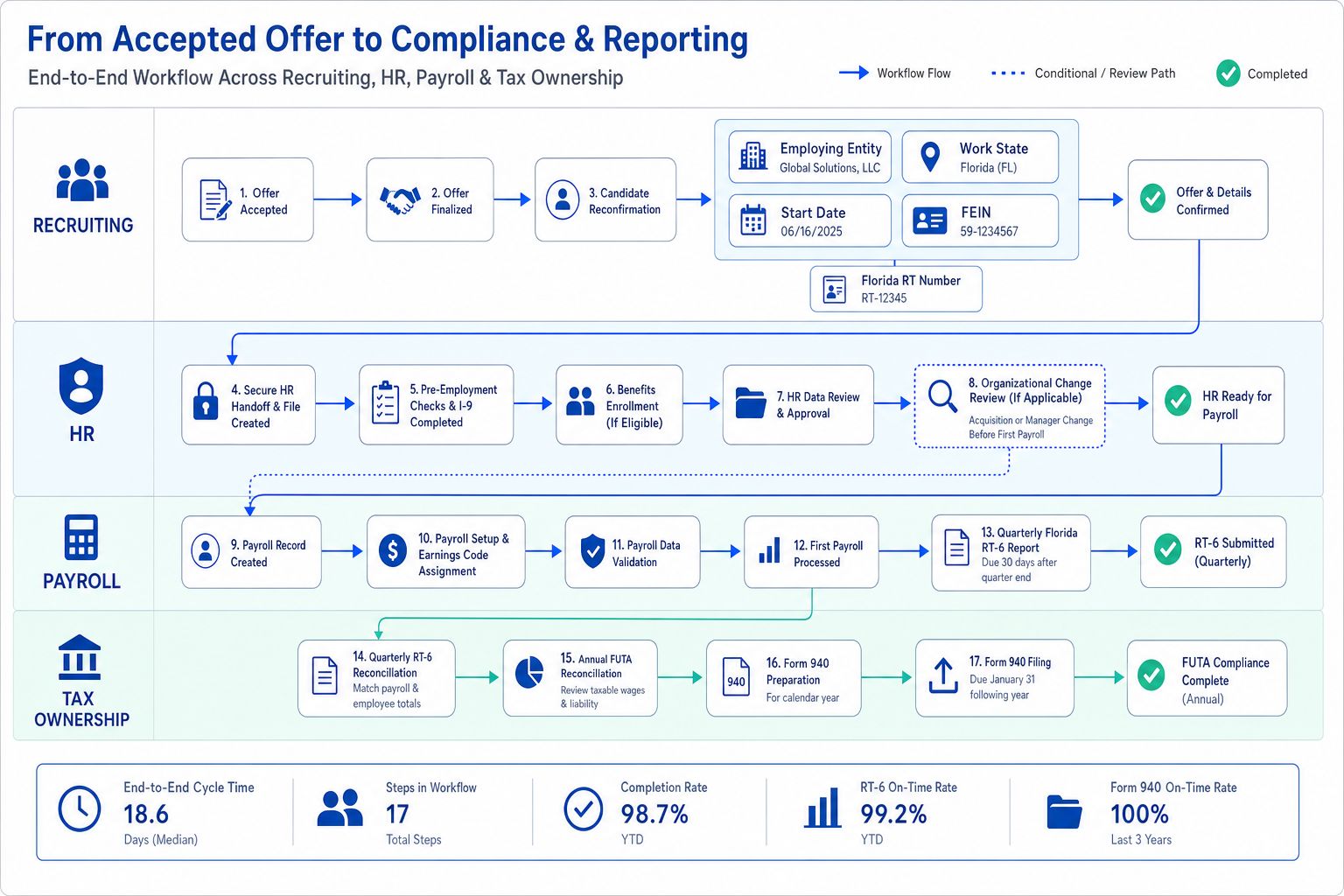
Recruiting leaders can assess SUI tax meaning and flag post-offer entity changes before payroll errors damage candidate trust.
That connection becomes critical when a reorganization, acquisition, manager departure, or employing-entity change occurs between offer acceptance and the first payroll. For an agency owner, missed updates can damage client confidence; for an individual recruiter, they can weaken a candidate relationship; and for an in-house recruiting team, they can produce incorrect work-location, entity, and wage records that payroll must repair at quarter-end.
A well-configured recruiting automation workflow can preserve message history, maintain timely candidate communication, collect authorized documents, and keep a recognizable contact involved when responsibilities shift. It can reduce dropped handoffs, but the recruiter must still assess the résumé, explain material changes, decide the next step, and ensure that verified onboarding information reaches HR and payroll.
Consider a product marketing executive who accepts an offer and then learns shortly before starting that the manager who hired her has left and the company has been acquired. She reviews whether the role, team, and reasons for joining still exist. Meanwhile, the recruiter checks the interview notes, updates the candidate record, confirms the new reporting relationship, and contacts her before she encounters an unfamiliar manager on her first day.
The incoming manager was not involved in the interviews and does not yet know why the candidate was selected or what expectations were established. The candidate therefore has to decide whether the opportunity remains acceptable, while the recruiter must distinguish what changed from what stayed intact and give her room to reconsider rather than presenting the transition as a minor administrative detail.
This scene exposes more than a candidate-experience problem. A change in manager may require only a communication update, but an acquisition, transfer, or entity restructuring can alter the employer of record, state registration responsibilities, wage reporting, and unemployment tax reconciliation. That is where SUI tax meaning, FUTA Form 940 filing, FL Form RT 6, and the correct RT number Florida employers use become part of the same operational conversation.
Practical takeaway: Preserve continuity for the candidate while revalidating the employing entity, work state, payroll account, and reporting ownership before the first affected payroll.
Table of Contents
- SUI tax meaning and its connection to FUTA
- Four controls for hiring through organizational change
- Form 940 versus Florida Form RT-6
- FUTA rates and the state unemployment tax credit
- What an RT number means in Florida
- Information required for FL Form RT 6
- RT-6 deadlines and zero reports
- An integrated recruiting, payroll, and filing workflow
- Common compliance mistakes
- Frequently asked questions
SUI Tax Meaning and Its Connection to Form 940
SUI means State Unemployment Insurance. SUTA, short for State Unemployment Tax Act, is another term commonly used for the state unemployment tax system. Florida calls its program reemployment tax, and covered employers report wages under Florida rules.
FUTA is the federal counterpart. Employers use Form 940 to report annual Federal Unemployment Tax Act liability, whereas state unemployment reports follow each jurisdiction's filing schedule. Florida employers generally use Form RT-6 for quarterly wage and reemployment tax reporting.
The returns are separate, but their records interact. State unemployment tax paid on qualifying wages can support the credit reported on Form 940. If state accounts, wage records, or payments are missing or assigned to the wrong entity, payroll may face a difficult reconciliation when preparing the federal return.
Recruiters do not normally calculate these taxes. Their responsibility is to prevent the upstream data from becoming unreliable. A candidate's legal employing entity, work location, start date, worker classification, and transfer status should be confirmed through authorized HR and payroll channels rather than inferred from a job description or reporting manager.
Four Hiring-Change Controls That Protect Tax Data
The same practices that preserve candidate confidence during organizational change also make unemployment tax reporting more dependable. They establish who knows what changed, which records must be updated, and who owns the next decision.
1. Disclose foreseeable change early
If the company is reorganizing, integrating an acquisition, or regularly moving roles between entities, candidates should receive a realistic description of the environment. This helps them decide whether they are comfortable with uncertainty and prevents a recruiter from making promises that the organization may not be able to keep.
Early disclosure also gives HR and payroll time to answer a different question: will the person be employed and paid by the entity named during recruiting? A reporting-line change does not automatically change the employer of record, but an acquisition or transfer may require closer review.
2. Reconfirm expectations instead of assuming continuity
When the original hiring manager leaves, the replacement manager should learn why the candidate was selected, what scope was discussed, and what the candidate expects. The recruiter can provide continuity by reviewing approved interview records and arranging a direct conversation, without disclosing restricted evaluation material.
At the same time, HR should reconfirm the work state, start date, payroll entity, and onboarding status. If any item changed, payroll and the appropriate tax owner need the update before wages are processed.
3. Keep a familiar contact in the handoff
A recruiter or interviewer who already has a relationship with the candidate is often better positioned to communicate an unexpected change than an unfamiliar manager. That person can explain what remains stable, identify unresolved questions, and document the candidate's decision.
Continuity matters operationally as well. A named owner should carry the record from recruiting into onboarding and confirm that payroll received the final data. Merely changing a candidate stage to hired is not evidence that state account readiness or tax jurisdiction was checked.
4. Give the candidate a genuine decision
A candidate who accepted one reporting structure or company context should be able to reconsider after a material change. Recruiters should not minimize an acquisition, a different role scope, or a new employing entity just to preserve an accepted offer.
If the candidate continues, document the revised facts and obtain any required updated employment documents. If the candidate withdraws, notify HR and payroll promptly so that no employee record, state wage entry, or unnecessary first payment is created.
Form 940 vs. FL Form RT 6
Form 940 is an annual federal return, while Florida Form RT-6 is a quarterly state report. One cannot be filed in place of the other, even though state wage and payment records help support the annual FUTA reconciliation.
| Filing | Jurisdiction | Typical frequency | Primary purpose | Primary account identifier |
|---|---|---|---|---|
| Form 940 | Federal | Annual | Report FUTA liability and applicable adjustments | Federal Employer Identification Number |
| Florida Form RT-6 | Florida | Quarterly | Report employee wages and reemployment tax | Florida reemployment tax account number |
Although Form 940 is filed annually, FUTA deposits may be required during the year based on accumulated liability. Employers should follow the current IRS deposit rules rather than treating the annual filing date as the only relevant deadline.
Organizational changes create an additional review point. In an acquisition or legal-entity transfer, predecessor and successor rules may affect federal and state wage treatment. The company should have a qualified payroll or tax professional determine the correct treatment instead of asking recruiting staff to make that judgment.
FUTA Rates, Wage Base, and the State Tax Credit
FUTA generally applies to the first $7,000 of FUTA-taxable wages paid to each covered employee during a calendar year. The statutory federal rate is 6.0%. A credit of up to 5.4% for qualifying state unemployment tax can produce a standard net rate of 0.6% when the full credit is available.
| FUTA element | General figure | Why it matters |
|---|---|---|
| Annual federal wage base | $7,000 per covered employee | Limits the wages generally subject to FUTA for that employee |
| Statutory FUTA rate | 6.0% | Federal rate before the state unemployment tax credit |
| Maximum state credit | 5.4% | Potential credit for qualifying state unemployment tax |
| Standard net rate with full credit | 0.6% | Common result when the complete credit is permitted |
The full credit is not automatic in every circumstance. The timing of state payments, whether wages were subject to state unemployment tax, differences between federal and state wage bases, and credit-reduction-state rules can affect the Form 940 calculation. Schedule A may also be required when an employer paid state unemployment tax in more than one state or had wages in a credit reduction state.
This is why quarterly discipline matters. Payroll should preserve state returns, payment confirmations, tax-rate notices, and account correspondence throughout the year rather than reconstructing them when Form 940 is due.
What Is an RT Number in Florida?
A Florida RT number is the employer's reemployment tax account number. It identifies the employer's Florida reemployment tax account and is different from the federal Employer Identification Number.
Someone searching for RT number Florida is often trying to identify which number belongs on an RT-6 filing. The state reemployment tax account number belongs in the state account field; the FEIN remains the federal identifier. Payroll systems should store them in separately labeled fields to prevent substitutions and account mismatches.
- FEIN: Identifies the employer for federal tax purposes.
- Florida RT number: Identifies the Florida reemployment tax account.
- Recruiting control: Confirm which legal entity will employ the candidate.
- Payroll control: Match that entity to the correct state and federal accounts before filing.
An employer that has not established the appropriate Florida account should review registration requirements with the Florida Department of Revenue. Hiring activity should be flagged early enough for the responsible team to complete registration before a report or payment becomes due.
What Information Is Required for FL Form RT 6?
FL Form RT 6 combines employer-level tax information with employee-level wage reporting. Exact fields and electronic filing requirements should be checked against the current Florida instructions, but the reporting workflow generally depends on the following records.
Employer and account information
- Legal employer name and filing period
- Florida reemployment tax account number
- Applicable state tax rate
- Taxable payroll and calculated tax
- Credits, adjustments, or amounts due when applicable
Employee and wage information
- Required employee counts for the quarter
- Employee legal names
- Social Security numbers
- Gross wages
- Excess wages above the applicable state taxable wage base
- Taxable wages
Recruiting and onboarding teams support this report by collecting legal identity information through secure, authorized systems and by confirming the work arrangement. Sensitive identifiers should never be placed in ordinary recruiter notes, email threads, or broadly accessible candidate records.
A reporting-manager change normally does not alter wage reporting by itself. A move to another employing entity, a change in work state, or a delayed start date can. The handoff checklist should therefore separate organizational-chart changes from changes that affect payroll and tax records.
Florida RT-6 Deadlines and Zero Reports
Florida Form RT-6 follows a calendar-quarter reporting cycle. The standard due dates are below, although employers should verify adjustments for weekends, holidays, or updated agency instructions.
| Reporting quarter | Standard due date |
|---|---|
| January 1 through March 31 | April 30 |
| April 1 through June 30 | July 31 |
| July 1 through September 30 | October 31 |
| October 1 through December 31 | January 31 |
Important: An active Florida reemployment tax account may still have a reporting obligation for a quarter with no employees, no wages, or no tax due.
This issue often appears after a location closes, a candidate's start is postponed, or the last Florida employee transfers to another entity. Zero headcount should prompt the account owner to review the filing and account status; it should not prompt a recruiter or hiring manager to cancel the filing reminder independently.
An Integrated Recruiting, Payroll, and Filing Workflow
The strongest process preserves the candidate relationship while creating a traceable path from accepted offer to quarterly state reporting and annual FUTA reconciliation.
- Confirm the approved position context. Record the role, expected work location, legal employing entity, planned start date, and approved reporting relationship.
- Warn candidates about material uncertainty. If a restructuring or acquisition may affect the role, communicate the known facts and avoid guarantees that have not been approved.
- Maintain a consistent contact. Keep a recruiter or established interviewer involved if the hiring manager changes, and document candidate questions and decisions.
- Revalidate the offer after a material change. Confirm role scope, manager, entity, location, compensation, and start date. Route any required document revisions through HR.
- Check state account readiness. The payroll or tax owner should verify that the correct entity has the required Florida RT number and reporting setup.
- Transfer verified onboarding data securely. Provide legal name, authorized identity information, start date, work state, and employing entity through controlled systems.
- Reconcile RT-6 data each quarter. Compare employee counts, gross wages, excess wages, taxable wages, tax rates, payments, and account identifiers.
- File required reports, including applicable zero reports. Preserve confirmations and evidence that payments were assigned to the correct account.
- Reconcile state records before Form 940. Review state filings, payment timing, multistate activity, and any entity changes before calculating the FUTA credit.
In my recruiting operations approach, the decisive control is not another status field; it is a named handoff owner. When a manager departs or a company structure changes, that owner reviews the candidate conversation, confirms the candidate's decision, and alerts payroll to any entity or location change. Automation can keep communications and reminders moving, but accountable people must validate the employment facts and tax treatment.
Common Form 940 and Florida RT-6 Mistakes
Using the FEIN as the Florida RT number
These identifiers serve different accounts. Store them separately and verify that each filing uses the identifier requested by the relevant agency.
Assuming a new manager means a new employer
A reporting-line change and an employer-of-record change are not the same. Confirm the legal entity rather than making conclusions from the organization chart.
Failing to review an acquisition or employee transfer
Entity changes can raise predecessor-successor, wage-base, registration, and reporting questions. Escalate them to qualified payroll or tax professionals before filing.
Treating Form 940 and RT-6 as interchangeable
Form 940 is federal and annual; RT-6 is Florida-specific and quarterly. Maintain separate filing tasks, then connect their records during reconciliation.
Skipping a quarter because no wages were paid
An active account can still require a zero report. The account owner should verify the obligation and complete any formal account closure or status change when appropriate.
Waiting until year-end to investigate state payments
Payment timing and proper account application can affect the FUTA credit. Review confirmations each quarter while corrections are easier to research.
Leaving candidates uninformed during organizational change
Candidate trust and payroll accuracy can fail for the same reason: important changes stayed with one manager or in one system. Maintain a familiar contact, explain material changes, and update downstream owners promptly.
Frequently Asked Questions
What is SUI tax meaning in payroll?
SUI means State Unemployment Insurance. It refers to a state's unemployment tax and benefit system and is also commonly called SUTA. Florida uses the term reemployment tax.
What is Form 940 used for?
Employers use Form 940 to report annual FUTA tax. The return also accounts for relevant state unemployment tax credits and adjustments. FUTA deposits may be required before the annual return is filed.
Is Florida Form RT-6 the same as Form 940?
No. Florida Form RT-6 is a quarterly state wage and reemployment tax report. Form 940 is the annual federal FUTA return. State records can affect the federal calculation, but the filing obligations remain separate.
What is an RT number in Florida?
It is the employer's Florida reemployment tax account number. It is not the same as the employer's FEIN.
When is FL Form RT 6 due?
The standard quarterly dates are April 30, July 31, October 31, and January 31. Employers should verify the applicable calendar and current filing instructions before submission.
Must an employer file RT-6 when no wages were paid?
An employer with an active Florida reemployment tax account may still need to file a report showing no activity. The employer should verify its filing status rather than assuming that a zero-payroll quarter removes the obligation.
How can a hiring change affect unemployment tax reporting?
A new manager alone may not affect tax reporting. A change in legal employer, work state, start date, or payroll arrangement can affect registration, wage reporting, and reconciliation. Those changes should be sent to HR and payroll before wages are processed.
What should a recruiter do after an acquisition changes an accepted role?
The recruiter should explain confirmed changes, preserve a familiar point of contact, reconfirm the candidate's interest, and document any revised entity, location, role, or start-date information. Payroll and tax decisions should remain with authorized specialists.
Final Filing and Hiring-Change Checklist
- Confirm the candidate's legal employing entity and work state.
- Explain material organizational changes before the start date.
- Give the candidate an opportunity to reconsider the revised role.
- Keep the FEIN and Florida RT number in separately labeled fields.
- Verify account readiness before the first affected payroll.
- Reconcile employee counts and wage categories every quarter.
- Track RT-6 deadlines and review zero-report obligations.
- Preserve state filing and payment confirmations.
- Review entity transfers and acquisitions with qualified specialists.
- Reconcile quarterly state records before completing Form 940.
Understanding SUI tax meaning is ultimately about understanding the data chain behind unemployment tax. When recruiting preserves candidate continuity and promptly communicates changes, payroll is better positioned to file Florida RT-6 reports accurately and support the annual FUTA Form 940 reconciliation.
This material provides general operational information, not tax or legal advice. Employers should verify current requirements with the IRS, the Florida Department of Revenue, and qualified professional advisers before filing.