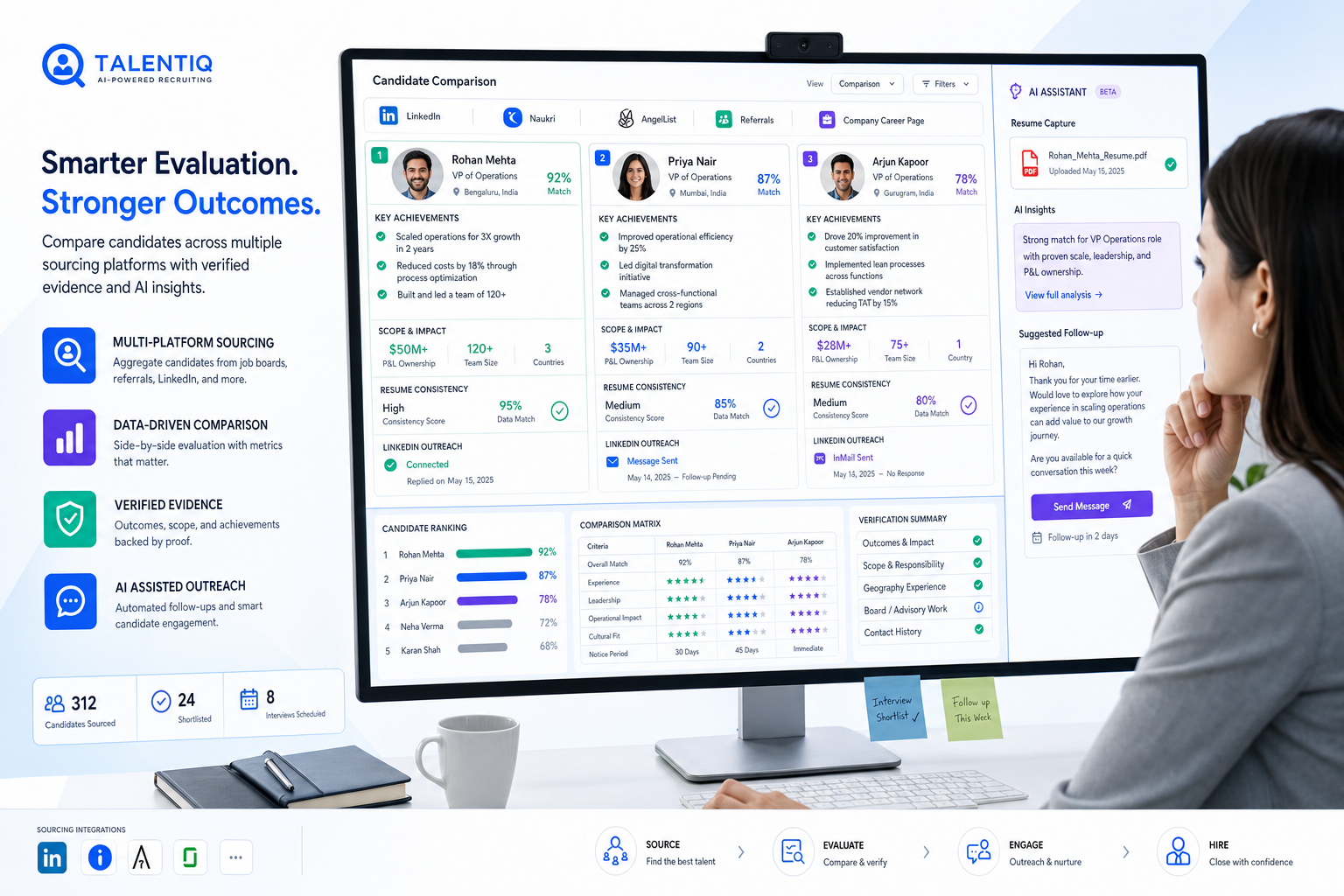
This article helps recruiters judge talent sourcing tools by evidence quality and avoid shortlists built on vague, inconsistent candidate signals.
That matters most when the brief is senior, specialized, or time-sensitive. In those searches, recruiters do not lose momentum because a database is small; they lose it because the signal is thin. Titles look inflated, accomplishments are vague, candidate stories change from one profile to another, and the team ends up spending hours validating what should have been obvious in the first pass. For a solo headhunter, that means fewer live conversations per day. For a small agency owner, it means slower delivery and harder client updates. For an in-house talent lead, it means more stakeholder friction when the shortlist does not clearly show why each person belongs there.
In my own workflow, I have used StrategyBrain AI Recruiter to reduce one part of that drag on LinkedIn: repetitive outreach, after-hours follow-up, and resume collection from interested candidates. It helps keep conversations moving, especially across time zones, while I still make the final call on fit, resume quality, and whether a candidate should move forward. That distinction matters. Automation can keep the top of funnel warm, but recruiter judgment is still what turns interest into a credible shortlist.
The issue becomes easiest to see in executive search. When a candidate is aiming for a C-suite role, strong claims are not enough. What stands out is a clear record of outcomes, specifics about scope, and a consistent story across resume, public profile, and supporting materials. A recruiter reviewing that market does not just scan for skills. They compare what the person says they delivered, how large the remit really was, whether the profile matches the resume, and whether the evidence is strong enough to survive a client conversation.
That is also where sourcing starts to break if the tool is too shallow. You open the requisition, search for likely leaders, review one profile, then pull up another source to confirm board work, geographic scope, publications, or past business size. Next you check whether the resume tells the same story as the public profile and whether outreach has already happened in your system. Those are consecutive, ordinary recruiting actions, but they reveal the bigger buying question behind this topic: which talent sourcing tools actually help recruiters validate results, context, and consistency across sources rather than just return a long list of names?
That is the lens for this article. Instead of treating non-LinkedIn sourcing as a simple database comparison, we will look at how experienced teams evaluate search quality, where resume sourcing tools still matter, and what really separates the top sourcing tools for recruiters when the search requires nuance rather than volume.
In this guide, you will learn:
- What non-LinkedIn talent sourcing tools actually help with
- Why executive-style evaluation standards improve sourcing quality across all role types
- Where resume sourcing tools fit in a modern recruiting stack
- How to compare the top sourcing tools for recruiters without relying on hype
Table of Contents
- What Recruiters Need From Talent Sourcing Tools
- Why Looking Beyond LinkedIn Improves Sourcing
- From Keywords to Context: How the Category Changed
- A Better Way to Assess Candidates: Lead With Results and Scope
- Where Resume Sourcing Tools Still Add Value
- How Top Sourcing Tools for Recruiters Differ by Use Case
- How I Use StrategyBrain AI Recruiter Alongside Sourcing Work
- Evaluation Checklist for Non-LinkedIn Sourcing Platforms
- Common Buying Mistakes
- FAQ
What Recruiters Need From Talent Sourcing Tools
Talent sourcing tools are not just search bars attached to candidate databases. At their best, they help recruiters identify relevant people, verify whether those people really match the assignment, and move them into outreach without losing context.
That last part is what gets overlooked. In practice, recruiters do not just need more profiles. They need tools that help answer familiar questions quickly: What did this person actually achieve? How large was the team, budget, or territory? Does the public footprint support the resume? Is this candidate visible in other communities or just on one platform? Have we already contacted them? If so, what happened?
Those are not abstract concerns. They come up every day in agency search, corporate recruiting, and leadership hiring. A good sourcing platform reduces the number of tabs, guesswork, and duplicate checks required to get from market mapping to first message.
Why Looking Beyond LinkedIn Improves Sourcing
Recruiters look beyond LinkedIn because many candidates leave stronger evidence elsewhere. Technical talent may show real credibility through code repositories, project participation, or conference activity. Researchers often surface through publications and patents. Operators and executives may reveal more through board service, company history, media coverage, or portfolio signals than through a polished network profile alone.
There is also a competitive reason to broaden the search. When every recruiter is drawing from the same visible pool, the market gets saturated quickly. The reply rates you see are not only a function of message quality; they are also shaped by how crowded the channel already is.
Key insight: The best non-LinkedIn sourcing strategy does not replace one website with another. It adds more reliable evidence for recruiter judgment.
That is especially important in senior searches. Executive candidates are often evaluated the same way strong executive resumes are evaluated: by results first, then by proof, then by consistency across platforms. The more senior the role, the less useful a vague profile becomes.
From Keywords to Context: How the Category Changed
The sourcing category used to revolve around Boolean strings, filter depth, and raw profile count. Those still matter, but the stronger platforms now compete on something broader: context quality.
In other words, can the system help a recruiter find adjacent-title candidates, understand likely scope, and separate generic claims from evidence-backed experience? Modern sourcing platforms increasingly use semantic search, natural-language prompts, and ranking logic that tries to infer relevance rather than just count exact keyword matches.
That does not make Boolean obsolete. In niche markets and precision-heavy searches, it still earns its place. But many recruiters now need both modes: Boolean for control, and semantic search for speed. The better talent sourcing tools support both without forcing every user into power-user behavior.
A Better Way to Assess Candidates: Lead With Results and Scope
One of the most useful lessons from executive recruiting applies directly to sourcing: start with results, not adjectives. When you are reviewing candidate profiles, phrases like strategic, visionary, or collaborative are much less valuable than clear evidence of what changed under that person’s leadership.
That principle sharpens sourcing in three ways:
- Lead with outcomes. Search for indicators of delivered results, not just self-description.
- Look for specifics. Scope matters: team size, region, budget, product line, revenue responsibility, or transformation mandate.
- Check consistency. Resume, public profile, and other visible signals should tell the same career story.
These standards help recruiters in far more than C-suite hiring. A sales leader search, a director-level operations brief, or a niche technical hire all benefit from the same discipline. If the sourcing platform cannot help you validate those dimensions, it will create extra manual work later.
It also explains why some non-LinkedIn tools outperform simple databases. They give recruiters more ways to confirm whether a profile reflects real achievement, not just good self-presentation.
Where Resume Sourcing Tools Still Add Value
Resume sourcing tools still have a place, especially when recruiters need broad role-family coverage, access to historical applicant pools, or a fast way to rediscover people already connected to the organization.
But they work best when used with clear expectations. A resume database can be excellent for surfacing candidates who are easier to parse by chronology, skills, and location. It is less effective when the assignment depends on indirect signals such as reputation, thought leadership, project influence, or nuanced progression between companies.
That is why many experienced recruiters do not frame the choice as one platform versus another. They use resume sourcing tools for one kind of evidence and broader sourcing platforms for another. The point is not to abandon resumes. It is to avoid treating the resume as the only trustworthy artifact.
| When resume sourcing tools help most | What to watch for |
|---|---|
| Broad functional hiring | Deduplication and stale records |
| Rediscovery of past applicants | Whether old resumes match current career stage |
| Location-driven or credential-driven roles | Weak context beyond resume text |
| Fast initial list building | Need for follow-up validation from other sources |
How Top Sourcing Tools for Recruiters Differ by Use Case
The top sourcing tools for recruiters are not all trying to solve the same problem. Comparing them well means matching the platform to the hiring model.
Technical hiring
Technical teams need more than title matching. Search works better when the tool can interpret adjacent stacks, project footprints, open-source activity, and nonstandard career paths.
What to verify: Can the platform surface evidence beyond resume keywords, and can recruiters understand why a candidate was ranked?
Executive search
Executive recruiting depends heavily on scope, progression, and proof. Leadership hiring benefits from tools that make it easier to validate company scale, geographic remit, board exposure, transformation work, and consistency across sources.
What to verify: Does the tool help you compare achievements and context, not just biographical basics?
High-volume recruiting
In fast-moving environments, workflow efficiency often matters more than deep research. Search speed, list building, outreach sequencing, and handoff to the core recruiting system become the priority.
What to verify: Can recruiters move from search to outreach without export-heavy workarounds?
Diversity and market-mapping work
These searches benefit from broader discovery paths and less dependence on one visible network. The right platform helps widen the map without making simplistic assumptions about candidate identity.
What to verify: Does the platform expand title logic, source variety, and adjacent-skill discovery in a measurable way?
| Tool style | Best fit | Main test |
|---|---|---|
| Semantic sourcing platforms | Teams that want faster shortlist creation | Result relevance and trust in ranking |
| Technical discovery tools | Engineering and specialist hiring | Depth of non-resume signals |
| Resume databases | Broad and repeatable role coverage | Freshness and search precision |
| Outreach-led suites | Teams prioritizing engagement speed | Contact quality and follow-up workflow |
How I Use StrategyBrain AI Recruiter Alongside Sourcing Work
Although this article is about non-LinkedIn sourcing, it would be incomplete if I ignored what happens after candidate discovery. In my own process, I often split the work in two: I use broader sourcing channels to identify and validate who belongs in the target market, then I use AI Recruiter to keep LinkedIn outreach moving for the candidates I do want to contact there.
The most practical benefit for me has been continuity. If a candidate replies outside my working hours, the system can continue the conversation, introduce the opportunity, and collect resume or contact details from interested people. That is particularly useful when I am running multiple searches or speaking with candidates across countries. I still review the resume myself, decide whether the person truly fits the brief, and determine the next step. But I spend less time babysitting early-message logistics.
Two capabilities stand out in that workflow:
- Always-on messaging: useful when candidates respond late or from different time zones
- Resume and contact capture: useful when interest is real and you want clean handoff for review
- Multilingual communication: useful when outreach crosses language boundaries
If you want to understand the operating model in more detail, the product overview for StrategyBrain AI Recruiter and the broader active sourcing workflow notes are the most relevant references. The key point is simple: it supports the outreach layer, not the final hiring judgment.
Evaluation Checklist for Non-LinkedIn Sourcing Platforms
When recruiters compare talent sourcing tools well, they usually test them against live roles rather than feature lists. That is the only way to see whether the platform can handle nuance, not just volume.
| Evaluation factor | Why it matters | What to test |
|---|---|---|
| Source coverage | Broader sources improve evidence quality | Can you find the same candidate through more than one signal? |
| Result specificity | Vague matches waste recruiter time | Does the platform surface scope, outcomes, and progression clearly? |
| Cross-platform consistency | Inconsistency creates shortlist risk | Can you compare profile claims against other visible records? |
| Search usability | Adoption depends on speed and trust | How well do Boolean and semantic search perform on live requisitions? |
| Contact readiness | Discovery has to lead to action | How reliable is outreach data and handoff? |
| Workflow fit | Manual transfer slows everything down | How easily does the sourced lead move into your recruiting process? |
A practical test I recommend is this: run the same executive or specialist brief through each platform and ask whether the first ten results tell a coherent story. If they do not, the tool may still be useful for list building, but it is not helping you think like a recruiter.
Common Buying Mistakes
Choosing size over evidence
A huge database sounds reassuring, but scale alone does not tell you whether the profile is credible, current, or relevant.
Confusing profile polish with candidate quality
Senior candidates often know how to present themselves well. The job of sourcing is to verify scope and outcomes, not just admire a polished narrative.
Treating outreach and sourcing as unrelated
Discovery creates little value if the handoff to engagement is clumsy. That is why many recruiters pair broader sourcing with workflow tools that keep candidate communication moving.
Overestimating what automation should decide
Automation can help with messaging, scheduling pressure, and resume capture. It should not replace recruiter judgment on whether the candidate’s background truly fits the assignment.
FAQ
What are talent sourcing tools?
Talent sourcing tools help recruiters find, evaluate, and organize potential candidates across multiple sources. The better ones support validation, not just search.
Are resume sourcing tools still useful?
Yes. Resume sourcing tools remain useful for broad coverage, historical applicant rediscovery, and fast list building. They are just not enough on their own for every search.
What makes the top sourcing tools for recruiters different?
The strongest tools improve result relevance, reveal better candidate context, and make it easier to verify claims across sources. They save time because they reduce uncertainty, not just because they return more names.
Why should recruiters look beyond LinkedIn?
Because many candidates leave stronger signals elsewhere, and relying on one network often means competing in the most crowded part of the talent market.
Can LinkedIn automation replace recruiter judgment?
No. It can help manage repetitive outreach, follow-up, and resume collection, but final qualification and decision-making still belong to the recruiter.
Conclusion
The best talent sourcing tools do more than broaden candidate reach. They help recruiters apply the same standards that matter in strong senior-level evaluation: results first, specifics over vague claims, and consistency across platforms.
If you keep that lens in mind, the choice between non-LinkedIn sourcing platforms, resume sourcing tools, and outreach support becomes much clearer. The top sourcing tools for recruiters are the ones that make candidate evidence easier to find, easier to trust, and easier to act on.
And when outreach volume becomes the bottleneck rather than discovery itself, tools like StrategyBrain AI Recruiter can support the communication layer while leaving final assessment where it belongs: with the recruiter.