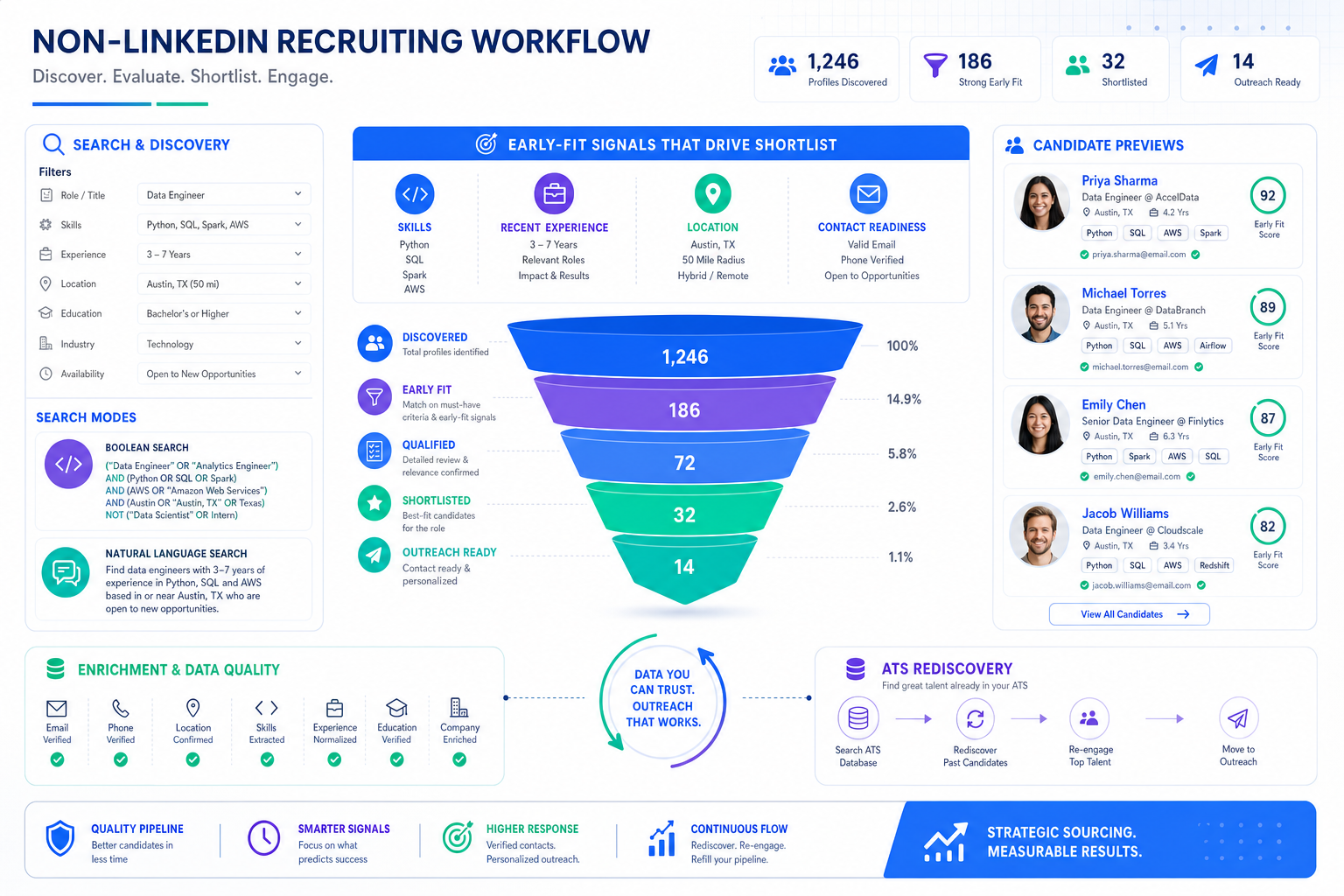
This article helps recruiters judge talent sourcing tools by early-fit signals, avoid noisy searches, and speed stronger shortlists.
That early visibility matters more than many teams admit. When recruiters cannot confirm the right signals near the start of a search, they spend too long reviewing weak profiles, miss responsive candidates, and send outreach before they are clear on fit. For a solo recruiter, that means wasted hours and lower response quality. For a boutique search firm, it can damage client confidence. For an in-house team, it often turns into slower hiring, duplicate work, and a thinner pipeline for hard-to-fill roles.
In my own workflow, I have found that StrategyBrain AI Recruiter is most useful when the bottleneck is repetitive first-touch work rather than final judgment. Used carefully, it can keep candidate communication moving, collect resumes and contact details from interested prospects, and handle after-hours replies across languages while the recruiter stays responsible for shortlist quality, resume review, and next-step decisions. That matters most when active sourcing creates more conversations than one person can realistically manage by hand.
A useful way to understand this is to borrow a lesson from resume screening itself. When a candidate applies, the education and training section needs to show the employer early that the baseline requirements are met. If the most relevant credentials are buried under less important details, the reviewer loses time and may miss a good fit. The same logic shows up in sourcing: if a recruiter cannot see the most relevant signals quickly, the search gets noisy before outreach even begins.
That is why the best non-LinkedIn sourcing process starts by making the right evidence visible first. A sourcer reviews the job requirements, separates must-have signals from nice-to-have background, and keeps secondary information in a different lane until the shortlist is stronger. Once you look at sourcing through that lens, evaluating talent sourcing tools becomes clearer: the issue is not only where a tool searches, but whether it helps recruiters surface the most relevant evidence early, organize supporting details cleanly, and move from discovery to contact without losing control.
- Modern sourcing works better when recruiters surface the most relevant candidate signals early instead of collecting maximum profile volume.
- Active sourcing tools are most valuable when they support discovery, prioritization, enrichment, and structured outreach across non-LinkedIn channels.
- When teams compare the top sourcing tools for recruiters, the real differentiators are source coverage, search quality, contact usability, workflow fit, and compliance discipline.
Table of Contents
- Why Early Signal Matters in Sourcing
- What Are Talent Sourcing Tools?
- Active Sourcing vs Inbound Recruiting
- How to Evaluate Talent Sourcing Tools
- Top Sourcing Tools for Recruiters: Use-Case View
- Non-LinkedIn Sourcing Workflows That Hold Up
- Boolean Search vs Natural-Language Search
- Where AI-Supported Outreach Helps
- Common Mistakes When Choosing Sourcing Software
- FAQ
Why Early Signal Matters in Sourcing
Recruiters already understand this principle when they review resumes. The most relevant qualification should be easy to spot, especially when a role has a clear educational baseline, certification need, or training requirement. If those signals are hidden, the reviewer has to work harder just to confirm whether the person belongs in the funnel.
The same principle applies to non-LinkedIn sourcing. A good search process highlights what matters first: skill evidence, role scope, recent experience, location reality, and credible contact paths. Secondary information still matters, but it should not crowd out the details that determine whether a recruiter should engage now.
That is one reason many teams overestimate search volume and underestimate search clarity. More profiles do not help if the shortlist still requires heavy manual rework. The strongest talent sourcing tools reduce that friction by helping recruiters see the core fit signals early and keep supporting detail organized without overwhelming the workflow.
Key insight: In sourcing, just like in resume review, the first win is not more information. It is better visibility into the information that actually decides fit.
What Are Talent Sourcing Tools?
Talent sourcing tools are systems that help recruiters proactively identify, organize, and act on potential candidates before those candidates apply. In practical recruiting terms, that usually means searching across multiple sources, enriching available profile data, filtering for likely fit, and turning a raw market scan into a shortlist.
The distinction that matters is proactive discovery. These are not simply applicant intake systems. They are part of the outbound layer of recruiting. That is why the term active sourcing tools is useful: it points to software built for finding and prioritizing people who are not already in your process.
In strong recruiting teams, these tools do not replace recruiter judgment. They reduce low-value manual work so the recruiter can spend more time on role calibration, shortlist quality, outreach relevance, and hiring manager alignment.
Active Sourcing vs Inbound Recruiting
Inbound recruiting begins when a candidate enters the funnel through a job ad, referral, career site, or employer brand channel. Active sourcing begins when the recruiter goes out to the market and identifies someone who has not yet applied.
That difference matters because the operating model is different. Inbound workflows are built for capture, screening, and process routing. Active sourcing workflows need stronger search capability, better data enrichment, flexible segmentation, and cleaner transition into outreach.
- Inbound recruiting: application flow, screening, coordination, funnel management
- Active sourcing: candidate discovery, evidence review, contact finding, shortlist building
- Best practice: run both in parallel instead of expecting one workflow to solve both problems
For hard roles, relying on inbound alone often creates delay. For recruiters handling niche searches, active sourcing is what restores control over pipeline building.
How to Evaluate Talent Sourcing Tools
If you are comparing top sourcing tools for recruiters, evaluate them the way you would review a strong resume section: does the most relevant information appear early, clearly, and in a format the user can act on? That standard leads to a more practical buying framework.
1. Source coverage beyond a single network
Good candidates leave signals in many places: code repositories, portfolio sites, communities of practice, alumni networks, personal sites, conference pages, and your own ATS history. The question is not whether a tool claims broad coverage. The question is whether it reaches the ecosystems your target talent actually uses.
Technical hiring may need deeper skill-footprint visibility. Commercial hiring may need broader professional coverage. Executive and niche search often value signal quality over sheer scale.
2. Search quality and prioritization
A useful sourcing platform helps recruiters move from role criteria to an actionable shortlist without requiring endless query tweaking. Traditional Boolean still matters, but so do structured filters and natural-language search. What matters most is whether the output puts the strongest-fit people near the top.
This is where the resume analogy helps. If the tool cannot surface the most relevant evidence early, recruiters end up doing the same sorting work manually.
3. Contact enrichment that is actually usable
Enrichment only matters if it leads to credible action. Email data, work history context, location clues, and profile completeness should help the recruiter decide whether and how to reach out. Weak or stale contact data creates wasted effort and a poor candidate experience.
4. Internal database rediscovery
One of the most overlooked sourcing channels is your own history. Previous finalists, silver-medalist candidates, past applicants, and earlier referrals can be faster to re-engage than a net-new market search. Strong tools either search those records directly or connect cleanly with the systems that hold them.
5. Workflow fit for the recruiting team
Some teams need tight governance and integrations. Others need speed and simplicity. A sourcing tool fails when it adds admin, hides decision signals, or forces recruiters into a rigid process that does not match how the team actually works.
6. Compliance and data discipline
Candidate data handling is part of sourcing quality, not a side issue. Teams should review consent standards, retention practices, duplicate management, access control, and regional privacy requirements before scaling use.
| Evaluation Area | What to Review | Why It Matters |
|---|---|---|
| Source coverage | External and internal search breadth | Expands reach beyond one channel |
| Signal visibility | How quickly relevant fit appears | Improves shortlist quality |
| Search method | Boolean, filters, natural language | Affects usability and adoption |
| Enrichment | Contact and profile usability | Supports better outreach |
| Integration | ATS/CRM handoff and duplicate control | Reduces manual admin |
| Compliance | Privacy, retention, permissions | Protects recruiting operations |
Top Sourcing Tools for Recruiters: Use-Case View
Most buyers searching for top sourcing tools for recruiters are not looking for abstract feature lists. They are trying to match a tool category to a hiring situation.
| Use Case | What Matters Most | Ideal Capability |
|---|---|---|
| Technical recruiting | Evidence beyond job titles | Deep multi-source search |
| Niche search | Precision and relevance | Strong filtering and ranking |
| High-volume outreach | Fast move from shortlist to contact | Reliable enrichment and sequencing support |
| ATS rediscovery | Using owned candidate data well | Good internal search and sync |
| Lean recruiting teams | Speed without heavy admin | Simple setup and intuitive workflow |
| Larger TA teams | Consistency and governance | Controls, collaboration, integration |
For technical hiring
Technical recruiters usually care less about polished profile summaries and more about evidence of actual work. They often need to assess projects, stack relevance, community activity, or signs of current practice. Non-LinkedIn channels are especially useful here because the signal often lives outside a conventional resume profile.
For hard-to-fill and niche searches
When the role is specialized, the shortlist depends on how well the tool separates required evidence from secondary background. That is the same logic as showing the most relevant education early on a resume. The more precise the requirement, the more important prioritization becomes.
For rediscovery and re-engagement
Past applicants and former finalists often become relevant again when a search shifts slightly. Teams that can search previous candidate history well are usually faster to build a credible pipeline.
Non-LinkedIn Sourcing Workflows That Hold Up
Teams often talk about moving beyond one network, but the real gain comes from workflow discipline, not channel count alone. The following process tends to work better than title-led mass search.
Workflow 1: Start with requirement proof, not keyword volume
Before opening a search, define what evidence proves the person can do the job. In some roles that may be training, certification, or educational background. In others it may be project history, function scope, or stack depth. This reduces false positives early.
Workflow 2: Separate core signals from supporting signals
If a candidate has a long list of adjacent credentials, that information can still be useful, but it should not obscure the main reason they belong on the shortlist. Recruiters who separate primary and secondary evidence make better search decisions faster.
Workflow 3: Search external channels and internal history together
Do not wait to search your ATS until after external sourcing stalls. The most efficient teams rediscover internal candidates while they scan the broader market.
Workflow 4: Segment before outreach
Once a shortlist starts to form, group candidates by fit level, likely motivation, location constraints, or readiness for contact. Segmentation makes outreach more relevant and follow-up easier to manage.
Workflow 5: Validate before automating at scale
Even the best sourcing process needs a recruiter to confirm role fit, resume relevance, and next-step value before large-scale messaging begins.
Boolean Search vs Natural-Language Search
Boolean search remains valuable because experienced sourcers can control inclusion, exclusion, and specificity tightly. But many recruiting teams now benefit from natural-language search or structured filters because they reduce setup time and let hiring stakeholders participate more effectively.
When Boolean is the better choice
- Highly specific roles with complex exclusions
- Searches led by experienced sourcers
- Situations where precision matters more than speed
When natural-language or attribute-led search works better
- Rapid search setup for busy recruiters
- Collaboration with hiring managers
- Iterative roles where requirements are still being refined
In practice, strong teams benefit from having both. The right system lets recruiters choose the method that best surfaces relevant evidence early.
Where AI-Supported Outreach Helps
Sourcing and outreach are not the same thing, but they are closely linked once a shortlist becomes real. In my own experience, one of the biggest operational gaps appears after candidate discovery: too many early conversations, too many follow-ups outside working hours, and too much manual effort spent collecting resumes from prospects who are interested but not yet qualified.
That is where I found AI Recruiter useful as a support layer rather than a replacement for recruiting judgment. It can help continue candidate conversations, introduce the role, answer common questions, and capture resumes or contact details from people who want to move forward. For cross-border or multilingual searches, the ability to maintain communication across time zones is also practical. But the important boundary is this: the recruiter still decides whether the person actually matches the brief after reviewing the resume.
For teams that still rely heavily on LinkedIn for first contact, this active sourcing workflow example reflects a real operational truth. Automation is most helpful after the recruiter has already defined the right candidate signals. If the search logic is weak, automation just scales noise. If the shortlist logic is strong, it can reduce repetitive messaging work and keep momentum alive between sourcing and human review.
Common Mistakes When Choosing Sourcing Software
Confusing profile volume with shortlist quality
Large datasets feel impressive, but they do not solve the recruiter's main problem if the tool still hides the most relevant fit signals.
Using the same search logic for every role
Different roles require different proof. Some depend on education, certification, or training. Others depend on project evidence, scope, or domain context. A rigid search process creates weak results.
Separating sourcing from follow-up reality
A shortlist has limited value if recruiters cannot handle early outreach volume, follow-up timing, or resume collection efficiently. That is why sourcing workflow and communication workflow need to connect.
Ignoring internal data
Recruiters often search the market first and owned candidate history second. For many teams, that order should be reversed or at least run in parallel.
Expecting software to fix a vague brief
No platform can compensate for unclear role requirements. The strongest tools amplify recruiter clarity; they do not create it from nothing.
FAQ
What is a talent sourcing tool?
A talent sourcing tool helps recruiters proactively find and organize potential candidates before they apply. It supports discovery, prioritization, enrichment, and shortlist building.
How are active sourcing tools different from an ATS?
Active sourcing tools help recruiters find and engage prospects. An ATS is mainly used to manage applicants and hiring stages once people are in process.
Why look beyond LinkedIn for sourcing?
Because valuable candidate signals often exist in other places, including niche communities, portfolios, repositories, personal websites, and your own candidate database.
What should recruiters compare first when reviewing top sourcing tools?
Start with source coverage, search quality, contact usability, internal rediscovery, workflow fit, and compliance controls. Those factors affect day-to-day value more than long feature lists.
Can automation replace recruiter judgment in sourcing?
No. Automation can support outreach, follow-up, and resume collection, but recruiters still need to evaluate fit, review resumes, and decide next steps.
What is the biggest mistake in non-LinkedIn sourcing?
Starting with too broad a search and failing to define what evidence matters most for the role. That creates noisy shortlists and weak outreach.
Conclusion
The best talent sourcing tools do not just search more places. They help recruiters identify the most relevant evidence early, keep supporting detail organized, and move from shortlist to conversation without losing workflow control.
If you are comparing active sourcing tools or narrowing down the top sourcing tools for recruiters, focus less on hype and more on how the system handles relevance, prioritization, enrichment, internal rediscovery, and recruiter workload. Non-LinkedIn sourcing works best when the process is clear, the signals are visible early, and the recruiter stays in charge of the final hiring judgment.