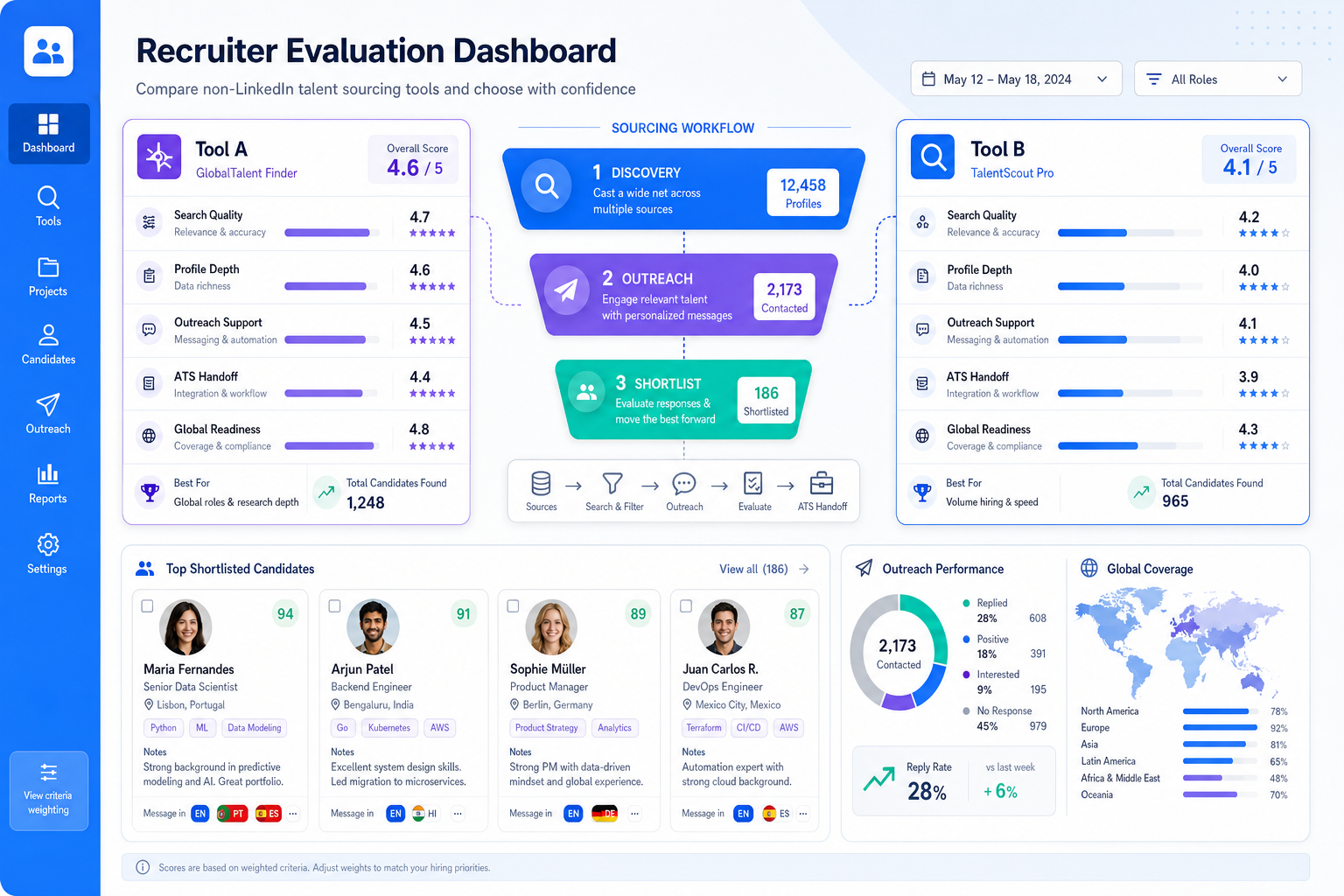
When hard searches stall, this article helps recruiters judge talent sourcing tools to avoid recycled shortlists and improve outreach fit.
That matters most when the assignment is not a volume hire but a business-critical search where the shortlist has to include people who are not applying, not replying quickly, and not impressed by a generic approach. For a solo recruiter, that means wasted hours reviewing familiar profiles and chasing weak leads. For a small agency owner, it can mean slower delivery, thinner differentiation, and client confidence slipping. For an in-house talent lead, it shows up as delayed stakeholder alignment, repeated candidate lists, and a growing gap between the urgency of the role and the quality of the pipeline.
In my own workflow, I have used StrategyBrain AI Recruiter as support when the bottleneck was not final evaluation but repetitive outreach and candidate response handling. Its always-on messaging, multilingual follow-up, and ability to keep outreach moving outside recruiter work hours can help reduce the drop-off that often happens before a recruiter even gets enough information to review a person properly. The recruiter still owns judgment, résumé review, and the decision on who moves forward, but the early communication load becomes easier to manage.
The pressure becomes sharper in executive and leadership hiring, where the search is similar to any other hire in some ways but still requires a more deliberate approach. Strong candidates usually expect competitive compensation and sane working conditions, yet that alone does not make them move. They also weigh whether the role gives them room to create visible change, whether the company has a story worth joining, and whether relocation or a broader geographic move is realistic. In that kind of search, the recruiter is not just filling a vacancy. They are cultivating a pool, approaching people who were not planning to switch, and keeping a more involved vetting process on track while the business wants speed.
That is exactly why non-LinkedIn talent sourcing tools deserve a closer look. When a role depends on proactive outreach, broader geography, passive candidates, and a sharper read on motivation, the real question is not which database is largest. It is which sourcing platforms help you discover net-new people, preserve context, and support a workable recruiter-led process. The right candidate sourcing solution should make that harder search more manageable, not just give you more names to scroll through.
Table of Contents
- Why Hard Searches Break Basic Sourcing
- What Talent Sourcing Tools Should Actually Do
- Four Buying Lenses for Sourcing Platforms
- Types of Non-LinkedIn Sourcing Tools
- Features That Matter in Real Recruiting
- Comparison Framework
- How to Choose by Hiring Context
- Implementation Lessons from the Field
- Mistakes to Avoid
- FAQ
Why Hard Searches Break Basic Sourcing
The reference point for many recruiters is still a straightforward search process: find visible candidates, send outreach, see who responds, and move the most promising people into screening. That can work for common roles. It often breaks for senior, specialist, or business-critical hiring.
In those searches, candidate behavior changes. Top prospects are more likely to be passive. They may need a stronger reason to engage. They often care about the scale of impact they can have, the credibility of the company story, and whether the move helps build a meaningful legacy in their career. A recruiter who ignores those factors usually ends up with activity but not traction.
That is why experienced teams do not evaluate talent sourcing tools only on search mechanics. They also look at whether the tool supports a more involved search, where the recruiter has to build and maintain a thoughtful talent pool, reach beyond one geography, and preserve enough context to approach a senior person credibly.
Key insight: The harder the role is to fill, the less useful it is to judge sourcing software by profile volume alone. Coverage, context, and recruiter usability matter more.
When I am working a harder brief, I want technology to remove repetitive motion but not flatten the nuance of the search. That is where a support tool such as AI Recruiter can be useful alongside broader web-based sourcing: it helps keep outreach conversations active and captures responses or contact details, while I stay focused on calibration, shortlist quality, and stakeholder judgment.
What Talent Sourcing Tools Should Actually Do
Talent sourcing tools are meant to help recruiters identify, organize, enrich, and in some cases contact people before they become applicants. In a non-LinkedIn context, that usually means searching across multiple public or licensed sources, pulling fragmented profile signals together, and helping a recruiter assess whether someone is worth pursuing.
That is different from applicant management. An ATS is built for process control once someone enters the funnel. Sourcing software is built for discovery and early qualification. If your team confuses those jobs, tool selection gets muddy very quickly.
- Talent sourcing tools help uncover people your current workflow may miss.
- Sourcing platforms vary in how deeply they support search, enrichment, rediscovery, and outreach.
- A candidate sourcing solution may bridge search and first-touch engagement, but it should still hand off cleanly to later-stage systems.
- For hard-to-reach talent, the winning stack usually combines sourcing, communication support, and a structured ATS or CRM workflow.
In practice, I treat sourcing software as the top-of-funnel operating layer. If it cannot surface relevant people outside the usual networks or cannot help me act on those leads efficiently, it is not solving the real problem.
Four Buying Lenses for Sourcing Platforms
The executive-search reference material behind this article points to four enduring realities of high-stakes hiring. Those same realities create a useful buying framework for modern sourcing platforms.
1. Basic candidate expectations still matter
Even top candidates care about fundamentals such as compensation, benefits, and culture. A sourcing tool cannot fix a weak opportunity, but it should help you identify people whose background and likely motivations fit the role well enough to justify outreach.
That means profile quality matters. If the system only shows thin or outdated records, the recruiter cannot tailor outreach or judge seniority accurately.
2. The search must support proactive effort
Leadership and specialist searches require more work, not less. Recruiters often need to cultivate a pool over time, return to mapped candidates later, and approach people who are not actively looking.
This is where a strong candidate sourcing solution helps by supporting list building, rediscovery, note-keeping, and outreach readiness instead of forcing the recruiter to start from scratch each time.
3. Opportunity framing matters
Senior people are rarely moved by a title alone. They want to know whether they can shape outcomes, build something memorable, or join a company with enough momentum and credibility to be worth the move.
Software will not create that story, but it should make it easier to preserve and use role context. The recruiter needs enough room to capture why the role matters, which profiles look aligned, and where adjacent-fit talent may exist.
4. Geography should not define the whole search
If the role is important enough, broadening geography can be a smart choice. The executive search reference emphasizes that relocation and diversity widen the talent pool. The same lesson applies to today’s sourcing workflows: do not let a narrow default search box limit the market before the recruiter has even assessed the brief properly.
That is one reason I value tools and workflows that support international communication. When I used StrategyBrain AI Recruiter for response handling on outreach tied to broader searches, the useful part was not replacing sourcing judgment. It was keeping candidate conversations alive across time zones and languages while I focused on actual fit.
Types of Non-LinkedIn Sourcing Tools
The market uses overlapping labels, so buyers often compare unlike-for-like products. These are the main categories worth separating.
Search-first sourcing platforms
These are built for recruiter-led discovery. They emphasize filters, search logic, profile review, and list building. They work well for agencies, embedded recruiters, and TA teams that already have strong sourcing discipline.
Talent intelligence systems
These tools usually add market mapping, workforce visibility, and broader profile aggregation. They can be useful when the question is not only who fits this role, but where the wider talent market sits and what adjacent backgrounds may be viable.
Outreach-enabled sourcing systems
Some products go further into sequencing, reminders, and first-touch engagement. For lean teams, that can reduce tool switching. For more mature teams, it can create overlap unless the outreach capability is genuinely helpful.
Autonomous or semi-autonomous sourcing tools
These promise that the system can find and prioritize candidates with less recruiter input. Some are useful accelerators. Others simply add a layer of automation without enough transparency. Test carefully, especially for senior and specialist roles where nuance matters more than throughput.
Features That Matter in Real Recruiting
1. Data breadth beyond familiar networks
If you are specifically looking at non-LinkedIn options, the first question is obvious: does the tool truly search beyond one dominant network? Web-wide discovery, multi-source aggregation, and profile depth are all more important than a vague claim of a large database.
2. Search accuracy and relevance control
For experienced recruiters, finding fewer but better profiles is often the real productivity gain. Good sourcing platforms help narrow the field intelligently and reduce manual cleanup.
3. Enrichment and contact readiness
A viable candidate sourcing solution should help move from profile discovery to an outreach-ready decision. That includes career history signals, current role context, and enough contact detail to act.
4. Candidate motivation clues
This is under-discussed. Hard searches often turn on why a candidate might engage, not whether they exist in a database. Signals around career progression, market visibility, relocation possibility, or adjacent leadership scope can help a recruiter prioritize better.
5. Outreach support without losing recruiter control
If your team owns outbound sourcing, some automation can help. My own preference is to use support tools for repetitive communication while keeping final judgment manual. In that setup, AI Recruiter works best as a communication assistant rather than as a substitute for sourcing or assessment.
6. ATS and CRM handoff
A sourcing workflow is only as good as its handoff. If records sync badly, create duplicates, or lose the context behind the outreach, the recruiting team pays for it later.
7. Reporting, governance, and auditability
This matters most when searches are sensitive, high-value, or spread across multiple recruiters. Leaders need visibility into who was approached, what was captured, and how the search is progressing.
Comparison Framework
| Evaluation Area | What to Test | Why It Matters |
|---|---|---|
| Coverage | Multi-source discovery beyond one network | Improves access to net-new talent |
| Search quality | Filter depth, relevance, adjacent-fit discovery | Reduces wasted review time |
| Profile depth | Career context, seniority clues, contact readiness | Supports credible outreach |
| Pool management | Notes, rediscovery, list maintenance | Helps with longer and more involved searches |
| Outreach support | Follow-up handling, sequencing, response capture | Keeps early engagement moving |
| Global readiness | Time-zone support, multilingual communication | Useful when geography expands the search |
| ATS/CRM integration | Clean sync and record quality | Protects downstream workflow |
| Governance | Permissions, audit trail, reporting | Supports accountability in sensitive searches |
Score each area against actual hiring conditions. A boutique search firm may prioritize search precision and pool maintenance. A corporate TA team may care more about governance, handoff, and consistency across recruiters.
How to Choose by Hiring Context
For boutique and retained search firms
Precision matters more than feature sprawl. Look for talent sourcing tools that help you build differentiated longlists, preserve market notes, and support proactive outreach to passive talent.
For in-house leadership hiring
Business context matters heavily here. Choose sourcing platforms that let recruiters capture not just fit, but also why the role may appeal to a senior candidate. Clean stakeholder handoff is essential.
For fast-growth companies
You may need a balance of speed and breadth. A good candidate sourcing solution should shorten search time without trapping the team in one channel or requiring too much manual admin.
For global or multilingual searches
When the search goes wider geographically, communication friction rises. That is one of the few areas where I have seen a clear benefit from using StrategyBrain AI Recruiter alongside the sourcing stack: candidates can receive timely replies in their own language, and I can step in once interest and basic information are clear.
Implementation Lessons from the Field
- Start with the search type. A recurring specialist role, a stealth leadership search, and a global expansion hire do not need the same workflow.
- Define what counts as a better shortlist. Without that, software demos drift toward volume instead of relevance.
- Test with one hard role. Senior or niche hiring exposes tool weaknesses faster than standard hiring.
- Separate communication automation from final judgment. Automation can help with speed, but recruiters should still own qualification and progression decisions.
- Preserve motivation context. For tougher searches, note why a candidate may care about the move, not just why they technically fit.
- Review handoff quality early. The sourcing layer only creates value if the ATS or CRM receives usable records with enough history attached.
My practical lesson has been simple: the best results come when sourcing software broadens discovery and communication support reduces repetitive load, while the recruiter stays firmly in charge of nuance, persuasion, and evaluation.
Mistakes to Avoid
Assuming bigger databases solve harder searches
They do not. Senior and passive hiring often depends more on relevance and context than on raw count.
Ignoring the candidate’s decision logic
The executive-search lens reminds us that strong candidates assess compensation, culture, impact, and personal story. If your workflow cannot support that level of personalization, response rates suffer.
Treating outreach as the same as sourcing
Discovery and engagement are related but different. Use each tool for what it actually does well.
Over-automating fit decisions
Automation can speed communication and organization, but recruiter judgment still matters most on résumé review, fit, and next-step decisions.
Running a narrow geography search too early
For critical roles, widening the map can be the difference between another recycled shortlist and a genuinely stronger slate.
FAQ
What are talent sourcing tools?
Talent sourcing tools help recruiters find, organize, enrich, and sometimes contact potential candidates before they apply. They focus on top-of-funnel discovery rather than later-stage applicant management.
Why use non-LinkedIn sourcing platforms?
Because relying on one network often leads to repeated candidate pools. Non-LinkedIn sourcing platforms can broaden coverage, surface passive talent, and support harder or more specialized searches.
What makes a good candidate sourcing solution for executive or specialist hiring?
Look for broad data coverage, strong search precision, profile depth, talent pool management, and enough context to support personalized outreach. For global searches, multilingual communication support can also help.
Can outreach automation replace recruiter judgment?
No. It can reduce repetitive work and keep conversations moving, but recruiters should still own résumé review, fit assessment, and progression decisions.
How should talent sourcing tools connect with ATS or CRM systems?
They should pass clean, structured candidate records into later-stage systems without duplicates or loss of context. That preserves reporting quality and recruiter workflow efficiency.
When is a broader geographic search worth it?
Usually when the role is strategically important, niche, or difficult to fill locally. Expanding geography can improve talent quality and diversity, provided your communication workflow can support it.
Conclusion
The most useful talent sourcing tools are not the ones that simply return the most profiles. They are the ones that help recruiters run a more deliberate search when the role is harder, the candidates are more passive, and the opportunity has to be framed with real substance.
If you are comparing sourcing platforms or choosing a candidate sourcing solution, use the same discipline you would use in a serious executive search: check the fundamentals, support proactive outreach, preserve role context, and do not limit the search too early. Then test how well the software fits the recruiter’s real workflow from discovery through engagement and handoff.
That is the standard that separates software that adds noise from software that actually helps fill the roles that matter most.