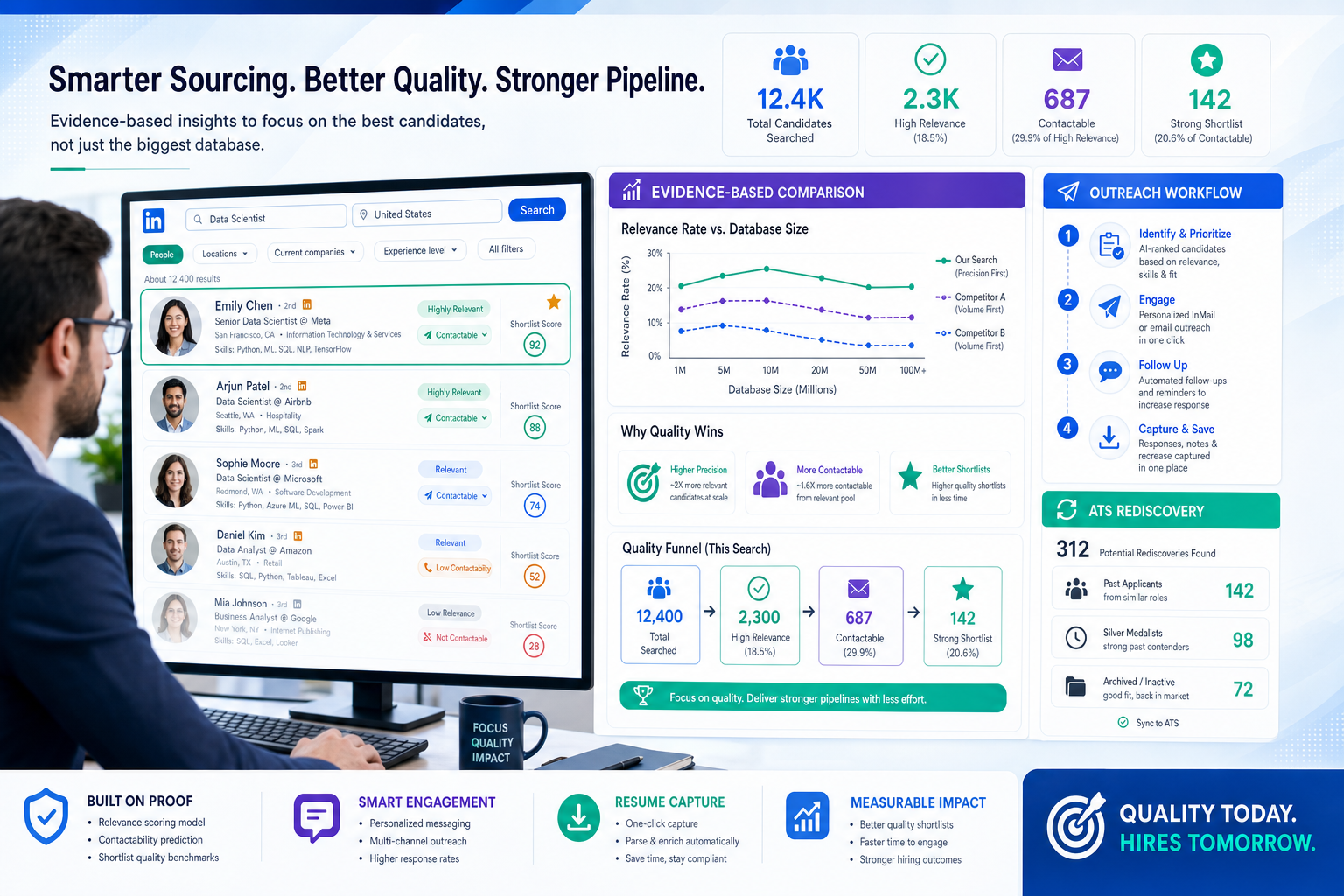
This article helps recruiters evaluate talent sourcing tools by proof, so they avoid bloated lists and defend stronger shortlists.
That sounds simple, but weak sourcing habits usually start with language that looks persuasive and turns out to be empty. Recruiters lose time on bloated lists, agency owners see consultants chasing profiles that do not hold up in interview, and in-house teams damage response rates when outreach is built on generic assumptions instead of proof. The cost is not just efficiency. It affects shortlist quality, hiring-manager trust, and the credibility of your talent function.
That is also why I have found it useful to pair non-LinkedIn search with workflow support rather than relying on search alone. In my own process, StrategyBrain AI Recruiter has been most helpful when repetitive outreach, after-hours replies, and résumé collection start eating into sourcing time. Its always-on candidate messaging, multilingual communication, and automatic capture of interested candidates can reduce manual follow-up pressure, while the recruiter still makes the final call on fit, résumé quality, and whether to move someone forward.
A useful comparison comes from resume review, not software demos. In finance recruiting, hiring teams have long learned to distrust phrases like “team player,” “results-oriented,” “hard working,” or “expert” when nothing on the page proves them. The stronger resume is the one that shows contribution, outcomes, and real level of capability. The same judgment problem appears in sourcing: a profile may look polished, but if the underlying tool cannot show why the person is relevant, the recruiter is still guessing.
Once you see that parallel, the buying question changes. The best recruiting tools to find candidates are not the ones that return the most people or the most flattering profile summaries. They are the platforms that help recruiters strip away generic signals, verify contactability, compare evidence, and move from search to action. That is the core lens I use below to evaluate top sourcing tools for recruiters outside LinkedIn.
Table of Contents
- Why Generic Candidate Signals Fail
- What Are Talent Sourcing Tools?
- Non-LinkedIn Tool Types Compared
- What To Measure Instead of Database Size
- Top Sourcing Tools for Recruiters by Use Case
- Features That Matter in Real Recruiting Work
- ATS vs CRM vs Sourcing Tools
- How To Choose the Right Platform
- Common Buying Mistakes
- FAQ
Why Generic Candidate Signals Fail
One of the clearest lessons from resume screening is that generic language rarely helps a recruiter make a decision. If a candidate writes that they are a team player or results-oriented without showing how, the statement adds almost no hiring value. Good recruiters naturally ask for proof: What team? What result? What did this person specifically do? How deep is the expertise?
The same logic should guide how we evaluate talent sourcing tools. Many platforms produce profiles filled with broad descriptors, inferred skills, and impressive-looking summaries. But if the search experience does not help you validate actual fit, all it has done is shift vague language from a resume onto a dashboard.
In practice, the strongest sourcing platforms help recruiters answer five evidence-based questions:
- Why did this candidate appear in the results?
- Which experience signals support the match?
- How current and trustworthy is the profile data?
- Can I reach this person without excessive manual checking?
- Can I act on this profile inside my workflow quickly?
That evidence-first mindset matters whether you recruit for finance, engineering, operations, sales, or executive roles. Search quality is not about flattering labels. It is about whether a recruiter can defend the shortlist to a hiring manager.
What Are Talent Sourcing Tools?
Talent sourcing tools are platforms that help recruiters discover, organize, assess, and often contact candidates across sources beyond a single professional network. They are designed for top-of-funnel recruiting work: finding people who may not have applied, identifying signals of fit, enriching contact details, and moving qualified prospects into a structured process.
Most modern sourcing tools support some combination of:
- Multi-source candidate discovery
- Boolean or semantic search
- Skills, seniority, industry, and location filters
- Contact enrichment and email lookup
- Browser-based profile capture from the open web
- Shortlist building and tagging
- Outreach support and follow-up reminders
- Rediscovery of older candidates in your ATS or CRM
That last point is often underestimated. A surprising amount of recruiting waste comes from sourcing externally before checking whether your team has already spoken with a strong past applicant or silver medalist. If a tool cannot help surface internal history cleanly, your recruiters may keep starting from zero.
From an operational standpoint, sourcing software is different from the rest of the recruiting stack. It helps answer, “Who should we talk to?” The ATS answers, “Where is this candidate in process?” A CRM answers, “How do we maintain the relationship over time?” Those distinctions matter when teams compare technology categories too broadly.
Non-LinkedIn Tool Types Compared
When recruiters search for top sourcing tools for recruiters, they often expect a simple ranking. That is usually less useful than comparing tool types by hiring motion.
| Tool Category | Best For | Primary Strength | Main Tradeoff |
|---|---|---|---|
| Technical sourcing platforms | Engineering, data, security, product | Skill and project-based relevance | Often narrower for generalist hiring |
| Contact enrichment tools | Recruiters who already know where to search | Reachability and faster outreach | Weak if search quality is poor |
| Outbound workflow tools | High-volume passive candidate outreach | Sequencing, follow-up, response tracking | Can amplify bad targeting |
| ATS rediscovery tools | Teams with large historical applicant databases | Recover overlooked past talent | Dependent on data hygiene |
| CRM-style sourcing platforms | Mature TA teams building long-term pipelines | Search plus nurture capability | Requires process discipline |
| Lightweight SMB tools | Small agencies and lean in-house teams | Faster adoption and simpler workflows | May lack depth for niche searches |
The key is to match the platform to the actual bottleneck. If your recruiters cannot identify relevant people, buy for search quality. If they can identify people but fail to maintain follow-up, buy for workflow. If they are repeatedly overlooking known talent, buy for rediscovery.
What To Measure Instead of Database Size
The resume lesson from earlier is useful here: broad claims are cheap, specifics matter. A vendor can talk about massive profile coverage, AI matching, or industry-leading relevance, but those phrases are as unhelpful as a resume that says “expert” without evidence.
What should recruiters measure instead?
1. Quality of the first page of results
Run the same three to five difficult searches in each platform. Review the first 20 profiles only. If the top of the list is weak, the tool is weak for your use case.
2. Evidence behind the match
Can the recruiter quickly see why the candidate surfaced? This is especially important for technical or niche hiring, where title similarity alone is misleading.
3. Contactability
Even a strong shortlist loses value if outreach fails because email data is stale or hard to verify.
4. Workflow continuity
Can the tool support notes, list management, outreach, reminders, and handoff? Or does the recruiter have to rebuild the process in spreadsheets and inbox folders?
5. Rediscovery of prior talent
If your ATS contains years of candidates, measure how well the platform helps surface previous applicants who are now more relevant.
Key insight: In sourcing, generic profile claims are the equivalent of generic resume buzzwords. Recruiters need proof, not flattering summaries.
Top Sourcing Tools for Recruiters by Use Case
Instead of treating every platform the same, start with the hiring environment you need to support. That is the most reliable way to compare recruiting tools to find candidates without overbuying.
Technical hiring and skill-based search
For engineering or data roles, recruiters need tools that understand stack relevance, project depth, seniority, and adjacent technologies. The strongest platforms surface candidates based on skill evidence rather than only title matching. This is where “expert” becomes a risky word in both resumes and sourcing results. A tool should help you see whether the person is truly advanced, not simply labeled that way somewhere online.
Diversity sourcing and broader market reach
If the problem is overreliance on the same visible candidate pools, a sourcing tool should widen where you search while keeping relevance high. The danger here is creating long lists that look broad but still lack alignment to the role. Widening the funnel only helps when the tool still preserves enough signal quality for meaningful outreach.
Outbound-heavy passive recruiting
Some recruiters already know how to source but cannot keep pace with follow-up. This is where workflow support becomes more important than raw search volume. In my own desk work, tools are most useful when they reduce repetitive communication without taking away recruiter judgment. For that reason, I have used AI Recruiter alongside sourcing work when a campaign required after-hours replies, multilingual communication, and automatic collection of resumes from interested candidates. What it did well was keep conversations moving; what it did not replace was my evaluation of whether the candidate actually matched the brief.
CRM-led pipeline building
For teams filling similar roles every quarter, the objective is not a one-time search. It is creating reusable talent pools with notes, segmentation, and nurture logic. A platform with strong search but no memory becomes expensive over time because recruiters repeat the same discovery work.
Lean teams and smaller agencies
Smaller recruiting businesses usually need something different from enterprise talent teams. Fast adoption, decent contact quality, and simple workflow support matter more than feature sprawl. A lighter tool that your team actually uses will outperform a sophisticated platform that never becomes part of recruiter habits.
Features That Matter in Real Recruiting Work
Once you move past generic claims, several capabilities tend to separate strong sourcing software from platforms that only look good in demos.
Search relevance
The top results should feel defensible to an experienced recruiter. If too many results are adjacent but not right, the platform creates review fatigue.
Multi-source visibility
Non-LinkedIn evaluation usually means you want reach beyond one ecosystem. The ability to combine public professional signals, internal databases, and niche communities matters.
Contact data quality
Good sourcing creates options. Good contact data turns those options into conversations.
Outreach continuity
Many tools stop at discovery. But in actual recruiting, value is created when a candidate replies, shares a resume, or agrees to speak. For teams that struggle there, automation can help if it stays within recruiter control. I have seen the most practical benefit when StrategyBrain AI Recruiter handled repetitive outreach and résumé capture during busy search periods, especially when candidates replied outside working hours. That relieved manual pressure without changing the basic rule that the recruiter must still review the resume and decide next steps.
ATS and CRM connection
If recruiters have to copy data by hand or maintain duplicate records, even a good search tool will lose adoption. Workflow fit is not a secondary concern. It is often what determines whether a sourcing platform becomes part of the operating model.
ATS vs CRM vs Sourcing Tools
These categories overlap, but they solve different problems.
| System Type | Main Purpose | Core Question |
|---|---|---|
| Sourcing tool | Find and engage prospects | Who should we contact? |
| Applicant tracking system | Manage active candidates through process | Where is each candidate now? |
| Recruiting CRM | Maintain long-term relationships | How do we nurture talent over time? |
Teams get into trouble when they expect one category to do all three jobs equally well. The better approach is to define where discovery starts, where evaluation happens, and where relationship history lives.
If your recruiting operation has strong sourcing but weak handoff, invest in integration and process. If the ATS is tidy but top-of-funnel is weak, invest in search. If people keep getting rediscovered from scratch, invest in CRM discipline.
How To Choose the Right Platform
If you are building a shortlist of top sourcing tools for recruiters, use a process that mirrors how recruiters assess candidates: remove generic claims, look for evidence, and test in live conditions.
- Start with hard roles. Easy requisitions do not reveal tool limitations quickly enough.
- Test the first 20 results. Do not be distracted by total result counts.
- Look for proof of fit. The tool should show why each profile is relevant.
- Check contactability. Search without reachability is only partial value.
- Review workflow support. Search, outreach, reminders, and data capture should connect.
- Assess internal rediscovery. Strong past candidates should be easy to surface.
- Include recruiter usability testing. Leadership demos rarely show daily friction.
A practical SEO and CTR lesson applies here too: strong titles and opening lines work because they promise specificity. Buyers respond the same way in software evaluation. If a platform describes itself in broad, flattering terms but cannot demonstrate what makes results better, experienced recruiters tune out.
Common Buying Mistakes
Even experienced teams make avoidable errors when evaluating talent sourcing tools.
- Buying on profile volume alone. Big databases can still produce poor shortlists.
- Confusing polished summaries with real evidence. Generic labels are not proof of fit.
- Automating weak outreach logic. Messaging scale does not fix bad targeting.
- Ignoring old candidates in the ATS. Silver medalists are often easier wins than new cold outreach.
- Overcomplicating the stack for small teams. Adoption matters as much as capability.
- Treating sourcing and recruiter workflow as separate problems. The handoff is where many desks lose momentum.
The common thread is simple: recruiters should judge tools the same way they judge resumes. Cut vague claims. Prioritize proof. Ask what actually helps a decision get made.
FAQ
What are talent sourcing tools?
Talent sourcing tools are platforms that help recruiters find, organize, and often contact potential candidates before they apply. They usually combine search, filtering, contact enrichment, and workflow support.
How are sourcing tools different from ATS software?
Sourcing tools help you identify and engage prospective candidates. ATS software manages candidates after they enter the hiring process. One supports discovery; the other supports execution.
What should recruiters look for in non-LinkedIn sourcing tools?
Look for search relevance, evidence behind the match, contact data quality, workflow fit, and the ability to rediscover candidates already in your systems.
Why is database size a weak buying criterion?
Because volume does not guarantee relevance. Recruiters benefit more from a tool that returns 20 strong, contactable prospects than one that returns 2,000 loosely related profiles.
Can outreach automation help with sourcing?
Yes, especially for passive candidate recruiting, but only when it supports a strong search process. Automation can help with follow-up, multilingual communication, and resume capture, while the recruiter still owns fit assessment and decision-making.
Conclusion
The best talent sourcing tools help recruiters do what good resume reviewers already know how to do: remove vague claims, focus on evidence, and make decisions faster with more confidence. That is why the real comparison is not database size versus database size. It is signal quality, contactability, workflow continuity, and how well the tool helps a recruiter defend the shortlist.
If you are comparing recruiting tools to find candidates, use your hardest searches, judge the first page of results, and test what happens after discovery. For most teams, the best top sourcing tools for recruiters are the ones that turn proof into pipeline, not just profiles into clutter.