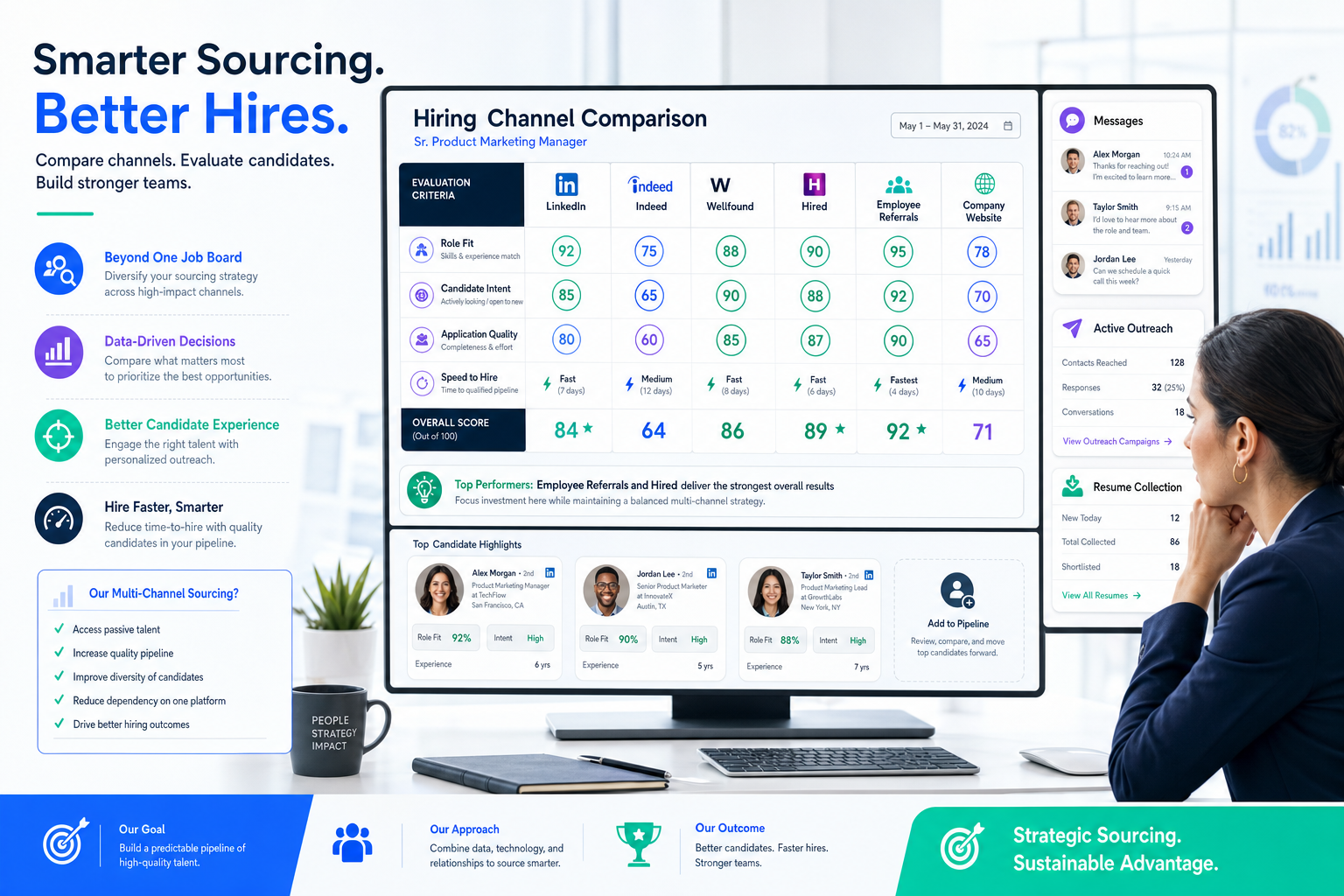
Match role fit, candidate intent, and speed to judge what’s the best alternative to Indeed and avoid weak pipelines and bloated shortlists.
That matters because the wrong source does more than waste posting budget. It creates weak pipelines, duplicate applications, slow hiring-manager feedback loops, and missed candidates who were never searching on one major board in the first place. For agency recruiters, that means more manual follow-up and fewer placements. For in-house teams, it usually means bloated shortlists and less confidence in which source is actually working.
In my own workflow, tools that reduce repetitive outreach and keep candidate conversations moving can help before the formal application stage. AI Recruiter is one example I have looked at for LinkedIn-heavy sourcing because it can automate first-touch messaging, keep replies moving after hours, and collect resumes or contact details from interested people while the recruiter still makes the final judgment on fit, resume quality, and whether to advance someone. That kind of support is most useful when the real problem is channel chaos, not a lack of places to post.
A useful reminder came from a March 2018 professional development seminar focused on women in PR and career positioning. One recruiter’s takeaway was not about gaming job boards at all. It was about how candidates prove value: anticipating needs, showing problem-solving ability, bringing personality to the first conversation, and aligning with a team beyond the line items on a job description. The seminar also noted a market tension many recruiters recognize immediately: a competitive local market can still offer compensation that feels less attractive than comparable roles in another city.
That is exactly why the search for Indeed alternatives cannot be reduced to a generic top-10 list. When candidates are weighing credibility, compensation, culture, and long-term goals, and recruiters are screening for adaptability, ideas, and team fit, the best channel depends on the job itself. So if you are wondering where to look for jobs other than Indeed, or whether general LinkedIn alternatives are stronger for a certain role type, the right answer starts with decision criteria rather than brand loyalty.
Table of Contents
- What’s the best alternative to Indeed?
- The criteria that actually matter
- Quick comparison of general LinkedIn alternatives and Indeed alternatives
- Best overall for broad job searches
- Best for remote jobs
- Best for tech jobs
- Best for startups
- Best for entry-level jobs
- Where to look for jobs other than Indeed
- Should you apply on a job board or the company website?
- How LinkedIn sourcing fits into the search
- How to choose by industry and career stage
- FAQ
What’s the best alternative to Indeed?
The best alternative to Indeed depends on what the candidate needs to evaluate and what the recruiter needs to verify. For broad-market searches, large job boards still help with volume and discovery. For PR, tech, startup, remote, or early-career roles, specialized channels often work better because they surface openings in a context where compensation, growth path, employer identity, and role expectations are clearer.
The seminar example above is useful because it highlights how real job decisions happen. Candidates are not only looking for a vacancy. They are assessing whether they can market their value, whether the employer will recognize that value, and whether the package, team environment, and future opportunity make sense. Recruiters are making a parallel judgment about readiness, communication style, and personal fit. That is why the strongest answer to what’s the best alternative to Indeed is usually a role-based choice, not a universal winner.
In practice, experienced recruiting teams rarely rely on a single source. They combine broad visibility, targeted discovery, direct applications, and networking. Candidates who do the same usually see more of the market and avoid overdependence on one board’s ranking, sponsorship model, or duplicate listings.
The criteria that actually matter
Before comparing Indeed alternatives, it helps to use a recruiter’s screening lens. The seminar themes map surprisingly well to job-platform choice because they point to what both sides are trying to learn early.
- Role fit: Does the channel attract candidates and employers in the same function, level, or niche?
- Compensation clarity: Can you judge whether the market rate is competitive across locations?
- Employer context: Does the listing give enough information about team, culture, and expectations?
- Candidate intent: Are people on the platform actively applying, casually browsing, or open to direct outreach?
- Application quality: Does the source lead to thoughtful applications or high-volume, low-fit submissions?
- Speed: Will the role likely move fast enough that direct applications or networking matter more than board volume?
Those factors are more practical than a simple popularity ranking. They also explain why one channel can work very well for PR, communications, sales, or operations roles while another performs better for software engineering or startup hiring.
Quick comparison of general LinkedIn alternatives and Indeed alternatives
| Platform Type | Best For | Why It Works | Main Limitation |
|---|---|---|---|
| Broad job boards | General business, support, operations, sales | High listing volume and easy market scanning | More noise, duplicates, and uneven fit |
| General LinkedIn alternatives | Professionals who want context plus networking | Combines jobs, profiles, and employer visibility | Can favor passive candidates over active applicants |
| Niche industry boards | PR, marketing, tech, healthcare, finance, legal | Better language match and stronger intent | Smaller inventory |
| Startup-focused boards | Early-stage and growth-stage companies | Candidates self-select for pace and ambiguity | Less useful for traditional corporate roles |
| Remote-specific boards | Distributed teams and remote-first candidates | Better filters for location and work style | Competition is often intense |
| Company career pages | Direct applications | Cleaner, more current, and closer to the employer | Takes more effort to search company by company |
For most searchers, the comparison above is a better answer than naming a single winner. It speaks to three common searches at once: what’s the best alternative to Indeed, where to look for jobs other than Indeed, and which general LinkedIn alternatives make sense for a particular job-search strategy.
Best overall for broad job searches
If you need wide coverage across many industries, a large general job board is still one of the strongest Indeed alternatives. It is efficient for market mapping, salary benchmarking, and comparing many openings quickly.
But large boards work best when you treat them as discovery tools, not as the whole strategy. In recruiting operations, the downside is familiar: sponsored posts crowd results, stale listings linger, and applicant quality varies dramatically. From the candidate side, you may see the opening first on a large board but get better results by verifying it on the employer’s own site before applying.
That broad-board approach is especially useful for operations, customer support, administrative, and general business roles where listing volume still matters. It is less decisive for niche work where role language and employer context carry more weight.
Best for remote jobs
For remote work, specialized remote-job platforms usually outperform a general board with a remote filter. Candidates need clearer information on time zones, location restrictions, employment status, and how a distributed team actually operates.
If you are asking where to look for jobs other than Indeed because remote searches feel noisy, this is often the cleanest place to improve results. Remote-specific channels reduce the number of mislabeled hybrid jobs and make it easier to spot companies that are genuinely built for distributed work.
Recruiters should keep in mind that remote roles often attract very high application volume. Better channels help, but clear screening and role definition matter just as much.
Best for tech jobs
For engineering, data, IT, cybersecurity, and product roles, tech-focused channels tend to beat broad boards on relevance. The reason is simple: they support more specific filters, clearer stack language, and candidate expectations that are closer to how technical hiring really works.
When someone asks what’s the best alternative to Indeed for tech jobs, the answer is rarely “the biggest site.” It is usually the place where the role is described with enough technical precision that qualified candidates can tell whether it is worth their time.
Broad boards still help with reach, but they are often a secondary layer here. Strong tech hiring usually comes from a mix of niche boards, direct sourcing, referrals, and career-page applications.
Best for startups
Startup candidates are often evaluating more than title and compensation. They want to understand stage, mission, reporting lines, pace, and whether the role has genuine scope. That makes startup-focused job marketplaces strong Indeed alternatives for people targeting smaller or faster-moving companies.
This also connects back to the seminar’s theme of knowing your worth. In startup hiring, value is often framed in terms of initiative, adaptability, and ability to contribute beyond a narrow job description. Those traits are easier to assess when the channel itself gives more context about the company and role than a generic listing page.
For candidates, apply quickly and directly. For recruiters, expect role requirements to evolve faster than they do in larger organizations.
Best for entry-level jobs
Students, recent graduates, and career changers usually get better results on channels built for early-career hiring. Campus boards, graduate-job sites, internship marketplaces, and employer career pages with structured entry pathways often outperform broad boards for this audience.
This is another reason generic rankings are not very helpful. A candidate seeking a first PR coordinator role, for example, needs different signals than an experienced account director. They need to know whether the employer will train, whether the role truly welcomes limited experience, and whether the compensation is realistic for the market.
That is why early-career candidates should combine targeted boards with direct employer research instead of relying only on one giant marketplace.
Where to look for jobs other than Indeed
If you want a practical answer to where to look for jobs other than Indeed, use a layered search process.
- Start with one broad board to scan the market and identify active employers.
- Add one niche source tied to your function, such as PR, marketing, tech, finance, or healthcare.
- Use general LinkedIn alternatives and professional networks to understand the people and teams behind the listing.
- Check company career pages for the roles you care about most.
- Use networking selectively to clarify compensation, reporting lines, or whether the role is still active.
This layered approach reflects how good recruiters source and how strong candidates search. One channel gives reach. Another gives precision. A direct application gives better control.
Practical takeaway: The best replacement for Indeed is usually not another single site. It is a tighter combination of broad discovery, niche relevance, and direct employer access.
Should you apply on a job board or the company website?
Use the job board to discover the opportunity, then apply through the company website when possible. That advice holds up in most hiring environments because company sites are usually more current and more closely tied to the employer’s actual recruiting workflow.
For job seekers comparing Indeed alternatives, this matters more than many platform reviews admit. A job board can show you what exists, but the employer’s site often gives better role detail, cleaner application steps, and a stronger signal that the opening is still live.
It also helps when you are evaluating compensation and fit. If a listing feels vague on a board but more specific on the career page, that alone tells you something about how carefully the employer manages hiring communications.
How LinkedIn sourcing fits into the search
Because this topic overlaps with general LinkedIn alternatives, it is worth separating two different uses of LinkedIn-style channels: candidate discovery and employer assessment. They are often useful not because they replace boards entirely, but because they add context that boards often miss.
In my experience, LinkedIn-heavy recruiting becomes most effective when it handles relationship-building rather than acting like a static listing archive. That is where I see the appeal of StrategyBrain AI Recruiter for teams doing large volumes of outreach. It can keep conversations active across time zones, respond when candidates write back after hours, and collect resumes from those who are genuinely interested. I would still review the resume myself, decide whether the person’s background actually fits the brief, and determine next steps, but it can remove a lot of repetitive delay from front-end sourcing.
That matters for recruiters working communications, PR, marketing, and similar roles where personality, responsiveness, and employer positioning all shape conversion. If a candidate’s first impression depends on timely engagement, a tool that supports 24/7 multilingual messaging and captures interested replies can help maintain momentum while the recruiter stays focused on judgment calls. Anyone exploring that workflow can review the product page here: AI Recruiter, or its broader background here: StrategyBrain.
The larger point is not that LinkedIn outreach replaces job boards. It is that different channels solve different parts of the recruiting problem. Boards create discovery. Profile-based networks create context. Direct applications create cleaner conversion.
How to choose by industry and career stage
PR, communications, and marketing roles
Use a mix of niche boards, professional networking channels, and employer career pages. These roles often depend on portfolio thinking, communication style, and employer brand, so context matters more than raw listing count.
General business roles
Start with a broad board, then verify the opening on the company website. This is often the most practical answer to what’s the best alternative to Indeed for support, operations, admin, and sales work.
Technical roles
Use a tech-focused board first, then layer in direct outreach and referrals. Technical fit is easier to judge when the platform supports technical specificity.
Startup roles
Use startup-focused marketplaces and apply directly once you confirm interest. These companies move fast, and the role can shift quickly.
Entry-level roles
Use graduate-oriented channels plus company career pages. Look for employers that explain training, progression, and realistic expectations clearly.
FAQ
Is there a better site than Indeed?
Yes, in the right context. For some general roles, another broad board may work just as well. For niche, remote, startup, or early-career roles, a specialized source may be much better.
What’s the best alternative to Indeed for professional roles?
For professional roles, the best choice usually combines one broad board, one niche or network-driven source, and direct applications through company sites. That gives better context than relying on one marketplace alone.
Where should I look for jobs other than Indeed?
Look at niche industry boards, general LinkedIn alternatives, company career pages, remote-job platforms, startup-job sites, and targeted networking channels tied to your field.
Are Indeed alternatives better for salary visibility?
Sometimes. The better platforms are usually the ones that provide more employer context and make cross-market comparisons easier. In some fields, niche boards and direct networking reveal more realistic compensation signals than broad boards do.
Should recruiters use job boards or LinkedIn-style sourcing?
Usually both. Job boards help with reach and discovery, while LinkedIn-style sourcing helps with context, direct contact, and passive-candidate engagement. The right mix depends on the role.
Conclusion
If you started with the question what’s the best alternative to Indeed, the most honest answer is that the best option depends on the kind of opportunity being evaluated. The seminar example from PR recruiting makes that clear: candidates are weighing worth, compensation, personality fit, and long-term goals, while recruiters are screening for value, adaptability, and commitment. A single giant board cannot solve all of that on its own.
So the smarter path is to match the channel to the decision. Use broad boards for discovery, niche sources for relevance, networking platforms for context, and company career pages for cleaner applications. That is the most reliable answer to both Indeed alternatives and where to look for jobs other than Indeed if you want better signal instead of just more listings.