When follow-up lag and low-signal volume are hurting placements, this article helps recruiters judge what’s the best alternative to Indeed.
That distinction matters in real recruiting work. A board can flood your inbox and still hurt hiring if it attracts low-intent applicants, hides passive talent, or leaves your team sorting resumes while candidate conversations go cold. For solo recruiters, small agency owners, and in-house talent teams, the cost is not just time. It shows up in missed placements, slower response cycles, weaker employer perception, and strained hiring-manager trust.
In my own LinkedIn-heavy searches, one way I have reduced that drag is by using StrategyBrain AI Recruiter to handle the repetitive first layer of outreach, candidate replies, and resume collection while I keep control of shortlist judgment and next-step decisions. In practice, its strongest fit is when follow-up speed matters, after-hours candidate replies pile up, or multilingual outreach creates friction. I still review the actual resumes, decide whether the profile is relevant, and own the hiring recommendation.
The reason that workflow matters becomes clearer when you look at how people evaluate work itself. Employees do better when the environment supports the way they actually operate, not when companies bolt on extra programs nobody uses. In workplace design, that means shaping the daily setting around comfort, focus, movement, and collaboration. In recruiting, the parallel is obvious: if your hiring channel forces extra effort, duplicate admin, and fragmented messaging, recruiters and candidates default to the easiest path, even when it produces worse outcomes.
That is also why the search for better Indeed alternatives is not only about audience size. It is about whether a platform fits natural recruiting habits: profile discovery for passive talent, quiet space for deeper evaluation, open visibility for employer brand, and workflow design that keeps communication close at hand. Once you frame the decision that way, LinkedIn emerges as the strongest general alternative for many recruiters—but not for every hiring case, and not without support from the right process and tools.
Table of Contents
- What Is the Best Alternative to Indeed?
- Why the Answer Depends on Recruiting Environment
- Quick Comparison of Indeed Alternatives
- Why LinkedIn Is the Best General Alternative
- Where LinkedIn Is Not the Best Fit
- What Workplace Design Teaches Recruiters About Platform Choice
- How I Use LinkedIn and AI Recruiter Together
- How Recruiters Should Choose Among Indeed Alternatives
- Should You Apply on Job Boards or Company Websites?
- FAQ
What Is the Best Alternative to Indeed?
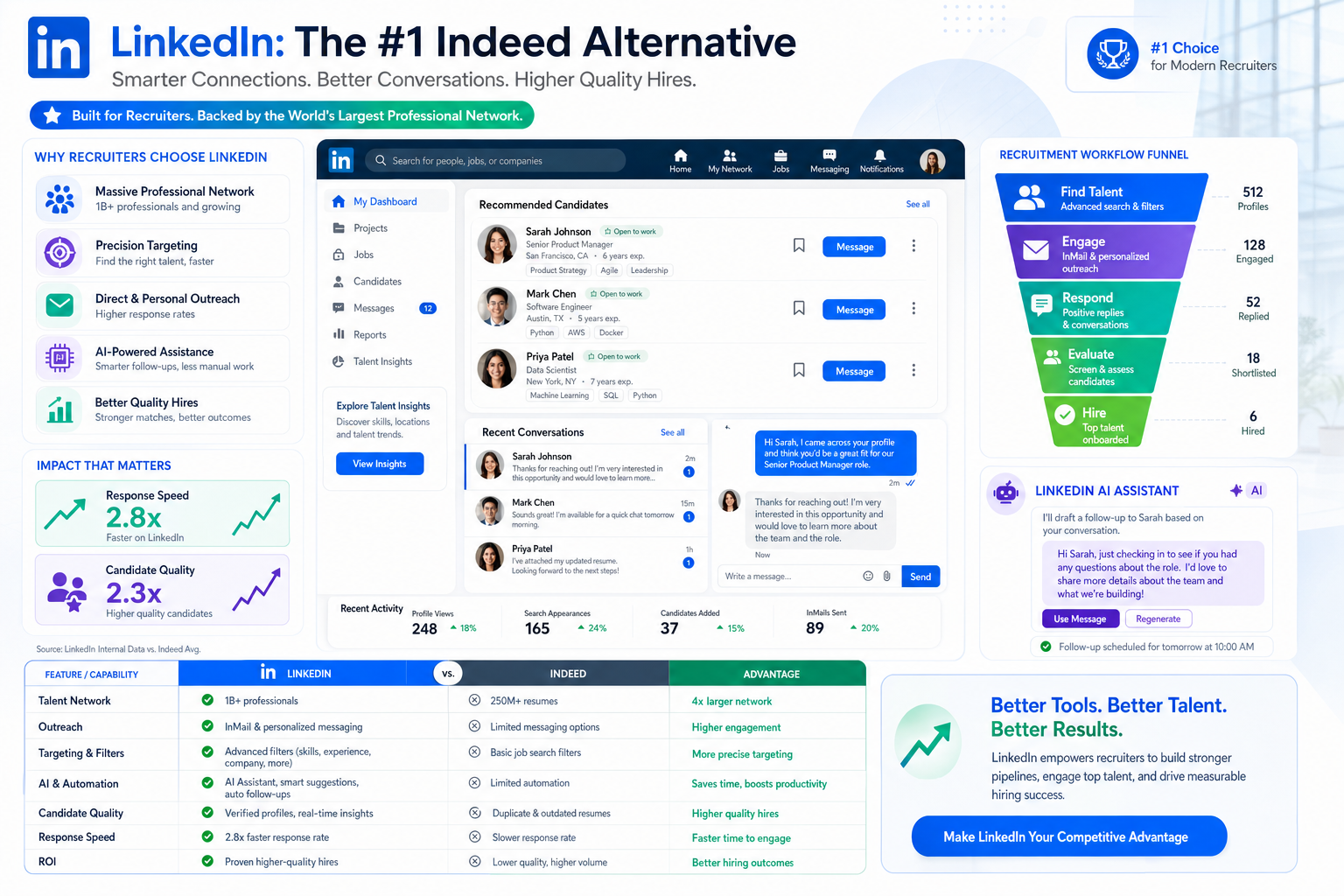
LinkedIn is the best general alternative to Indeed for most recruiters, headhunters, and experienced professionals because it combines job discovery, profile-based sourcing, recruiter visibility, employer branding, and network-driven trust in one place.
If someone asks me what’s the best alternative to Indeed, I do not answer by traffic alone. I answer by hiring behavior. Indeed is strong when you need broad reach and active applicants quickly. LinkedIn is stronger when the role depends on credibility, work history, passive talent, referrals, and professional context. That makes it the better all-around choice for many white-collar, mid-career, and specialist searches.
Still, the best answer changes by use case. High-volume operational hiring may need faster top-of-funnel application flow. Remote hiring may benefit from targeted niche boards. Employer review platforms can matter more when candidates are screening companies as carefully as companies screen them. So while LinkedIn is my default answer among Indeed alternatives, it is not the only useful answer.
Why the Answer Depends on Recruiting Environment
One of the most useful ideas from workplace strategy is that people rarely sustain behaviors that require extra effort on top of an already busy routine. That is why optional wellness perks often underperform, while changes to the actual work environment have a bigger effect. In recruiting, the same principle applies to sourcing channels.
If a platform makes recruiters chase scattered conversations, re-enter candidate details, dig through low-signal volume, or wait too long for meaningful profile context, it creates friction. Most teams will either overuse easy-apply volume or abandon the channel. Candidates behave the same way. If an application path feels stale, unclear, or duplicative, many good prospects leave.
So when assessing Indeed alternatives, do not just ask which site is biggest. Ask which environment supports your actual hiring habits. Do you need a place that encourages proactive outreach? A place where employer identity is visible before application? A place where profiles tell a richer story than a one-page resume? The best recruiting choices usually come from environment fit, not list count.
Quick Comparison of Indeed Alternatives
| Platform Type | Best For | Main Strength | Main Limitation |
|---|---|---|---|
| Professional network platform | Passive talent, recruiter visibility, white-collar hiring | Rich profiles, networking, employer brand | Less useful for some local volume hiring |
| Fast-match job marketplace | Urgent hiring, broad applicant flow | Speed and reach | Can generate heavy screening volume |
| Review-led job platform | Candidate research, salary visibility | Company context and reputation signals | Weaker for direct sourcing |
| Legacy general job board | Wide audience, standard posting coverage | Familiarity and scale | Stale listings and duplicate exposure concerns |
| Niche board or community | Remote, technical, creative, regulated roles | Audience relevance | Smaller overall reach |
This is the comparison I would use before making a budget call. Then I would validate it against real funnel data: qualified screens, interview rates, offer rates, and recruiter effort required to get there. A channel that feels productive can still be expensive in hidden labor.
Why LinkedIn Is the Best General Alternative
LinkedIn wins as the best general answer because it is not just a job board. It is a labor-market map. You can see work history, mutual connections, content activity, profile completeness, and signs of professional credibility before you ever send a message.
That changes the sourcing model. Instead of waiting for active applicants only, recruiters can identify passive candidates, sense how visible the employer brand is, and approach people with more context. For candidates, the benefit is discoverability. A strong profile can create inbound interest even before they start actively applying.
From a recruiter’s perspective, that profile depth often produces better judgment earlier in the funnel. You are not guessing from a stripped-down application alone. You can evaluate trajectory, relevance, stability, and communication signals more quickly. That is why, when people ask what’s the best alternative to Indeed, LinkedIn is usually the most practical broad answer.
Where LinkedIn Is Not the Best Fit
LinkedIn is not automatically best for every search. If you are filling a large number of hourly roles fast, a high-volume marketplace may create more immediate applicant flow. If your challenge is candidate trust in the employer, review-led platforms may influence conversion more. If the role is highly specialized, a niche board may produce fewer but better-matched applicants.
There is also the operational reality that LinkedIn can become message-heavy. Good candidates often reply after hours, across time zones, or in different languages. If the recruiter cannot keep up, the advantage of the platform weakens. This is one reason workflow support matters as much as platform selection.
That is where I have found AI Recruiter useful in practice. For searches where I need LinkedIn’s network and profile depth but do not want candidate replies sitting untouched overnight, it helps carry the repetitive front-end communication, answer basic role questions, and collect resumes from interested prospects. I still make the real recruiting calls, but the lag between candidate interest and recruiter response becomes much easier to manage.
What Workplace Design Teaches Recruiters About Platform Choice
The workplace article behind this discussion made a simple but important point: productive environments are built from the inside out. You do not copy another office because it looks modern. You first ask what your people actually need to do well, then shape the space around those needs.
Recruiting platforms should be chosen the same way.
- Work inward, not outward: Start with the role type, talent market, recruiter capacity, and stakeholder expectations. Do not choose a platform because everyone else uses it.
- Create open space carefully: In office design, open areas can improve collaboration if balanced well. In recruiting, broad-visibility platforms are useful when you want discovery, referrals, and brand reach—but they need structure.
- Protect privacy and focus: Quiet space matters at work, and signal quality matters in recruiting. If a source generates distraction without depth, productivity drops.
- Use natural paths: People use what is closest and easiest. Candidates do the same. Clean application paths and fast follow-up beat complicated process design.
- Ask the people doing the work: Just as smart employers survey employees before changing the office, smart recruiting leaders should ask recruiters and candidates where the process breaks.
This framework is more useful than most platform rankings because it forces you to connect hiring channels to actual recruiter behavior and candidate behavior. That is the real decision criteria behind strong Indeed alternatives.
How I Use LinkedIn and AI Recruiter Together
When I run searches that live or die on LinkedIn outreach, I try to protect my own time for the parts only a recruiter should do: calibrating with the hiring manager, refining the target, reading resumes closely, and deciding who deserves a serious conversation.
The repetitive part is different. Candidate connection requests, first-touch role introductions, routine replies about the company or compensation range, and resume collection can consume hours without improving judgment quality. In those situations, I have used StrategyBrain AI Recruiter as a support layer rather than a substitute for recruiting. It is most useful when:
- candidates reply outside normal working hours
- you are sourcing across multiple countries or languages
- you need to keep outreach moving while protecting recruiter focus
I want to be careful here: it does not replace final qualification. It helps move conversations forward, gathers interested-candidate information, and reduces the dead time between outreach and response. I still decide whether a profile is right, whether the resume really matches, and whether the candidate moves to interview. For LinkedIn-centric recruiting, that division of labor has been the most sensible use I have seen.
If you want to understand how that workflow is positioned in more detail, the public AI Recruiter overview and the broader LinkedIn recruiting notes are the most relevant starting points.
How Recruiters Should Choose Among Indeed Alternatives
If you are deciding among Indeed alternatives, use these four questions first.
- What kind of talent are you trying to reach?
Passive professional talent points toward LinkedIn-style platforms. Urgent active applicants may point elsewhere. - Where does your funnel usually break?
If you get applicants but few interviews, your issue is quality. If you get replies late and lose momentum, your issue is follow-up capacity. - How much context does the role require?
The more credibility, trajectory, and stakeholder fit matter, the more valuable profile-rich sourcing becomes. - What can your team realistically manage?
A great channel still fails if your recruiters cannot respond, screen, and coordinate at the required speed.
That last point is underestimated. Platform choice is really workflow choice. A better sourcing channel with weak execution often performs worse than an average channel with disciplined follow-up.
Practical takeaway: Choose the platform that fits how your recruiters and candidates actually behave, then support it with a workflow that removes routine friction without removing human judgment.
Should You Apply on Job Boards or Company Websites?
For candidates, the best habit is to use job boards to discover opportunities and the employer’s career site to verify them. This reduces the risk of stale or duplicate listings and helps confirm that the opening is still active.
For employers and recruiters, the equivalent lesson is to treat outside platforms as sourcing channels, not the source of truth. Your own hiring workflow should remain anchored in your internal process, whether that is an ATS, a structured CRM, or a clearly managed recruiter workflow.
That is another reason LinkedIn often works well as an Indeed alternative. It supports discovery and outreach without forcing you to treat the platform itself as your entire hiring system.
FAQ
What is the best alternative to Indeed?
For most recruiters and professionals, LinkedIn is the best general alternative because it combines jobs, sourcing, networking, and employer visibility in one place.
Is LinkedIn better than Indeed?
LinkedIn is often better for professional hiring, passive candidate sourcing, and profile-based evaluation. Indeed can still be better for broad active applicant flow in some hiring categories.
Why do recruiters look for Indeed alternatives?
Usually because they want better candidate quality, stronger employer visibility, more passive talent access, or a workflow that creates less screening waste.
Are niche job boards better than general job boards?
They can be. For specialized roles, niche boards often produce more relevant applicants even though total volume is lower.
Can AI help with LinkedIn recruiting without replacing the recruiter?
Yes. In the best use cases, AI supports repetitive outreach and candidate communication while the recruiter keeps control of qualification, judgment, and interview decisions.
Conclusion
If you came here asking what’s the best alternative to Indeed, my practical answer is LinkedIn for general recruiting use—especially when hiring depends on professional context, passive talent, and recruiter visibility.
But the better long-term lesson is broader. The strongest Indeed alternatives are the ones that fit the real environment of recruiting work. Just as healthy workplaces are designed around natural behavior instead of forced extras, effective hiring channels should reduce friction, support focus, and match the way recruiters and candidates actually operate.
That is why LinkedIn is often the best starting point, and why workflow support matters so much once you choose it. When outreach volume, after-hours replies, and multilingual conversations start slowing down recruiter judgment, tools like StrategyBrain AI Recruiter can help keep the front end moving while the recruiter stays responsible for the final call. In my experience, that is the right way to think about platform choice: not as a popularity contest, but as a working system built around better hiring behavior.