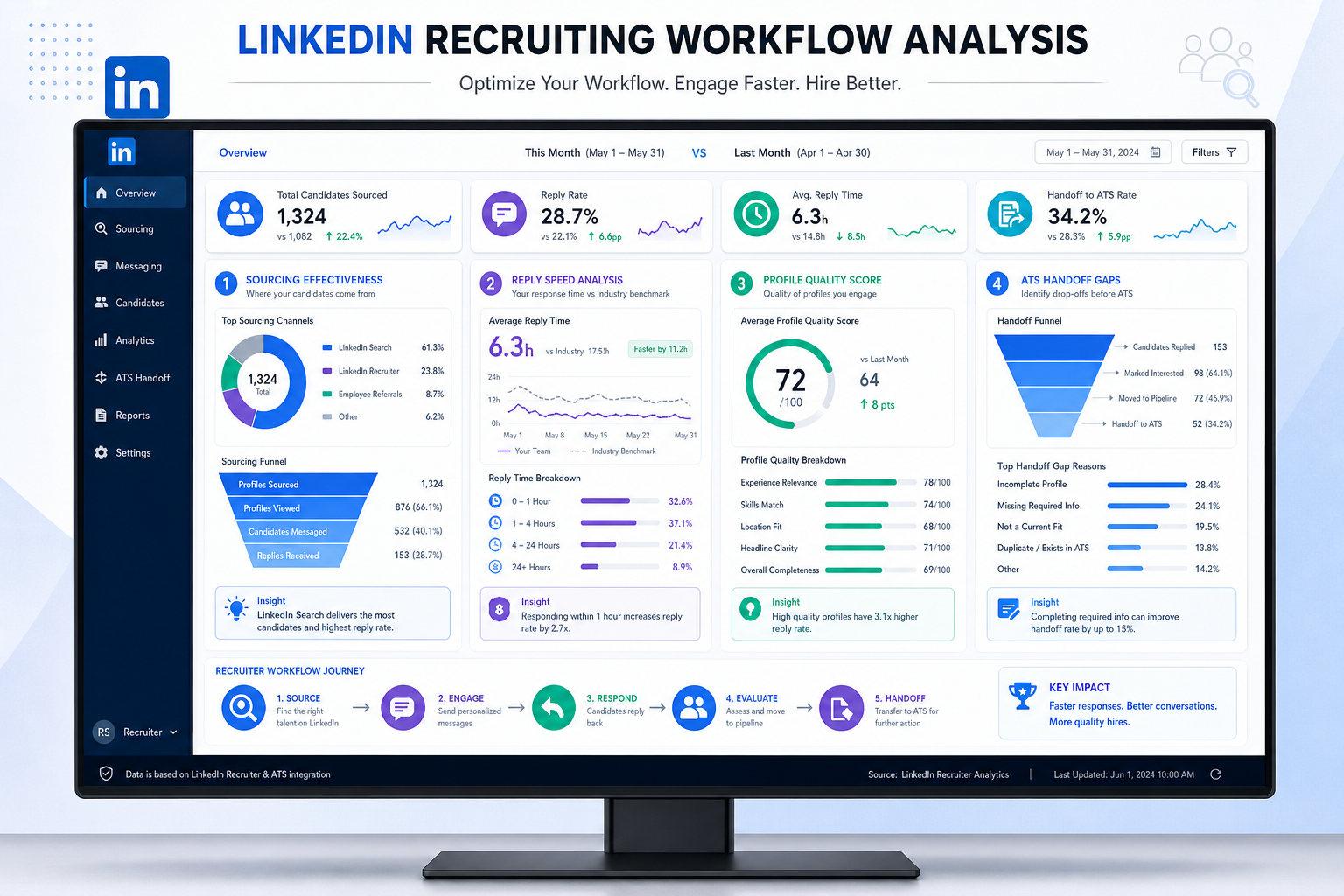
Compare ai recruiting companies with this guide to spot reply, profile, and handoff gaps before LinkedIn candidates go cold.
That matters because LinkedIn recruiting usually breaks long before the interview stage. A recruiter can have a strong requisition, decent outreach copy, and a workable shortlist strategy, yet still lose candidates because the first click never happens, the follow-up lands too late, or profile context is weak enough that good prospects keep scrolling. For small agency owners, that means lower consultant output and harder desk economics. For solo recruiters, it means nights spent catching up on replies and résumé requests. For in-house teams, it often means slower hiring manager confidence, weaker shortlist quality, and a brand impression that feels generic rather than credible.
In my own LinkedIn-heavy search work, I have found that AI support is most useful when it removes repetitive message handling without taking final judgment away from the recruiter. Tools such as AI Recruiter can help by automating first-touch LinkedIn outreach, keeping candidate conversations moving after hours, and collecting résumés or contact details once interest is confirmed. That is especially useful when candidates reply outside business hours or across time zones. The recruiter still has to review the résumé, judge relevance, and decide who moves forward, but the administrative drag is much lower.
The candidate-side reality is easy to miss until you spend enough time sourcing manually. Recruiters often decide within seconds whether a LinkedIn profile is worth opening, and candidates make similar snap judgments about recruiter messages. In that short window, the top of the profile does a surprising amount of work: photo, headline, and location act like fast filters. If those elements do not quickly signal credibility, relevance, and market fit, neither side gets to the deeper value. A strong engineer in Vancouver can be overlooked because the headline is vague. A remote-friendly operator can be skipped because the location field is too broad. A recruiter can send a perfectly good role and still get ignored because the outreach arrives without enough context or at the wrong moment.
That same 10-second screening logic is why this topic sits at the center of modern ai recruiting software evaluation. When buyers compare ai recruiting companies, an artificial intelligence recruitment agency, or an ai staffing agency, they are really asking who handles those first signals best, who keeps conversations alive, and who preserves recruiter control when candidate interest turns into an actual hiring workflow. From there, the software question becomes much clearer: which tools improve sourcing, outreach, profile-based qualification, ATS handoff, and response speed without creating a black box?
Table of Contents
- Why LinkedIn First-Impression Signals Matter
- What AI Recruiting Software Actually Does
- AI Recruiting Software vs AI Staffing Agency
- The LinkedIn Workflows Worth Comparing
- Why the Applicant Tracking System Still Matters
- Best Fit for In-House Recruiting Teams
- Best Fit for Recruiting and Staffing Agencies
- How to Evaluate AI Recruiting Companies
- Common Buying Mistakes
- FAQ
Why LinkedIn First-Impression Signals Matter
One of the most useful lessons from day-to-day sourcing is that recruiters do not begin with deep analysis. They begin with rapid triage. When a search returns dozens or hundreds of profiles, the first pass is driven by visual and keyword cues: does the profile look credible, does the headline match the role, and does the location fit the market or remote setup?
That quick scan affects both sides of the market. Recruiters use it to decide whether to open a profile. Candidates use it to decide whether to trust an inbound message. In practice, three top-of-profile elements shape that decision disproportionately:
- Photo: a clear, professional image still influences whether someone feels approachable and credible.
- Headline: this should communicate function, specialty, and likely fit in plain language recruiters actually search for.
- Location: city, region, and work-market relevance remain heavily used filters, even when remote work is possible.
These are candidate-side details, but they matter directly to software selection. The better AI-assisted workflows are built around the reality that recruiting begins with imperfect signals and fast judgments. If a platform cannot help recruiters manage that first layer well, it usually underperforms later too.
Practical takeaway: In LinkedIn recruiting, the first bottleneck is rarely interview coordination. It is whether relevance is obvious enough, fast enough, for someone to click and respond.
What AI Recruiting Software Actually Does
AI recruiting software should be evaluated as workflow support, not as autonomous hiring. Most teams exploring ai recruiting companies are not simply looking for a smarter database. They are trying to improve the sequence from sourcing to first contact, from candidate reply to résumé capture, and from recruiter review to shortlist handoff.
In LinkedIn-led recruiting, the strongest use cases tend to include:
- Profile-led sourcing to identify active and passive candidates
- Message assistance for personalized outreach and follow-up
- Always-on reply handling so conversations do not stall after hours
- Interest confirmation before the recruiter spends time on deeper qualification
- Résumé and contact collection once a prospect signals real intent
- Screening support so recruiters can prioritize live opportunities
- Analytics around recruiter activity, response flow, and conversion
That is where a tool like AI Recruiter fits naturally into LinkedIn-heavy hiring. In my experience, its value is not that it magically decides who should be hired. It is that it can keep outbound recruiting active around the clock, continue candidate communication in multiple languages, and gather the next-step information recruiters usually chase manually. I still want the recruiter making the final call on fit, motivation, and résumé quality, but I do not need that same recruiter spending half the evening waiting for résumé attachments or repeating the same opening explanations.
Good software, then, is less about replacing recruiter judgment and more about protecting recruiter time. That distinction matters for both compliance and actual hiring quality.
AI Recruiting Software vs AI Staffing Agency
Search intent around ai recruiting companies often blends software vendors with service providers. Buyers lose time when they treat them as the same category. An ai staffing agency or artificial intelligence recruitment agency can use AI-enabled workflows, but the commercial model is still different from buying software for your own team.
| Category | AI Recruiting Software | AI Staffing Agency / Artificial Intelligence Recruitment Agency |
|---|---|---|
| Primary value | Improves internal recruiter speed and consistency | Provides external sourcing, screening, and recruiting capacity |
| Daily operators | Internal TA teams, agency recruiters, hiring managers | External recruiters and client stakeholders |
| Typical use case | Teams building repeatable internal workflow | Teams needing delivery support or surge capacity |
| Control of process | Mostly retained in-house | Shared with or delegated to outside partner |
| Speed benefit | Comes from better tooling and automation | Comes from added recruiter labor plus process support |
| Tradeoff | Requires adoption and internal process ownership | Reduces workload but increases vendor dependency |
If your issue is that recruiters spend too much time manually sourcing and messaging on LinkedIn, software can be enough. If your issue is that no one has the bandwidth to run the search at all, an ai staffing agency may be the more realistic short-term choice. And if you need both, the best answer can be a blended model where software strengthens the internal process while external recruiters handle peak demand or niche searches.
The LinkedIn Workflows Worth Comparing
Once you accept that first-impression signals drive response rates, the comparison becomes more practical. Experienced recruiters should assess ai recruiting companies by workflow, not by generic automation claims.
1. Sourcing and profile relevance
The first job is not just finding names. It is surfacing profiles where role fit is visible quickly. Strong tools help recruiters refine by market, function, seniority, and likely responsiveness. Weak ones produce long lists with little context.
When I test LinkedIn-oriented tools, I look at whether the search output makes the top of the profile easier to interpret. If a system cannot help me quickly separate clear signals from weak ones, it usually creates more review work than it saves.
2. Outreach and candidate trust
LinkedIn outreach is one of the clearest applications for AI because timing and consistency matter so much. A recruiter may write a good first message, but if replies wait until morning, momentum fades. If follow-ups are irregular, response rates soften. If every message sounds templated, brand credibility drops.
This is another place where I have seen AI Recruiter help in practice. It can continue the opening conversation, answer routine role questions, and keep the thread active without forcing the recruiter to live in LinkedIn all day. That is especially useful for agencies covering multiple client requisitions and for in-house teams hiring across regions. The recruiter still decides whether the conversation reflects a genuinely relevant prospect.
3. Interest capture and résumé collection
One underrated bottleneck in LinkedIn recruiting is the gap between a positive reply and a usable candidate file. Prospects say they are open, but the résumé comes later, contact details get buried in the message thread, and someone has to tidy the handoff manually.
The better AI-supported systems reduce that gap by requesting the next-step information in the same conversation flow. That does not replace screening, but it does move the recruiter faster from curiosity to reviewable candidate material.
4. Screening and shortlist generation
After the résumé arrives, the process returns to classic recruiting discipline. Someone has to assess skills, progression, context, compensation range, and motivation. This is where AI can help prioritize, but not where it should silently decide.
For teams already using an applicant tracking system for recruiters, this stage works best when AI-generated activity flows into a visible pipeline with comments, stage history, and handoff discipline.
5. Global communication and after-hours continuity
This matters more than many buying teams expect. Candidates often respond at night, on weekends, or in another language. If your team recruits internationally or covers multiple time zones, the cost of delayed replies compounds quickly.
Always-on multilingual communication can be useful here, especially for staffing teams handling global searches. But the standard should still be the same: AI can keep the conversation moving, while a human recruiter owns qualification and the decision to advance.
Why the Applicant Tracking System Still Matters
One common mistake in this market is assuming that AI recruiting software can replace the ATS. In real recruiting operations, that is rarely how things should work. The applicant tracking system remains the system of record for requisitions, interview stages, feedback, compliance notes, and final hiring history.
That is why the conversation about best recruiting software still overlaps with classic ATS questions. The advantages of applicant tracking system discipline include:
- Centralized records for candidate history and requisition activity
- Pipeline visibility across recruiter and hiring manager touchpoints
- Auditability for outreach, notes, and movement decisions
- Consistency across screening and interview stages
- Cleaner handoffs once LinkedIn conversations become active candidates
In other words, AI helps the front end move faster, but ATS structure keeps the process defensible and manageable. That is especially important when LinkedIn outreach creates a higher volume of warm conversations than the team is used to processing.
Best Fit for In-House Recruiting Teams
In-house teams usually benefit most from AI recruiting software when their pain starts in sourcing, recruiter capacity, or response speed. If the company already has a stable hiring process but too much repetitive work, software can provide meaningful leverage.
Good in-house use cases
- High-volume first-touch outreach on LinkedIn
- Hard-to-fill roles that require passive candidate sourcing
- Global or cross-time-zone recruiting where replies arrive outside working hours
- Need for cleaner message consistency across recruiters
- Need to move interested prospects into the ATS faster
The key is not to over-automate. Hiring managers still need recruiter context. Candidates still need relevant communication. And final selection still depends on human judgment. AI helps when it removes low-value manual repetition, not when it pretends context does not matter.
Best Fit for Recruiting and Staffing Agencies
Agency and staffing environments often see the clearest productivity upside because their desks rely so heavily on sourcing volume, message cadence, and speed to shortlist. This is where many people searching for ai recruiting companies are really comparing three options: buying software, partnering with an artificial intelligence recruitment agency, or turning an existing desk into an AI-assisted delivery model.
What matters most for agencies
- LinkedIn sourcing depth across multiple searches
- Outbound messaging support that does not flatten recruiter tone
- Fast collection of résumés and contact details
- Multi-account or team-scale workflow for broader coverage
- Reporting by recruiter, client, and requisition
For agencies especially, I would not judge a tool by the boldest marketing promise. I would judge it by whether it helps consultants spend more time qualifying and closing, and less time nudging candidates for basic next steps. That is where LinkedIn automation can materially improve output if the recruiter remains in control of the shortlist.
How to Evaluate AI Recruiting Companies
A practical evaluation process should be grounded in the same reality the opening case exposed: recruiting is often won or lost in the first few seconds of relevance and in the first few hours of response.
A useful evaluation sequence
- Start with the first-click problem. Are you losing candidates because profile relevance, outreach timing, or market fit is unclear?
- Map the handoff points. Where do conversations stall: reply, résumé request, screening, scheduling, or ATS entry?
- Separate software from service. Do you need a tool, external delivery, or both?
- Test on live roles. Use current requisitions and compare how quickly relevant conversations become reviewable candidates.
- Review human oversight. Recruiters should be able to edit, override, and decide final next steps.
- Check ATS fit. Make sure the conversation flow becomes a usable candidate record.
- Review governance and privacy. Especially where outreach, contact data, and message histories are involved.
| Evaluation Area | What to Ask | Why It Matters |
|---|---|---|
| LinkedIn workflow fit | Does it improve sourcing, replies, and résumé capture? | Targets real recruiter bottlenecks |
| Candidate experience | Do messages feel timely and relevant? | Protects response rate and employer brand |
| Recruiter control | Can recruiters review and override outputs? | Preserves judgment and defensibility |
| ATS alignment | How do active conversations become structured records? | Prevents process fragmentation |
| Global capability | Can it support multilingual, after-hours communication? | Useful for distributed hiring |
| Scalability | Can it support one recruiter, a team, or an agency desk model? | Determines long-term operational fit |
If you are considering an ai staffing agency instead, run the same test from a different angle: can that partner actually absorb the workflow gap your internal team cannot cover?
Common Buying Mistakes
1. Treating all AI recruiting companies as the same
Some tools mainly support sourcing. Others focus on workflow automation. Others function closer to service delivery. If you do not separate these categories, demos become misleading.
2. Ignoring the first-impression problem
Many buyers obsess over dashboards and forget that LinkedIn recruiting begins with profile signals, message timing, and trust. If those fail, deeper features never get used.
3. Confusing automation with qualification
Automation can confirm interest and gather materials. It should not be mistaken for final candidate evaluation. Recruiters still need to read the résumé and assess fit.
4. Adding AI on top of weak process discipline
If your ATS usage is inconsistent or your recruiter workflow is unclear, AI may simply increase the speed of disorder.
5. Buying for theoretical scale instead of current bottlenecks
The best tool for your team is the one that solves today’s workflow friction while leaving room to grow. Not every team needs enterprise-level complexity.
FAQ
What does AI recruiting software do in LinkedIn hiring?
It helps recruiters source profiles, send and manage outreach, respond faster, collect candidate information, support screening, and move interested prospects into a more structured hiring workflow.
How is AI recruiting software different from an AI staffing agency?
Software gives your team capability. An ai staffing agency gives your team outside recruiting capacity. One improves internal execution; the other can partially replace it.
What is an artificial intelligence recruitment agency?
An artificial intelligence recruitment agency is a service-based recruiter or staffing model that uses AI-supported sourcing, outreach, and screening workflows to deliver candidates more efficiently.
Can AI replace recruiter judgment?
No. It can reduce repetitive work and speed up message handling, but recruiters still need to assess résumés, motivations, fit, compensation alignment, and final shortlist quality.
Why does LinkedIn profile quality matter when evaluating ai recruiting companies?
Because recruiting often starts with very fast judgments. Tools that work well with profile relevance, outreach timing, and candidate trust usually perform better in real sourcing conditions.
What should I measure when evaluating ROI?
Look at recruiter time saved, speed from outreach to candidate response, speed from response to résumé capture, shortlist quality, stage conversion, and overall time-to-hire.
Conclusion
The reason so many teams struggle to compare ai recruiting companies is that they start too late in the workflow. They compare features at the bottom of the funnel instead of asking what happens in the first 10 seconds of profile review and the first hours after a candidate replies. In LinkedIn hiring, those moments shape everything that follows.
If your team wants internal capability and better recruiter leverage, ai recruiting software is often the right route. If you need added execution capacity, an ai staffing agency or artificial intelligence recruitment agency may be more practical. In either case, the best choice is the one that improves early relevance, keeps conversations moving, supports ATS discipline, and leaves final hiring judgment with experienced recruiters.