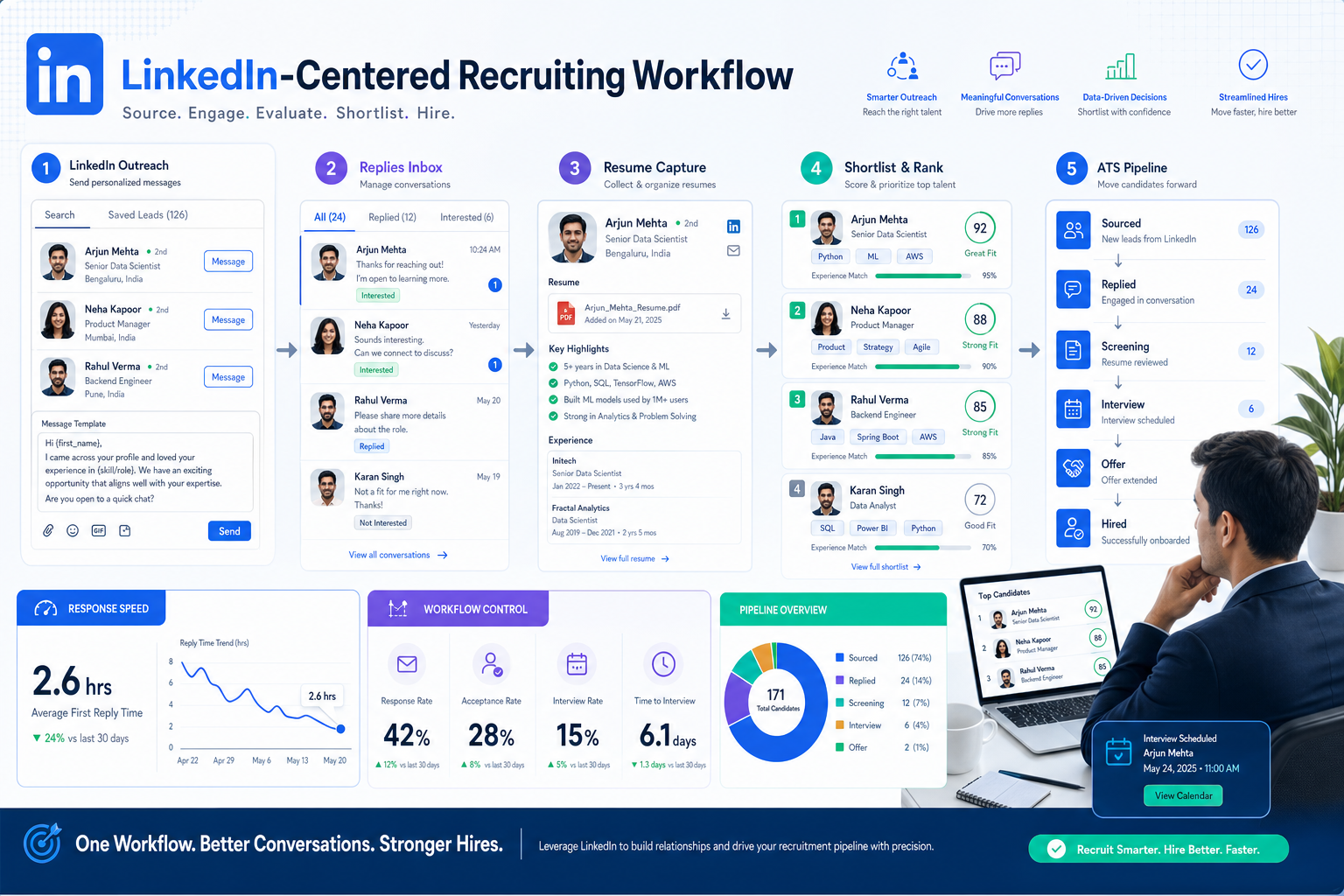
When LinkedIn outreach and scattered follow-up drain headhunter capacity, this article helps recruiters judge ai recruiting companies by workflow control, speed, and shortlist visibility.
That sounds simple until a real desk gets busy. A boutique search firm can lose hours to manual LinkedIn outreach, after-hours replies, resume collection, and candidate follow-up that sits in scattered inboxes instead of a usable pipeline. An internal TA team feels the same pressure differently: slower first contact, delayed interview scheduling, weaker candidate experience, and less confidence in who actually belongs at the top of the shortlist. When that drag continues, it hurts placements, hiring-manager trust, recruiter focus, and operating margins.
In my own testing, StrategyBrain AI Recruiter is most useful when the bottleneck is repetitive LinkedIn communication rather than final candidate judgment. It helps by handling first-touch outreach, ongoing candidate replies, and resume or contact capture across time zones, while the recruiter still owns shortlist decisions, resume review, and whether a candidate moves to interview. That division of labor matters because speed is valuable, but control is non-negotiable.
That balance is easier to understand if you look at how recruiting changed long before the current AI wave. In financial recruitment, one of the earliest big shifts came from tools that made candidate discovery easier, remote conversations more practical, and early screening more structured. Recruiters could search professional profiles by criteria such as industry background or software exposure, then use video calls to speak with hard-to-reach senior talent whose travel schedules made in-person meetings difficult. The gain was not magic matching. It was access, responsiveness, and a more objective starting point.
But those same gains also exposed a persistent operational problem. Once a recruiter found the right profile, reached out, received interest, and tried to compare candidates against a list of must-haves, the work quickly became fragmented unless the system tied discovery, communication, and evaluation together. That is exactly where AI recruiting software, ai staffing, and machine learning staffing now overlap: not in replacing recruiter judgment, but in turning candidate search, messaging, scheduling, and structured comparison into one manageable workflow.
- Why technology changed recruiting before AI
- What AI recruiting software actually does now
- Where ai recruiting companies help most
- LinkedIn outreach and recruiter workflow realities
- Why ATS and CRM still matter first
- AI staffing vs staffing services
- How machine learning staffing works in practice
- How to evaluate platforms without getting distracted
- Common buying mistakes
- FAQ
Why Technology Changed Recruiting Before AI
Experienced recruiters know the current conversation did not start with generative AI. The deeper shift began when recruiting moved from phone-heavy, location-bound work to digital search, profile-based discovery, remote interviewing, and more structured comparison. Professional networks made it easier to find niche candidates. Video tools made it easier to speak with people who were traveling or not ready for an office meeting. Structured scorecards made it easier to compare prospects against explicit requirements instead of relying on memory and gut feel alone.
That history still matters when comparing ai recruiting companies. The best systems are usually solving old recruiting friction with newer tooling: how to find qualified people faster, reach them while they are available, track what has already happened, and compare talent against real hiring criteria. If a vendor cannot improve those basics, the AI label does not add much.
From an SEO perspective and a buyer's perspective, the more useful question is not whether a platform uses AI. It is whether the software improves accessibility, early-stage objectivity, and recruiter throughput without making the process harder to audit.
What AI Recruiting Software Actually Does Now
At a practical level, AI recruiting software helps teams automate repetitive work and direct recruiter attention toward the candidates and requisitions that need human judgment. Common use cases include sourcing, resume intake, candidate matching, ranking, outreach support, interview scheduling, talent rediscovery, and reporting on stage movement.
When buyers research ai recruiting companies, they are often looking across several overlapping categories:
- AI recruiting platforms that support sourcing, screening, messaging, and analytics
- AI-enabled ATS platforms that add ranking, automation, and workflow recommendations
- Recruiting CRM systems that focus on outreach, nurture, and passive candidate relationships
- LinkedIn-centered workflow tools that reduce repetitive communication and candidate handoff work
The practical distinction is important. Some tools are strongest in database structure and compliance. Others are better at outreach volume and response handling. Others are useful for candidate comparison or rediscovery. A sound buying process starts by identifying where your desk actually loses time.
Where AI Recruiting Companies Help Most
Most hiring teams do not need software to make hiring decisions for them. They need relief from the repetitive tasks that slow those decisions down. In my experience, these are the areas where ai recruiting companies tend to add the most real value.
1. Candidate discovery
Recruiters still spend too much time rebuilding the same searches. Better tools help identify adjacent skills, searchable profile patterns, and candidates already known to the business. That is especially valuable in agency recruiting and specialist search, where the obvious shortlist is rarely enough.
2. First contact and follow-up
This is where many teams quietly lose momentum. A good platform can support message drafting, cadence management, candidate replies, and follow-up logic without forcing recruiters to live in separate tools all day. If your workflow depends heavily on LinkedIn, this is often the first area worth fixing.
3. Resume and contact capture
It sounds basic, but this is one of the easiest places for desk-level chaos to appear. When candidate interest is spread across messages, attachments, inboxes, and recruiter notes, handoff quality suffers. AI-enabled workflow can centralize this intake so recruiters spend more time reviewing fit than chasing paperwork.
4. Structured comparison
Technology is most useful early in the process when it helps recruiters compare candidates against stated must-haves. That mirrors the older data-driven approach many strong recruiting teams adopted years ago. The goal is not to pretend models are neutral by default. The goal is to create a visible and more consistent basis for first-pass review.
5. Accessibility and scheduling
Remote interviewing changed expectations. Candidates who travel often, work across regions, or are only available outside normal hours are no longer edge cases. A platform that supports scheduling and communication without long email chains can materially improve speed to interview.
LinkedIn Outreach and Recruiter Workflow Realities
The reference case from financial recruiting still holds up because LinkedIn changed one thing decisively: access to talent. Recruiters could search by background and skills faster than before, but access alone did not solve throughput. Once outreach started, the process became a chain of small manual tasks that often swallowed the desk.
I have seen the same issue in modern AI recruiting evaluations. A recruiter finds a relevant profile, sends an initial note, gets a reply late in the evening, answers screening questions the next morning, requests a resume, waits for contact details, then manually decides whether the conversation belongs in the ATS, CRM, both, or neither. Multiply that by dozens of candidates and the value of automation becomes obvious.
That is why a narrowly defined tool can still be useful when paired with a broader system. For LinkedIn-heavy sourcing work, I found AI Recruiter most effective as a front-end communication assistant rather than a replacement for recruiting judgment. It can maintain candidate conversations around the clock, engage in the candidate's language, answer early role questions, and collect resumes and contact details from interested prospects. What it does not do, and should not do, is make the final call on fit. I still want the recruiter reviewing the CV, checking context, and deciding who deserves a serious shortlist conversation.
That use case matters for both in-house and agency teams. In-house recruiters often need help keeping passive talent warm without extending recruiter hours. Agency recruiters and headhunters need a way to keep outreach moving while preserving personal control over submission quality. In both cases, the benefit is not simply speed. It is continuity.
Practical takeaway: The best AI recruiting workflows remove friction from sourcing and communication first, then support structured comparison second.
Why ATS and CRM Still Matter First
Even when LinkedIn outreach is your biggest pain point, the underlying system still matters. A weak ATS or disconnected CRM can erase the gains from faster sourcing and messaging because the team still cannot track ownership, stage progression, interview status, or candidate history cleanly.
For that reason, comparing ai recruiting companies should begin with workflow architecture rather than AI claims. Ask:
- Where do candidate records live once interest is confirmed?
- Can recruiters see outreach history, resume status, and pipeline stage in one place?
- How are passive prospects separated from active applicants?
- Can hiring managers review structured criteria instead of scattered notes?
- Is there an audit trail for why someone progressed or stalled?
The classic applicant tracking system benefits still carry most of the operational weight:
- Requisition ownership
- Pipeline visibility
- Interview coordination
- Structured feedback records
- Candidate history and rediscovery
- Actionable reporting
AI becomes useful when it strengthens those fundamentals. If it sits outside them, recruiters usually end up doing reconciliation work that cancels out the promised efficiency.
| Workflow Area | Traditional Need | AI-Enabled Improvement |
|---|---|---|
| Candidate search | Manual profile review | Faster pattern-based discovery and rediscovery |
| Initial outreach | One-by-one messaging | Automated first contact and follow-up support |
| Candidate replies | Inbox monitoring | Always-on response handling and interest capture |
| Resume collection | Manual file chasing | Centralized resume and contact intake |
| Early comparison | Subjective first-pass review | Structured ranking against visible criteria |
| Interview setup | Back-and-forth scheduling | Faster coordination and calendar flow |
AI Staffing vs Staffing Services
The term ai staffing causes confusion because it can point to either software-enabled recruiting workflows or outsourced staffing delivery. Those are very different purchases.
AI staffing software helps recruiters work faster by supporting sourcing, outreach, scheduling, ranking, and pipeline management. Staffing services provide recruiter capacity, market access, and candidate delivery through a third party. One gives you infrastructure. The other gives you labor and execution.
If you are comparing ai recruiting companies, define the problem first:
- If your team has recruiter expertise but loses time to repetitive sourcing and communication, software may be the right move.
- If your team lacks bandwidth, niche search capability, or local market reach, a staffing partner may be more relevant.
- If your model combines internal recruiting with external search support, you may need both, but with separate scorecards.
This distinction matters especially for smaller firms and lean in-house teams. It prevents them from buying software to solve a capacity issue, or paying for service when the real problem is poor workflow design.
How Machine Learning Staffing Works in Practice
Machine learning staffing is most useful when described plainly. In recruiting, models usually identify patterns across resumes, profiles, engagement signals, and past hiring activity. That can support better prioritization, but only if the underlying data is structured well enough to trust.
In practice, machine learning staffing often appears in five places:
- Matching candidates to role criteria
- Ranking talent pools for recruiter review
- Rediscovery of previous applicants or silver-medalist candidates
- Outreach timing based on engagement behavior
- Workflow alerts for stalled stages or aging roles
The strongest implementations keep the recommendation visible and challengeable. Recruiters should be able to inspect why a candidate surfaced, what criteria mattered, and where manual override makes sense. That is the operational version of responsible AI in hiring.
My own bias as a recruiter is simple: let software identify patterns, but keep humans accountable for selection. The minute a platform makes it difficult to understand why someone was prioritized, it becomes harder to defend decisions internally.
How to Evaluate Platforms Without Getting Distracted
Teams often get distracted by broad automation claims when they should be pressure-testing ordinary recruiting work. If you want to compare ai recruiting companies well, build the evaluation around live desk activity.
- Map your current workflow. Start with sourcing, first outreach, replies, resume capture, screening, scheduling, and handoff to hiring managers.
- Identify the exact choke point. Is the problem discovery, responsiveness, admin load, weak rediscovery, or inconsistent first-pass review?
- Check the ATS first. Make sure requisitions, stages, scorecards, and reporting work before you evaluate any AI layer.
- Test candidate communication. If LinkedIn is central to your process, watch how the system handles first contact, FAQs, late replies, and contact collection.
- Review human control boundaries. Confirm what is automated and what still requires recruiter approval.
- Inspect match logic. Good systems expose criteria and let recruiters adjust them.
- Assess multilingual and after-hours needs. This matters more than many buyers expect in cross-border or passive-candidate hiring.
- Measure reporting quality. You need visibility into conversion, aging, source value, and recruiter workload.
If your workflow is heavily LinkedIn-led, I would also test one practical scenario end to end: sourcing a passive candidate, starting the conversation, answering early questions, collecting a resume, and moving the record into your main workflow. That is where tools like StrategyBrain AI Recruiter can either create real leverage or reveal limitations. In my use, the gain came from reducing after-hours message handling and keeping outreach active without forcing recruiters to monitor every reply in real time.
Common Buying Mistakes
Most evaluation mistakes come from ignoring the lesson embedded in older recruiting technology shifts: access is valuable, but workflow wins the day.
Buying for search, not for follow-through
Finding profiles is only the first step. If the system does not handle contact, responses, scheduling, and records cleanly, recruiters still lose momentum.
Letting automation blur accountability
Candidate interest is not candidate fit. Recruiters should still review resumes, challenge assumptions, and decide who moves forward.
Ignoring data hygiene
Matching and rediscovery are only as useful as the tags, stages, notes, and criteria behind them.
Confusing software needs with service needs
This is especially common in ai staffing discussions. Software helps process. Services help capacity.
Overvaluing broad AI claims
If a vendor cannot explain exactly how the workflow improves, the platform may be more marketing than operational support.
FAQ
What are ai recruiting companies?
They are vendors offering recruiting technology that uses automation, analytics, or AI-assisted workflows to support sourcing, communication, screening, scheduling, and candidate management.
How is AI recruiting software different from a normal ATS?
A standard ATS focuses on requisitions, applicant records, stage tracking, and reporting. AI recruiting software usually adds matching, ranking, outreach support, rediscovery, and workflow automation on top of that foundation.
Where does AI help recruiters the most?
Usually in repetitive tasks: candidate discovery, first outreach, reply handling, resume capture, scheduling, and identifying who needs attention next.
Is ai staffing the same as using a staffing firm?
No. AI staffing generally refers to software-supported recruiting workflows. A staffing firm provides recruiting execution as a service.
How does machine learning staffing work?
It uses data patterns to support candidate matching, ranking, rediscovery, and workflow prioritization. It should guide recruiter attention, not replace final judgment.
Why does LinkedIn workflow matter in AI recruiting evaluations?
Because many recruiters still begin candidate discovery and first contact there. If the workflow breaks between outreach and pipeline management, efficiency gains disappear quickly.
Can StrategyBrain AI Recruiter replace a recruiter?
No. It is better understood as a workflow assistant for LinkedIn recruiting tasks such as outreach, candidate replies, and resume capture. Recruiters still need to review fit and make progression decisions.
Conclusion
The most useful lesson from earlier recruiting technology is still the right one today: better access and faster communication only matter when they connect to a structured hiring workflow. That is the real standard for judging ai recruiting companies.
If your team is comparing AI recruiting software, focus on the tasks that actually absorb recruiter time: discovery, outreach, responses, resume capture, structured comparison, and stage visibility. That is where ai staffing and machine learning staffing become practical rather than theoretical. The software worth buying is the software that makes those handoffs cleaner while keeping final hiring judgment where it belongs: with the recruiter and hiring team.