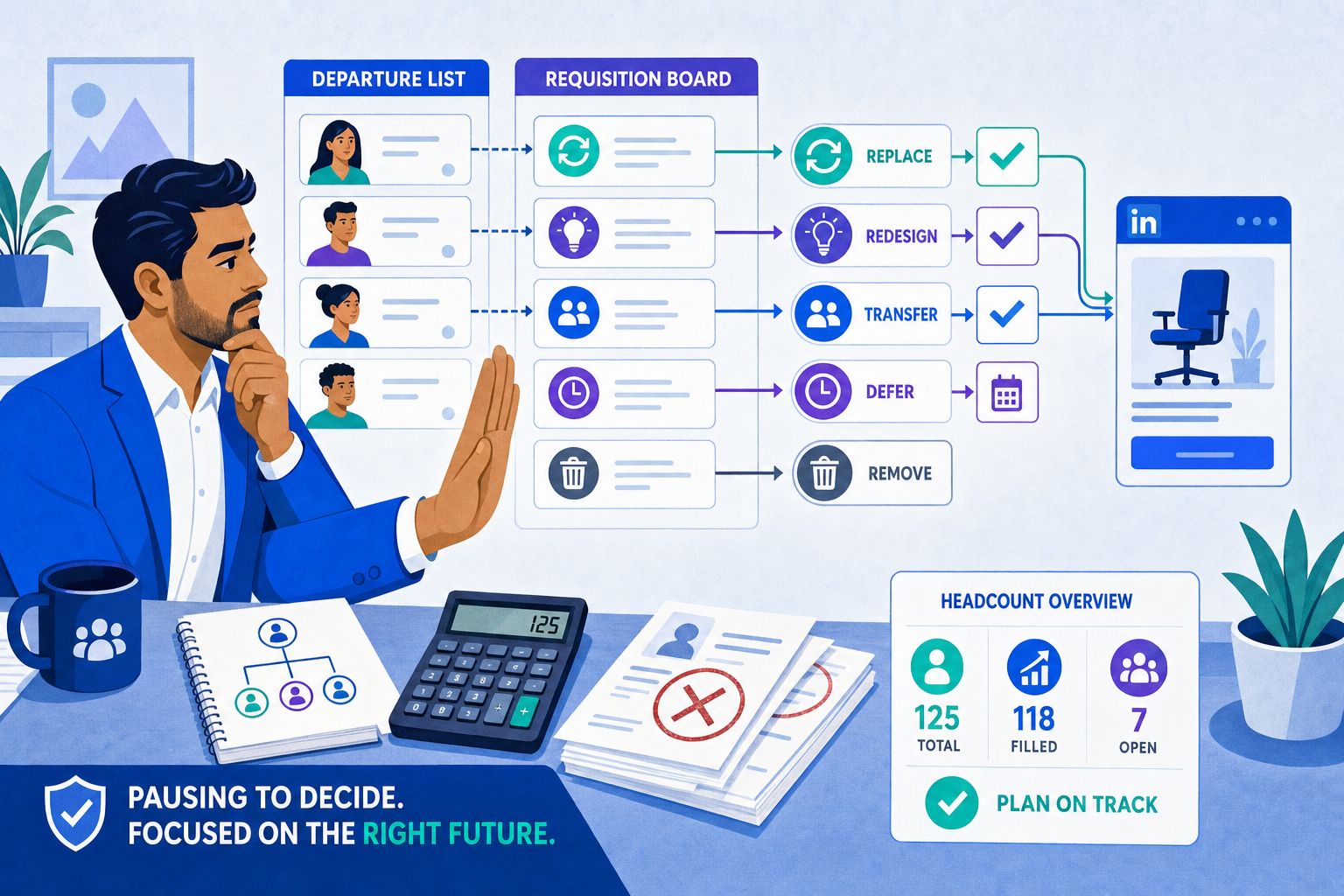
This framework helps recruiters evaluate an attrition rate definition, verify backfill demand, and avoid promoting unapproved roles.
Without that distinction, a small search firm may pursue roles that will never be approved, an individual recruiter may misallocate sourcing time, and an in-house team may promise hiring capacity based on departures that are not meant to be backfilled. Conflicting definitions also damage trust when HR, finance, and hiring managers present different numbers for the same workforce.
Recruiting automation can reduce the administrative pressure around this problem by maintaining candidate outreach, answering routine questions in multiple languages, following up outside normal working hours, and collecting résumés and contact details. It cannot decide which departures count as attrition or whether a résumé meets the role requirements; recruiters must retain responsibility for workforce definitions, candidate evaluation, and the next hiring decision.
Consider the point at which a recruiter prepares several vacancies for promotion on a professional-network company page. The recruiter reviews the page description, clarifies the employer’s specialties, adds career-focused content, and schedules updates for candidates and employees to share. After tracking responses and matching them to the requisition list, the recruiter discovers that several recently vacated positions are still being advertised even though management has decided not to replace them. The page is attracting attention, but the underlying hiring demand is inaccurate.
This disconnect between employer-brand activity and approved workforce demand is why the attrition rate definition matters. Before recruiters promote jobs, contact prospects, or estimate sourcing capacity, they need to define attrition rate, determine which vacancies will remain unfilled, and understand attrition vs retention using the same population, dates, and counting rules.
Key takeaway: Attrition data should shape the requisition list before employer-brand content and candidate outreach create expectations around roles that may not be filled.
Table of Contents
- What does attrition rate mean?
- Why does attrition context matter before recruiting?
- How do you calculate attrition rate?
- What is a worked attrition example?
- How do attrition, turnover, retention, and churn differ?
- Which types of attrition should HR track?
- What is the difference between attrition and retention?
- How should recruiters interpret attrition?
- How should attrition inform recruiting workflow?
- What mistakes make attrition data unreliable?
- How can HR report attrition consistently?
- Frequently asked questions
What Does Attrition Rate Mean?
In workforce reporting, attrition rate measures employee loss over a defined period. The commonly used calculation expresses the number of employees who left as a percentage of average headcount.
The word attrition, however, does not have one universally applied operational meaning. Some organizations use it for all employee departures. Others apply a stricter definition: attrition occurs when an employee leaves and the position is not immediately replaced, causing the workforce to contract gradually.
For recruiting decisions, the stricter distinction is especially useful. A departure that produces an approved backfill represents replacement demand. A departure attached to an eliminated, deferred, transferred, or redesigned position does not automatically create a search assignment.
In practical terms, the metric answers a narrow question: What percentage of the relevant workforce left during the reporting period? It does not independently explain why people left, whether the departures were damaging, or which positions should be advertised.
Why Attrition Context Matters Before Recruiting Begins
A public-facing company page serves several audiences at once. Prospective candidates may visit to investigate jobs and culture, potential customers may research services, and professional contacts may look for employees in their network. A clear description, recognizable page address, relevant specialties, strong visual identity, and current career content help those visitors understand the organization.
That visibility needs an accurate workforce plan behind it. Promoting jobs before confirming whether departures will be replaced can produce avoidable candidate disappointment, duplicate recruiter effort, and inconsistent messages from hiring managers. Employer branding can make an opportunity easier to find, but it cannot determine whether the opportunity should exist.
Align the company description with workforce reality
A concise company description should explain the organization’s work, direction, and employment proposition without overstating growth. If attrition is part of a planned contraction, recruiters should not imply that every departing employee will be replaced. If the business is selectively investing in critical functions, career messaging should identify those priorities.
Use role and specialty terms carefully
Searchable specialty terms can help relevant professionals discover an employer. Recruiters should align those terms with approved role families rather than with an outdated organizational chart. This is particularly important when attrition is being used to remove some roles while investment continues elsewhere.
Segment career content by audience
Organizations often need different messages for technical candidates, commercial hires, graduates, executives, or particular locations. Segmenting content can improve relevance, but each audience stream should map to an approved workforce need. Otherwise, a highly visible campaign may generate interest for a team that has no authority to hire.
Maintain ownership and a regular review cycle
An actively maintained page needs a named owner, a publishing schedule, and input from employees who may share vacancies with their networks. The same operating discipline should apply to attrition data. Before each campaign, the owner should confirm the requisition status, replacement decision, hiring manager, and closing conditions.
How Is Attrition Rate Calculated?
To define attrition rate in measurable terms, choose a reporting period, specify the workforce population, count the qualifying departures, and divide that count by average headcount. Multiply the result by 100.
Attrition rate (%) = Included employee departures ÷ Average headcount × 100
When only beginning and ending headcount are available, a standard approximation is:
Average headcount = (Beginning headcount + Ending headcount) ÷ 2
- Set the reporting period. Choose a month, quarter, or year and apply the same dates to departure and headcount data.
- Define the population. State whether the calculation covers the entire company, a country, a business unit, a department, or a role family.
- Specify eligible workers. Decide how employees, temporary workers, contractors, interns, and workers on leave are treated.
- Define included departures. Document whether resignations, dismissals, retirements, internal transfers, and other exit categories count.
- Clarify replacement treatment. If attrition means non-replaced departures, identify how long a role must remain unfilled before it qualifies.
- Calculate average headcount. Use a consistent method, preferably one based on regular headcount snapshots when workforce size changes substantially.
- Publish the result with its rules. Label the period, scope, departure count, denominator, and methodology.
HR, recruiting, and finance should agree on these rules before comparing results. Percentages based on different populations or departure categories may appear comparable while answering different questions.
Worked Attrition Rate Example
Suppose an operations group starts the year with 240 employees. During the year, 20 employees leave, their positions are not immediately replaced, and the group finishes with 220 employees.
| Input | Value |
|---|---|
| Reporting period | One year |
| Beginning headcount | 240 employees |
| Ending headcount | 220 employees |
| Included departures | 20 employees |
| Average headcount | (240 + 220) ÷ 2 = 230 |
| Attrition rate | 20 ÷ 230 × 100 = 8.7% |
The annual attrition rate is 8.7% when rounded to one decimal place. Because the example uses the stricter non-replacement definition, the recruiting team should not turn the 20 departures into 20 new requisitions.
The calculation still needs business context. HR should establish which roles were affected, whether the exits were voluntary, what work remains, and whether the reduction supports the operating plan. Recruiters can then distinguish positions to replace from work that will be removed, transferred, or redesigned.
Attrition, Turnover, Retention, and Churn
These terms frequently overlap in dashboards and leadership discussions. The following distinctions are useful for workforce planning, although every organization should document its own conventions.
| Term | Practical meaning | Primary question | Recruiting implication |
|---|---|---|---|
| Attrition | Employees leave; under the stricter definition, their positions are not immediately replaced. | How much workforce loss occurred? | May indicate contraction rather than replacement hiring. |
| Turnover | Employees leave and may be replaced. | How much movement out of roles occurred? | May generate backfill requisitions and sourcing work. |
| Retention | Eligible employees remain through the measurement period. | How much of the workforce stayed? | Helps identify continuity and potential replacement risk. |
| Churn | An informal term for recurring employee exits. | How quickly are employees cycling out? | Requires a formal definition before it informs hiring plans. |
Some employers use attrition and turnover as synonyms. That convention is not inherently wrong, but it must be visible in the report. A recruiter needs to know whether an exit number represents all departures, non-replaced departures, or only positions with approved backfills.
Types of Attrition HR Should Track
An overall rate can conceal very different workforce events. Segmenting departures helps HR and recruiting teams determine what action, if any, is required.
Voluntary attrition
Voluntary attrition occurs when employees choose to leave. Analysis should consider role, location, tenure, skills, exit reason, and replacement status. A voluntary departure is not automatically a regrettable loss, and it does not automatically authorize a backfill.
Involuntary attrition
Involuntary attrition follows an employer-initiated exit. Combining this category with resignations can make workforce contraction look like a retention problem. Reports should therefore separate the categories when they result from different management decisions.
Internal attrition
An internal transfer can be attrition for the employee’s former team while leaving company-wide headcount unchanged. Recruiters should confirm whether the originating team will backfill the role or redistribute the work.
Retirement-related attrition
Retirement-related departures can sometimes be anticipated, creating time for succession planning, knowledge transfer, selective hiring, or role redesign. The reporting method should avoid making assumptions about an individual’s retirement plans.
Demographic attrition
Aggregate analysis can show whether departures are concentrated within a workforce segment. Organizations should apply appropriate privacy controls, review small sample sizes carefully, and avoid using protected characteristics to make inappropriate employment decisions.
Functional or skill-based attrition
This view groups departures by role family or critical skill. It is particularly useful for recruiters because a modest company-wide rate can conceal significant losses in a hard-to-fill specialty.
Attrition vs Retention: What Is the Difference?
Attrition measures employee loss, whereas retention measures the employees who remain. Attrition looks outward at departures; retention looks inward at workforce continuity.
The two percentages are not necessarily exact mathematical opposites. A retention calculation may follow only employees who were present at the beginning of the period, while an attrition calculation may include employees hired and lost during that same period. Internal transfers, worker eligibility, acquisitions, reorganizations, and leave status can also be handled differently.
A typical cohort-based retention formula is:
Retention rate (%) = Employees from the starting cohort still employed at period end ÷ Employees in the starting cohort × 100
When reviewing attrition vs retention, ask five questions:
- Do both calculations cover the same dates?
- Do they include the same worker types and organizational units?
- Are employees hired during the period included?
- How are internal transfers and employees on leave treated?
- Do the departure rules distinguish replaced and non-replaced roles?
For recruiters, the practical difference is that retention indicates workforce continuity, while attrition can signal either a retention concern or an intentional reduction. Neither metric alone establishes the number of open requisitions.
How Should Recruiters Interpret an Attrition Rate?
There is no universal good attrition rate. Results vary by industry, occupation, location, labor market, workforce composition, seasonality, reporting period, and methodology. A generic benchmark may be less useful than a consistent internal trend.
Recruiters and HR leaders should interpret the rate through operational questions:
- Where are departures concentrated? Review relevant teams, locations, levels, role families, and tenure groups.
- Which losses affect delivery? Separate critical-skill and regrettable exits from expected or planned workforce changes.
- Which positions will be replaced? Require an explicit replace, redesign, transfer, defer, or remove decision.
- Is the pattern changing? Compare equivalent periods using stable definitions.
- What happens to the work? Determine whether responsibilities stop, move to another team, or remain with fewer employees.
- What should candidates see? Align career content and job promotion with approved demand rather than raw departure counts.
A rising rate in a scarce-skill function may justify earlier pipeline development. Planned attrition in a shrinking operation may require no external search. The same percentage can therefore lead to opposite recruiting decisions.
Turning Attrition Data Into a Recruiting Workflow
The most useful process connects workforce measurement, requisition governance, employer communication, and candidate outreach. It prevents public hiring activity from getting ahead of internal approval.
- Reconcile departures. Review exit records and assign each departure to the organization’s documented category.
- Record the position decision. Mark each affected role as replace, redesign, transfer, defer, or remove.
- Validate the requisition list. Confirm budget, approval status, hiring manager, location, compensation parameters, and target start date.
- Update candidate-facing information. Ensure descriptions, role specialties, career content, and team information reflect current plans.
- Launch outreach only for approved demand. Automation may support connection requests, initial role explanations, routine candidate questions, multilingual follow-up, and collection of résumés and contact details.
- Keep human judgment at decision points. Recruiters should evaluate experience, assess résumé relevance, address sensitive questions, and decide who advances.
- Close the feedback loop. Update candidate stages, tell content owners when hiring priorities change, and compare filled roles with the original replacement plan.
Automation is most useful after the organization has resolved the ambiguity. It can help a recruiter maintain timely communication and avoid losing interested candidates, but it should not turn an uncertain vacancy into a live opportunity or infer that every departure needs a replacement.
Limitations and Common Attrition Rate Mistakes
Mixing definitions across reports
If one report includes retirement and another excludes it, the apparent trend may reflect methodology rather than workforce behavior. Maintain a shared data dictionary across HR, recruiting, and finance.
Using mismatched dates or populations
Quarterly departures divided by an annual headcount figure do not produce a meaningful quarterly rate. Keep the measurement period, organizational scope, and worker eligibility aligned.
Assuming every departure creates a vacancy
This is the mistake that most directly affects recruiters. A departure may result in a backfill, a redesigned position, transferred work, delayed hiring, or permanent role removal.
Using only beginning and ending headcount during rapid change
The simple average is convenient but may be misleading when headcount changes sharply during the period. Monthly or payroll-period snapshots can provide a more representative denominator.
Annualizing short periods without explaining seasonality
Multiplying a monthly rate to estimate an annual rate assumes a stable departure pattern. Seasonal hiring, restructures, and one-time events can make that assumption unreliable.
Treating the rate as an explanation
The percentage describes the scale of employee loss, not its cause. Exit data, manager input, engagement evidence, workforce plans, and role-level analysis are needed before drawing conclusions.
Publishing percentages without counts
A high rate in a very small team may represent only one or two departures. Show the leaver count and average headcount beside the percentage to prevent exaggerated interpretations.
Promoting roles before approval is stable
Current career content and active professional-network pages can increase candidate interest. If the requisition is later withdrawn because the underlying departure was meant to reduce headcount, the employer risks wasting recruiter effort and weakening candidate trust.
Best Practices for Consistent Attrition Reporting
A credible attrition rate definition should be understandable to leaders and reproducible by analysts. Use this checklist before publishing the result or converting it into a hiring plan:
- Name the reporting period and use the same dates for departures and headcount.
- State the workforce population, including business unit, geography, and eligible worker types.
- List included departure categories, such as resignations, retirement, dismissals, and internal movement.
- Explain replacement treatment when attrition is distinguished from turnover.
- Document the denominator and explain how average headcount was calculated.
- Show counts with percentages so readers can assess scale.
- Segment for a business reason rather than producing unnecessary cuts of sensitive employee data.
- Assign a workforce decision to each departure: replace, redesign, transfer, defer, or remove.
- Reconcile approved roles with candidate-facing content before launching promotion or outreach.
- Record methodology changes so a revised definition is not mistaken for a change in employee behavior.
This discipline gives recruiters, headhunters, hiring managers, HR partners, finance teams, and employer-brand owners a common operating picture. It also makes it easier to explain why employee departures and advertised vacancies are not always equal.
Frequently Asked Questions
What is the simplest attrition rate definition?
Attrition rate is the percentage of employees who leave a defined workforce during a specified period relative to its average headcount. Under a stricter workforce-planning definition, it covers departures whose positions are not immediately replaced.
How do you define attrition rate for a company?
Document the reporting period, workforce population, eligible worker types, included departures, replacement rules, and average headcount method. Then divide qualifying departures by average headcount and multiply by 100.
What is the standard attrition rate formula?
The standard formula is included employee departures divided by average headcount, multiplied by 100. A simple average headcount is beginning headcount plus ending headcount, divided by two.
Is attrition the same as turnover?
Not always. Some organizations use the terms interchangeably. Under a stricter distinction, attrition refers to departures without immediate replacement, while turnover can include departures that lead to backfill hiring.
What is the difference between attrition and retention?
Attrition measures employee loss, while retention measures how many eligible employees remain. In an attrition vs retention comparison, the percentages may not be exact inverses because the calculations can use different populations and eligibility rules.
What is a good attrition rate?
There is no universal good rate. Interpretation depends on the role, industry, labor market, workforce plan, measurement method, and whether the departures were expected, regrettable, or part of an intentional reduction.
Can attrition rate be calculated monthly?
Yes. Divide qualifying departures during the month by average monthly headcount and multiply by 100. Label it as a monthly rate and do not compare it directly with annual figures without adjusting the methodology and considering seasonality.
Should internal transfers count as attrition?
It depends on the reporting scope. A transfer may count as attrition for the originating team but not for the company. The recruiting implication depends on whether the former team receives approval to backfill the position.
Does a high attrition rate always mean more recruiting?
No. It creates more recruiting demand only when the organization chooses to replace the departing employees. Planned contraction, automation, restructuring, outsourcing, and work redistribution can reduce or eliminate backfill requirements.
Can employer branding reduce attrition?
Clear and accurate employer communication can help candidates form realistic expectations, but a company page alone cannot diagnose or correct attrition. Retention also depends on factors such as management, work design, compensation, development, workload, and organizational conditions.
Conclusion
The attrition rate definition is the percentage of included employee departures relative to average headcount during a stated period. Its value depends less on the arithmetic than on clear rules about population, departure categories, replacement status, and time frame.
For hiring teams, the decisive step is connecting each departure to an approved workforce action. Once recruiters know whether a role will be replaced, redesigned, transferred, deferred, or removed, they can align employer-brand content, requisition planning, candidate outreach, and human evaluation with real demand.