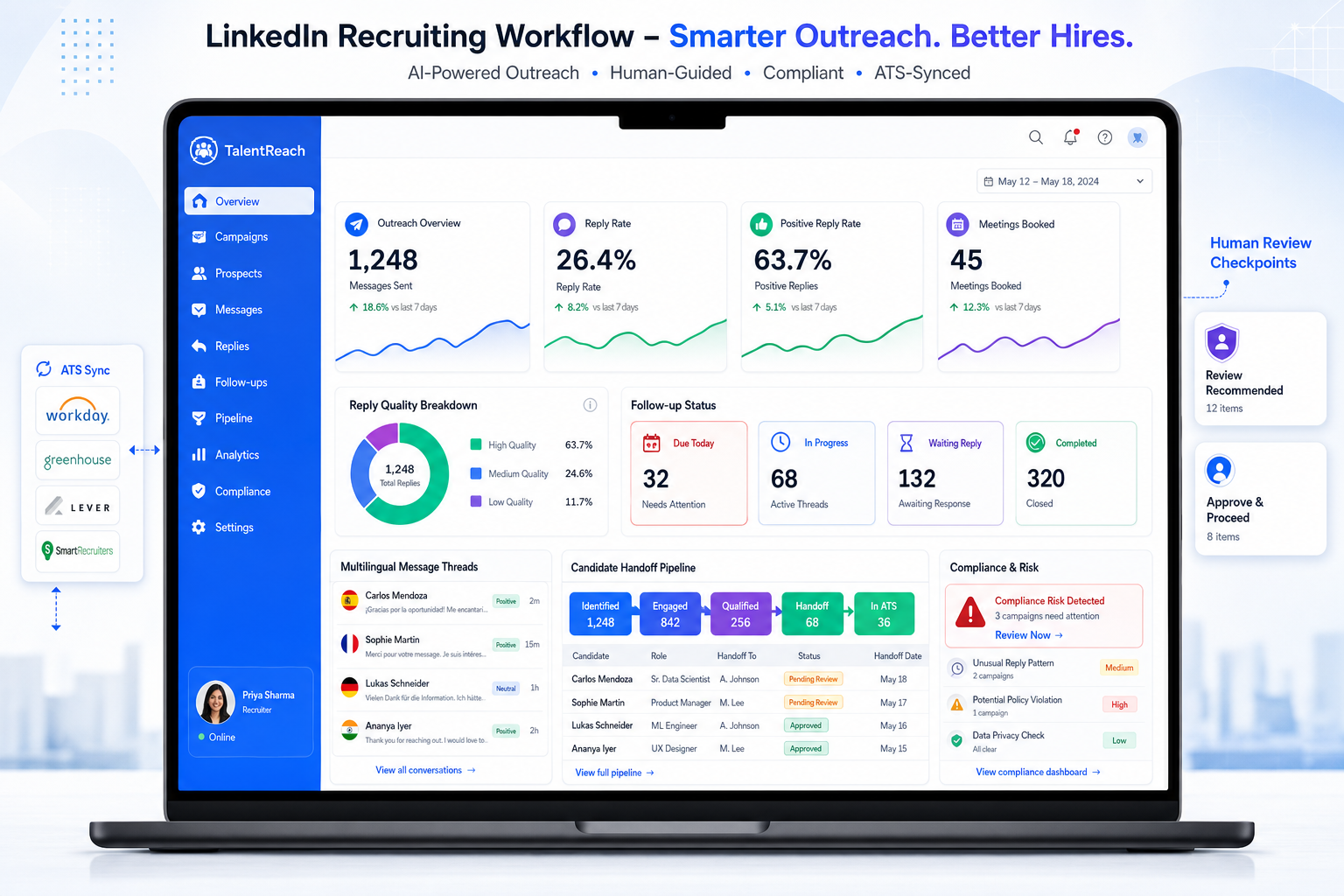
When reply quality drops and prospects go cold, this article helps recruiters judge linkedin recruiting automation, fix workflow gaps, and avoid scaling noise.
That sounds obvious until a search gets busy. A solo recruiter loses context between replies, a boutique agency owner watches consultants send generic outreach, and an in-house talent lead sees strong prospects go cold because no one followed up at the right time. The damage is not just slower hiring. It shows up in weaker response quality, duplicate effort, messy records, and a brand impression that feels transactional instead of credible.
That is why I prefer AI-supported workflow help over blind activity bots. In my own process, StrategyBrain AI Recruiter has been most useful when the problem is not finding a way to send more messages, but keeping candidate conversations moving after hours, handling multilingual replies, and collecting resumes or contact details from interested people without removing recruiter judgment. The recruiter still decides who is truly qualified, who belongs in the shortlist, and what the next step should be.
You can see the same logic in a different LinkedIn task that recruiters know well: profile positioning. When a candidate struggles to write a LinkedIn summary, the issue is rarely word count alone. They first need to define their target market, decide what pains they solve, and connect accomplishments to the keywords recruiters actually search. Then they need a sharp headline, a concise summary, some real personality, and a clear reason to reach out. Without that structure, even a capable finance or accounting professional becomes harder to find and harder to assess quickly.
That candidate-side problem maps directly to recruiting operations. If recruiters automate outreach before they clarify audience, role pain points, search terms, and the action they want from the candidate, they scale confusion instead of results. That is the real starting point for linkedin recruiting automation, and it is also where questions about a linkedin connection automation tool and linkedin sales automation tools need a more careful recruiting lens.
Key takeaway: The safest and most effective approach to LinkedIn recruiting automation is to automate search support, follow-up discipline, and candidate handoff workflows while keeping human review over outreach quality and qualification decisions.
Table of Contents
- Why Good Automation Starts With Positioning
- What LinkedIn Recruiting Automation Really Means
- What Recruiters Can Automate Safely
- Native LinkedIn Workflows vs Third-Party Automation
- Where AI Recruiter Fits in a Real Workflow
- Compliance Risks Recruiters Should Understand
- A Practical Recruiting Automation Workflow
- Recruiting Automation vs LinkedIn Sales Automation
- How to Evaluate Tools and Processes
- Common Mistakes to Avoid
- FAQ
Why Good Automation Starts With Positioning
One of the most useful lessons from LinkedIn profile writing is that clarity comes before scale. Candidates are told to define their target market, connect achievements to real business pain, use searchable keywords in the headline, stay concise, show some personality, and end with a call to action. Recruiters need the same order of operations when they automate.
Before adding any linkedin recruiting automation workflow, ask the same basic questions a candidate should ask when writing a summary:
- Who is the target market? In recruiting terms, that means the right candidate segment, not the biggest one.
- What problem are you solving? Is the role about revenue growth, audit cleanup, team leadership, systems implementation, or cost control?
- What proof matters? Titles alone are weak. Accomplishments, scope, and context matter more.
- Which keywords actually drive discovery? LinkedIn behaves like a search engine, so title variants, hard skills, and industry terms affect sourcing quality.
- What action do you want? A reply, a conversation, a resume, or permission to speak later?
This matters because automation amplifies whatever logic you give it. Clear positioning produces better search results, more credible messaging, and easier screening. Poor positioning just creates more noise, faster.
What LinkedIn Recruiting Automation Really Means
Many teams still treat linkedin recruiting automation as a synonym for automatic connection requests or message sequences. That definition is too narrow. In real recruiting operations, automation can support sourcing, profile review, outreach drafting, candidate follow-up, response management, job distribution, recordkeeping, and ATS updates.
The best version is usually not hands-off. It is assisted automation: tools that reduce repetitive work while leaving the recruiter in charge of interpretation, persuasion, and selection. That is a better fit for hiring because candidates are making career decisions, not responding to a standard sales sequence.
As search behavior shifts, recruiters are also becoming more careful with language. Many are now looking for AI-assisted sourcing, workflow automation, candidate engagement support, and better handoffs between LinkedIn and their internal systems. That reflects a more mature buying mindset.
What Recruiters Can Automate Safely
The safest automation usually sits around repetitive coordination work rather than around fully autonomous candidate interaction. Here is where automation can help without stripping away recruiter judgment.
1. Candidate search and shortlist building
Automation can help narrow large pools, surface related profiles, identify title variants, and structure search logic. This is especially valuable when a hiring manager gives a fuzzy brief and the recruiter has to translate it into searchable terms.
2. Message drafting support
Drafting help is useful for creating a first version of outreach, especially when you need to reflect role context, candidate background, and a believable reason to connect. The recruiter should still review tone and relevance before anything goes out.
3. Follow-up discipline
Many missed hires are not caused by poor sourcing. They happen because good replies arrive late at night, on weekends, or in another language, and no one handles them quickly enough. Reminders, reply support, and next-step tracking are strong use cases for automation.
4. Resume and contact capture
If an interested candidate shares a resume or contact details, the process should be easy to manage and easy to find later. Structured capture matters because it reduces inbox chaos and makes the next recruiter action faster.
5. ATS-connected administration
Job posting, status changes, notes, handoffs, and pipeline visibility are all excellent candidates for automation. These tasks are repetitive, necessary, and often neglected when recruiters are overloaded.
This is also where a linkedin connection automation tool should be judged carefully. If it mainly promises more actions, that is not enough. A recruiting workflow should improve relevance, control, and follow-through.
Native LinkedIn Workflows vs Third-Party Automation
Recruiters need to separate two very different categories: official in-platform workflows and outside tools that automate behavior around LinkedIn.
| Category | Native or Workflow-Aligned Use | High-Risk External Automation |
|---|---|---|
| Primary goal | Search efficiency, better outreach support, cleaner process control | Bulk actions, simulated behavior, scraping, sequence volume |
| Recruiting fit | Supports sourcing and candidate management | Often adapted from outbound prospecting |
| Candidate experience | Usually more contextual and selective | Can feel repetitive or impersonal |
| Compliance posture | Generally safer when aligned to platform and internal policy | Needs close review if it changes site behavior or automates prohibited actions |
| Best use case | Assisted recruiting workflows | Rarely ideal for relationship-driven hiring |
Confusion often happens because recruiters evaluate tools built for sales teams. Many linkedin sales automation tools focus on connection acceptance, outbound cadence, and pipeline volume. Recruiters need different outcomes: relevance, trust, qualified interest, and an orderly hiring process.
Where AI Recruiter Fits in a Real Workflow
I have found that AI support is most helpful in the gap between first candidate interest and recruiter follow-through. When a search spans time zones or candidate replies pile up after hours, AI Recruiter can keep communication moving, answer basic role questions from the information the recruiter provides, and gather resumes or contact details from people who want to continue. That is useful for agencies managing multiple searches and for in-house teams trying to avoid reply bottlenecks.
What I would not delegate is final assessment. Interest is not fit. A candidate can be open to hearing more and still miss the mark on technical depth, leadership scope, compensation alignment, or industry context. In practice, that means AI can reduce repetitive front-end workload, while the recruiter keeps ownership of qualification, shortlist quality, and interview decisions.
For recruiters who want to understand the setup and use cases more directly, the workflow overview and the conversation examples are the most relevant starting points. The value is not a fantasy of replacing recruiting. It is keeping momentum in the repetitive parts that usually slow a live search down.
Compliance Risks Recruiters Should Understand
Compliance is central to linkedin recruiting automation, not a footnote. Recruiters should be cautious with any setup that depends on scraping profile data, altering site behavior, or simulating user actions at scale.
Risk usually increases when a tool does the following:
- Scrapes profile data into uncontrolled databases
- Automates actions such as connecting, viewing, or messaging in a way that imitates user behavior
- Uses browser overlays or extensions to trigger activity on the platform
- Runs hands-off outreach without recruiter review or candidate context
Safer territory usually includes:
- AI-assisted drafting with human approval
- Follow-up reminders and structured response handling
- Resume and contact capture from interested candidates
- ATS workflow automation for records, stages, and reporting
If you lead talent acquisition or run a recruiting agency, involve operations, legal, or procurement early. Short-term convenience is not worth account risk or poor data control later.
A Practical Recruiting Automation Workflow
The most sustainable workflow starts before any outreach is sent. Borrow the discipline of a well-written LinkedIn summary: define the audience, decide what matters, use the right keywords, keep the message concise, and make the next step obvious.
- Clarify the hiring brief. Define business pain, required skills, title variations, geography, and likely motivators.
- Build search logic around discoverability. Think the way candidates think when they optimize a headline and specialties section. Use keyword variants and role-specific language.
- Review profiles for evidence, not just labels. Look for accomplishments, scope, and proof points that map to the role.
- Segment the pool. Separate high-fit passive candidates, adjacent talent, prior applicants, and referrals.
- Draft personalized outreach. Keep it short, relevant, and specific to the candidate’s likely interests.
- Use AI to support replies and capture intent. Let repetitive front-end communication stay active without losing control of the process.
- Move interested candidates into the formal workflow. Sync notes, resumes, and contact details into your ATS or source-of-truth process.
- Review outcomes weekly. Measure reply quality, shortlist quality, and process speed rather than raw send counts.
This model is useful for headhunters, in-house recruiters, and hiring teams because it keeps candidate experience tied to search quality. Automation works best when it supports a sharp brief and disciplined follow-up.
Recruiting Automation vs LinkedIn Sales Automation
There is obvious overlap between recruiting outreach and outbound prospecting, which is why buyers often compare recruiting workflows with linkedin sales automation tools. But the goals are different enough that the same playbook can cause problems.
- Sales automation is often built for repetition and sequence completion.
- Recruiting automation should be built for candidate fit, timing, and employer credibility.
- Sales teams can tolerate heavier templating.
- Recruiters usually need stronger personalization because career moves are personal and high-stakes.
- Sales metrics often emphasize volume.
- Recruiting metrics should emphasize response quality, qualified interest, and hiring progress.
That is why a linkedin connection automation tool may look efficient on paper but still be the wrong fit for a search team. If it treats candidates like standard outbound prospects, response quality often suffers.
How to Evaluate Tools and Processes
When I evaluate linkedin recruiting automation, I use a simple set of filters.
1. Does it improve signal, not just volume?
The strongest tools help recruiters identify better-fit candidates, write better outreach, or keep qualified conversations moving.
2. Does it reflect how LinkedIn search actually works?
Remember the lesson from profile writing: keywords, positioning, and concise messaging shape discoverability and response. Tools should support that, not bypass it.
3. Does it keep a human in the loop?
Recruiter judgment should remain central for fit, persuasion, and next-step decisions.
4. Does it fit your operating model?
A solo headhunter, a five-person agency, and a global in-house team do not need the same level of automation. Match the workflow to your scale.
5. Does it protect candidate experience?
If the process feels generic, over-automated, or hard to trust, it will eventually hurt response rates and employer reputation.
6. Does it create cleaner handoffs?
The best setup reduces the chance that a reply sits unanswered, a resume gets buried, or a hiring manager receives incomplete context.
Common Mistakes to Avoid
- Starting with activity instead of positioning. If you have not defined your audience and role pain points, automation only spreads weak logic.
- Using sales-style sequences for candidate outreach. What works in pipeline generation can feel impersonal in recruiting.
- Ignoring keywords and search behavior. LinkedIn still functions like a search engine, so title variants and specialties matter.
- Overwriting personality. Just as candidate summaries need some authentic voice, recruiter outreach also needs to sound human.
- Letting resumes and replies live outside a controlled workflow. That creates delays, duplication, and preventable drop-off.
- Confusing interest with qualification. AI can help identify willingness to engage, but recruiters still need to assess fit.
A useful rule is this: if your automation improves response handling but weakens message credibility, redesign the workflow. Efficiency should not come at the cost of trust.
FAQ
Is LinkedIn recruiting automation allowed?
Some forms are safer than others. Workflow support, drafting assistance, candidate follow-up structure, and ATS-connected process automation are generally more defensible than scraping or hands-off action automation.
What is the safest use of linkedin recruiting automation?
The safest use is usually support for search logic, outreach drafting, response handling, and recordkeeping while keeping recruiter review in place.
Should recruiters use a linkedin connection automation tool?
Only with caution. Recruiters should ask whether the tool was designed for relationship-based hiring or adapted from sales prospecting. The second category is often a poor fit.
Are linkedin sales automation tools useful for recruiting teams?
Sometimes for inspiration around process design, but not always as direct recruiting tools. Recruiting requires more context, more nuance, and stronger candidate trust.
How does candidate profile writing relate to recruiting automation?
It shows the order of operations. Good outcomes start with target audience, keywords, accomplishments, concise positioning, and a clear call to action. Recruiters need the same discipline before automating outreach.
Where can AI support actually help recruiters?
It is especially helpful in after-hours replies, multilingual communication, repeated role explanations, and collecting resumes or contact details from interested candidates before the recruiter takes over qualification.
Conclusion
LinkedIn recruiting automation works best when it makes recruiters more consistent, not less human. The strongest workflows start with positioning, use searchable keywords intelligently, keep outreach concise and credible, and add automation where follow-up or admin work normally breaks down.
If you remember one lesson from the profile-writing analogy, make it this: clarity comes before scale. Define who you want, what problem the role solves, and what proof matters. Then automate the parts that preserve momentum. That is how recruiters get more value from LinkedIn without turning candidate outreach into a volume exercise.