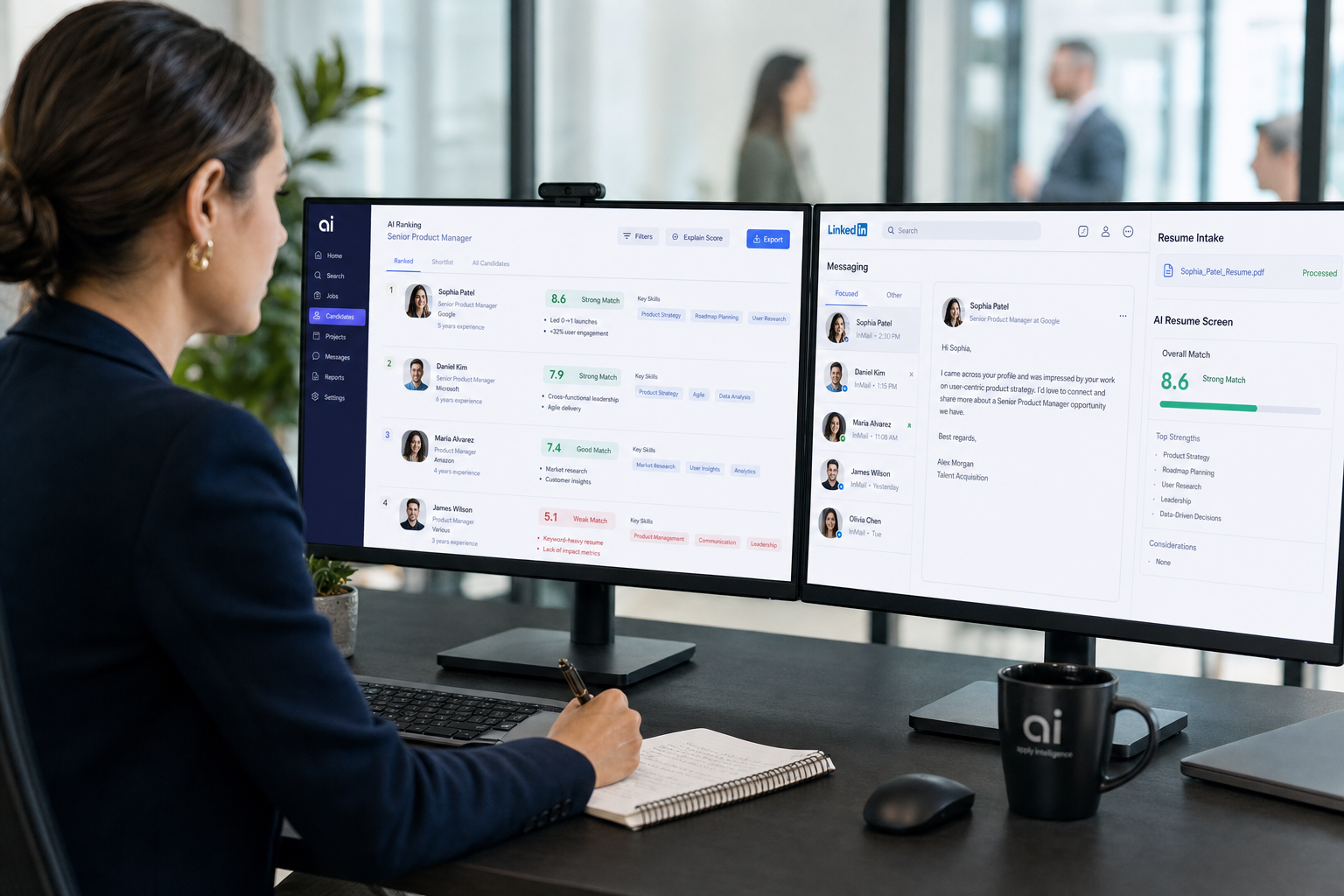
This article helps recruiters judge AI resume screening tools by whether they surface credible fit, prevent weak keyword-led shortlists, and keep human review explainable.
That distinction matters in real hiring work. Small search firms lose hours when strong applicants are buried under weak but well-optimized resumes. In-house recruiting teams feel it when shortlist quality drops, hiring managers stop trusting the funnel, and candidates who might have fit the role never get a fair first review. Individual recruiters feel it most directly: more manual triage, more backtracking, and more pressure to explain why one profile moved forward while another did not.
One workflow that helped me reduce that front-end noise was using StrategyBrain AI Recruiter for the outreach and intake stage before deeper resume review. In practice, its always-on candidate messaging, multilingual follow-up, and automatic collection of resumes and contact details helped keep the top of funnel organized when candidates replied outside working hours or across regions. What it did not replace was recruiter judgment. I still had to review the resume, evaluate relevance, and decide whether the candidate should move forward.
The underlying problem becomes clearer when you look at mixed-style teams, which is where the reference case is useful. A manager leading Baby Boomers, Gen X professionals, and Millennials in the same finance team is not dealing with one uniform definition of productivity. One person wants structure and longer planning cycles; another values flexibility, faster feedback, and room to juggle several priorities. In recruiting, that same difference shows up earlier than most teams expect: in how candidates present themselves, how managers describe success, and how recruiters interpret fit on paper.
If the hiring process is rigid, resumes from candidates who work well in flexible, collaborative environments can look weaker than they are; if the process is too loose, highly relevant experience gets lost in vague language and inconsistent screening. That is why modern AI candidate screening is not just about speed. It is about whether the workflow can recognize different but valid signals of fit, surface them clearly, and still leave room for a recruiter to make the final call.
That opening tension is the real frame for this topic. Employers are not only asking whether software can rank applicants faster. They are also asking whether screening reflects the job’s context, whether do employers check resumes for ai has become a credibility issue, and how to get past ai resume screening without turning a resume into a keyword dump. The rest of this article breaks that down from a recruiter’s perspective.
- Why Context Matters in AI Candidate Screening
- ATS vs AI Screening: What Actually Changed
- What AI Resume Screening Tools Actually Check
- Do Employers Check Resumes for AI?
- How to Get Past AI Resume Screening
- Formatting Risks That Hurt Parsing and Ranking
- How Recruiters Should Build the Workflow
- Fairness, Bias, and Human Oversight
- FAQ
Why Context Matters in AI Candidate Screening
One of the biggest recruiting mistakes I see is treating every job as if it can be screened with the same narrow logic. The finance-team example above shows why that fails. Teams made up of different generations often need a mix of flexibility, collaboration, and varied project styles. A role may require someone who can work across structured long-range planning and quick-turn stakeholder demands at the same time. If the screening setup only looks for obvious title matches or repeated keywords, it may miss that broader capability.
AI candidate screening works best when it helps recruiters interpret resumes against the actual success pattern of the role. That means understanding not just hard skills, but also the operating environment around them: pace, stakeholder mix, communication style, ownership level, and whether the job rewards steady depth or fast adaptation.
For recruiters, this is where technology either helps or hurts. A useful system should make it easier to compare resumes against the whole brief, not just the easiest parts of the brief to search.
Key insight: The strongest screening workflows do not reward the loudest resume; they surface the clearest evidence of fit for the real job context.
ATS vs AI Screening: What Actually Changed
Recruiters often use ATS and AI screening interchangeably, but they are not the same layer of technology. The ATS manages applications, stages, records, and workflow. The AI layer tries to interpret the candidate content inside that workflow.
| Function | Classic ATS | AI Screening Layer |
|---|---|---|
| Application intake | Collects and stores resumes | Uses stored application data as input |
| Resume parsing | Extracts basic fields | Can enrich and interpret those fields |
| Keyword handling | Looks for direct term matches | May evaluate related concepts and relevance |
| Ranking | Often rule-based | Can support prioritization and grouping |
| Workflow control | Moves candidates through stages | Supports decisions inside stages |
| Main recruiter value | Organization and compliance | Speed, consistency, and review support |
That shift matters because many hiring teams still think in old ATS terms. A classic system stores and routes applications. Newer AI resume screening tools attempt to read them more intelligently. In real life, most employers are using both together.
In my own workflow, I found it useful to separate outreach automation from final screening judgment. For top-of-funnel work, AI Recruiter helped handle first contact, candidate replies, and resume capture without forcing me to monitor every message thread manually. But once resumes came in, the decision point still depended on recruiter review, hiring-manager context, and whether the profile matched the role beyond surface terms.
What AI Resume Screening Tools Actually Check
Most tools follow a fairly standard sequence. They convert the resume into machine-readable text, identify fields such as title history, employers, dates, education, location, and skills, then compare that information against job criteria. Better systems add semantic interpretation, which means they can look beyond exact keyword repetition and try to understand related experience.
In practice, recruiters should expect screening to focus on a mix of these signals:
- Role alignment: whether previous titles and responsibilities are relevant to the open job
- Skill match: whether required and preferred skills appear clearly and credibly
- Achievement evidence: whether the resume shows outcomes, not only responsibilities
- Career recency: whether the relevant experience is current enough for the role
- Industry or domain fit: whether the candidate has worked in a similar environment
- Credential fit: whether education, licenses, or certifications matter for the role
The generational team example is still useful here. A candidate may have exactly the kind of collaboration style, adaptability, or flexible work habits a mixed team needs, but if the resume does not translate that into concrete work evidence, the screening layer may never surface it. That is why the resume has to make the bigger context visible.
What good recruiters evaluate in screening output
- Whether parsing extracted the candidate’s work history cleanly
- Whether the recommended match reflects the actual role brief
- Whether the ranking is explainable to a hiring manager
- Whether the workflow gives room to challenge the automated output
If a system cannot do those things, it may save time on paper while lowering decision quality in practice.
Do Employers Check Resumes for AI?
The short answer is yes, some do, but usually not in the simplistic way candidates imagine. When people ask do employers check resumes for ai, what they often mean is whether employers look for signs that the resume was over-generated, artificially optimized, or detached from the candidate’s real experience.
Most recruiters do not care whether a candidate used AI for editing support. They care whether the resume is believable. If the language becomes too polished, too generic, or too perfectly tailored without specific evidence, it raises questions. The issue is not AI as a tool. The issue is authenticity, defensibility, and relevance.
In screening terms, a few patterns tend to create concern:
- Heavy keyword overlap with the job ad but little proof of actual results
- Abstract bullet points that sound impressive but say nothing concrete
- Claims that do not align with level, dates, or job scope
- A sudden shift in tone across sections of the resume
- Summary language that could belong to almost anyone in the market
From a recruiter’s perspective, the test is straightforward: can the candidate explain every important line in conversation, and does the document hold together as a credible work story?
How to Get Past AI Resume Screening
If you are searching for how to get past ai resume screening, the most reliable answer is to make your fit easier to recognize, not to try to trick the system. Strong results usually come from alignment, specificity, and clean presentation.
1. Mirror the job language where it is true
If the role asks for budget planning, stakeholder management, SQL, compensation analysis, campus recruiting, or client development, and you have done that work, use those terms naturally. This helps both literal matching and broader skill interpretation.
2. Show outcomes, not just task lists
Resumes that only describe duties often underperform. A better bullet shows scope, ownership, and result. Even when you cannot share exact numbers, show what changed because of your work.
3. Put the strongest evidence near the top
Do not bury your most relevant experience. If the role depends on collaboration across different work styles, fast project switching, or long-range planning discipline, show that early. This directly reflects the flexibility-and-choices logic from the opening case.
4. Keep formatting simple enough to parse
Single-column resumes, standard headings, normal date formatting, and plain bullets remain safer than graphics-heavy designs. Machines still need readable structure before any scoring can happen.
5. Make your summary specific
A good summary names your function, level, domain, and strongest fit. A weak summary sounds like every other candidate in the market.
6. Remove filler that adds no evidence
Terms like “results-oriented leader” or “dynamic self-starter” mean little on their own. Replace them with actual tools, industries, responsibilities, or achievements.
- Read the job description for repeated must-have language.
- Update the title, summary, and recent bullets to match true overlap.
- Move the most role-relevant achievements into the first half of the resume.
- Use clean, machine-readable formatting.
- Check that each keyword on the page is backed by real experience.
That is the honest version of getting through screening. Good candidates do not beat the system by gaming it. They improve how clearly the system and the recruiter can understand them.
Formatting Risks That Hurt Parsing and Ranking
Formatting still causes more screening problems than many candidates realize. In most systems, the resume is converted into text before it is reviewed. If the original layout is difficult to parse, relevant information may land in the wrong place or disappear from the structured profile entirely.
| Formatting Choice | Likely Impact | Safer Alternative |
|---|---|---|
| Multi-column layout | Can scramble reading order | Single-column format |
| Graphics or skill bars | May not convert into useful text | Plain text skill lists |
| Tables for work history | Can break extraction logic | Standard role headings with bullets |
| Headers and footers with key details | May be skipped | Keep important info in main body |
| Hidden keywords | Can look manipulative | Use truthful visible language |
Clear structure helps both machines and humans. It also supports the collaborative review process that mixed hiring teams need, because everyone sees the same core evidence more consistently.
How Recruiters Should Build the Workflow
Recruiters should treat screening as part of a broader decision system, not a standalone scoring exercise. The lesson from the multi-generational team example is that hiring quality improves when managers appreciate differences in work style and define success clearly. Screening workflow design should do the same.
Three operating principles that matter most
Flexibility: The system should not be so rigid that it only rewards one resume style or one career pattern. Good candidates may show fit through different combinations of experience.
Choices: Recruiters need control over required versus preferred criteria. Not every strong candidate checks every box in the same way, and the workflow should reflect that.
Collaboration: Screening output should be explainable enough for recruiters and hiring managers to discuss it together. A black-box ranking is much less useful than a ranking you can challenge, adjust, and learn from.
What recruiting teams should evaluate
- Parsing reliability: Can the system read normal resume variation accurately?
- Criteria control: Can users define what matters most for the role?
- Transparency: Can recruiters see why a candidate was surfaced?
- Workflow fit: Does it work with existing sourcing and ATS processes?
- Human override: Can a recruiter challenge the recommendation easily?
- Auditability: Can the team review outcomes for consistency and risk?
I have found that this becomes easier when the sourcing and intake burden is reduced before manual review starts. In one hiring cycle with heavy LinkedIn traffic, using AI Recruiter helped me keep candidate conversations moving overnight, collect resumes from interested prospects, and avoid losing momentum because of time-zone gaps. But that only improved results because the final resume review stayed structured and human-led.
Fairness, Bias, and Human Oversight
Fairness is not a side issue in AI candidate screening. Screening shapes who gets seen, and visibility shapes who gets interviewed. That means teams need clear criteria, documented processes, and regular review of outcomes.
The opening case points to a useful standard here. Different generations may value flexibility, planning horizon, communication style, and loyalty differently. A fair process should avoid punishing candidates simply because they present those strengths in different ways. The goal is not identical resumes. The goal is consistent evaluation of relevant evidence.
Reality check: Automation should reduce sorting work, not remove recruiter accountability for judgment, context, and final decision quality.
For candidates, this means a rejection at an early stage may reflect limited visibility rather than a full human review. For employers, it means screening should always be something the team can explain and improve.
FAQ
Are AI resume screening tools the same as an ATS?
No. An ATS mainly stores applications and manages workflow stages. AI resume screening tools typically help interpret, compare, rank, or prioritize resumes inside that workflow.
Do employers check resumes for AI-written content?
Some employers do review for signs of over-automation or authenticity issues, but most care more about credibility than about the tool used. Accurate, specific, defensible content matters more than whether AI helped edit it.
How can candidates improve their chances without gaming the system?
Use the job’s real vocabulary where it applies, highlight relevant achievements, keep the layout simple, and make sure every important claim is backed by real experience.
Can AI screening understand meaning, not just keywords?
Many newer systems can interpret related concepts and broader skill relevance, but exact wording and clean structure still matter because the resume has to parse correctly first.
What resume formatting choices create the most risk?
Multi-column designs, graphics, tables, complex headers and footers, and hidden text are common problems because they can disrupt parsing and lower confidence in the extracted data.
Should recruiters rely on automated rankings alone?
No. Automated rankings are useful for triage, but final judgment should stay with recruiters and hiring teams who understand the role context and can challenge weak recommendations.
Conclusion
AI resume screening tools are most useful when they help recruiters see fit more clearly, not when they pretend to replace judgment. The mixed-team lesson from the opening case still applies: hiring works better when flexibility, choices, and collaboration are built into the process. For candidates, that means clear, evidence-based resumes usually perform better than heavily optimized ones. For employers, it means the real value of AI candidate screening lies in better workflow discipline, stronger interpretation, and accountable human review.