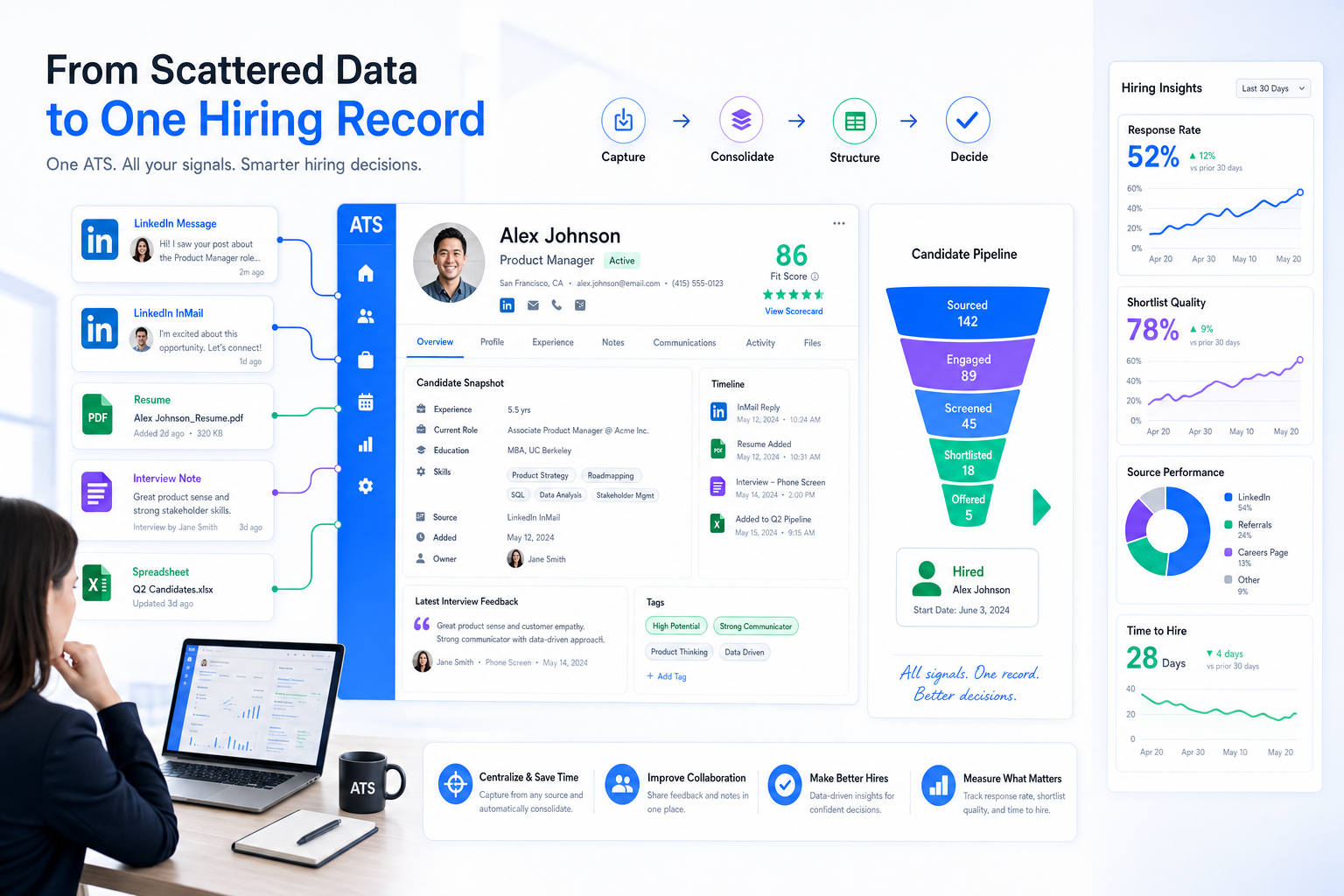
See how recruiters can evaluate an ats for recruiters to avoid fragmented hiring, preserve judgment, and stop strong candidates from being missed.
The teams that struggle most are rarely the least experienced. More often, they are trying to run nuanced hiring with fragmented tools: candidate updates in LinkedIn messages, resume versions in email threads, interview notes in docs, and requisition status in someone else’s spreadsheet. That creates speed problems, but it also creates decision risk. Good candidates get missed, hiring managers lose confidence, and recruiters spend too much of the week reconstructing what already happened.
That is where an automation layer can help, provided it is attached to a disciplined workflow rather than used as a substitute for recruiter thinking. In my own process, I have seen AI Recruiter help most with three pressure points that usually sit outside the ATS: first-touch LinkedIn outreach, after-hours candidate replies, and collecting resumes or contact details from interested prospects before momentum drops. The useful part is not “full automation.” It is that the repetitive front-end work keeps moving while the recruiter still owns resume review, shortlist judgment, and the next-step decision.
A helpful way to think about this comes from a very different hiring discussion: the case for bringing more maverick-style talent into a team. The argument was not that every company needs rule-breakers everywhere. It was that certain organizations benefit when they can identify people who think strategically, challenge stale process, stay goal-focused, and keep pushing through uncertainty. In recruiting, that creates an immediate operational problem. The very candidates who can improve a business are often the ones buried in crowded outreach queues, scattered stakeholder notes, and inconsistent follow-up.
Once you start hiring for people who are unconventional but high-value, the workflow gap becomes obvious. A recruiter may open the req, source through LinkedIn, chase a late reply, compare whether a candidate is creative or merely noncompliant, and then try to preserve that nuance for the hiring manager inside an ats job workflow that was built for consistency. That is exactly why understanding the applicant tracking system meaning matters in practical terms: an ATS is not just storage for applicants, but the structure that lets automation support speed while preserving context, risk boundaries, and human judgment.
Table of Contents
- Why an ATS Matters Before You Add Automation
- Applicant Tracking System Meaning in Plain English
- What Hiring Unconventional Talent Teaches Recruiters
- How Recruitment Automation Tools Work Around the ATS
- Advantages of Applicant Tracking System Workflows
- What ATS Job Means for Recruiters and Candidates
- Recruitment Automation Tools Compared
- How to Evaluate an ATS for Recruiters
- Common Mistakes When Buying Recruitment Automation Tools
- FAQ
Why an ATS Matters Before You Add Automation
Most recruiting teams do not start by saying, “We need process discipline.” They start by saying they need faster sourcing, fewer scheduling delays, or better candidate response rates. Those are real needs, but they usually point back to a core systems question: where does hiring activity actually live, and who can trust it?
An ATS for recruiters is what turns hiring from a set of disconnected actions into a repeatable operating model. It gives recruiters one place to manage requisitions, applications, stage movement, interview records, search history, and hiring outcomes. Without that base layer, automation tends to create more activity without creating more control.
That distinction matters even more when a role requires nuance. If you are recruiting the kind of candidate who might challenge the status quo, take calculated risks, or bring original thinking into a team, your process cannot rely on vague memory and message history. You need a clean system of record, because those candidates are often discussed in terms that need context, not just binary pass-fail labels.
Practical takeaway: The more judgment-heavy the search, the more valuable a strong ATS becomes. Automation can help you move faster, but the ATS is what stops speed from flattening the signal.
Applicant Tracking System Meaning in Plain English
The simplest applicant tracking system meaning is this: it is software that tracks who entered your hiring process, where they stand, what happened so far, and what should happen next.
That definition sounds basic, but it clears up a common misconception. An ATS is not just a resume vault, and it is not only a place where jobs get posted. It is a structured workflow environment that lets recruiters and hiring stakeholders work from the same candidate history.
In practice, that usually means the system handles the following sequence:
- A requisition is created. The role, team, and approval context are entered into the platform.
- The opening is published. The job can be distributed to selected channels.
- Applications and prospects are captured. Candidate records begin to form around resumes, application responses, and contact data.
- Screening starts. Recruiters search, filter, review, and compare talent against role criteria.
- Stages define movement. Candidates move through structured steps such as applied, screened, interview, final review, offer, and hired.
- Collaboration is attached to the record. Notes, evaluations, and communication history stay connected to the profile.
- The outcome is documented. Final hiring decisions remain available for reporting, compliance, and future search.
For experienced recruiters, the real value is not the definition itself. It is what that structure makes possible: cleaner judgment, less admin reconstruction, and better handoffs across a process that rarely moves in a straight line.
What Hiring Unconventional Talent Teaches Recruiters
The maverick-hiring idea is useful because it forces a recruiter to separate “different” from “valuable.” Some companies need people who are more open to new approaches, more willing to challenge accepted thinking, and more persistent in driving a change initiative through resistance. Startups, transformation teams, and organizations trying to build more entrepreneurial energy often benefit from that profile more than stable, highly scripted environments do.
But that same profile also introduces evaluation tension. Hiring teams may admire creativity and strategic thinking while worrying about fit, acceptable risk, or whether the person can operate inside team boundaries. In recruiting terms, that means your workflow must preserve more than status updates. It has to preserve reasoning.
When recruiters lack that structure, the process usually breaks in predictable ways:
- the sourcing rationale is never properly logged
- the candidate’s strengths get reduced to generic comments
- hiring managers react to style before substance
- follow-up slows because nobody is fully sure what was agreed
- the process favors tidy applications over strategically strong candidates
This is one reason mature recruiting teams care so much about workflow design. The software is not there to eliminate complexity. It is there to hold complexity in a form the team can actually use.
How Recruitment Automation Tools Work Around the ATS
Once the ATS is doing its job as the system of record, recruitment automation tools can support the repetitive layers around it. In most teams, the ATS remains the official place for candidate status and hiring decisions, while automation reduces manual effort in the steps that create drag.
Common automation areas include:
- Sourcing support: finding prospects and moving them into an active workflow
- Outreach: sending first messages and maintaining early-stage conversation momentum
- Resume and contact capture: collecting candidate details once interest is confirmed
- Scheduling assistance: reducing email back-and-forth for interviews
- Candidate communication: managing reminders, updates, and routine follow-up
- Reporting: surfacing funnel bottlenecks and conversion trends
I have found this most useful in LinkedIn-heavy searches where recruiters lose time not because they lack sourcing skill, but because too much of the day disappears into repetitive contact work. In those cases, StrategyBrain AI Recruiter can take over candidate connection, role introduction, and reply handling across time zones while still leaving final qualification to the recruiter. That matters because interest is not the same as fit. The system can keep the front end moving, but the recruiter still has to decide whether the resume, background, and context justify a real next step.
Used properly, automation supports recruiter leverage. Used carelessly, it creates the illusion of progress while hiding weak records and shallow decision-making.
Advantages of Applicant Tracking System Workflows
When people ask about the advantages of applicant tracking system adoption, I usually answer in operational terms rather than feature language. The best gains come from process reliability.
1. Better candidate organization
Every applicant and prospect sits in a shared structure instead of being scattered across inboxes, notes, and browser tabs. That alone improves continuity.
2. Faster and more defensible screening
Search, parsing, filters, and structured questions help recruiters narrow the field faster. More importantly, they make it easier to explain why one person advanced and another did not.
3. Stronger context for nuanced roles
If you are hiring candidates whose upside depends on creativity, strategic range, or calculated risk-taking, you need room to store more than a thumbs-up or thumbs-down. A good ATS helps teams retain that reasoning.
4. Cleaner collaboration with hiring managers
Recruiters can preserve notes, stakeholder comments, and stage movement in one place. That reduces the usual backtracking when a manager asks why a candidate was shortlisted two weeks earlier.
5. Better compliance and auditability
Structured systems create a more reliable record of applications, communication, and decisions than ad hoc tools do.
6. Easier integration with automation
Automation works better when it has a stable destination for candidate records and stage updates. Otherwise, teams just create new silos.
| Operational Need | How an ATS Helps | Recruiter Impact |
|---|---|---|
| Application intake | Centralizes incoming candidate records | Less manual triage |
| Screening | Supports parsing, search, and filtering | Faster shortlist creation |
| Nuanced evaluation | Stores notes and stage logic together | Better judgment continuity |
| Team collaboration | Keeps feedback attached to the profile | Fewer update gaps |
| Reporting | Tracks funnel movement over time | Clearer bottleneck analysis |
What ATS Job Means for Recruiters and Candidates
The phrase ats job usually gets used in two different ways, and the distinction matters.
On the employer side, an ATS job is simply a role being managed through an applicant tracking workflow. The recruiter opens the req, distributes the posting, collects applications, reviews records, and moves candidates through defined stages.
On the candidate side, people often use the term when they are talking about ATS-friendly resumes or applications that are easier for systems to parse. That version is common online, but it can oversimplify how hiring actually works.
In most real recruiting environments:
- the ATS may organize or filter information
- knockout questions may remove obvious mismatches
- search logic may prioritize certain profiles
- but recruiters still make contextual decisions
That is especially true in searches where the most valuable candidates are not the most standardized candidates. If a person looks unconventional on paper but appears highly relevant in conversation, the recruiter’s judgment still matters more than the software’s first pass.
Recruitment Automation Tools Compared
Because this topic is about software use, it helps to separate three familiar categories that recruiting teams often evaluate together: an ATS, LinkedIn outreach automation, and broad recruiting-suite workflow tools. They can overlap, but they are not interchangeable.
1. Greenhouse
Greenhouse is well known as a structured hiring platform with strong process design, interview workflow support, and broad adoption among scaling companies.
- Experience: generally strong for structured internal hiring; less sourcing-native than recruiter-led outbound tools
- Effectiveness: valuable when interview coordination and process consistency are priorities
- Cost: typically better suited to organizations with budget for a mature ATS program
- Best fit: in-house teams that need standardized hiring operations
- Working alongside StrategyBrain AI Recruiter: a useful pairing when LinkedIn outreach and candidate engagement need to happen before formal ATS-stage review
2. Lever
Lever is often chosen by teams that want ATS and CRM-style recruiting workflows in one environment, especially where nurture and rediscovery matter.
- Experience: often appreciated by teams that revisit older talent pools and run more relationship-based workflows
- Effectiveness: helpful for balancing active req management with longer-term pipeline building
- Cost: commonly better aligned with mid-sized companies that want a unified platform
- Best fit: internal teams that need both applicant tracking and candidate relationship continuity
- Working alongside StrategyBrain AI Recruiter: useful where recruiters want LinkedIn conversations and off-hours responses to keep moving while the ATS or CRM remains the source of record
3. Workday Recruiting
Workday Recruiting is often selected by larger organizations that prioritize enterprise integration, governance, and alignment with broader HR systems.
- Experience: can be more process-heavy, which suits some enterprises and frustrates some high-speed recruiting teams
- Effectiveness: strongest where data governance and downstream HR integration are major concerns
- Cost: usually most practical for larger employers already operating inside that ecosystem
- Best fit: enterprise environments with complex stakeholder structures
- Working alongside StrategyBrain AI Recruiter: especially relevant when enterprise teams still need faster LinkedIn prospect engagement than the core system is designed to provide
Against those categories, StrategyBrain AI Recruiter serves a different but increasingly important role: automating repetitive LinkedIn recruiting tasks, continuing candidate communication outside working hours, and collecting resumes or contact details from interested people before recruiter attention returns. It is not a replacement for an ATS, and that is exactly the point. It is most valuable when paired with an ATS for recruiters that already handles official records, decisions, and workflow control.
How to Evaluate an ATS for Recruiters
If you are selecting an ATS for recruiters, evaluate it against actual recruiter behavior, not just software demos.
- Map the real workflow. Start with how reqs open, how sourcing happens, where resumes arrive, how managers review, and where handoffs stall.
- Identify roles that need nuance. If your searches involve candidates who are strategic, unconventional, or difficult to assess through simple filters, your system must preserve context well.
- Review search and profile quality. A weak record structure makes later rediscovery much harder.
- Test collaboration behavior. Ask how a recruiter, coordinator, and hiring manager would each use the same candidate record.
- Check automation boundaries. Make sure automations help with repetitive work but do not obscure the final logic behind candidate decisions.
- Validate LinkedIn workflow support. If outbound sourcing matters, decide what should live in the ATS and what should be handled by a separate tool such as AI Recruiter.
Best practice: During evaluation, use a live scenario that includes an unusual but promising candidate. That is often where weak workflow design becomes obvious.
Common Mistakes When Buying Recruitment Automation Tools
Buying for volume instead of control
More outreach and more messages are not useful if candidate history becomes harder to interpret.
Assuming automation should decide fit
Recruitment automation tools can handle repetitive action, but they should not be trusted to make the final call on nuanced candidate quality.
Ignoring acceptable-risk discussions
The original maverick argument included an important balancing point: organizations need boundaries around risk. Recruiting workflows need the same discipline. Teams should define what must be reviewed by a human and what can safely be automated.
Underestimating hiring manager behavior
If managers do not engage with the system, recruiters end up maintaining a clean ATS and a messy side process at the same time.
Skipping the sourcing-to-system handoff
Many teams automate outreach but fail to decide when an interested prospect becomes a formal record. That gap causes duplication and lost context later.
FAQ
What does ATS stand for in recruiting?
ATS stands for applicant tracking system. It is software used to manage job postings, applications, candidate records, hiring stages, and related recruiting activity.
What is the applicant tracking system meaning in simple terms?
The applicant tracking system meaning is straightforward: it is a system that helps recruiters track applicants and run a structured hiring workflow from application to hire.
How does an ATS for recruiters help with automation?
An ATS for recruiters usually acts as the core system of record. Automation tools then support sourcing, outreach, scheduling, candidate messaging, and reporting around that base workflow.
What does ATS job mean?
ATS job can mean a job opening managed through an applicant tracking system, or it can refer to the candidate-side idea of applying with an ATS-friendly resume.
Can automation replace recruiter judgment?
No. Automation can reduce repetitive manual work, but recruiters still need to evaluate resumes, interpret context, calibrate with hiring managers, and decide who should move forward.
Where does StrategyBrain AI Recruiter fit?
It fits best as an automation layer for LinkedIn-heavy sourcing and communication. It can help handle first-touch outreach, candidate replies, and resume collection while the ATS remains the official record and the recruiter keeps final screening responsibility.
Conclusion
Recruitment automation tools become far more useful when you stop treating speed as the only goal. The better goal is controlled momentum: faster outreach, cleaner follow-up, stronger records, and enough context to evaluate non-obvious talent properly.
That is why the best setup usually starts with an ATS for recruiters. Once the workflow foundation is stable, automation can support the repetitive work around it without weakening decision quality. If you recruit through LinkedIn often, that may include a tool like StrategyBrain AI Recruiter to keep conversations moving and collect candidate information while recruiters focus on judgment.
In the end, the most practical applicant tracking system meaning is not technical at all. It is the system that lets your team move faster without becoming careless, especially when the right hire is not the most obvious one.