When recruiting teams compare the best recruiting tools, this article shows how to judge stacks that prevent process drag, lost context, and trust breakdowns.
That matters because recruiting rarely breaks down on search alone. It breaks down when a recruiter cannot keep candidate conversations, hiring-manager expectations, and internal trust aligned at the same time. For a solo recruiter, that means missed follow-ups and weaker response rates. For a small agency owner, it means consultants spending too much time on manual outreach instead of closing searches. For an in-house talent lead, it means process drag, inconsistent handoffs, and a hiring team that loses confidence in the function.
In my own workflow, one of the more useful ways to reduce that drag has been adding StrategyBrain AI Recruiter where repetitive LinkedIn outreach starts to crowd out judgment work. I have found it especially helpful for always-on candidate messaging, multilingual follow-up, and collecting resumes or contact details from interested prospects while I still keep final responsibility for resume review, qualification, and next-step decisions. Used that way, it supports the recruiter; it does not replace the recruiter.
That balance between technical skill and people dynamics is not new. In the reference story behind this article, a finance leader reflected on a career shaped not just by expertise, but by learning how organizations actually work: relationships up, down, and across the business; credibility earned through hard work; and the willingness to take on bigger opportunities before feeling perfectly ready. That is a career lesson, but it maps closely to recruiting work, where success depends as much on trust, timing, and judgment as on search syntax or process compliance.
Once you view hiring through that lens, the software question changes. The best recruiting software is not the flashiest platform or the longest feature list. It is the stack that helps recruiters build trust, handle bigger searches without chaos, and stay disciplined across sourcing, follow-up, and evaluation. That is also where diversity sourcing tools and technical recruiting diversity sourcing become practical operating questions, not just policy language.
Table of Contents
- What the Best Recruiting Software Should Actually Do
- Why Hiring Software Must Support Human Dynamics
- ATS vs. the Broader Recruiting Stack
- Recruiting Software Categories at a Glance
- Must-Have Features in the Best Recruiting Tools
- Where Diversity Sourcing Tools Add Real Value
- Technical Recruiting Diversity Sourcing in Practice
- How to Choose the Right Recruiting Stack
- Common Buying Mistakes to Avoid
- FAQ
What the Best Recruiting Software Should Actually Do
When recruiters search for the best recruiting software, they are often trying to solve a larger operating problem. They may need cleaner workflow control, more reliable sourcing, better passive-candidate follow-up, stronger reporting, or a way to support recruiters taking on more complex searches without dropping details.
That is why the best recruiting tools are usually not defined by one feature. They work because they support three things at once:
- Execution: recruiters can move candidates through outreach, screening, and interviews without manual chaos
- Relationships: recruiters and hiring managers can trust the same data, history, and next steps
- Decision quality: leaders can see what is working, where pipelines stall, and which sources actually produce qualified talent
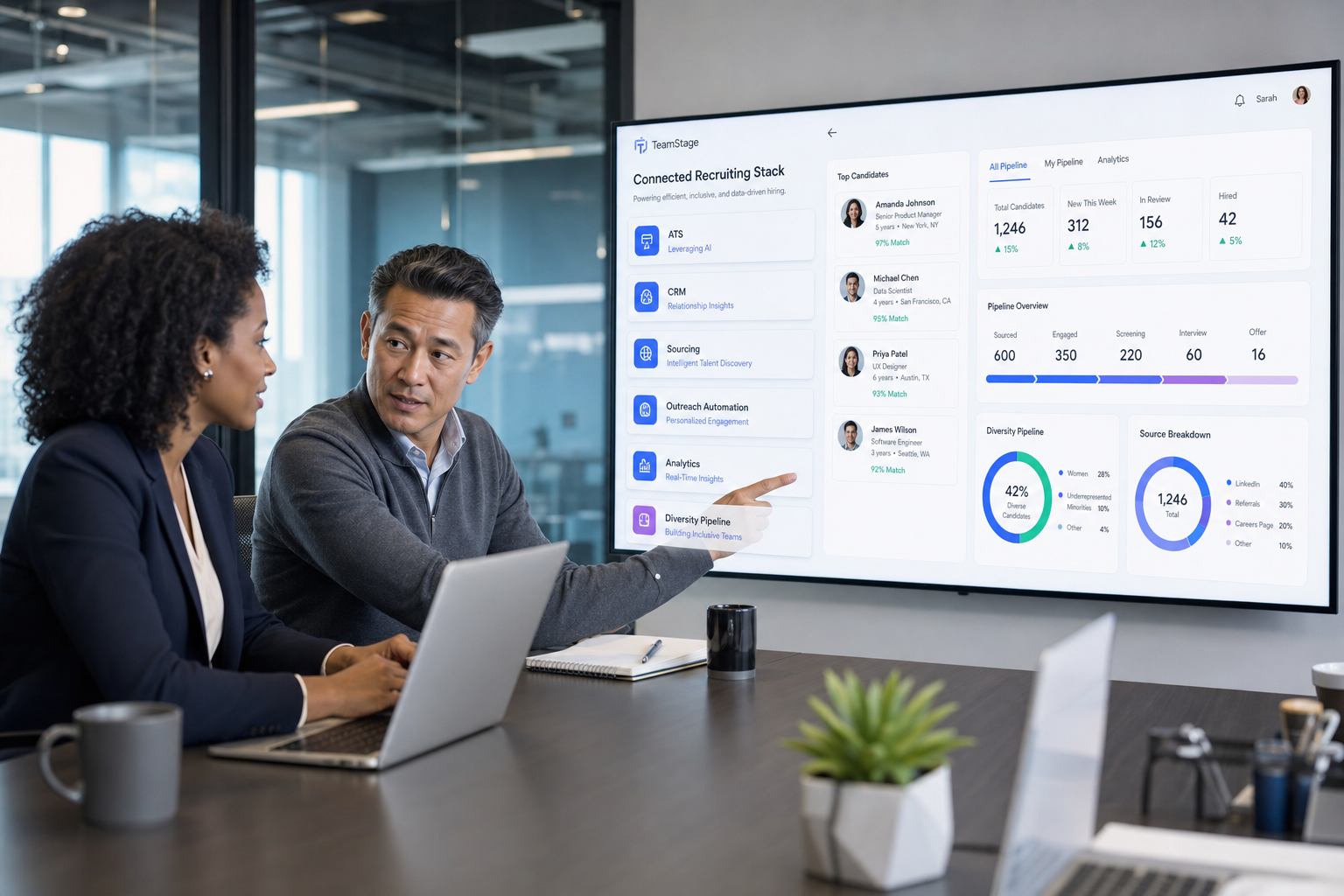
In practical terms, most teams need a connected stack across six areas:
- ATS: requisitions, stages, interviews, approvals, and recordkeeping
- CRM: talent pools, nurture workflows, reminders, and rediscovery
- Sourcing tools: search across public profiles, niche communities, and specialist signals
- Outreach automation: email sequences, messaging workflows, text recruiting, and follow-up consistency
- Analytics: source quality, funnel conversion, recruiter activity, and bottleneck visibility
- Structured hiring and fairness support: scorecards, stage consistency, and inclusive workflow design
The key lesson is similar to the career lesson in the reference piece: technical capability matters, but it only becomes valuable when it helps people operate better inside a real organization.
Why Hiring Software Must Support Human Dynamics
One of the strongest ideas in the reference article is that career progress depends on understanding human dynamics, not just mastering technical work. Recruiting teams run into the same reality every day. A process can look strong on paper and still fail if sourcers, recruiters, coordinators, hiring managers, and executives do not share context or trust the workflow.
That is why software evaluation should include more than features. Ask whether the system helps recruiters build credibility across the organization. Can hiring managers see status clearly? Can interview feedback be collected without chasing people? Can recruiters preserve the context behind a candidate relationship instead of restarting every conversation from scratch?
Software should help teams think bigger, too. In the reference article, taking on more than feels comfortable was framed as a career advantage, because even the attempt builds respect and the upside can be significant. Recruiting software should support that same growth pattern. If your current stack only works when hiring volume is low and every recruiter remembers everything manually, it will not support a team trying to step into larger mandates, new markets, or more demanding technical roles.
Practical takeaway: Evaluate recruiting software by asking whether it strengthens trust and operating discipline, not just whether it adds automation.
ATS vs. the Broader Recruiting Stack
An applicant tracking system is essential, but it is not the whole answer. An ATS gives recruiters a system of record: stages, approvals, interview scheduling, feedback capture, and compliance support. Those are meaningful applicant tracking system benefits, especially for teams moving beyond spreadsheets, email threads, and scattered notes.
The advantages of applicant tracking system software usually include:
- Workflow visibility: everyone can see candidate status
- Collaboration: recruiters and hiring managers work from one shared record
- Consistency: stages, scorecards, and feedback are easier to standardize
- Reporting: leaders can review funnel movement and source tracking
- Compliance support: records are easier to maintain and audit
But most experienced recruiters also know where an ATS stops short. It may not offer strong passive-candidate sourcing, nurture workflows, rediscovery, or enough outreach support for hard-to-fill searches. That is where the broader recruiting stack matters.
In LinkedIn-heavy recruiting, for example, I have used AI Recruiter as a layer for repetitive outreach and after-hours follow-up while keeping the ATS as the source of process truth. The value was not abstract automation. It was the ability to keep conversations active, gather candidate contact details, and avoid losing momentum between sourcing and human review. The recruiter still had to decide who was qualified, who should move forward, and how to position the role credibly.
Recruiting Software Categories at a Glance
Before comparing products, it helps to map software types to the recruiting problems they solve.
| Software Category | Best For | Key Features | Main Benefit | Who Should Prioritize It |
|---|---|---|---|---|
| Applicant Tracking System | Managing active hiring workflows | Requisitions, stages, scheduling, feedback, source tracking | Control and visibility | Any team hiring at repeatable volume |
| Recruiting CRM | Nurturing passive and silver-medalist talent | Talent pools, segmentation, reminders, campaigns | Stronger candidate relationships | Teams with recurring hiring needs |
| Sourcing Software | Expanding the talent pool | Search, profile discovery, technical filters, contact finding | Wider market access | Agency recruiters and hard-to-fill teams |
| Outreach Automation | Improving response consistency | Sequences, personalization support, text recruiting, follow-ups | More recruiter capacity | Lean teams and LinkedIn-heavy workflows |
| Analytics Tools | Improving hiring decisions | Conversion reporting, source quality, stage drop-off | Clearer performance insight | Ops leaders and TA managers |
| Diversity and Bias-Reduction Tools | Building broader and fairer pipelines | Inclusive content support, pipeline analysis, structured evaluation | Better access and consistency | Organizations with inclusion goals |
If you are looking for the best recruiting tools, use this table to identify what is actually broken today. Teams usually do not need more software everywhere. They need the right support at the point where trust, follow-through, or pipeline quality starts failing.
Must-Have Features in the Best Recruiting Tools
The strongest recruiting software improves the day-to-day craft of recruiting. Five areas deserve close attention.
1. Shared context between ATS, CRM, and outreach
The first test is whether candidate history survives handoffs. If a recruiter sources someone, starts a conversation, gets a reply, and then moves the person into process, that context should not disappear. Clean syncing reduces duplicate outreach, protects candidate experience, and helps hiring managers understand where momentum was built.
2. Search depth and rediscovery
Teams hiring for specialist roles should look for more than keyword matching. Good software helps recruiters rediscover past prospects, segment talent pools, and search beyond the obvious channels. That matters because hard searches are often won through patient market coverage, not just quick applicant flow.
3. Outreach support that saves judgment time
The best outreach features do not try to replace the recruiter's voice. They reduce repetitive work so the recruiter can spend more time on calibration, closing, and stakeholder management. In my experience, that is where tools like StrategyBrain AI Recruiter are useful: they can keep first-touch and follow-up activity moving across time zones and languages while the recruiter handles positioning, qualification, and final screening.
4. Reporting that supports action
Dashboards alone are not enough. Teams need analytics that answer practical questions. Which source is producing interviewable talent? Where do candidates drop out? Which hiring managers slow decisions? Which message sequences create real conversations instead of vanity opens?
5. Structured hiring support
The best recruiting software should make disciplined evaluation easier. Scorecards, consistent stages, and visible feedback loops reduce random decision-making. This matters even more when teams are trying to scale or broaden talent access, because a wider top of funnel only helps if downstream evaluation stays fair and clear.
Where Diversity Sourcing Tools Add Real Value
Diversity sourcing tools are most useful when they are treated as part of operating discipline rather than a symbolic add-on. Their real value usually comes from helping recruiters widen discovery, improve inclusive outreach, and monitor whether representation changes across the funnel.
When evaluating diversity sourcing support, ask:
- Can recruiters search beyond the most obvious networks?
- Can the tool help identify overlooked talent pools without reducing people to labels?
- Can leadership see stage-by-stage representation and drop-off points?
- Does it improve outreach language or job-description quality?
- Does it fit the existing ATS and CRM workflow?
This is another place where the reference article's lesson carries over. Building relationships laterally, upward, and downward inside an organization is a trust exercise. Inclusive recruiting works the same way. It is not only about finding more people. It is about creating a process that keeps trust intact from first outreach through final decision.
Technical Recruiting Diversity Sourcing in Practice
Technical recruiting diversity sourcing is different from generalist sourcing because technical talent often leaves uneven signals across mainstream databases. Strong recruiters need tools and workflows that look beyond the most visible profiles and capture a fuller picture of expertise.
In practice, that may mean sourcing across technical communities, code activity, publications, open-source participation, patents, or niche expert footprints. The point is not to create complexity for its own sake. The point is to align sourcing with how technical professionals actually demonstrate capability.
For that reason, the best recruiting tools for technical hiring should help answer these questions:
- Can the software surface passive technical talent from more than one signal set?
- Can recruiters filter by specialization, project relevance, or depth of experience?
- Can outreach and ATS workflows stay connected after discovery?
- Can the team measure whether broader sourcing improves both diversity and candidate quality?
I would add one practical point from experience: technical recruiting diversity sourcing works better when recruiters do not try to evaluate everything in one step. Let sourcing widen access. Let outreach test interest. Let resume review and structured screening handle fit. That separation of tasks is where software helps most.
How to Choose the Right Recruiting Stack
A scenario-based buying approach is usually more useful than chasing the biggest demo. Start with your hiring motion and the point where the workflow becomes fragile.
For small or growing teams
Start with core discipline: ATS, simple CRM behavior, and usable outreach support. Smaller teams usually need relief from admin drag before they need advanced analytics.
Prioritize: ease of adoption, clean workflows, and low-maintenance integrations.
For agency recruiters and headhunters
Agency environments often feel the pain of volume and responsiveness first. Recruiters need strong sourcing, candidate relationship continuity, and ways to keep LinkedIn follow-up moving even when consultants are split across multiple searches.
Prioritize: sourcing depth, message consistency, CRM discipline, and tools that reduce manual outreach load without taking final candidate judgment away from the desk.
For high-volume in-house hiring
Text recruiting, stage automation, scheduling efficiency, and funnel analytics often matter more than highly specialized search. Here, applicant tracking system benefits show up clearly because standardization drives consistency.
Prioritize: automation, visibility, and hiring-manager self-service.
For technical and specialist hiring
Hard-to-fill roles demand stronger search logic, better passive-candidate management, and more patient relationship tracking.
Prioritize: rediscovery, specialist sourcing, outreach sequencing, and long-term talent pool management.
For teams focused on inclusive hiring
Choose software that connects diversity sourcing tools, pipeline analytics, and structured evaluation.
Prioritize: broader discovery, stage visibility, and consistency after candidates enter process.
Common Buying Mistakes to Avoid
- Buying for feature count instead of workflow fit. More buttons rarely mean better recruiter performance.
- Assuming the ATS will solve sourcing. It usually will not.
- Ignoring trust and adoption. If hiring managers avoid the system, your process will fracture.
- Treating diversity sourcing as branding. It needs operational follow-through.
- Separating outreach from recordkeeping. That leads to repeated messages, poor handoffs, and damaged candidate experience.
- Not defining the real bottleneck first. Teams should know whether they are solving for speed, quality, recruiter capacity, or market reach.
A simple internal brief before demos can prevent most of these mistakes. Write down your top three recruiting breakdowns, the handoffs that fail most often, the integrations you cannot live without, and the reporting questions your current stack cannot answer.
FAQ
What is the difference between recruiting software and an ATS?
An ATS manages hiring workflow and records. Recruiting software is the broader category that can also include sourcing, CRM, outreach automation, analytics, and fairness support.
What are the main advantages of applicant tracking system software?
The main advantages of applicant tracking system software are workflow visibility, consistency, collaboration, source tracking, and reporting. Those applicant tracking system benefits become especially valuable as hiring volume grows.
What are the best recruiting tools for passive candidates?
The best recruiting tools for passive candidates usually combine sourcing, CRM, and follow-up automation. Recruiters need to find people, keep context, and stay consistent in outreach.
How do diversity sourcing tools help?
Diversity sourcing tools can expand search reach, support inclusive messaging, and provide pipeline analytics. They work best when paired with structured hiring and clear downstream evaluation.
What matters most in technical recruiting diversity sourcing?
Technical recruiting diversity sourcing works best when recruiters can search beyond obvious channels, track specialist signals, and keep outreach and process data connected.
Where can AI-supported outreach help without replacing recruiters?
AI-supported outreach can help with repetitive first contact, follow-up consistency, multilingual communication, and resume or contact-detail collection from interested candidates. Recruiters should still own qualification, stakeholder alignment, and hiring decisions. For LinkedIn-heavy workflows, tools such as AI Recruiter can be useful when the problem is message volume rather than hiring judgment.
Conclusion
The best recruiting software is the stack that helps recruiters do two things at once: stay operationally disciplined and stay credible with people. That is the common thread between the reference article's career advice and good recruiting operations. Technical tools matter, but they only create value when they help teams build trust, handle bigger challenges, and keep context intact.
If you are comparing the best recruiting tools, focus on the point where your hiring process breaks under pressure. It may be sourcing depth, candidate follow-up, reporting, hiring-manager visibility, or inclusive pipeline design. Once you identify that pressure point, the right mix of ATS, CRM, outreach support, analytics, and diversity sourcing tools becomes much easier to evaluate.