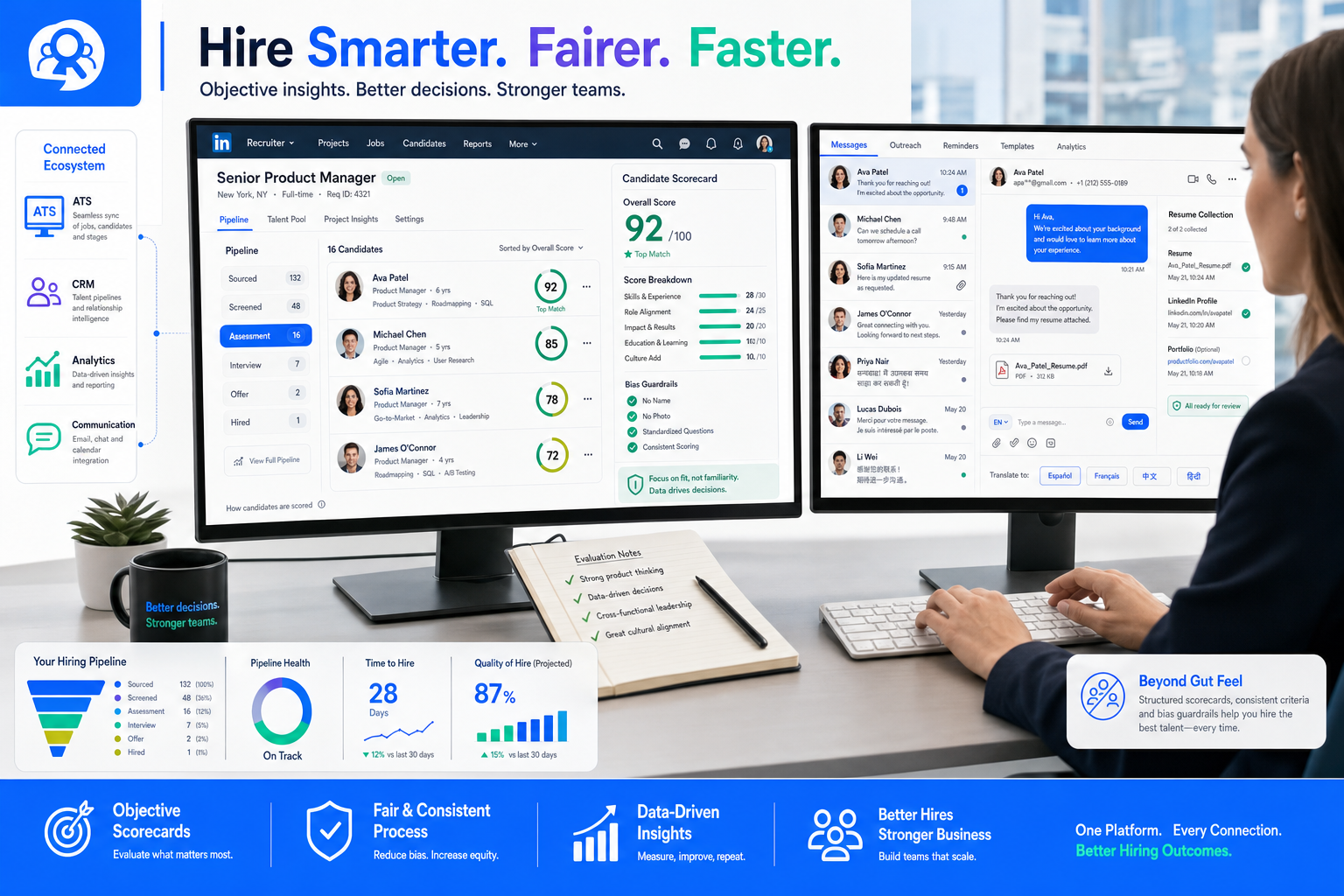
When business recruitment feels fast but subjective, this article helps agency leaders choose software that protects shortlist quality and avoids familiarity bias.
That matters more than many teams admit. In agency search, internal talent acquisition, and owner-led firms, weak systems do not just slow down admin. They make it easier to overvalue the candidate who feels familiar, replies first, or mirrors the interviewer’s background. Over time that creates real losses: missed placements, weaker slates, slower client confidence, inconsistent hiring manager feedback, and a database full of candidates who were contacted but never re-engaged properly. For small and mid-sized firms in the recruitment business, those mistakes affect both delivery and reputation.
One workflow that has helped me reduce that drift is pairing structured software with StrategyBrain AI Recruiter for the earliest outreach and follow-up stages. I have found it most useful when I need always-on candidate communication, multilingual responses, and a consistent way to collect resumes and contact details without letting fast-moving LinkedIn conversations disappear. The recruiter still makes the final judgment on fit, reviews the resume, and decides who moves forward, but the workflow becomes more disciplined before bias or inbox chaos starts steering the process.
The problem is easiest to see in a familiar hiring moment. A recruiter is screening for a role with a large applicant pool, then moves into live conversations with sourced candidates. Two people look strong on paper. One shares a similar school background with the hiring manager and speaks in a style that feels immediately comfortable. The other has the better track record for the actual work but is less familiar in tone, accent, or career path. If the process is loose, the comfortable option often gets more airtime.
That is exactly where software selection stops being a simple feature comparison. The issue is not only how to post jobs or move applicants between stages, but how to build a business recruitment workflow that scores competencies over chemistry, preserves candidate history, standardizes outreach, and gives agencies a cleaner way to challenge instinctive preference. For the recruitment business, and especially for fast desks like recruiting agencies nyc, the best recruiting software is the system that improves speed without making decision quality more subjective.
Table of Contents
- Why “best” recruiting software now means fairer process
- Where affinity bias enters recruiting workflow
- Agency software vs general HR software
- Core features that matter in business recruitment
- Three software approaches buyers usually compare
- Applicant tracking system benefits for recruiters
- How different teams should evaluate software
- What recruiting agencies NYC should prioritize
- How to choose without overbuying
- Common software selection mistakes
- FAQ
Why “best” recruiting software now means fairer process
In the market, best recruiting software often gets reduced to automation, dashboards, or user interface polish. In practice, especially in business recruitment, the stronger question is whether the system helps recruiters make more objective decisions under pressure. Good software should make it easier to compare candidates consistently, preserve full interaction history, and separate evidence from comfort.
That shift matters because affinity bias is not usually loud. It shows up quietly when recruiters or hiring managers give extra weight to shared background, familiar communication style, or personal chemistry. In a weak workflow, those preferences can shape resume review, sourcing follow-up, shortlist selection, and final submissions without anyone saying so directly.
For a healthy recruitment business, “best” should mean the platform supports the full chain of work while also reducing avoidable subjectivity:
- Structured applicant tracking so every candidate is assessed inside a consistent process
- CRM depth so passive talent is not forgotten simply because they were not the most familiar profile at first contact
- Searchable history so prior outreach, interview notes, and client reactions are visible
- Standardized communication so fast follow-up does not depend only on who a recruiter instinctively remembers first
- Reporting so leaders can spot drop-off patterns and conversion gaps by source, stage, or recruiter
Practical takeaway: if a demo shows sleek screens but cannot explain how candidates are evaluated against consistent criteria from sourcing through submission, it is not strong enough for serious business recruitment.
Where affinity bias enters recruiting workflow
Most teams think of bias as an interview issue, but it often enters much earlier. It can appear during resume review, outbound sourcing, first-message follow-up, candidate note-taking, or how recruiters define “culture fit.” The pattern is simple: when time is short, people trust familiarity.
In recruiting, that can look like:
- Favoring candidates who share an educational or career background with the interviewer
- Overvaluing polished communication that feels socially familiar
- Confusing “easy rapport” with role relevance
- Giving more benefit of the doubt to a candidate who resembles a previous successful hire
- Overlooking stronger but less familiar candidates in high-volume searches
I have seen this most clearly on broad searches where the market gives you plenty of options. On hard-to-fill niche assignments, clients tend to focus on capability. On roles with many applicants, subjectivity sneaks back in. That is one reason software matters: a better system creates more checkpoints between first impression and final decision.
The best recruiting software cannot eliminate human judgment, and it should not try to. But it can force stronger discipline around what evidence is captured, how decisions are compared, and whether outreach and evaluation are happening consistently across the full slate.
Agency software vs general HR software
Many buyers still compare recruiting software with broader HR systems, and that often leads to poor fit. General HR software is usually built around employee records, onboarding, and internal administration. Agency recruiting software has to support a two-sided market where recruiters manage candidates and clients at the same time.
For business recruitment, that difference is critical. An internal team may mainly need cleaner applicant review and hiring manager coordination. An agency desk also needs re-engagement workflows, shortlist management, submission tracking, and a searchable relationship database that helps the recruiter challenge first-impression bias with actual history.
| Software Type | Best For | Strengths | Gaps for Recruiters |
|---|---|---|---|
| General HR software | Internal employee administration | Onboarding, records, approvals | Weak candidate nurturing and limited agency workflow |
| Basic ATS | Simple applicant management | Job posting, stage tracking, resume storage | Shallow CRM, weak re-engagement, less support for structured submissions |
| Agency recruiting software | Business recruitment and search delivery | ATS plus CRM, matching, outreach, client coordination, reporting | Requires more process design and adoption discipline |
Practical advice: if your work involves clients, repeat candidate touchpoints, or talent pools you expect to reuse, do not buy software that treats recruiting as little more than vacancy administration.
Core features that matter in business recruitment
When evaluating the best recruiting software, buyers should focus less on broad claims and more on the capabilities that improve real recruiting judgment.
1. Dual ATS and CRM functionality
This is the base requirement. Recruiters need one system to manage active applicants and another layer to retain long-term relationship value. In the recruitment business, strong CRM behavior helps prevent the familiar pattern where only the most recent or most personally memorable candidates stay visible.
2. Structured evaluation and interview workflow
If your software cannot support consistent scorecards, competency-based notes, or stage-specific review criteria, it leaves too much room for chemistry-driven decisions. That is where bias often slips in under the label of “fit.”
What to test: Can recruiters and hiring managers review candidates against shared criteria rather than freeform opinion?
3. Candidate sourcing and communication support
Recruiters need to capture candidates from multiple channels and follow up in a way that is fast but trackable. This is where I have used StrategyBrain AI Recruiter as a useful companion to core recruiting software. In LinkedIn-heavy searches, it can keep outreach moving, reply around the clock, and collect resumes from interested candidates while I stay focused on qualification and shortlist quality. That is especially helpful when language, time zone, or after-hours response gaps would otherwise skew who gets recruiter attention first.
4. Client management and submission workflow
For agencies, software should help recruiters present a balanced slate and document why each candidate belongs on it. When submissions are handled well, recruiters are better positioned to push back if a client starts drifting toward comfort-based selection.
5. Automation that removes admin without flattening judgment
Automation is valuable when it handles reminders, scheduling triggers, and status follow-up. It becomes risky when teams start assuming automation equals assessment. The recruiter still has to review resumes, test evidence, and decide who moves forward.
6. Reporting and pipeline analytics
Leaders need visibility into conversion rates, bottlenecks, and source quality. They also need enough detail to spot patterns that may suggest subjectivity, such as uneven movement across comparable candidate groups or unusually inconsistent stage outcomes by interviewer.
7. Integrations with email, calendars, and sourcing channels
Most recruiters live in inboxes and browser tabs. Good integrations reduce duplicate entry and preserve a reliable history of who said what, when, and why that candidate was advanced or paused.
Three software approaches buyers usually compare
Most buyers are not comparing one perfect system against another. They are usually choosing among three practical approaches: a broad enterprise ATS, an agency-first CRM/ATS platform, or a lighter system paired with sourcing automation. Below is the framework I use when discussing software with agency owners and internal recruiting leads.
| Approach | Use Experience | Effect on Results | Cost Pattern | Best Fit | How it works with StrategyBrain AI Recruiter |
|---|---|---|---|---|---|
| Enterprise ATS platforms | Strong process control, often heavier to configure | Useful for compliance and large hiring teams, but can feel slow for desk-based agency work | Usually higher total cost once implementation and admin are considered | Large in-house teams and multi-layer approvals | Can pair well when LinkedIn sourcing volume is high and recruiters want outreach support outside the ATS |
| Agency-first ATS/CRM platforms | More natural for candidate-client matching and submissions | Better for reusable talent pools and recruiter workflow visibility | Often more practical for firms that earn through placements rather than HR administration | Search firms, staffing desks, boutique agencies | Useful companion when recruiters want to automate early LinkedIn messaging but keep final review inside the main database |
| Light ATS plus sourcing automation | Fast to start, easier for lean teams | Can improve outreach speed quickly, but needs discipline so data does not fragment | Can be cost-efficient for smaller teams if workflow is kept tight | Solo recruiters, small agencies, growth-stage in-house teams | Often the clearest setup for teams that rely heavily on LinkedIn and want faster resume collection without expanding headcount |
I am intentionally not turning this into a brand leaderboard because fit matters more than logos. But in live evaluations, these are the trade-offs buyers usually miss: enterprise systems can be strong but heavy, agency-first systems are often better for the recruitment business, and lighter setups can work if the recruiter is disciplined about where final judgment lives.
On that last point, my own experience with StrategyBrain AI Recruiter has been strongest in searches where LinkedIn response handling becomes the bottleneck. What stood out was not a magical replacement for recruiter work, but the practical relief of having candidate replies handled continuously, in native language when needed, while I remained responsible for resume review, qualification, and submission decisions. That kind of support is useful when fairness and speed are both at risk because the loudest inbox thread is getting all the attention.
Applicant tracking system benefits for recruiters
Once hiring volume rises, the advantages of applicant tracking system adoption become obvious. Spreadsheets and inbox folders do not preserve enough structure for fair, scalable recruiting.
- Centralized pipeline visibility: everyone sees where a candidate sits and why
- Cleaner coordination: interviews, feedback, and follow-up stop living in scattered messages
- Better compliance support: structured records help maintain consistency
- Reusable talent pools: strong candidates do not disappear after one search
- More disciplined submissions: recruiters can present evidence, not just intuition
- Stronger reporting: leadership can spot weak stages and subjective decision patterns earlier
For business recruitment, the strongest applicant tracking system benefits show up when ATS structure is paired with CRM behavior and high-quality outreach support. That combination helps recruiters run active searches while preserving long-term candidate value.
How different teams should evaluate software
The best recruiting software depends on operating model. A smart buying process starts with workflow, not marketing language.
Internal HR teams
Internal teams usually need structured review, interview coordination, approval flows, and reporting. Their version of business recruitment is often less about client delivery and more about consistency across departments.
What to prioritize: interview scorecards, hiring manager usability, compliance support, and reporting.
Recruiting agencies and search firms
In the recruitment business, agencies need ATS plus CRM depth, talent pooling, submissions, and recruiter activity visibility. Their database is a commercial asset, and their process needs enough structure to challenge instinctive preference without slowing delivery.
What to prioritize: candidate-client matching, outreach history, submission workflow, desk-level analytics, and re-engagement tools.
High-volume staffing teams
Fast-moving teams need process guardrails because subjectivity grows when many candidates move quickly through similar stages.
What to prioritize: bulk actions, scheduling, communication templates, source tracking, and stage-level reporting.
LinkedIn-heavy recruiters
If a meaningful share of your pipeline depends on LinkedIn conversations, evaluate not just the ATS but the sourcing layer around it. This is where a dedicated workflow with AI Recruiter can help keep outreach consistent, especially after hours or across countries, while the recruiter keeps control of qualification and shortlist decisions.
What recruiting agencies NYC should prioritize
Searchers looking at software for recruiting agencies nyc usually care about one thing: can the platform support a dense, competitive market without turning speed into sloppy judgment?
In New York-style agency environments, recruiters often manage multiple urgent searches at once. That makes the workflow vulnerable to the exact issue raised earlier: the candidate who feels easiest can get more attention than the candidate who is actually stronger.
For business recruitment in a fast metro market, useful software should support:
- Fast database search across sectors, notes, and prior submissions
- Clear ownership when several recruiters touch the same account or talent pool
- High-velocity communication without losing personalization or record quality
- Live reporting for desk leaders who need to spot stall points quickly
- Structured evaluation so urgent roles do not default to whoever felt most familiar in the first call
Practical advice: if your desk looks like the pace of recruiting agencies nyc, test software with a real scenario: one urgent role, multiple same-day candidate replies, a hiring manager with strong personal preferences, and a shortlist that must be justified clearly. That will reveal more than a polished feature tour.
How to choose without overbuying
Software selection usually fails when teams buy for aspiration instead of the process they actually run. Here is the approach I recommend for business recruitment.
- Map the real workflow. Document how jobs open, where sourcing begins, how candidates are compared, and where judgment currently becomes inconsistent.
- Identify bias-sensitive steps. Resume review, first-response handling, interview note-taking, and shortlist selection usually matter more than cosmetic extras.
- Test a real scenario. Ask vendors to show sourcing, outreach, stage movement, scorecards, client or manager feedback, and final submission logic in sequence.
- Check data migration practicality. Candidate notes, contact history, and prior submissions matter as much as resumes.
- Review integrations. Make sure email, calendar, job board, and sourcing workflows connect cleanly.
- Involve recruiters, not just leadership. Adoption quality determines whether the promised applicant tracking system benefits become real.
If LinkedIn sourcing is central to your process, I would also test how the ATS works alongside a tool like StrategyBrain AI Recruiter. In my own workflow, that combination has been most helpful when candidate replies come in at uneven hours and across multiple languages. It kept early engagement moving, but the important discipline remained the same: I still reviewed resumes myself and made the decision on who deserved the next conversation.
Common software selection mistakes
Choosing a system that is too HR-centric for agency work
This is common in the recruitment business. The platform may look modern but still lack the relationship depth, search flexibility, and submission structure that agencies need.
Buying for automation without testing judgment quality
Automation can improve recruiter productivity, but it should not replace evaluation discipline. The system still needs clean notes, scorecards, and decision transparency.
Ignoring how bias actually shows up in workflow
If buyers never ask where familiarity influences outcomes, they may end up with software that tracks activity but does little to improve decision quality.
Underestimating adoption effort
A stronger system on paper still fails if recruiters do not use it consistently enough for the data to become trustworthy.
Forgetting local market pressure
Teams operating like recruiting agencies nyc need software that supports urgency, but urgency should not erase structure.
FAQ
What is the difference between an ATS and a CRM in recruiting?
An ATS mainly tracks candidates through active jobs and hiring stages. A CRM helps recruiters manage longer-term relationships with passive candidates, talent pools, and prior applicants. In business recruitment, the strongest setups combine both.
How does recruiting software help reduce affinity bias?
It helps by creating more structure around sourcing, evaluation, interview feedback, and submissions. Good systems make it easier to compare candidates against evidence instead of relying too heavily on comfort or familiarity.
What are the main advantages of applicant tracking system adoption for recruiters?
The biggest advantages of applicant tracking system use are pipeline visibility, cleaner coordination, reusable candidate data, better reporting, and less manual admin. For recruiters, that means more time for judgment-heavy work.
What applicant tracking system benefits matter most for agencies?
For agencies, the most useful applicant tracking system benefits are ATS plus CRM capability, client-candidate matching, shortlist management, outreach history, and reporting by recruiter or desk.
How should recruiting agencies NYC evaluate software differently?
Recruiting agencies NYC should prioritize search speed, communication tracking, ownership clarity, structured evaluation, and real-time reporting. In a dense market, speed without process discipline can make hiring decisions less objective.
Where does StrategyBrain AI Recruiter fit into this workflow?
It fits best as support for LinkedIn-heavy outreach and early candidate engagement. It can automate connection, conversation, and resume collection while the recruiter still owns qualification, resume review, and final next-step decisions.
Final take
The best recruiting software for business recruitment is not simply the platform with the longest feature list. It is the system that helps recruiters move faster while making better, more consistent decisions. In the modern recruitment business, that means combining ATS structure, CRM depth, communication support, and enough process discipline to keep familiarity from quietly shaping the shortlist.
If you are evaluating options, start with your actual workflow. Agencies, internal teams, search firms, and recruiting agencies nyc will not need the same balance of features. But all of them benefit when software supports evidence-based recruiting instead of just documenting activity after the fact.