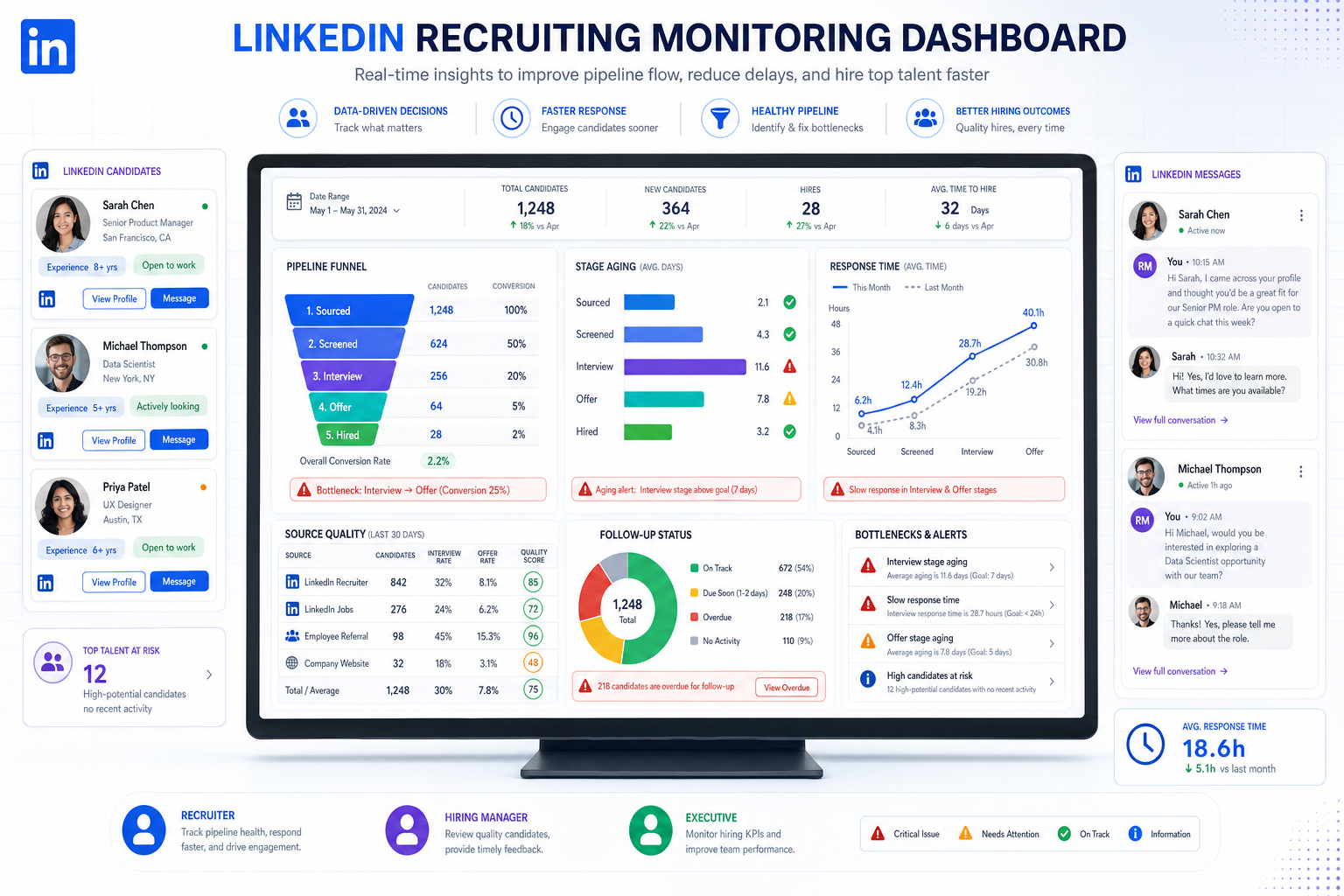
When hiring teams evaluate recruitment monitoring, this article helps them spot whether follow-up gaps, weak intent, or manager delays are hurting hiring control.
That sounds simple, but in real recruiting work the failure usually starts before the dashboard. A candidate applies broadly without a clear target, sends a long unfocused cover note, shows up underprepared, asks weak questions, or never follows up after the interview. For an agency recruiter, that creates wasted screening calls, poor shortlist quality, slower submissions, and avoidable damage to client trust. For an in-house team, the same pattern inflates workload, muddies recruiter judgment, and makes hr hiring metrics look worse than the process actually is.
In my own workflow, tools only became useful when they helped with the communication gaps behind those mistakes. I have used StrategyBrain AI Recruiter to keep outreach active after hours, reply to candidate questions quickly, and collect resumes and contact details once interest is confirmed. That matters most in the messy middle of sourcing and early engagement, where dropped replies and delayed follow-up distort recruitment monitoring. It does not replace recruiter judgment; I still review resumes, assess fit, and decide who moves forward.
A familiar version of this problem appears when a recruiter opens a requisition and the first wave of applicants looks busy on paper but weak in intent. Some candidates have applied aimlessly across unrelated roles. Others send long cover letters that bury the useful points. During interviews, they criticize former employers, arrive with little understanding of the company, or fail to ask informed questions. Nothing is technically broken in the ATS, yet the recruiter is already spending time sorting noise from signal.
The next failure is harder to see unless the team tracks it. After interview rounds, nervous body language, weak preparation, and missed follow-up emails start showing up as stalled decisions, lower offer confidence, and unnecessary re-contact work. That candidate-side behavior is exactly why the best recruiting software cannot be judged on features alone. It has to support recruitment monitoring, surface recruiting metrics to track, and give HR teams hr hiring metrics that explain whether the issue is sourcing quality, process speed, or communication discipline.
- Why Recruitment Monitoring Starts Before the Dashboard
- What the Best Recruiting Software Should Actually Show
- Core Features to Compare in Recruiting Software
- Recruiting Metrics to Track That Reveal Real Hiring Problems
- How to Choose Software by Team Size and Hiring Model
- How to Set Up Recruitment Monitoring Without Noise
- Common Software Buying Mistakes
- FAQ
Why Recruitment Monitoring Starts Before the Dashboard
Most hiring dashboards become less useful when teams treat reporting as something that starts after candidates enter the system. In practice, recruitment monitoring begins earlier, with how candidates are attracted, how intent is confirmed, and how consistently follow-up is handled. If those steps are inconsistent, the reporting layer will tell an incomplete story.
That is the hidden lesson in common job seeker mistakes. When candidates search without direction, write bloated cover letters, show weak interview preparation, or disappear after the interview, recruiters experience the results as poor funnel quality, longer stage times, and noisy conversion data. A good system should help you identify that pattern rather than bury it under activity counts.
For that reason, the best recruiting software should answer questions such as:
- Are we attracting serious candidates or just generating applicant volume?
- Where do prepared, qualified candidates drop out?
- Are recruiters losing momentum because follow-up happens too slowly?
- Are hiring managers creating delays that look like candidate quality issues?
- Which sources produce interview-ready applicants rather than only clicks?
Practical takeaway: Reliable recruitment monitoring does not start with more reports. It starts with cleaner signals about candidate intent, follow-up discipline, and stage movement.
What the Best Recruiting Software Should Actually Show
The best recruiting software is not just a database for applicants. It should function as a control system for the hiring process. Recruiters need visibility into candidate engagement, manager responsiveness, source performance, and stage-level bottlenecks. Without that, teams are left guessing whether a slow search reflects the market, the role, or the process itself.
One reason applicant tracking systems often disappoint buyers is that they are purchased for storage, posting reach, or automation demos rather than operational clarity. Yet one of the real advantages of applicant tracking system adoption is standardized process data. When communication, scheduling, notes, and stage changes live in one place, you can finally compare recruiters, departments, and sources with more confidence.
In my experience, the biggest applicant tracking system benefits show up when a team stops debating anecdotes and starts reviewing the same numbers every week. That includes recruiter workload, stage aging, offer acceptance patterns, and source-to-hire conversion. If software cannot support those discussions, it is difficult to call it one of the best recruiting software options.
Core Features to Compare in Recruiting Software
If your priority is recruitment monitoring, compare software based on hiring control rather than feature volume. The right system should make weak preparation, poor follow-up, and process friction more visible—not easier to ignore.
1. Source Attribution That Survives Real Hiring Activity
Plenty of tools capture where an application came from. Fewer preserve that data accurately across outreach, referrals, direct applications, and manual additions. That matters because many recruiting metrics to track become unreliable when source data is inconsistent.
If a recruiter cannot tell which channels produce serious, interview-ready candidates, the team may over-invest in high-volume but low-intent sources.
2. Pipeline Visibility Beyond Candidate Lists
You should be able to see where candidates sit, how long they have been there, and whether the delay is on the recruiter side, candidate side, or hiring manager side. This is essential for recruitment monitoring because stage volume alone does not explain why a search is slowing down.
Strong pipeline visibility helps teams spot patterns like:
- candidates dropping after first outreach
- interview feedback arriving too late
- offers stalling because communication is inconsistent
- applications rising while qualified screens do not
3. Communication Support and Follow-Up Tracking
One of the most expensive avoidable problems in hiring is inconsistent follow-up. Candidates often decide whether to stay engaged based on speed and clarity, especially early in the process. Software should support templates, reminders, conversation logging, and easy handoff from sourcing to screening.
This is also where I found AI Recruiter most useful as a supporting layer. For LinkedIn-heavy workflows, it can continue conversations, answer common role questions, and collect resumes from interested candidates while I focus on assessment and shortlist decisions. That does not replace the ATS, but it reduces one of the exact breakdowns that damages recruitment monitoring: missing or delayed early-stage communication.
4. Reporting That Separates Activity From Progress
Many systems look impressive in demos because they show lots of numbers. What matters is whether reports help a recruiter or hiring lead decide what to do next. Good dashboards distinguish between busyness and movement.
Look for reporting that can break down:
- time to fill by team and role type
- time to hire by source and recruiter
- conversion rates between stages
- offer acceptance rates
- aging candidates and overdue feedback
5. Structured Collaboration
Recruiting slows down when hiring managers participate through scattered email threads, unstructured comments, and late approvals. Good software should support intake notes, feedback forms, role visibility, and accountability on next steps.
That is one of the more practical applicant tracking system benefits. It keeps recruiter effort from being wasted by collaboration habits that are impossible to measure later.
6. Integration With the Broader HR Stack
Reliable hr hiring metrics depend on stable data flow. If your recruiting system cannot connect cleanly to scheduling, HRIS, or downstream reporting tools, teams end up debating whose spreadsheet is right. That makes recruitment monitoring harder to trust.
| Comparison Area | What to Look For | Why It Matters |
|---|---|---|
| Source tracking | Persistent attribution across channels | Improves source-of-hire accuracy |
| Pipeline visibility | Stage aging and bottleneck reporting | Shows where searches truly slow down |
| Communication tools | Templates, reminders, message logs | Reduces candidate follow-up failures |
| Analytics | Custom reports by recruiter, role, and source | Supports recruiting metrics to track |
| Collaboration | Structured manager feedback and approvals | Prevents hidden decision delays |
| Integrations | Reliable HR data flow | Improves consistency of hr hiring metrics |
Recruiting Metrics to Track That Reveal Real Hiring Problems
Teams often collect too many numbers and too little insight. A better approach is to group recruiting metrics to track into quality of input, process speed, funnel efficiency, and candidate commitment.
Quality of Input Metrics
These metrics help identify whether recruiters are seeing genuine fit or just application volume.
- Qualified applicant rate: the share of applicants who meet baseline criteria
- Screen-to-interview conversion: whether screened candidates are actually viable
- Source quality: which channels produce candidates who progress
These are especially important when candidate behavior suggests low intent or weak preparation.
Speed Metrics
- Time to fill: days from requisition open to accepted offer
- Time to hire: days from candidate entry to acceptance
- Stage velocity: average days spent in each stage
These hr hiring metrics show whether your process moves cleanly or gets stuck in review, scheduling, or decision making.
Efficiency Metrics
- Source of hire
- Cost per hire
- Application-to-screen conversion
- Interview-to-offer conversion
- Offer-to-acceptance conversion
For most recruiting leaders, these are the recruiting metrics to track first because they connect workload to outcomes.
Candidate Commitment Metrics
The reference case at the beginning of this article points to a simple truth: hiring performance is affected by how seriously candidates engage with the process. So your dashboard should also include:
- Interview no-show rate
- Candidate response time
- Interview drop-off rate
- Follow-up completion rate
- Offer acceptance rate
These metrics often explain why a funnel looks healthy at the top but weakens later.
A Practical Dashboard for Recruitment Monitoring
If I were setting up a hiring dashboard from scratch, I would start with:
- Time to fill
- Time to hire
- Qualified applicant rate
- Source of hire
- Stage conversion rates
- Interview drop-off rate
- Offer acceptance rate
- A simple quality of hire indicator
That set is narrow enough to manage and broad enough to tell whether the problem is candidate quality, recruiter throughput, or manager delay.
How to Choose Software by Team Size and Hiring Model
Small Teams and Solo Recruiters
Smaller firms usually need quick setup, clean workflow, and enough reporting to understand what is working. They often do not need complex governance first. They do need an applicant tracking system for recruiters that captures communication, source data, and stage progression accurately.
For independent recruiters and small agencies that rely heavily on LinkedIn outreach, a combination of ATS discipline and AI-supported outreach on LinkedIn can help maintain response coverage without turning every evening into manual follow-up time.
Mid-Sized Recruiting Teams
Mid-market teams usually need stronger reporting, approval workflows, and recruiter-level comparisons. This is where inconsistent definitions start causing trouble. If one recruiter logs a passive lead as screened and another logs the same candidate as applied, your recruitment monitoring loses credibility fast.
Enterprise Teams
Larger organizations need governance, permissions, integrations, and reporting depth across business units. Enterprise buyers should pay particular attention to how dashboards handle role families, geographies, recruiter teams, and hiring manager responsiveness. Reliable hr hiring metrics become part of workforce planning, not just recruiting operations.
How to Set Up Recruitment Monitoring Without Noise
Start With the Hiring Questions You Actually Need Answered
Do not begin with every available chart. Start with practical questions: Which sources create interview-ready candidates? Where do candidates lose momentum? Which hiring managers delay decisions? Are recruiters screening too much low-intent traffic?
Define Stages Consistently
If one team calls an introductory message a screen and another calls it sourced, comparisons collapse. Consistent stage rules are one of the core advantages of applicant tracking system discipline.
Track Follow-Up as a Process Requirement
The reference article on job seeker mistakes highlights follow-up as a decisive moment, and recruiters should treat it the same way operationally. Candidate and recruiter follow-up both affect conversion rates. If your system does not make follow-up visible, teams will underestimate how often strong candidates go cold for process reasons.
Assign Metric Ownership
Recruiters can own stage hygiene. Recruiting operations can own reporting logic. Hiring managers can own feedback timing. HR leaders can own standards for hr hiring metrics. Without ownership, even excellent software turns into a reporting archive.
Review Metrics on a Cadence
Weekly reviews catch bottlenecks. Monthly reviews reveal trends. Quarterly reviews help teams decide whether they need workflow changes, sourcing changes, or better training for hiring stakeholders.
Common Software Buying Mistakes
- Choosing software for feature count instead of process clarity: more features do not guarantee better recruitment monitoring.
- Confusing applicant volume with candidate quality: dashboards should expose that difference.
- Ignoring follow-up workflows: weak communication support hurts conversion and employer brand.
- Underestimating manager collaboration: late feedback often looks like sourcing failure in reports.
- Tracking too many numbers: a crowded dashboard usually hides the recruiting metrics to track that matter most.
FAQ
What are the most useful recruiting metrics to track first?
Start with time to fill, time to hire, qualified applicant rate, source of hire, stage conversion rates, interview drop-off rate, and offer acceptance rate. These give a balanced picture of speed, quality, and candidate commitment.
Why is recruitment monitoring important when evaluating recruiting software?
Because the best recruiting software should help you improve hiring decisions, not just store applicants. Recruitment monitoring reveals where your process slows down, where candidate quality drops, and whether follow-up and manager response are hurting results.
Which hr hiring metrics matter most to HR leaders?
Time to fill, cost per hire, source of hire, offer acceptance rate, and quality of hire are among the most practical hr hiring metrics because they connect recruiting activity to workforce outcomes.
How can recruiters reduce follow-up failures in early-stage hiring?
Use clear workflows, message logging, reminders, and response tracking. In LinkedIn-heavy sourcing, support tools such as AI Recruiter conversation workflows can help maintain contact speed while recruiters keep control of qualification and shortlist decisions.
What is the difference between time to hire and time to fill?
Time to hire measures the candidate journey from entry into process to acceptance. Time to fill measures the full search cycle from opening the role to filling it. Both are useful, but they answer different operational questions.
Is quality of hire easy to measure in recruiting software?
No. It usually requires combining recruiting data with later retention, manager assessment, or performance signals. Good software helps by creating structured, consistent input data early in the process.
Conclusion
The best recruiting software should make hiring easier to manage, but its real value shows up in recruitment monitoring. When your system reveals low-intent applications, follow-up gaps, source quality, and hiring manager delays, it helps recruiters make better calls earlier.
That is why the most useful recruiting metrics to track are not just speed metrics. They also include candidate commitment, funnel quality, and stage discipline. For teams that want reliable hr hiring metrics, the right software is the one that turns messy recruiting behavior into visible patterns you can act on.
And if your workflow depends heavily on LinkedIn outreach, I have found that using an ATS alongside StrategyBrain AI Recruiter can reduce one of the most common early-stage failures: inconsistent communication that weakens the rest of the funnel. The recruiter still owns judgment. The system just makes that judgment easier to apply with better timing and cleaner signals.